



Greetings,
Free-thinking, free-conscienced, beautiful people.
Continuing to look through the mirror of art...
Today, the figure appearing to us in the mirror of art is Paul Cézanne, the man who learned from the mountain...
The man who learned from the mountain?
Are you asking, "Abidin, are you okay? Is everything alright?"
Yes, I am quite well.
Here is a wise answer from thousands of years ago:
"If you observe deeply, everything becomes your teacher."
Who says this?
I am not saying it, of course.
It is the Buddha, who wisely offered the peace born from the enlightenment brought by spiritual purification to the people of the world.
Are you asking what the Buddha's words have to do with our topic?
Are you asking if I could elaborate a little?
It is as if;
If you observe deeply—that is, if you can take the thing you are looking at out of being an object of pleasure and transform it into a field of thought, abstract it from its singularity, and grasp it as a part of a whole through the creative imagery fed by the limitless comprehension capacity of the human mind—only then, within a calmed mental clarity, can you discover your own horizon of learning and create a new map of meaning.
In other words, the thing you are looking at can then cause the existence of a new reality within a universal totality, rather than being a particular thing in itself, within the coordinates produced by the abstraction skill that the human mind has acquired as a result of its evolutionary development.
Now, some dear friends among you might ask: what are these abstract realities that we cannot see directly when we look at nature, but can see as a result of our reasoning?
Let us tell you, sir.
For example, mathematics, for example, geometry, for example, the art of music, for example, the art of painting...
You are saying, "Let's get to the point," aren't you, sir?
For instance, if the human mind could not develop the potential to learn from everything and to establish connections, and if it could not see the harmony emerging from the totality of things, could the relationship between harmony and beauty be a subject of thought as an aesthetic judgment?
Very difficult....
Living around 570-495 BC, the ancient Greek mathematician and philosopher Pythagoras, who went down in history with the "Pythagorean Theorem," integrated mathematics and philosophy on his own axis of thought, creating both a scientific and an esoteric universe of thought.
Furthermore, according to Pythagoras, mathematical ratios and the properties of numbers are directly related to aesthetic beauty. In this context, geometry became a tool for expressing beauty as an aesthetic judgment by providing the visual representation and order of numbers.
The Pythagoreans believed that geometric shapes and ratios reflected the fundamental structure of the universe and that this structure offered an aesthetic order.
Therefore, according to Pythagoras, the beauty we perceive from the object of sight seen by the eye was not merely a result of the act of seeing, but was born from the abstract mathematical image that the mind, which is beyond the senses, attributed to the thing seen.
So, as sons and daughters of Adam, when we look at nature, can we see the mathematics that Pythagoras saw and the harmony formed by the order arising from it, and classify it in our minds? Where......
Well, does the mathematics we cannot see when we look disappear just because we cannot see it?
Let me answer my own question. No, it does not disappear.
Are you asking, "It doesn't disappear, but why can't we see it?"...
What did the Buddha say? He said, "If you observe deeply."
Abidin, you pulled us into the depths and made us forget Paul Cézanne, the man who learned from the mountain...
Would we forget, dear reader? Of course, we would not.
This Paul Cézanne and Pythagoras are people of the same mold; that is, they are among those who observe deeply and make nature and the universe their teacher.
Now let us come to the story of the man who learned from the mountain...
Born in France in 1839, about 2500 years after Pythagoras, as the child of a wealthy merchant family, Paul Cézanne, who is accepted as the father of modern painting, took the entrance exam for the fine arts academy twice and failed both times.
You are saying there is something wrong here, aren't you? The man is accepted as the father of modern painting, yet he is not accepted into the academy. You are asking, "What a contradiction, can such a thing happen?" I say, "Good thing it happened."
Otherwise, modern painting might not have been born at all....
The life story of Paul Cézanne, who was rejected twice, ended in the city but began anew at the foothills of Mont Sainte-Victoire. From 1870 until his death in 1906, the artist painted the mountain from different angles and produced about 30-40 oil paintings and about 40 watercolors.
You are asking, "This great artist who changed the direction of painting, what did he learn from this mountain? Could you explain it to us now?"
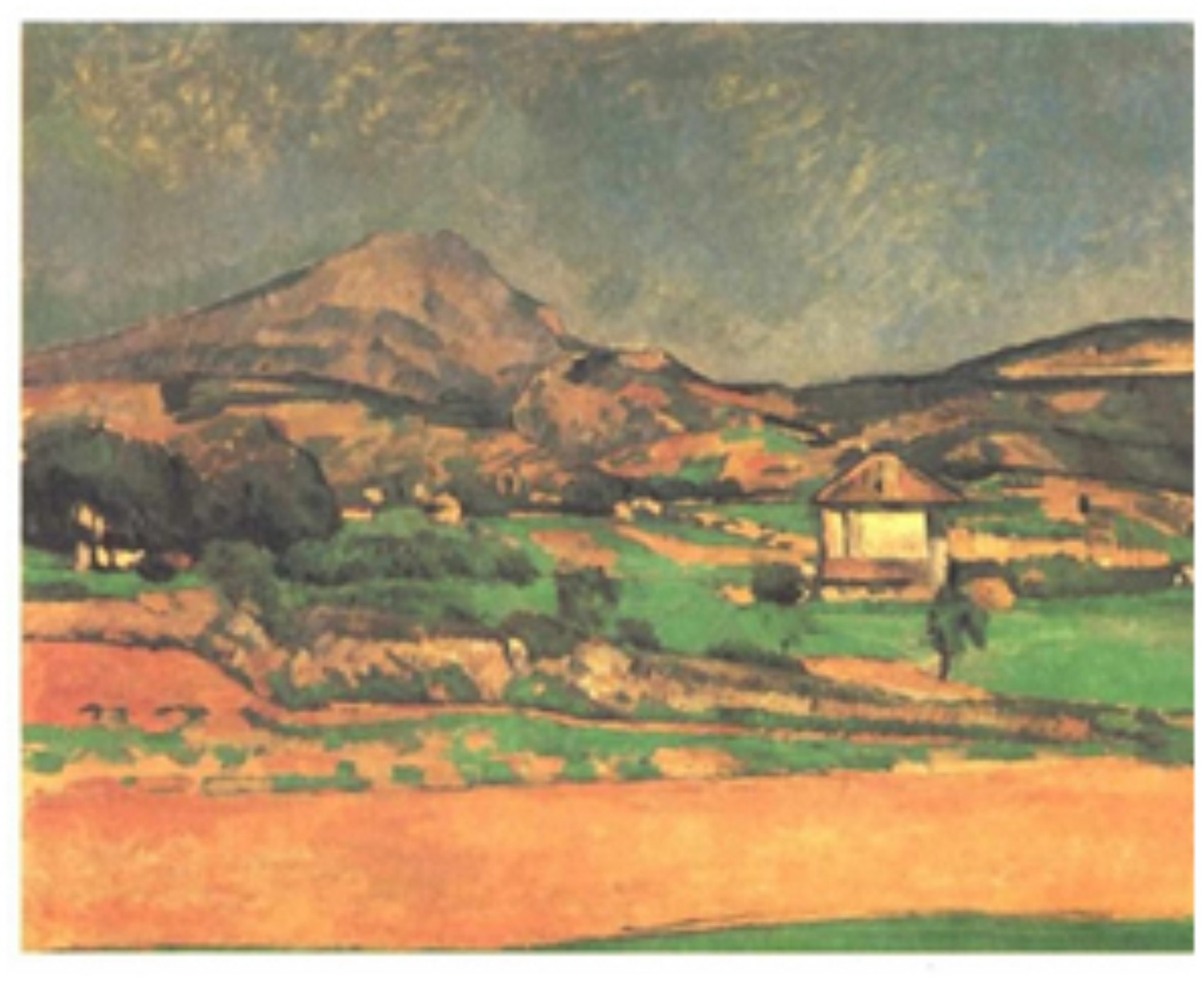
The painting below is one of his first works using Mont Sainte-Victoire as a model. Everything covering the surface of the painting, especially the mountain, is in a form that can be understood. The forms have not been dissolved into one another through color. Since the painting is composed according to perspective, the resulting sense of depth increases the effect of reality. What is decisive in this painting is the reflection of nature in a realistic style rather than the artist's emotions and thoughts.
 In the work below, which is the last mountain painting the artist made, all objects, especially the mountain that forms the surface of the painting, are dissolved into one another with patches of color. The pictorial composition is not constructed on natural perspective, but fictionally on a multi-angle, multi-perspective approach. The picture surface, which has been structured through superimposed patches of color, does not create a three-dimensional effect because it disrupts the sense of depth as a whole, but at the same time, an attempt was made to create a three-dimensional effect in some cube-shaped geometric forms used within the painting, which revealed a dynamic energy born from contrasts in the painting.
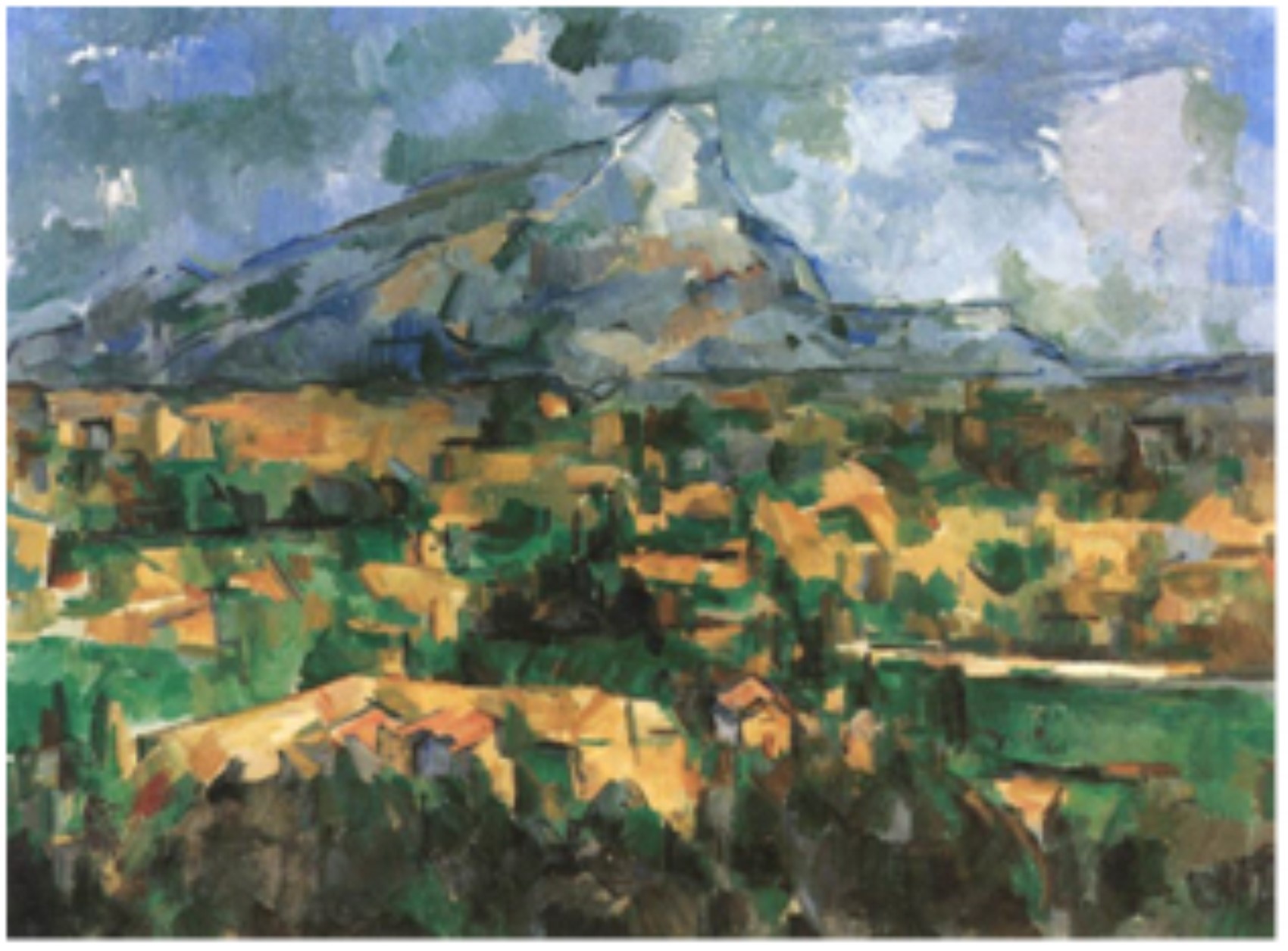
While painters contemporary to Cézanne focused on the instantaneous changes that light creates on objects with an Impressionist understanding of painting, Cézanne did not accept that light should be brought to the foreground and the object—that is, the form—should be pushed to the background. Because according to the artist, there is nothing new to be learned here. Nature is being imitated through light this time. According to him, what should really be done is not to imitate nature, but to bring to life a thought that can reveal the potential that feeds the act of creation within it with a new understanding of painting.
The artist, who constantly observed and thought about his works to feed his artistic creativity, did not see the mountain in the mountain; he saw the reflection of his own creative image in it and said, "I remained primitive in the face of what I discovered." To solve the mystery over nature, he resorts to Pythagoras's geometry with his own image and solves it too.... The mountain ceases to be a mountain, and in 1904, Paul Cézanne writes the following to Émile Bernard: "One must pay attention to treating nature with shapes such as cylinders, spheres, and cones, with each object and surface meeting at a central point in correct perspective. Nature is depth rather than surface; the sufficient addition of blue into the light vibrations represented by reds and yellows is to evoke an impression of depth. I am progressing very slowly, because nature shows itself to me in the most complex forms; and the progress I need is endless."
So, how will this new thought and creative aesthetic of the artist come to life? He formulates it and says: "Everything in nature takes its model from spheres, cylinders, and cones; therefore, one should learn to paint based on these simple shapes, and then the artist can do whatever he wants. First, it is necessary to intensify studies on geometric figures such as cones, cubes, cylinders, and spheres. Once object images are reduced to these basic forms, the habit of painting is acquired."
The man who learned from the mountain becomes a huge mountain himself for those who want to observe deeply, and do you know who is the first to look at this mountain deeply? Picasso. The Cubist Art Movement is born from this deep gaze of Picasso. Thus, Pythagoras, Cézanne, and Picasso turn into mountain ranges that are extensions of each other for those who manage to see through the mind.
Dear reader, as a final word, I want to finish by saying that one must look at mountains deeply, but I want to put a period by saying that one must look even more deeply at men who are like lofty mountains with deep blue eyes.
I say, how happy are those who have a mountain to look at.
So, it turns out one can also learn from mountains.
Until our next meeting, for now, goodbye; breathe with art, stay with art, now and always.
Most Read

Striking picture for Özgür Özel's 'New Party'

The PKK opening and Özgür Özel’s path!..

How did the newspapers view Özgür Özel's farewell to the CHP?

He killed his wife by slitting her throat: Their children witnessed the moments

What did the CHP do?

Özel’s new party move in the world press

The New CHP, against CEHAPE

Fire at TUSAŞ engine factory in Eskişehir under control

From self-efficacy to despair

Kılıçdaroğlu's first message on Özgür Özel's new party announcement