



Approximately 100 years ago today,
Atatürk gathered his friends at the Saraydüzü Barracks. They were going to prepare a circular. General Ali Fuat and former Minister Hüseyin Rauf were with him. This meeting lasted until the morning of June 22.
The purpose and the subject were clear. They were going to prepare a circular and call on the nation to resist the occupation. But this also meant a rebellion against the government.
They were aware of this.
Mustafa Kemal had the text of the circular written and dictated the articles himself. It was time to sign. He turned to Cevat Abbas and said, "Give it to our friends so they can sign it." Cevat Abbas took the circular to the 20th Corps Commander General Ali Fuat, who signed it immediately. Ali Fuat then handed it to Hüseyin Rauf; Hüseyin Rauf said, "I am a guest, I have no authority." After all, he had arrived in Amasya only a day earlier. Hearing these words, Mustafa Kemal intervened immediately;
"You are a well-known son of this country. We are writing a new history. Your signature must be on the document of this history," he said.
Upon these words, Hüseyin Rauf Bey signed it. When Cevat Abbas handed the text of the circular to the 3rd Corps Commander Colonel Refet Bey this time, Refet Bele hesitated to sign it. He turned to Ali Fuat and asked, "It is understood from this circular that a government will be formed when necessary. Do you understand it this way too?" After all, this was a rebellion. It was a coup. It was suggesting that a new government could be established against the Istanbul Government when necessary.
When Ali Fuat answered Refet Bele with a "Yes," Refet Bele became apprehensive. He could not bring himself to sign it. But because he was also intimidated by Mustafa Kemal, he placed a mark resembling a signature. It was something like a dot. It was not easy. The circular they were signing was a declaration of struggle, and at the same time, a declaration of rebellion against the Government. Naturally, if they were caught, their heads would be on the line.
15th Corps Commander Kazım Karabekir from Erzurum and Mersinli Cemal Pasha from Konya gave their approval to the circular.
They published the circular on June 22. Mustafa Kemal Pasha and his friends addressed the entire country with the Amasya Circular. They even notified all provinces and military commands of this circular via telegram.
The circular stated the following;
* The integrity of the homeland and the independence of the nation are in danger.
* The Istanbul government is a captive in the hands of foreigners. It is unable to do what is necessary in the face of occupations.
* The independence of the nation will be saved by the nation's own resolve and determination.
* Istanbul (the Palace) is no longer in control of Anatolia; it must be subject to it.
* The existence of a national committee is essential to fulfill the requirements of the situation and conditions in which the nation finds itself and to make its rights heard to the world.
* It has been decided that a national congress will be convened in Sivas as a matter of urgency.
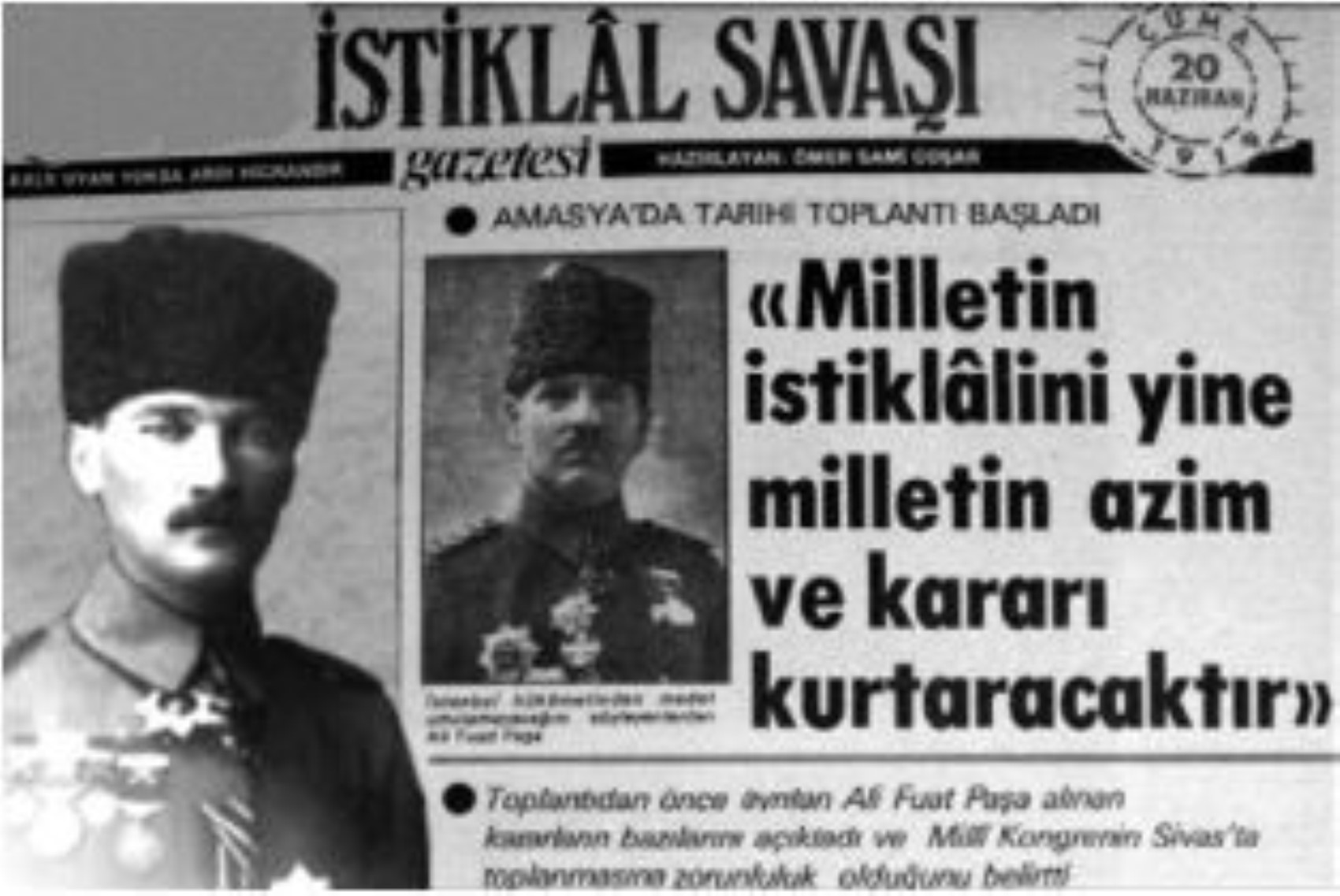
Another decision was made during these meetings. But this decision was secret. No one knew about it. If anything were to happen to Mustafa Kemal Pasha, who started a War of Independence with this circular, 20th Corps Commander Ali Fuat Pasha, who was in Eskişehir, and 15th Corps Commander Kazım Karabekir Pasha, who was in Eastern Anatolia, would immediately take over the civil and military administration of the country.
Furthermore, in the circular he sent to Thrace, he invited them to the National Struggle and said, "If the Turkish Nation entrusts its fate to this government, it will perish."
This was an Anatolian rebellion, and with this circular, the rebellion was effectively set in motion in Amasya.
The public gave great support. Enthusiastic rallies were held. Important figures joined this circular. The public's reaction was positive. Drawing support from the Amasya Circular, Mustafa Kemal immediately began preparations for the Erzurum Congress. He called the representatives of the Societies for the Defense of Rights from Eastern Anatolia, the Black Sea provinces, and the Southeastern provinces to the congress.
However, the Istanbul Government, hearing of this circular, gathered the Council of Ministers one day later, on June 23, 1919. And approximately 100 years ago today, they dismissed Mustafa Kemal Pasha from his post. It was reported to the Ministry of the Interior that he no longer had any official capacity, and therefore his instructions and orders should not be obeyed. Minister of the Interior Ali Kemal immediately issued this order to the provinces.
Moreover, he even slandered Mustafa Kemal by saying that the Ottoman State was not in a position to go to war with Greece, Italy, or any other state today, and that he was supporting associations like the Reddi İlhak (Rejection of Annexation) that were extorting the Muslim population.
Difficult days were now beginning for Mustafa Kemal. The Minister of the Interior, Ali Kemal, unable to contain himself, unfortunately gave the following statement to the foreign press correspondent of L'Entent;
"Mustafa Kemal and his friends are more dangerous than the Greeks. They are forming gangs that rob, destroy, and murder," he said.
Mustafa Kemal Pasha had been dismissed, but he had also lit the fuse in Anatolia. Despite it being forbidden, Turks organized rallies all over the country to protest the Government and the Greeks. The excitement spread throughout the country. The government and the occupiers were frightened and uneasy.
In the end, Mustafa Kemal Pasha won despite everything. He cleared the entire country of the occupiers.
We have come to today, and there is an occupation again. This time, it is a silent occupation. A silent invasion. The government, however, is not silent against this occupation; on the contrary, it is supporting this invasion. It is personally implementing this silent occupation through international agreements.
So what are we doing? We are also remaining silent.
But oh nation. Remember the purpose of the Amasya Circular published 100 years ago. Understand how they stood up against the occupation. If they hadn't resisted that day, if they had remained silent like you, could you even exist?
Understand now, the situation is that clear.
These lands and this homeland are not an inheritance for you. It is a trust that you will leave to your children in a clean and unoccupied state.
Most Read

Striking picture for Özgür Özel's 'New Party'

The PKK opening and Özgür Özel’s path!..

How did the newspapers view Özgür Özel's farewell to the CHP?

He killed his wife by slitting her throat: Their children witnessed the moments

What did the CHP do?

Özel’s new party move in the world press

Fire at TUSAŞ engine factory in Eskişehir under control

The New CHP, against CEHAPE

From self-efficacy to despair

Kılıçdaroğlu's first message on Özgür Özel's new party announcement