



Hasan Karakaya wrote the following in his column in 2011: “..It is present in the “case file” that the former 1st Army Commander, whose sectarian affiliation I never knew and who is currently an “Ergenekon suspect,” Gen. Çetin Doğan, gave the following instruction to the “Alevi commanders” under his command: “Religion is the greatest danger!.. The sound I hate the most is the sound of the adhan (call to prayer)! The PKK is not our business!.. Do not send Alevis to fight them, send Sunnis! Let our people in the Southeast not get their skin pierced! In the war against the PKK; let the Sunnis die, even if they are Atatürkists!” These lines were an example of the demonization of Alevis throughout history; of course, it had no basis in reality. Çetin Doğan was not an Alevi anyway. It was only İlker Başbuğ who spoke at that time about how Alevis within the army were targeted by the aforementioned operations. You know Ali Tatar; he was one of the Alevi commanders who was targeted. He could not withstand the attacks and eventually took his own life.
The pressures exerted on Alevis in Syria and now on social media are actually a continuation of this “demonization” process. There is a historical tradition and memory behind these attacks. Those who do not see this reality either look for the causes of the event in different places or, again, implicitly resort to blaming the Alevis.
Even the attacks carried out on the tomb of Husayn ibn Hamdan al-Khasibi, one of the most important scholars and historical figures of the Arab Alevi community, reflect the revived state of the memory we have expressed. In this respect, the fatwas written in the past calling them Qizilbash/Rafidi/Batini, and the hate-filled lines put to paper, are carefully embraced by the successors of that tradition. Moreover, these segments even go so far as to massacre Alevis as a legacy of this history, especially during periods of chaos and conflict. There is no need to go back very far; tragedies such as Maraş, Çorum, and Sivas appear before us as the grown saplings of those seeds of hatred we mentioned. Let us not forget that in Maraş in 1978, Alevi neighborhoods were kept under siege for three days; in Sivas, Alevi and leftist families were intended to be burned alive inside a hotel.
Memory is important in this respect. The moment we lose our social memory, we read all the developments that have taken place through the present and the moment, and we limit the perpetrators only to today. As a result, the burden and weight of the issues remain, root causes cannot be found, and naturally, all traces on the path to the truth are erased. Social memory is the sanctuary of reality in this respect. In that sanctuary, as author Elif Akpolat puts it, “Beyond the Desolation” awaits the Alevis. The author, who tries to explain some of the massacres experienced by Alevis in the lands of the homeland with “Beyond the Desolation”, says the following at this point:
“Beyond the desolation, they were left alone and unprotected, as it were. Vultures were circling above them, as it were. The state had withdrawn its hand from them. They were the 'other' in the eyes of the state now, too. Perhaps they were the victims of a secret agreement.”
In this respect, we are talking about a faith that has been tried to be isolated and condemned to desolation in various ways throughout history. This truth must shed light on today and tomorrow. Otherwise, similar tragedies may appear before us in the future.
Let us continue with the Syrian process, if you wish.
A striking name appears before us in this process. He is one of the ideological leaders of the Salafi/jihadi organizations that have increased the pressure on Nusayri Alevis in Syria.
I am talking about Ibn Taymiyyah.
Living in the 14th century, Ibn Taymiyyah demonized the Nusayri Alevis in his fatwas and, by openly targeting the aforementioned segments, pointed to the places where blood would be shed in the future.
The following fatwas belong to him:
“The people called Nusayriyyah and the Batini Qarmatian groups are more faithless than Jews and Christians, and even more than most polytheists. Their harm to the ummah of Muhammad (pbuh) is greater than the harm caused by faithless Turks (Mongols), Franks (Crusaders), and other warriors outside of these. They are thought to be from the Shia and are seen as supporters of the Ahl al-Bayt. (However) in reality, they do not believe in Allah, His Prophet, His book, commands and prohibitions, reward and sin, heaven and hell....
By the consensus of Islamic scholars, it is not permissible to marry them, nor to marry someone who owns a Nusayri slave; nor can the animals they slaughter be eaten.....It is also forbidden to bury them in a Muslim cemetery.
This cursed religion has spread to a large part of Syria, and its supporters consist of famous people. They are spreading their doctrines openly. Whoever among the Muslim scholars or clergy approaches, associates with, or mixes with them, let him guess what will happen to him. The public is only just beginning to have an idea about them.”
So, who has Ibn Taymiyyah inspired, and who has attempted practices such as establishing an emirate or a state under the light of these fatwas?
There is no doubt that Salafi/armed groups appear before us here. Therefore, the subconscious of the HTS militants coming from the Al-Qaeda and Nusra line is filled with such ideas.
So, what are those ideas, and where do the Alevis stand at this point?
Let us hear it from the pen of Kenan Çamurcu:
“Salafi organizations under the HTS banner are inspired by their master Ibn Taymiyyah, who attacked Alevi villages with his followers on the lie that the Nusayris were spying for the Tatars in the mountains of Damascus (Muhammad Abu Zahra, Ibn Taymiyyah Hayatuhu wa Asruhu, pp. 40-41), and their blood must surely be boiling to carry out massacres in Alevi villages. 10 years ago, they were shouting the slogan 'Christians to Beirut, Alevis to the coffin' with hysterical enthusiasm.”
Çamurcu's words are not limited to these. He also refers to the fatwas we quoted above and says the following in the continuation of his words:
“Let this be advanced reading information for those interested: Ibn Taymiyyah, the ideological ancestor of Salafi religious violence, constantly uses the phrase 'Repentance is mandatory, otherwise they will be killed' for Shias and Alevis in his books. In his shameful fatwa, which is a document of hatred against Alevis and which does not allow any religious or ethnic difference to exist in Muslim society, he writes that the Nusayris (Arab Alevis) are more infidel than Jews and Christians and that their harm to Islam is greater than that of warring infidels. To broaden his target spectrum, he adds to his fatwa that they appear to be Shia and lovers of the Ahl al-Bayt. (Majmu' al-Fatawa, 35/149-160). Thus, the Shias are also included in the massacre list.”
That is how the situation is. This is the history that lies behind the pressures of HTS militants on Alevis. Of course, Ibn Taymiyyah is only a part of this history. And in one respect, he is also important because he guides Salafi organizations. However, the marginalization of Batini/Alevi groups in Islamic history is not limited to this name.
As a result, we must state that we are going through a very chaotic and dirty process on behalf of Syria. We do not know exactly which news or information is true. For example, we can see CNN, which treats Gaza as a region on Mars, as a human rights defender in Syria. However, the fact remains that the Alevi community in general has been targeted by different names in different periods throughout the historical process and has been subjected to attacks that sometimes resulted in massacres. In this respect, we are facing a historical truth that transcends periods. And without the light of that truth, we cannot illuminate today.
Most Read

Striking picture for Özgür Özel's 'New Party'

Özgür Özel gives a dated response regarding the number of resignations

Forest fire in Antalya brought under control

Houthis strike Saudi-owned tanker

4 drones shot down near US Consulate General in Erbil

Özel’s new party move in the world press

Famous director Ezel Akay and his brother have been detained
The new rule of the field: Attrition
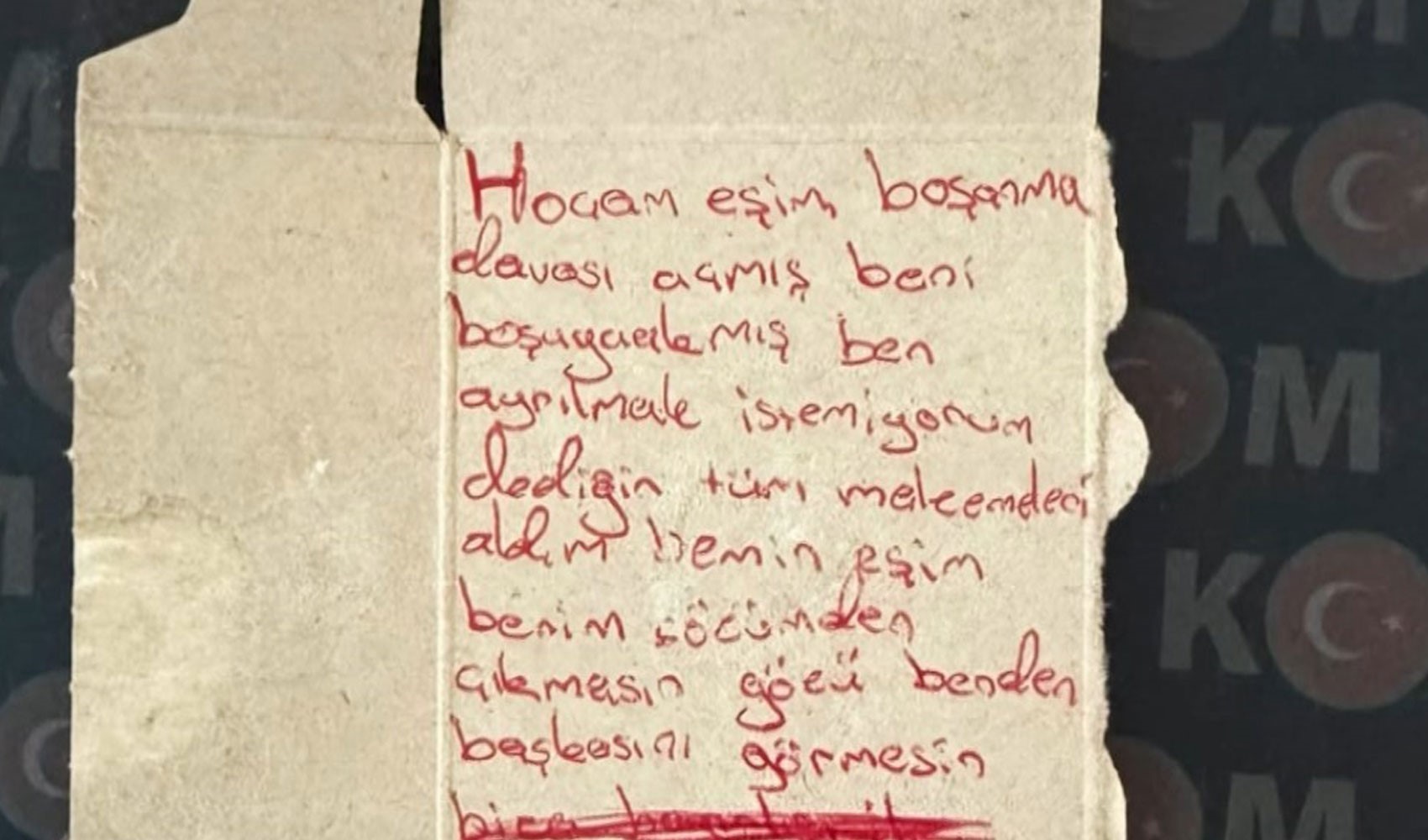
'Papers with spells and curses' operation: 'Master, my spouse filed for divorce'
Key figure in Epstein files found dead at home