



Bahçeli's intention to take three of his friends and go to İmralı has severely stirred up politics.
His former fellow nationalist Dervişoğlu said, "Let them go," but everyone knows he won't go. His entire concern is to corner the parliamentary commission and ensure that the deputies appear before Öcalan as soon as possible!
He wants the blood-stained terrorist to become an official interlocutor of the Republic of Turkey so that he can make progress in this dangerous game he has started.
He made a tactical maneuver on the podium that he considers critical; we will learn tomorrow whether this will yield the result he wants. One does not need to light a cigarette from a fortune-teller's pack to predict that the decision to emerge from the commission will have an impact far beyond what is visible in politics.
In a country like Turkey, where political memory is filled with fire and ash, even the mere pronunciation of engagement with Öcalan will strengthen the hands of the Kurdish nationalists and their imperialist masters—whom they serve without fail—and everyone else who hates the Republic, the Republican revolutions, and the Turkish nation, more than ever before in history.
The picture is clear:
The government has almost no room for maneuver left. The economic and social crisis has literally put the country in a vice; the base that views issues ideologically is tired, and the returns of the security policy, which it exploited before every election, have run out.
The patience of my country's people is at its breaking point.
But the "Kurdish stone" remains where it is.
Tayyip Erdoğan has long been eager to play this stone to consolidate his neo-Hamidian regime. Moreover, he knows how risky it is. So much so that if he takes a wrong step here, the system he has woven stitch by stitch since 2002 could collapse in an instant.
However, for now, we can say that he prefers to proceed cautiously.
What about the CHP?
Özgür Özel said of Tayyip Erdoğan, "He will make the MHP measure the depth of the stream while he steps aside again," but how aware is he of the seriousness of the matter?
Because he constantly dodges the issue regarding Öcalan and İmralı, almost no one can fully understand the CHP's political position.
Let us record our note in history. Let us warn and caution in our own way, perhaps he will take it into consideration, we say, and continue.
Even though human memory is prone to forgetfulness, the memory of politics in Turkey is stronger than we think.
The year 1991...
SHP leader Erdal İnönü had formed an alliance with the HEP, the new party of the Kurdish nationalists, before the general elections held on October 20, or rather, he had decided to carry independent candidates from HEP into Parliament on the SHP list.
There was an approach that did not align with the realities of Turkey, such as the belief that the cycle of violence and terrorism would disappear with the political representation of Kurdish nationalists. He believed that "political channels" needed to be opened in the Kurdish issue. Thus, he thought it was possible to both take a democratic step and build a politics based on the human rights sensitivity of the center-left.
But politics in Turkey was extremely far from this reading. When it came to the sociology of the country, this was not like solving a physics problem on paper. The Kurdish issue was an area that touched the nerve endings of the state, and every step taken in this area both frightened the center's voters and activated nationalist reflexes.
The 1991 elections provided a gain for the SHP in the short term in terms of parliamentary arithmetic, but in the medium term, it caused a chain reaction that broke the party's backbone. The core electorate—urban, social democratic, secular, middle class—found itself in a storm it was not used to at all.
The fact that those from HEP who came through the SHP lists spoke Kurdish on the parliamentary podium, the oath crises that occurred, the expressions of "Kurdistan" used in front of the cameras, etc...
Naturally, the party base could not handle this. A feeling that "the party is slipping out of our hands" emerged both in the organizations in Anatolia and among the middle class in Istanbul. The SHP voter thought that this "alliance" blurred the party's identity. The center-left saw the 1991 move as an "identity issue." According to them, the SHP management had intertwined the party identity with the Kurdish nationalist, harsh, radical, terror-linked—in short, discourse seen as risky by the state—of the HEP.
They were not wrong.
In fact, two types of blood were circulating in the veins of the SHP; those who advocated a "democratic left" opening and those who stood on a statist-nationalist line.
Every crisis experienced with the HEP deputies sharpened these two lines much more.
In the end, separations, expulsions, breakaways...
The party began to crack from within. At the end of the day, all of this was quickly reflected in the ballot box.
The first bill came in the local elections three years later.
The "SHP wind" that blew in 1989 gave way to a storm in 1994. As this storm tossed the party, it tossed it hard.
Istanbul, Ankara, Adana, İzmir...
It lost what it had one by one.
It didn't just lose; it also paved the way for those who laid the stones on the roads to the hell we are in today.
After that date, it could never be the decisive actor of the center-left again.
The collapse of the party was not just about losing votes; the perception of being the "party representing the backbone of Turkey" at the state level was damaged. The fact that those who claimed to be the heirs of the Republic's founding cadres took such reckless steps on the issue where the state mind is most sensitive created a trust deficit that could not be recovered for 30 years.
Let's come to today.
Although Özgür Özel has constructed his discourse very carefully in his statements regarding İmralı in recent weeks, it is seen that he stands on the line of "We would not say no if it comes to the agenda."
As far as it is understood, his goal is to keep the Kurdish voter by his side as an ally who contributed to the local election success; at the same time, to make the party an address again in the "democratic solution of the Kurdish issue."
It is clear that he has badly adopted this strategy pushed from across the Atlantic.
However, the power balances Turkey is in today are much harsher and much more polarized than in 1991; more importantly, the areas of political legitimacy are extremely narrowed. Moreover, there is an invisible tension between the "nationalist, Kemalist, Republican vein that carries state reflexes" and the "ethnicist, sectarian vein" within the CHP.
In 1991, the SHP had attempted to make a move to take the "excuse of political representation" out of the hands of terrorism without calculating the social and political response to the step it took. Today, the political position the CHP has or has not taken is directly related to the survival of Turkey.
Furthermore, every signal it gives regarding İmralı is of a nature that can turn into material for perception engineering in the hands of the government.
To summarize, the SHP had lost the trust of the center voter due to an "excessive opening" in 1991. The CHP, on the threshold of 2026, stands at a point where it could be harmed even by the shadow of such a process. That is, on an extremely sensitive ground!
Ultimately, Özgür Özel's intention may be to pull politics onto a solution-oriented line. However, when his "good intention" in his own mind combines with bad timing in the circumstances of today, it could trigger a fracture like in 1991.
This means that both the CHP and the country will be dragged toward disaster faster.
Those who look at issues through rose-colored glasses say that Özgür Özel should establish a "democracy-centered political line" without excluding the Kurdish voter, without alarming the traditional base, and without losing the trust of the center-right voter.
If only the aforementioned approaches, adorned with good intentions in the style of a love-bug, with flowers and insects, coincided with the painful realities of Turkey in this geography.
Let us emphasize once again. The CHP must carefully weigh every step it will take at this threshold of history, especially on the issue of the İmralı delegation. It must know that from the moment it gives the green light to this, it will enter a path of no return, and that the bill will be extremely heavy!
This would be a historic mistake!
Because the issue is not just the party's vote share or the support the Kurds will give in the short term; it is also the protection of the Republic's founding mind, the state memory, the sense of justice, and the society's need to feel safe.
In 1991, the SHP paid the price for its mistake by severing its historical bond with the state, losing its identity and its base.
Today, the CHP is facing a similar situation.
If Özgür Özel attempts to fine-tune politics on Turkey's most fragile fault line by sending CHP deputies to İmralı to appear before Öcalan, he will not be the only one facing the potential consequences. He should know that there is no success or failure at the end of this road; there is the future of Turkey as a whole.
When that future collapses, only a fragmented, dark Turkey remains where Islamists, Kurdish nationalists, and in short, collaborators competing to serve imperialism run wild, and with that, we put a period to our article.
Most Read

Striking picture for Özgür Özel's 'New Party'

Özgür Özel gives a dated response regarding the number of resignations

Forest fire in Antalya brought under control

The PKK opening and Özgür Özel’s path!..
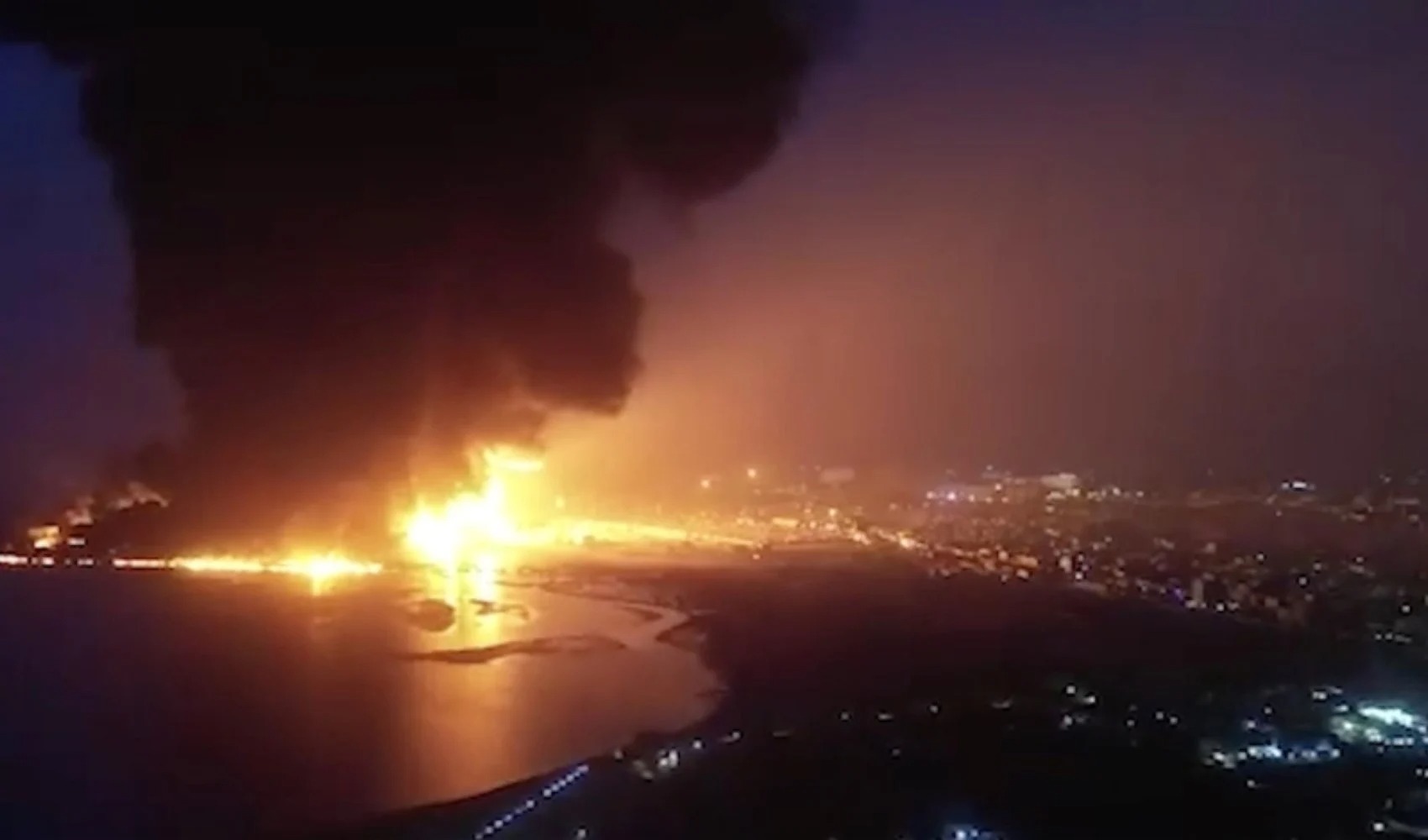
Houthis strike Saudi-owned tanker

How did the newspapers view Özgür Özel's farewell to the CHP?

What did the CHP do?

Özel’s new party move in the world press

The New CHP, against CEHAPE

From self-efficacy to despair