



Due to the intensity of the domestic agenda, we often fail to properly address what is happening abroad.
Let us try to evaluate Trump's visit to China, albeit a bit late, otherwise our work would be incomplete.
Without further ado, the contacts in Beijing have a meaning and significance that goes beyond classic diplomatic protocol.
To be more blunt; this visit was a declaration that the world is no longer governed from a single center, and that the era led by Washington, where 'I say it, and the world falls into line,' has effectively come to an end.
However, the real issue is not what Trump said there, but what he was forced to accept.
America has realized that China is no longer just a country that stands out for its cheap labor, but has become a center that produces technology, manages finance, creates diplomatic space, and establishes alternative global networks.
After years of wagging a finger at Beijing, has he said, 'We failed to bring the Chinese to their knees'?
Highly likely!
In fact, the most striking aspect of this visit was the change in tone in Trump's demeanor and attitude.
While just a few years ago he was stirring up trouble with trade wars, customs tariffs, and the slogan 'Make America Great Again,' today he is seeking a ground for controlled compromise with China.
To use a common local expression, even if he didn't exactly eat his words, he certainly swallowed hard before them.
For this reason, Trump's appearance in Beijing has been recorded by history as a historic symbol.
From now on, China will appear on the world stage as an equal power that America will have to live with.
To summarize, on many files ranging from the Iran crisis to energy pipelines, and from relations with Russia to competition in artificial intelligence, the Chinese are not sitting at the edge of the table, but right in the middle.
Today, we are not facing the bipolar world of the Cold War, nor the American unipolarity of the 1990s.
The doors to a more complex, more slippery, and more pragmatic era have opened.
States are taking political and military positions not through ideological slogans, but through energy corridors, artificial intelligence chains, semiconductors, rare earth elements, and trade security.
That is why the issue is a bit deeper than the question of 'is multipolarity coming?' Because the structure that is emerging is beyond a romantic multipolarity. It is more of a new balance order where great powers cannot completely eliminate each other and are therefore forced into controlled compromises.
In other words, we have stepped into an era where everyone is dependent on one another.
Whether this is good or bad for us, let us make that the subject of another article.
Now, let us continue.
We can summarize the issue as follows:
America cannot produce without China.
China cannot afford to lose the American market entirely.
Europe still leans on Washington for security, but it cannot sever its ties with Beijing for the sake of its economy.
Russia is moving closer to China, yet it fears being eclipsed by its shadow.
Therefore, we can describe this new era not as the collapse of an empire, but as a transitional phase in which the hegemonic power has lost its absolute dominance.
There is another point to consider here. China is not emerging with an ideological challenge like the Soviet Union. Beijing's concern is not to export communism to the world. The Chinese model is much more pragmatic. It does not say, 'Be like my system'; it says, 'Trade with me, let me build your infrastructure, let me provide your loans, let me construct your ports,' and so on.
That is precisely why China's rise is more dangerous for the West... Because it is not advancing with tanks, but through supply chains.
The language Trump displayed in Beijing was, to some extent, a result of this.
Controlled competition has replaced harsh ideological challenges. The parties do not want to destroy each other; they are trying to brake the speed of each other's rise.
And this is exactly where the key concept of this new world order emerges: manageable competition.
However, while all of this is happening, America's psychological superiority is also eroding. Throughout the 20th century, the world somehow believed that those in Washington would have the final say. Now, what Beijing has to say has become just as important as Washington.
Let us look for the symbolic value of Trump's visit here. We can call this the point where the idea of an "unrivaled superpower" in the minds of American elites has begun to dissolve, rather than just a diplomatic contact.
Of course, there is no need to get caught up in the pendulum of extremes.
In other words, even if the circumstances are manifesting in an unfavorable manner for Trump, it would be simplistic to say "America is finished, China has won" today. America is still militarily strong and possesses massive advantages in the financial system, dollar dominance, and global cultural influence. However, it is no longer the sole determinant.
In short, this is a historic turning point.
The world stands on the threshold of a new era. A period where no one wins completely, but no one loses completely either.
Trump's visit to China showed that the global system will no longer be one of ideological polarization, but one of shared interests. Those who appeared to be enemies yesterday are sitting at the same table today for energy, technology, and trade. Because the great powers of the 21st century have learned that in the age of the global economy, absolute war means absolute destruction for everyone.
This entire picture must also be read carefully from Turkey's perspective. Because as the world seeks a new balance, it will become increasingly difficult for countries acting on old habits to survive. The competition between America and China is far beyond just a fight between two superpowers; it is a global process of redistribution that draws everyone in, from energy routes to trade lines, and from defense policies to technology wars.
The real issue facing Turkey lies here.
To correctly read the changing world and assert its own influence... Let us conclude our article by stating that in this new era, it will not just be the strong who survive, but those who can correctly manage the fractures between the great powers.
Most Read

Striking picture for Özgür Özel's 'New Party'

Özgür Özel gives a dated response regarding the number of resignations

Forest fire in Antalya brought under control
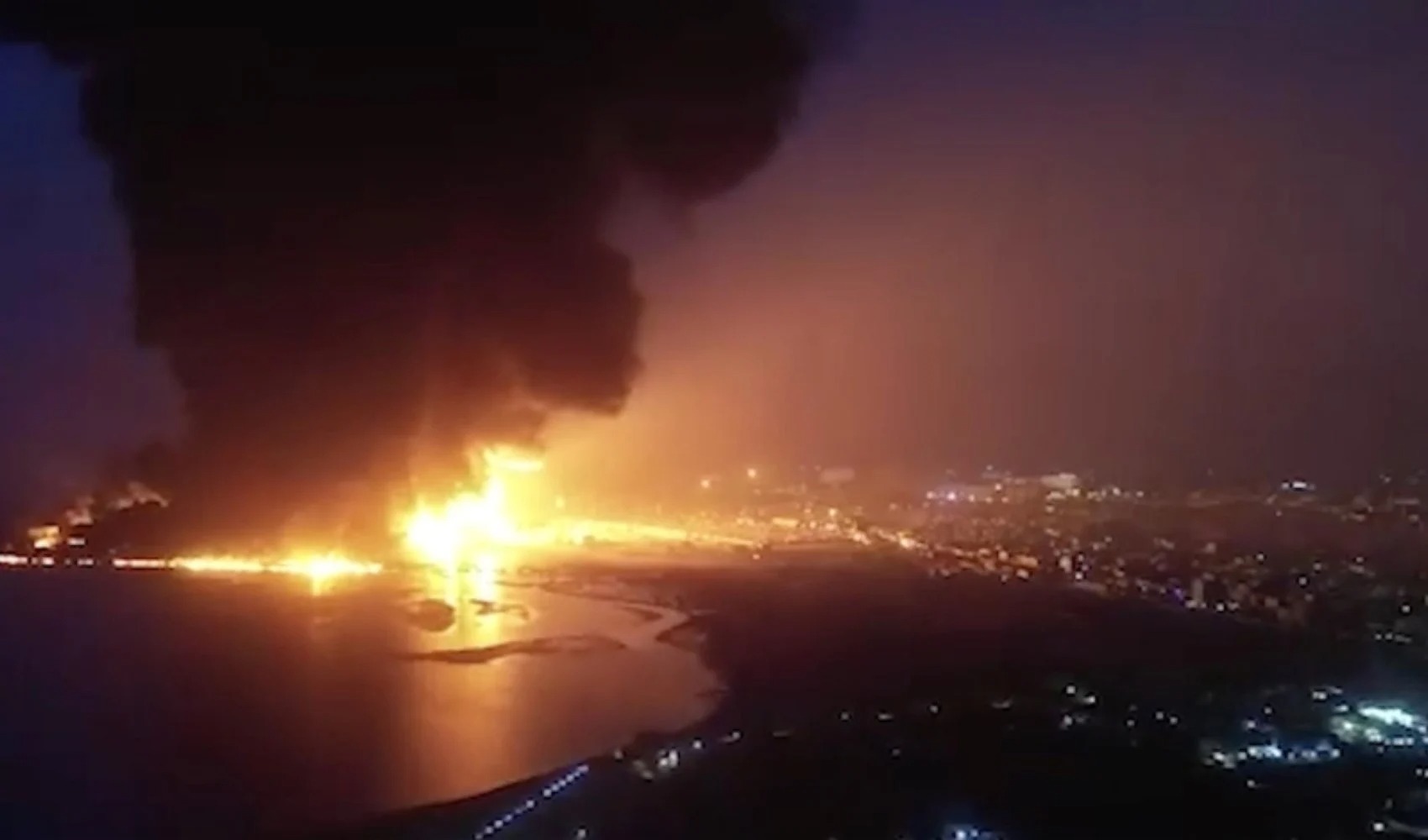
Houthis strike Saudi-owned tanker

4 drones shot down near US Consulate General in Erbil

Özel’s new party move in the world press

Famous director Ezel Akay and his brother have been detained

The new rule of the field: Attrition

'Papers with spells and curses' operation: 'Master, my spouse filed for divorce'

Key figure in Epstein files found dead at home