



Let us start by saying, unfortunately...
There is an undeclared state of emergency in Ankara.
Since we are hosting the NATO summit next week, the government is quite anxious.
Why?
Because their "big brothers," those whose legitimacy they depend on and whom they are trying to please, are all coming.
While the people of my country have been condemned for years to live with potholes on the roads, broken sidewalks, and neglected parks, we suddenly saw that they have started to give Ankara a complete makeover out of concern for "what will people say."
Of course, that is not the only issue.
They are going to almost completely shut down a massive city where 6 million people live for the summit. If they could find an easy way, they wouldn't even let the people breathe.
In fact, we pay the taxes, but the service goes to NATO.
Moreover, hundreds of people were detained as "terrorism suspects" before the summit.
Let the opposition be silent, let socialists, environmentalists, and unionists be kept under pressure, let anti-NATO rallies be banned...
They remembered the fight against terrorist organizations not for the safety of the citizens, but so that their guests would not be disturbed.
Let us sit crooked and talk straight.
It is clear that this has nothing to do with the seriousness of the state.
So what is it?
It is nothing if not the psychology of a colonial official...
When Eisenhower came to Ankara in 1959, life in the city had stopped, and the streets were decorated with American flags. During the era of the DP government, which today's government admires so much...
Now, NATO banners have replaced the American flags.
The same inferiority complex, the same desperate need to be liked, the same submissiveness to those they perceive as powerful!
Can it be a coincidence that those who have spent years conducting politics through supposed anti-Westernism are the ones who stand to attention the fastest in the face of the West?
This is not an ideological issue; it is a psychological one.
The complex they have accumulated for years under the guise of criticizing Westernism is now on the streets of Ankara, right before our eyes.
Those who yesterday treated the 6th Fleet as their qibla in Dolmabahçe are now spending 12 billion TL from the taxes of this impoverished nation to build an airport so that Trump's plane can land comfortably.
Closing a park because Macron might go for a morning run; or even worse, screening off shanty towns along the route and putting up barricades so that no one can see them...
Is this a security measure?
Give me a break...
Let us call it by its proper name.
This is being ashamed of the conditions one's own people live in.
In other words, it is the government's effort to cover up its own failure by hiding the poverty of its people from its guests.
Trying to silence citizens to ensure the comfort of foreign leaders has nothing to do with hospitality; it is, at best, an expression of an inferiority complex.
Weddings are banned.
Graduation celebrations are banned.
Demonstrations are banned.
Banners are banned.
Furthermore, even the printing of banners and brochures criticizing NATO is banned.
The pro-government media does not see any of this.
It does not see the arrests.
It does not see the bans.
It does not see the billboards covering up the people's poverty.
They have already started applauding long ago.
No one has the right to humiliate the citizens of the Republic of Turkey as if they were usual suspects. No foreign leader's comfort is more valuable than the honor and pride of this country. The streets of this country are not for NATO, but for the Turkish people.
From where to where...
Let us take a breath here and slowly turn the pages of recent history.
If I take my start as an intern at the Cumhuriyet newspaper in 1991 as a basis, I have left exactly 35 years behind in the profession.
During this time, I have followed dozens of summits, international meetings, and perhaps hundreds of bilateral contacts.
I have been present during the visits of presidents, prime ministers, and foreign ministers to foreign countries.
I remember them all as if it were yesterday.
But among them, there were some that truly left a mark on my professional life.
For example, in June 1996, the United Nations Second Conference on Human Settlements was held in Istanbul.
It was important for Turkey; because it was the first international meeting of this scale hosted by Istanbul in the post-Cold War era.
Representatives from nearly 170 countries participated, and many heads of state and government came to Istanbul for the summit.
Among them was the legendary leader of Cuba, Fidel Castro.
This was the first major summit I followed.
In 1997, I went to Strasbourg for the Second Summit of Heads of State and Government of the Council of Europe.
This summit was a critical meeting during the period when the post-Cold War European order was being reshaped.
In June 1998, I followed the Stability Pact Summit held in Sarajevo.
President Demirel and American President Clinton also attended.
The aim was to ensure the continuity of foreign aid for Bosnia and Herzegovina, which was trying to get back on its feet after the Dayton Agreement.
In fact, when Demirel said in his speech, "We did not come here to write history, but to make history," he received great applause.
In December 1999, I followed the EU summit in Helsinki where Turkey was declared a full member candidate. The Greek press had received the final declaration before us. While we were chasing diplomats to confirm it, they had already filed their stories.
In June 2000, I went to Kuala Lumpur for the meeting of the Organization of Islamic Cooperation, where Turkey nominated a candidate for secretary-general for the first time.
Yaşar Yakış, one of the few diplomats in the Foreign Ministry who knew Arabic, was hopeful because he would receive this title. But when he withdrew from the race due to a last-minute deal Ismail Cem made with Iran, his enthusiasm was cut short, and he cried his eyes out on the steps of the meeting hall. He was so ambitious that, with that momentum, he became the first Foreign Minister of the AKP, which would come to power two years later.
And the year 2004...
Turkey was hosting a NATO summit for the first time. For this meeting, I and many of my colleagues in Ankara made Istanbul our home.
It was just after the alliance's largest wave of expansion. Afghanistan, Iraq, and Mediterranean security were the main agenda items.
Moreover, it was a period when the security paranoia that emerged with 9/11 was at its peak. The smoke from the American occupation in Afghanistan and Iraq was still rising.
The Al-Qaeda threat was fresh. Everyone was on edge.
Despite this, they did not resort to measures as humiliating as those in Ankara, which emptied the public space to this extent and hid poverty.
I have not witnessed a similar scene in any of the international organizations I have followed to date.
In none of them were the city's people treated as a potential threat.
In none of them were citizens driven out of public space.
In none of them was poverty hidden behind a curtain of shame.
Let us say that the issue is about how the government views its own people.
Unfortunately, this mentality sees its own citizens as a threat, their poverty as a shame, and their dissent as a crime. It thinks that by taking these measures, it will gain prestige in the eyes of its foreign guests.
However, prestige is not gained by emptying streets, painting walls, or hiding poverty behind billboards.
Let us end our article by saying that a state's prestige is measured by the respect it shows to its own people.
Most Read

Striking picture for Özgür Özel's 'New Party'

Özgür Özel gives a dated response regarding the number of resignations

Forest fire in Antalya brought under control

The PKK opening and Özgür Özel’s path!..

How did the newspapers view Özgür Özel's farewell to the CHP?
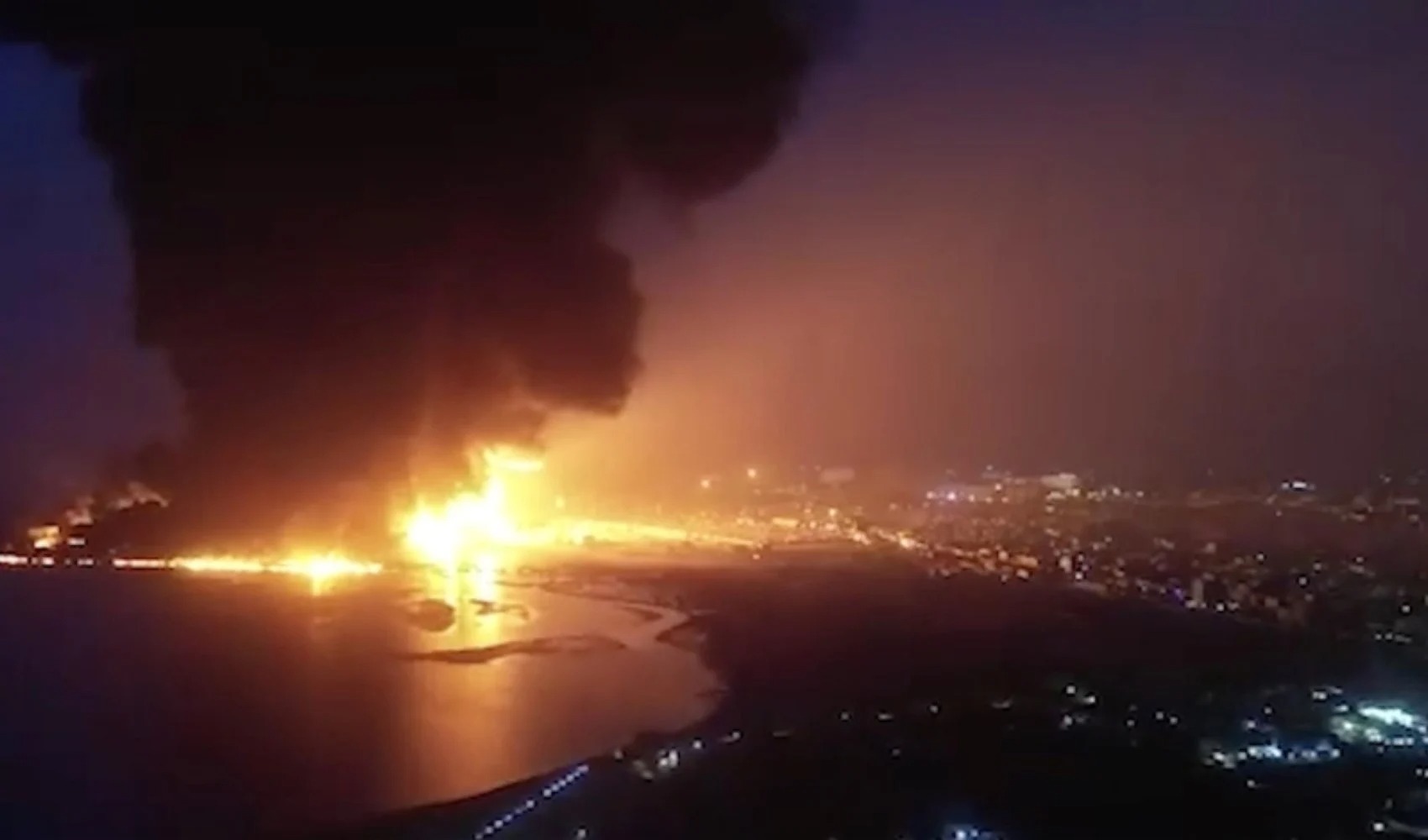
Houthis strike Saudi-owned tanker

What did the CHP do?

Özel’s new party move in the world press

The New CHP, against CEHAPE

From self-efficacy to despair