



We are sitting here, all of us, watching the war that broke out with the American and Israeli attack on Iran on our screens.
And in between commercials, we watch Trump's nonsensical statements...
Let us not think, "He is crazy, whatever he does is expected." It is not that simple; one of the most important proxy wars of the 21st century is taking place right before our eyes.
The picture before us has a very high depth of field in political, strategic, and economic terms.
Let us put on our reading glasses;
At first glance, the issue can be packaged under headings such as the nuclear program, regional security, or the "regime threat."
But that falls short of explaining the whole picture.
The issue here is neither just Iran's nuclear file nor a debate about the legitimacy of the mullah regime in the classical sense.
The issue is directly related to energy.
Or rather, to the new global power balances established, or being attempted to be established, through energy.
Let us underline this with a thick pen several times.
It is worth saying without beating around the bush: Neither a Syria nor a Venezuela will emerge from Iran.
Today, Iran is neither the Syria of 2011 nor a Latin American country that has lost its political legitimacy due to economic collapse.
Despite all its internal economic and social troubles, Iran has managed to preserve its strong state tradition; it possesses a deep-rooted bureaucracy, a security apparatus with a hardened ideological backbone, and, despite everything, a significant capacity for social mobilization.
The system formed after the 1979 Iranian Revolution is not fragile; on the contrary, it is a structure that is strongly fortified by being fed by external threats.
Of course, we are not sanctifying the medieval remnant mullah regime. We are not ignoring the suffering of the people. Let us not leave room for misunderstandings.
However, it is our duty to present what is happening with all its clarity and background.
If we continue;
To understand America's move toward Iran, one must look not at Tehran, but at Beijing.
As everyone familiar with these files knows, one of the most critical sources of China's growth model is Middle Eastern oil. Iran, despite all the sanctions it is subjected to, is a stable and strategic supplier for China.
In other words, China is Iran's largest oil customer.
Let us take a look at the numbers;
In 2025, an average of 1.38 million barrels of oil per day were exported from Iran to China.
This accounts for almost 90 percent of the oil Iran sells to the world market. At the same time, it means about 13–14 percent of China's crude oil imports by sea.
Trump's obsession is not in vain!
To prevent China's growth, first of all, the oil sent to this country must be cut off, or its control must be in American hands. Otherwise, the rest is literally just a story.
Those in Washington know very well that as China grows, America will not be able to move as comfortably around the world as it once did. Even if not in terms of military capacity, this is especially true in economic terms...
A truly multipolar world order is a nightmare scenario for those in Washington.
They handled things in Venezuela as easily as taking a hair out of butter. They ousted Maduro, solved the issue in their own way, and sat on top of the oil valve.
Iran, however, is a tough nut to crack, not an easy target.
Trump's concern here is to take control of the oil valve going to China. In fact, if possible, to take charge of that tap as they did in Venezuela.
For America, Iran's "democratization" or "reform" are secondary headings. Everyone who follows developments even a little bit sees and knows this.
Their main concern is to control the energy flow and narrow China's long-term strategic depth. We can see this as the energy front of the 21st-century great power competition.
For Israel, the picture is different but complementary. For Israel, Iran is not just a state; it is an actor coded as an existential threat.
Therefore, while the main motivation for Washington's attack on Iran is to tilt global economic balances in its favor, Israel's motivation is security and deterrence.
So, why won't Iran become Syria?
As Syria was dragged into civil war, its state apparatus disintegrated, the army split, and foreign intervention turned into a multi-actor chaos. Although the Supreme Leader Khamenei and the regime's leading figures may have been killed, the coordination between the Revolutionary Guards, the army, intelligence, and paramilitary structures is largely functioning.
Despite the ruthless onslaught by America and Israel, Iranian missiles are hitting their targets one after another. Israel and the Gulf countries supporting this war are on edge.
Furthermore, Iranian society can rapidly develop a "national reflex" when a perception of foreign intervention arises.
Venezuela, despite being oil-rich, experienced a serious internal collapse due to economic sanctions and mismanagement.
Although the Iranian economy has taken a heavy hit from sanctions, it has managed to keep the system afloat through illicit trade networks, regional connections, and alternative financial channels.
For this reason, we can evaluate the expectation of a rapid regime collapse in Iran as an overly optimistic Washington fantasy.
Here is the crux of the matter: will the Kurds and Balochs get involved at some point in the war?
Iran's multi-ethnic structure is always seen as a "fault line" in foreign interventions. Especially in the west, the Kurdish population, and in the east, the Baloch regions have occasionally experienced tensions with the center. This is already known.
However, there are two critical points; the difference in political culture between Iranian Kurds and Iraqi and Syrian Kurds is significant.
Secondly, the Iranian state has been severely fortifying its security architecture in border regions for many years. It is not likely to collapse easily.
Low-intensity conflicts, sabotage, and movements along the border line with the support of America and Israel may be seen. But it is a weak possibility that this will drag the country into a civil war similar to Syria.
In the Baloch region, the Pakistan and Afghanistan equation comes into play; this would enlarge the regional fire but would not produce an effect that would topple the central regime on its own.
Let us come to the Shah issue, will they take the field?
There are diaspora elements who long for the monarchy order of pre-1979. However, it is difficult to say that the Shah supporters within Iran have formed an organized, armed, and mass response. Although nostalgia for the Mohammad Reza Pahlavi era gains visibility on social media during moments of economic crisis, this has not turned into a social wave that would topple the regime.
A "government-in-exile" scenario created with foreign support might be on the table. However, considering Iran's security apparatus and nationalist reflex, this attempt could backfire and further fortify the regime.
There are a few scenarios before us regarding how this war might end.
Controlled escalation – Controlled withdrawal:
The US and Israel strike a limited blow to Iran's nuclear and military infrastructure. Iran retaliates, but diplomatic channels open before the war reaches regional expansion. This is the most rational scenario.
Regional expansion:
The Lebanon, Iraq, and Yemen line heats up. The Strait of Hormuz is put at risk. Oil prices skyrocket. In this case, the global economy takes a heavy hit, and the China-US competition enters a harsher phase.
Combination of internal unrest and external pressure:
Economic collapse is accelerated, and simultaneous ethnic and political movements are encouraged. But this could turn Iran into a long-term area of instability rather than leading to a Libya-like fragmentation.
Great power bargaining:
A tacit agreement is reached between Washington and Beijing. The Iran file becomes part of a broader trade and security deal. Energy flow is reorganized, but the regime remains in place.
In short; at the center of this war is not ideology, but the re-establishment of the global economic equation. The Iran file cannot be read independently of the China file. The US's goal is the control of the energy vein flowing to Beijing, rather than the character of the regime in Tehran.
Let us repeat, a Syria will not emerge from Iran because the state structure has not collapsed. A Venezuela will not emerge from Iran because the system has not yet disintegrated.
But Iran, right in the middle of great power competition, could be dragged into a long-term process of pressure and attrition. The wars of the 21st century are no longer fought for maps; they are fought for valves, pipelines, and supply chains. Let us put a period to our article by saying that the Iran file is exactly this.
Most Read

Striking picture for Özgür Özel's 'New Party'

Özgür Özel gives a dated response regarding the number of resignations

Forest fire in Antalya brought under control

The PKK opening and Özgür Özel’s path!..

How did the newspapers view Özgür Özel's farewell to the CHP?
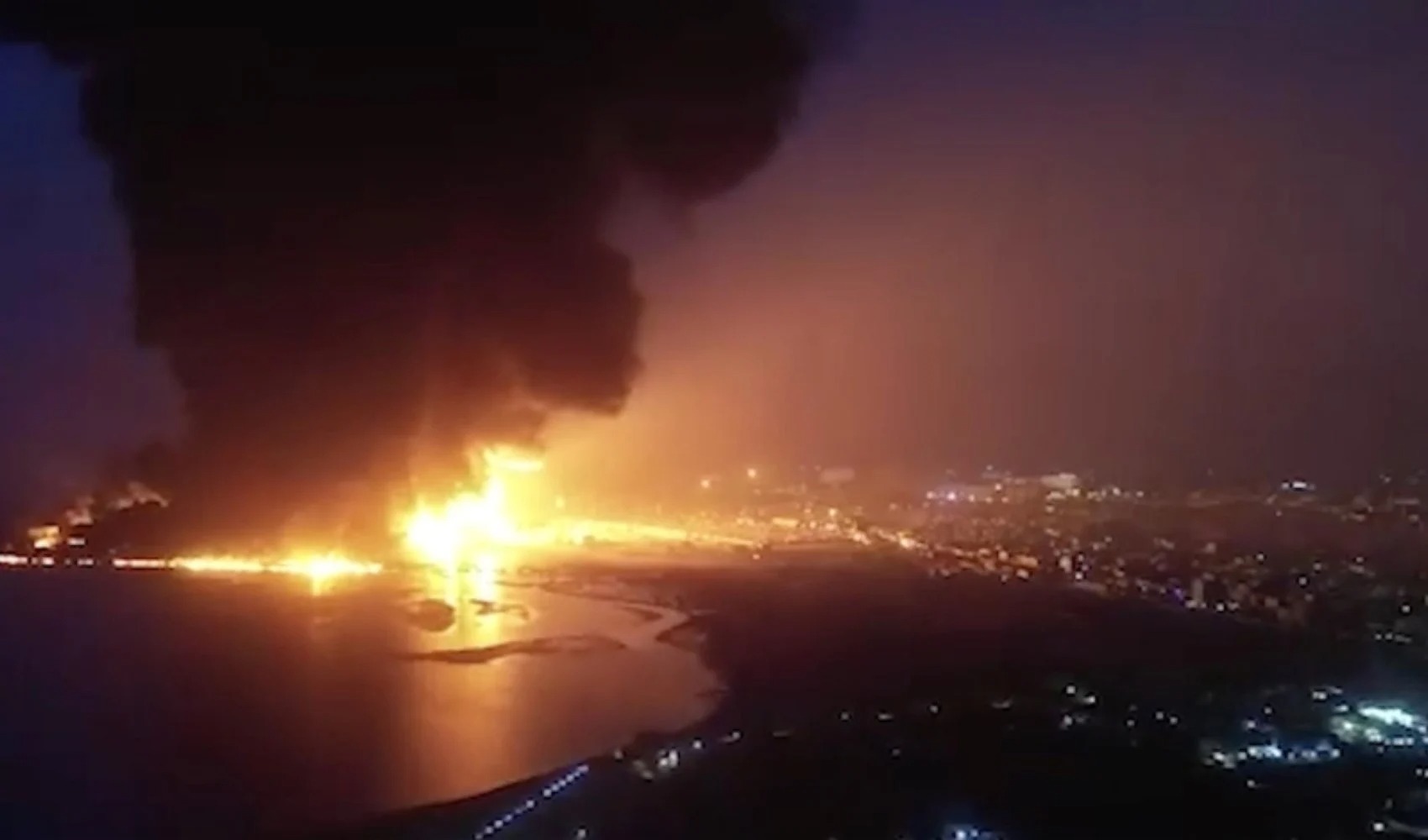
Houthis strike Saudi-owned tanker

What did the CHP do?

Özel’s new party move in the world press

The New CHP, against CEHAPE

From self-efficacy to despair