



It is certainly not a case of starting from scratch and ending with nothing.
But this depends on what is being recorded in the ledger and how it is read.
After a 40-day war, the fact that a negotiating table has been set up in Pakistan—even if it is on shaky ground—is in itself very significant. Because at the point reached today, moving from an equation where the parties completely ignored each other to a ground where they at least agree to talk marks a strategic breakthrough in its own right.
No one expected an agreement here that would lead to a comprehensive peace treaty.
If anyone was expecting that, they are either not reading the field correctly or have never flipped through a diplomacy textbook.
In reality, they were just posturing. They weighed each other's strengths, tested their reflexes, and probed each other's red lines.
That is all...
However, one should not lose heart.
It is highly probable that Trump, if not Netanyahu, has realized that things cannot continue this way.
He is aware that if he gets caught in a trap in the November elections, he will not be able to easily clean up the mess afterward. Because such crises, when not managed rationally, result in heavy costs not only in foreign policy but also in domestic politics.
He is talking nonsense and making absurd statements, but he is also looking for a way out. This search for an exit is actually an indirect admission that Washington is cornered. To use the trendy phrase of recent times, I am sure he regrets getting into this, but I cannot prove it...
For the sake of honor, he is forced to find a formula to end this madness that is shaking the region and the world to its core. Because uncontrolled escalation would produce consequences that could shake not only Iran but the global system as well.
For that reason, bombs and missiles might start flying again because the ceasefire talks did not yield results, but everyone has seen how important the negotiating table is.
This table has now become a necessity, not an option.
Let us put on our reading glasses and examine the issue that way.
Despite the media blackout, as far as we can understand from the information leaking out, the table established through Pakistan's initiative was actually more of a showcase for a display of power than a peace table. This showcase was a stage where the parties showed not what they could give each other, but what they would never give up.
We can say that this direct meeting between the US and Iran was a psychological battle that tested which boundaries the parties could impose on each other, rather than producing a consensus from the very beginning.
Let us call it a war of nerves disguised as diplomacy!
Indeed, the result was no surprise: no agreement, no step back, but plenty of threats and plenty of messages. We saw that what emerged from the table was a hardened version of mutual declarations of intent.
US Vice President JD Vance's statement that "the expected agreement could not be reached" sounds like a diplomatic courtesy. Perhaps it is even the softest expression of failure.
Washington did not get what it wanted from Iran. That is the naked truth on the ground.
Iran, on the other hand, locked the table by finding the US demands "unacceptable." This shows that Tehran is determined to maintain its position despite the pressure.
Then Donald Trump took the stage, trying to re-establish the balance in his own way with his classic style—that is, with threats, belittlement, and claims of absolute superiority. This style aims to send a message to the domestic public while simultaneously exerting psychological pressure on the other side.
But the real question that needs to be asked here is:
What really happened in the meetings?
Looking at Trump's statements, it is clear that a "victory narrative" is being constructed. This is not just rhetoric; it is also a perception operation. "Iran has no leverage," "they will return by giving everything," "I would destroy their energy infrastructure in an hour"... These sentences are a manifestation of an effort to cover up an incomplete result, not a diplomatic success.
Because if the US really holds all the cards, why did it walk away from the table so soon?
More importantly, if Iran is so weak, why has the US still not been able to make it abandon its nuclear program?
Here, one of the most fundamental contradictions of international politics—the gap between military capacity and the capacity to produce political results—emerges. As this gap widens, the chasm between power projection and real results grows.
The US is undeniably superior militarily. Its aircraft carriers in the Mediterranean and the Indian Ocean, its bases in the Gulf countries, the destroyers it sent to the Strait of Hormuz, the minesweepers it dispatched to the region, the support of the UK and other allies, and so on... All of these are power projections. But as long as this power cannot be converted into a concrete result at the table, it only produces "noise."
Unfortunately, in the international system, noise and results are not the same thing. Noise attracts attention, while results write history.
Let us look at the Iranian front.
It is certain that they have achieved a significant success against the US. This must be acknowledged. But this success is not an absolute gain; it is more of a state of avoiding a controlled loss.
It is clear that a very high bill has been issued for Tehran. The fact that the vast majority of its high-level officials, including its religious leaders, have been killed, the damage to military infrastructure, the deepening of economic fragility, the increased insurance costs for oil shipments, the further difficulty of attracting foreign investment, the social pressure accumulating internally... These are not items to be underestimated. The balance sheet of 40 days is extremely heavy.
These costs even have the potential to strain Iran's internal balances in the medium term. But the issue here is what Tehran's administration has protected despite these costs...
The answer is very clear: Regime security.
This is more critical than anything else for Tehran. Because Iranian foreign policy is largely shaped by the reflex to guarantee the survival of the regime.
Despite all the pressure, sanctions, and military threats from the US, Iran did not sit at the table by "surrendering." It did not abandon its nuclear program. It continued to hold the control card over Hormuz in its hand.
Most importantly, it was not pushed out of the game. It managed to remain within the system.
We wrote this last week, but let us repeat it; sometimes in international politics, victory is not winning, but not losing.
Iran did exactly that. And that is not a result to be underestimated.
The Strait of Hormuz issue stands at the heart of this equation. Today, Iran is one of the few actors that can touch the world's energy artery through Hormuz. This provides significant geoeconomic leverage in the short term. By increasing transit costs, raising risk perception, and unsettling global energy markets, it can increase its bargaining power.
However, this card also has an invisible side. In the long run, this type of leverage also carries risks that could work in reverse. The global system does not make such vulnerabilities permanent; it produces alternative routes and solutions.
Let us end our article by saying that we will make this the subject of the next piece.
Most Read

Striking picture for Özgür Özel's 'New Party'

Özgür Özel gives a dated response regarding the number of resignations

Forest fire in Antalya brought under control

The PKK opening and Özgür Özel’s path!..

How did the newspapers view Özgür Özel's farewell to the CHP?
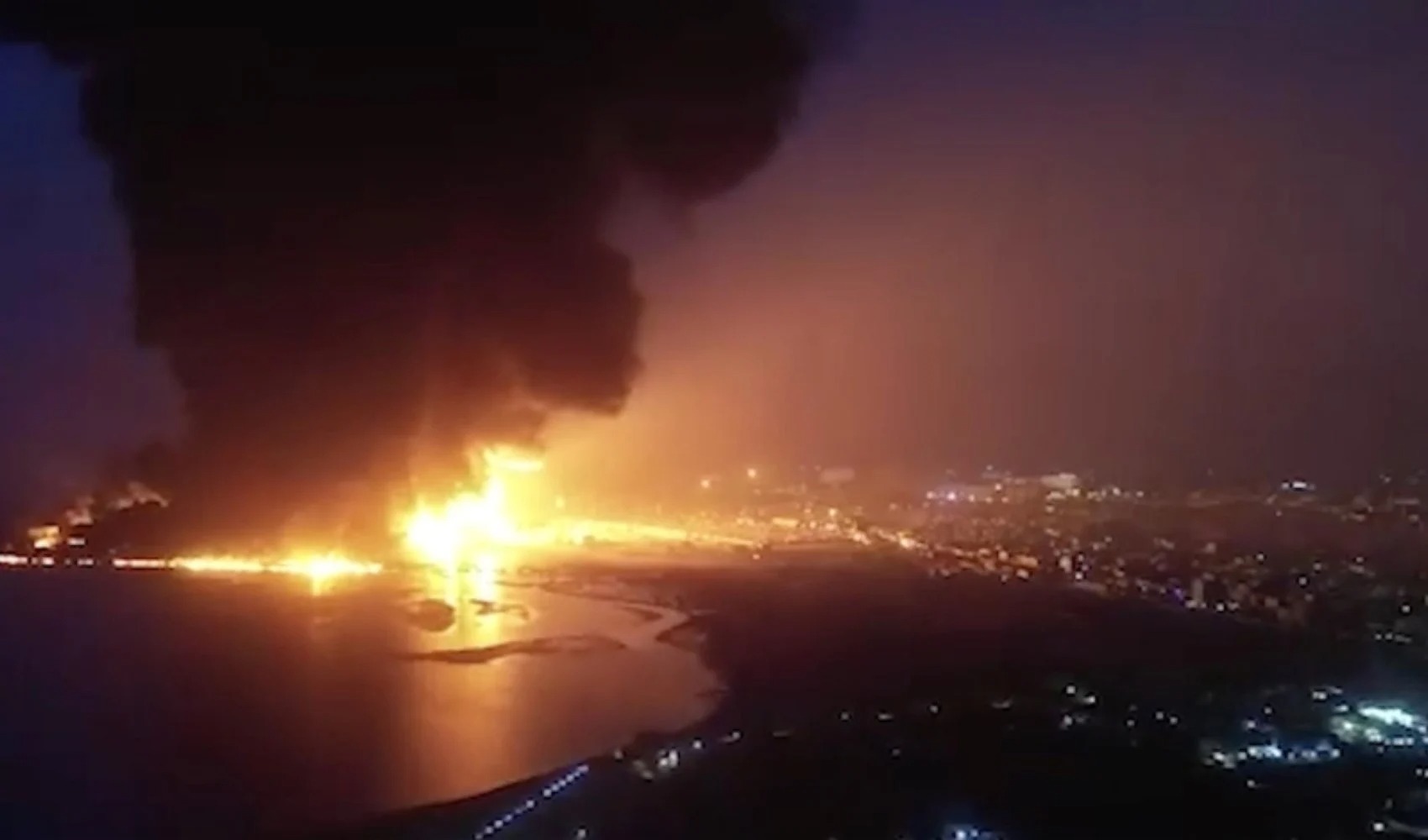
Houthis strike Saudi-owned tanker

What did the CHP do?

Özel’s new party move in the world press

The New CHP, against CEHAPE

From self-efficacy to despair