



The Turkish Food Codex is clear regarding pasta. Products labeled as pasta must be produced from Triticum durum wheat.
Pasta holds critical importance in our country. According to some, it is even a product that wins elections.
It would not be an exaggeration to say that pasta feeds low-income families in particular. The product we call "pasta" is essentially of Italian culinary origin and has become famous in Western languages under the name "pasta." Depending on the region in Italy, this product requires the durum wheat known as "Triticum durum" to be mixed with water or eggs to form a dough.
The common type of pasta is produced from dough made by mixing semolina obtained from this wheat or flour directly with eggs. Unfortunately, the Turkish Food Codex has deemed the addition of water instead of eggs sufficient: "Pasta: A product obtained by shaping and drying dough prepared by adding water to semolina produced from Triticum durum wheat and kneading it according to its technique; it is referred to as plain, whole wheat, seasoned, enriched, fortified pasta, and pasta with added vitamins and minerals."
Substituting water due to the spoilage effect of eggs is an understandable situation. Indeed, we also encounter pasta dough prepared without any eggs in Italian cuisine.
OBLIGATION OF INSPECTION AND UNFAIR COMPETITION
Assoc. Prof. Dr. Urartu Özgür Şafak Şeker from Bilkent University, who conducts excellent work on food, announced on his "X" account: "With a test we developed at our company, we examined pasta on the market for their durum wheat content; we saw that a significant amount of bread wheat is added to some pasta on the market. The reason you don't feel bloated when you eat pasta in Italy is not the gluten; it may be that you are consuming a large amount of starch in pasta in our country."
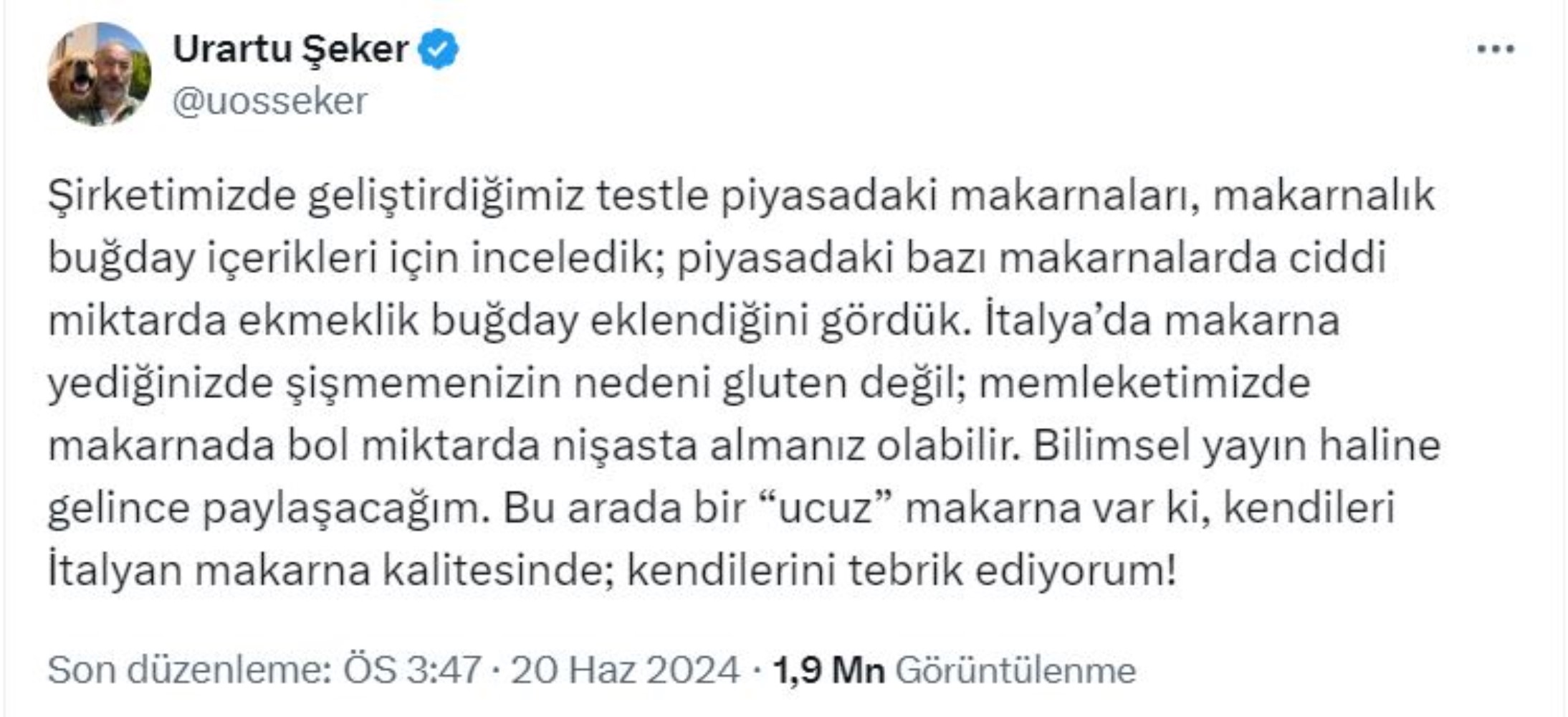
If Dr. Şeker's findings are correct, it is clear that "Triticum aestivum," which is a type of bread wheat, is being added to pasta dough, and thus the Turkish Food Codex is not being complied with. This means consumers are eating pasta that is protein-poor or altered with other additives instead of high-protein pasta dough.
In this case, it is possible to say that both the Ministry of Agriculture and Forestry is not fulfilling its inspection obligation and that those who produce the relevant products are engaging in unfair competition. I am looking forward to Dr. Şeker's findings being turned into a scientific publication. It seems a new legal/political struggle is on the horizon regarding consumer rights.
HEALTHY NUTRITION IS A RIGHT!
Is the struggle for citizens not to be deceived, to be able to eat properly, and especially for low-income segments to be healthy in order to lead a humane life, not political? Despite the prevailing political climate, for a political understanding that centers on the most fundamental concerns of human beings, this "pasta" issue is also a matter of existence.
Most Read

Striking picture for Özgür Özel's 'New Party'

The PKK opening and Özgür Özel’s path!..

How did the newspapers view Özgür Özel's farewell to the CHP?

He killed his wife by slitting her throat: Their children witnessed the moments

What did the CHP do?

Özel’s new party move in the world press

Fire at TUSAŞ engine factory in Eskişehir under control

The New CHP, against CEHAPE

From self-efficacy to despair

Kılıçdaroğlu's first message on Özgür Özel's new party announcement