



The cartoon, as a form of illustration highly suitable for political and social criticism, possesses a unique propaganda quality. Accordingly, with its widespread adoption in the 18th century, it inevitably became a part of wars. Significant production in this field also took place during the years of the National Struggle.
The purpose of propaganda cartoons is to define the "self" (or the friend) and the "other" in a context suitable to the circumstances, to glorify what belongs to oneself while primarily depicting the opponent as a distinct enemy, and secondarily attempting to portray them as immoral, weak, ridiculous, and incompetent.
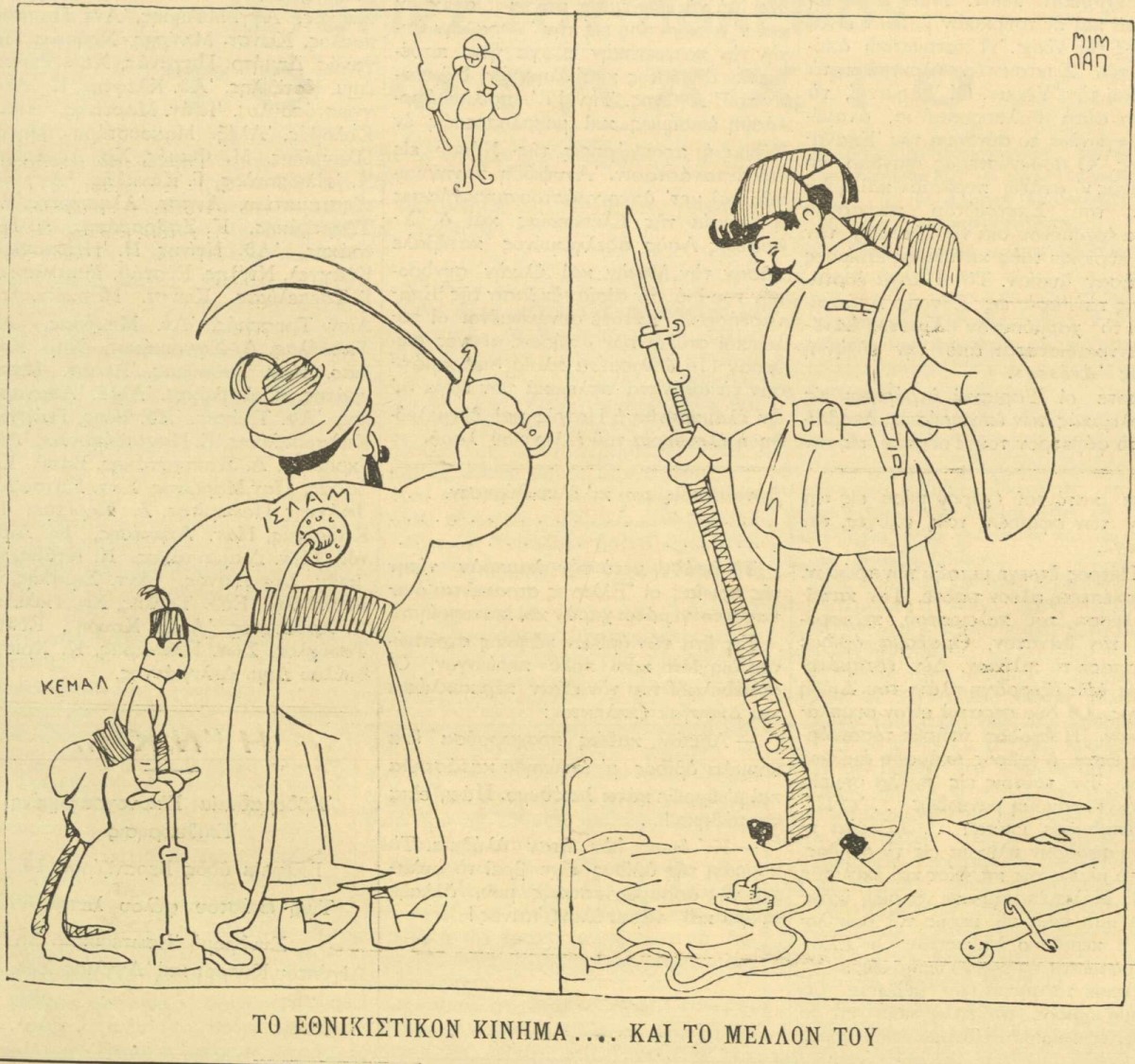 (The nationalist movement... and its future. (Niki, April 19, 1921)
Propaganda cartoons, like other political cartoons, mostly reflect the prejudices of the audience they address and the popular ideas of that period. Furthermore, for cartoons to find an audience among the masses, they must be simple and easily understandable. The prerequisite for this is that the reader is familiar with the context of the cartoon. In this respect, it is possible to trace the ideas and perceptions of a society or group through cartoons and reach certain generalizations.
During the War of Independence, cartoonists also glorified themselves and belittled their opponents through popular symbols and prejudices.
Orientalism, the common understanding of the period, dominates Greek propaganda cartoons. While the Greeks defined themselves as the guardians of the West, they defined the Turks as the Middle Eastern "other." In addition, although rare, cartoons that identify the Ankara movement with Prussian militarism and define Atatürk as a military dictator trying to awaken Prussian militarism in Anatolia are also encountered. In other words, Greek cartoonists also resorted to negative qualities belonging to Europe (according to the popular understanding of that period) in othering the Turks.
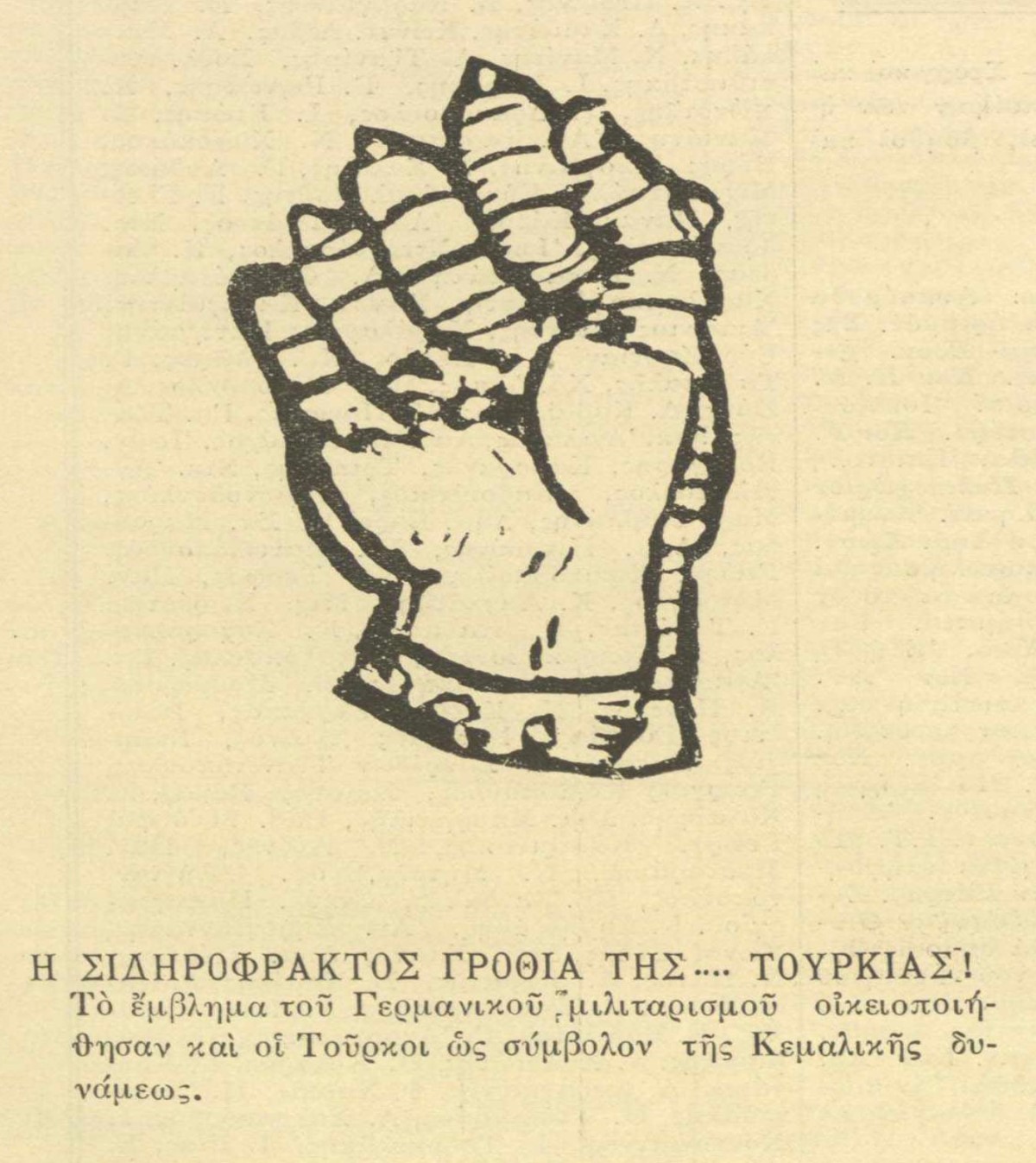
TURKEY'S IRON FIST! The Turks have found the symbol of German militarism suitable as the symbol of Kemalism. (Niki, July 5, 1921)
The second element of othering that stands out in Greek cartoons is class-based. Greek cartoonists generally depicted Turkish society as a mob engaged in menial tasks like porterage and incapable of understanding other work (at this point, let us recall that in Turkish cartoons, Greeks were also depicted through the character of the swindling and untrustworthy tradesman).
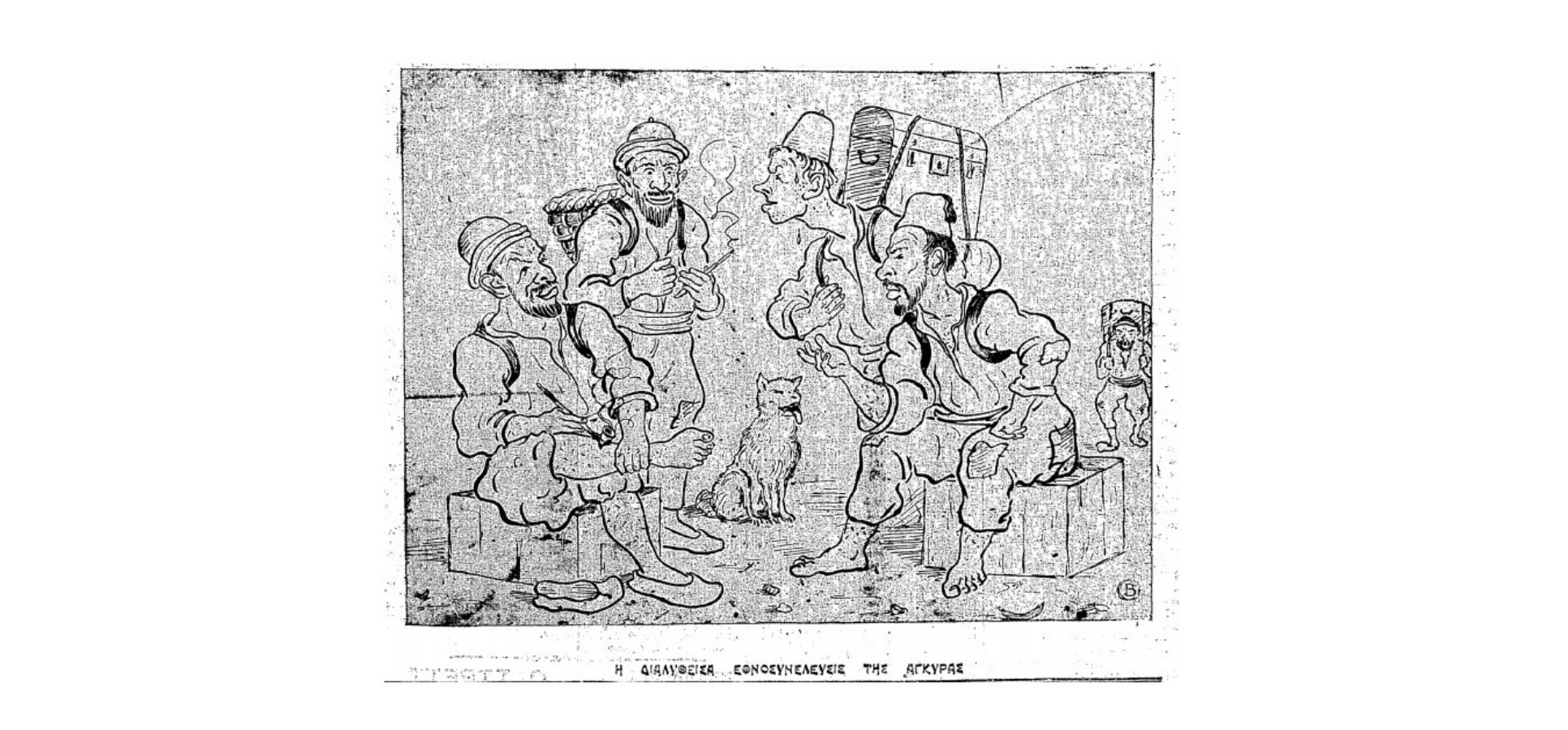
After the assembly in Ankara dissolved. (Skrip, January 27, 1921)
In line with these elements of othering, the first narrative that stands out in the cartoons is the incompetence and backwardness of the Turks. Turks are incompetent because they are Middle Easterners and do not understand anything other than menial occupations. Naturally, their armed forces are not modern, and therefore they have no chance against the Greeks. In these cartoons, while the Greeks are depicted as strong characters who know what they are doing, the Turks are depicted as weak, clumsy, and helpless.
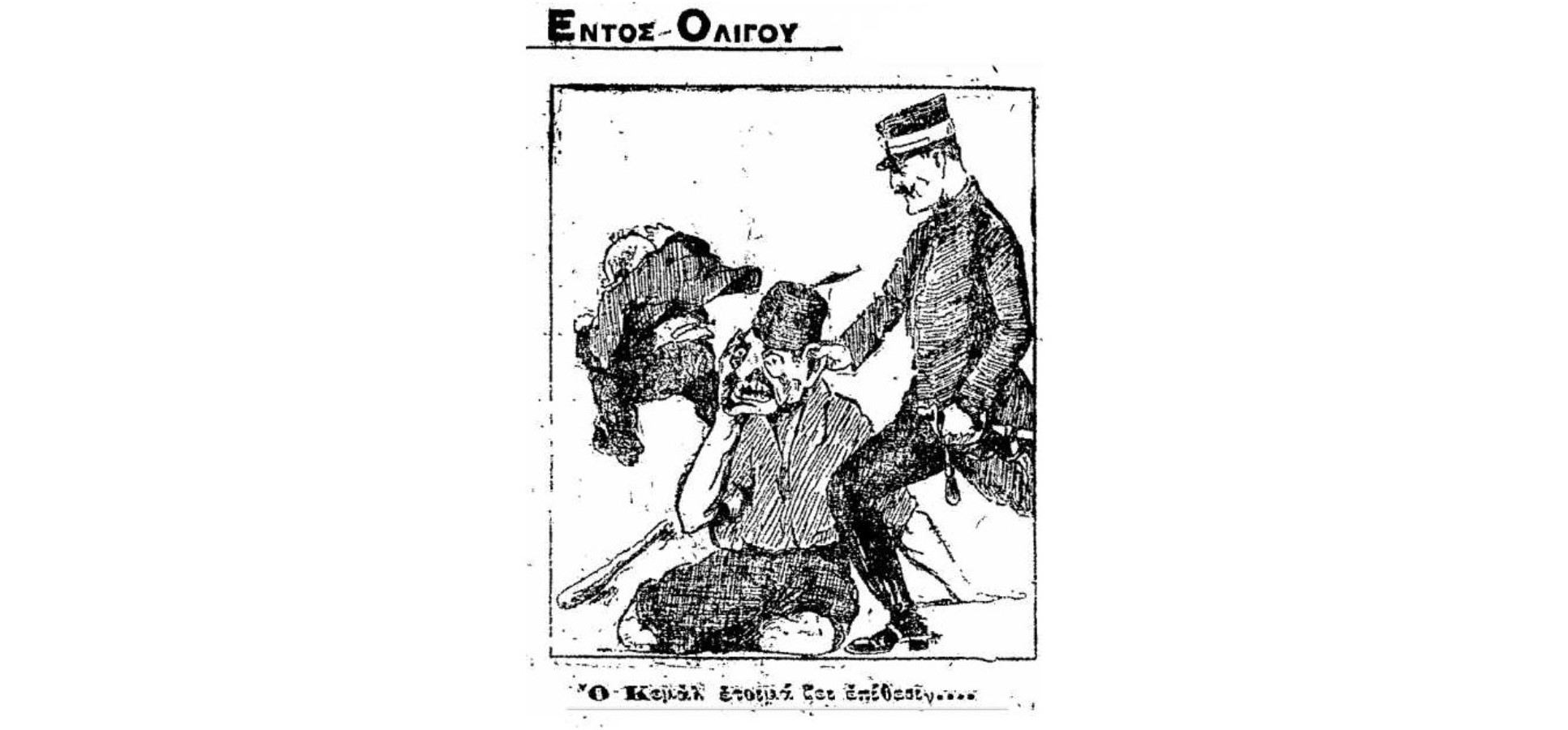
Kemal is preparing for an attack. (Skrip, December 30, 1920) The Greek officer is the Commander of the Asia Minor Front, Anastasios Papoulas. The person fleeing is Venizelos. Skrip is a royalist and anti-Venizelos newspaper.
Although this narrative is reasonable within the standards of propaganda, it is extremely far from being realistic. The Turkish army of the period was clearly more modern and capable than the Greek army. All Turkish officers were very well trained and had the experience of the First World War and the Balkan War. In the Greek army, training and experience were not common elements. Since there was no staff college (war academy) in Greece in those years, Greek officers received staff training in various countries of Europe, and naturally, the number of staff officers in the army was very low. Worse still, merit was also a rare element in the Greek army.
In 1921, the commander-in-chief of the Greek forces in Anatolia, Anastasios Papoulas, was a general who had risen from the rank of non-commissioned officer and had no military training. Papoulas was not the only example of an officer without formal training in the Greek army. Due to the mediocrity of the Greek command echelon, administrative problems were frequently experienced in large-scale operations, tactical and operational mistakes were made, and the Turks, despite all their shortcomings, often managed to bring the battles under control. The Greek army's successes on the battlefield stemmed from the fact that the Turkish army had been excessively worn out in the First World War and from the endurance of the Greek rank and file. With the recovery of the army after the Battle of Sakarya, the Greek army became a force unable to cope with the Turkish army.
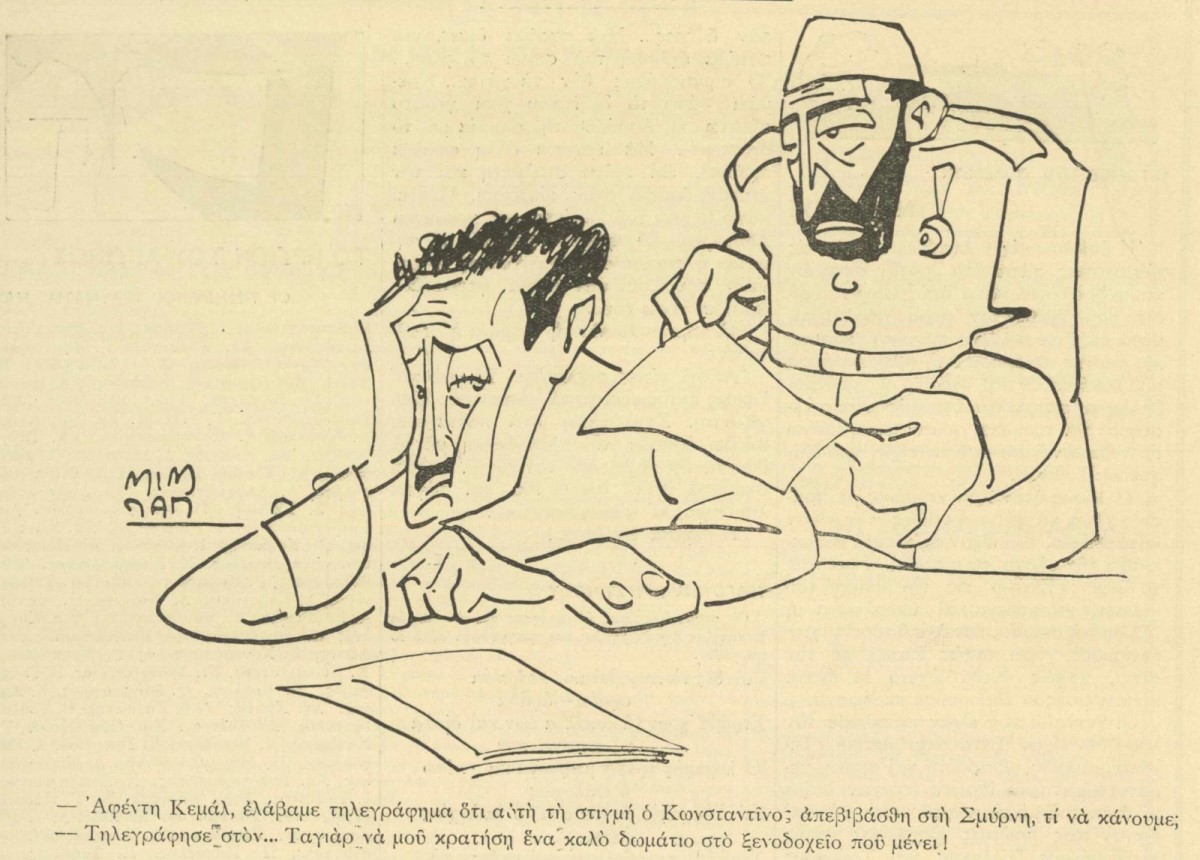
- Dear Kemal, [King of Greece] We received a telegram that Konstantinos has landed in İzmir. What shall we do?
- Send a telegram to Tayar, let him reserve a nice room for me at the hotel where the king is staying. (Niki, May 24, 1921)
The second narrative that stands out is directed at the barbarism of the Turks and their tendency toward dictatorship/sultanate. This narrative is also built on the influence of Prussian militarism and again on being Middle Eastern. In parallel with this narrative, emphasis is also placed on the fact that the Turks are occupiers in Anatolia and are destroying Greek civilization.
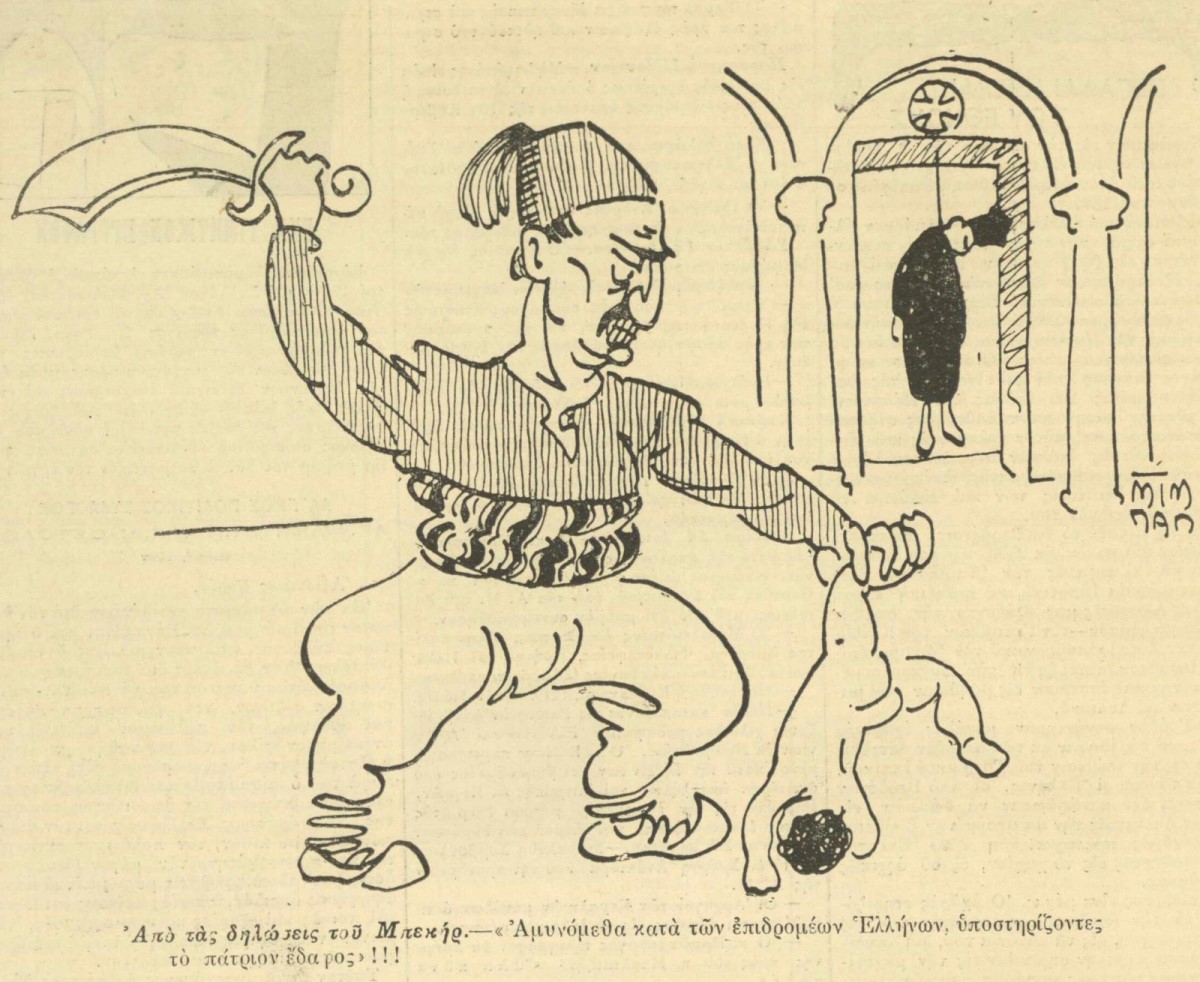
Bekir's excuses: We are protecting ourselves against Greek attacks, we are defending our homeland. (Niki, June 7, 1921)
The narrative of barbarism is also reasonable according to the propaganda standards of the period, but it is inappropriate for such a narrative to come from an occupying party. Acts of violence directed at civilians are encountered on both sides, and it is very unlikely that civilian massacres would not be encountered in an ethnic war experienced in the 20th century. However, the Greek side is clearly ahead of the Turkish side in terms of extremism, and the attacks by Greek soldiers on Turkish villages were condemned by many Greeks themselves.
The Grand National Assembly renders the dictatorship emphasis placed on Mustafa Kemal Atatürk in Greek cartoons meaningless. Although Atatürk was in the position of the director of the National Struggle, he derived his legitimacy and authority from the assembly.
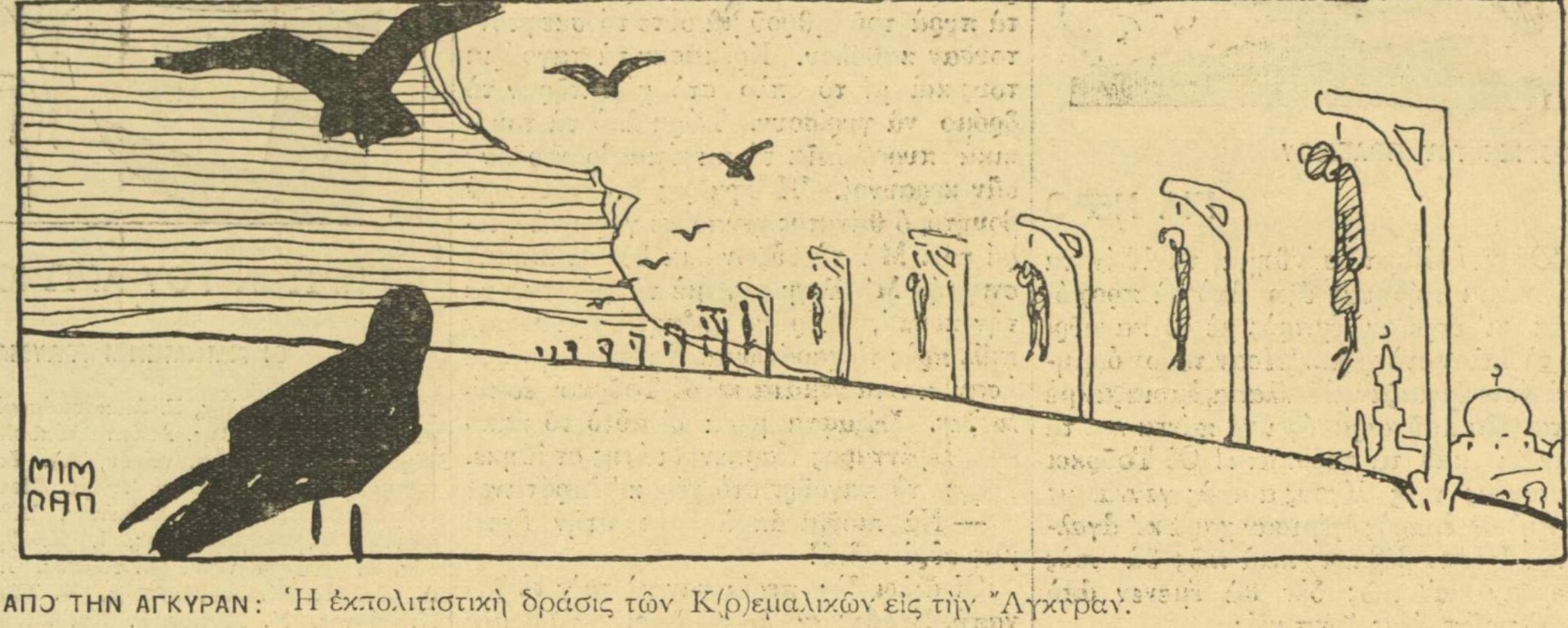
From Ankara: The Kemalists' contributions to civilization in Ankara. (Niki, April 23, 1921)
The claim that the Ankara movement bears the traces of Prussian militarism reveals how wrongly Greek cartoonists read Mustafa Kemal Atatürk and the National Struggle. In those years, Turks were inclined to reject almost all elements belonging to Germany due to the negative consequences of the alliance made with the Germans in the First World War. Identifying the National Struggle with Prussian militarism shows that Greek cartoonists resorted to every cliché they could get their hands on to define and marginalize the National Struggle. Naturally, the resulting product is also far from being realistic.
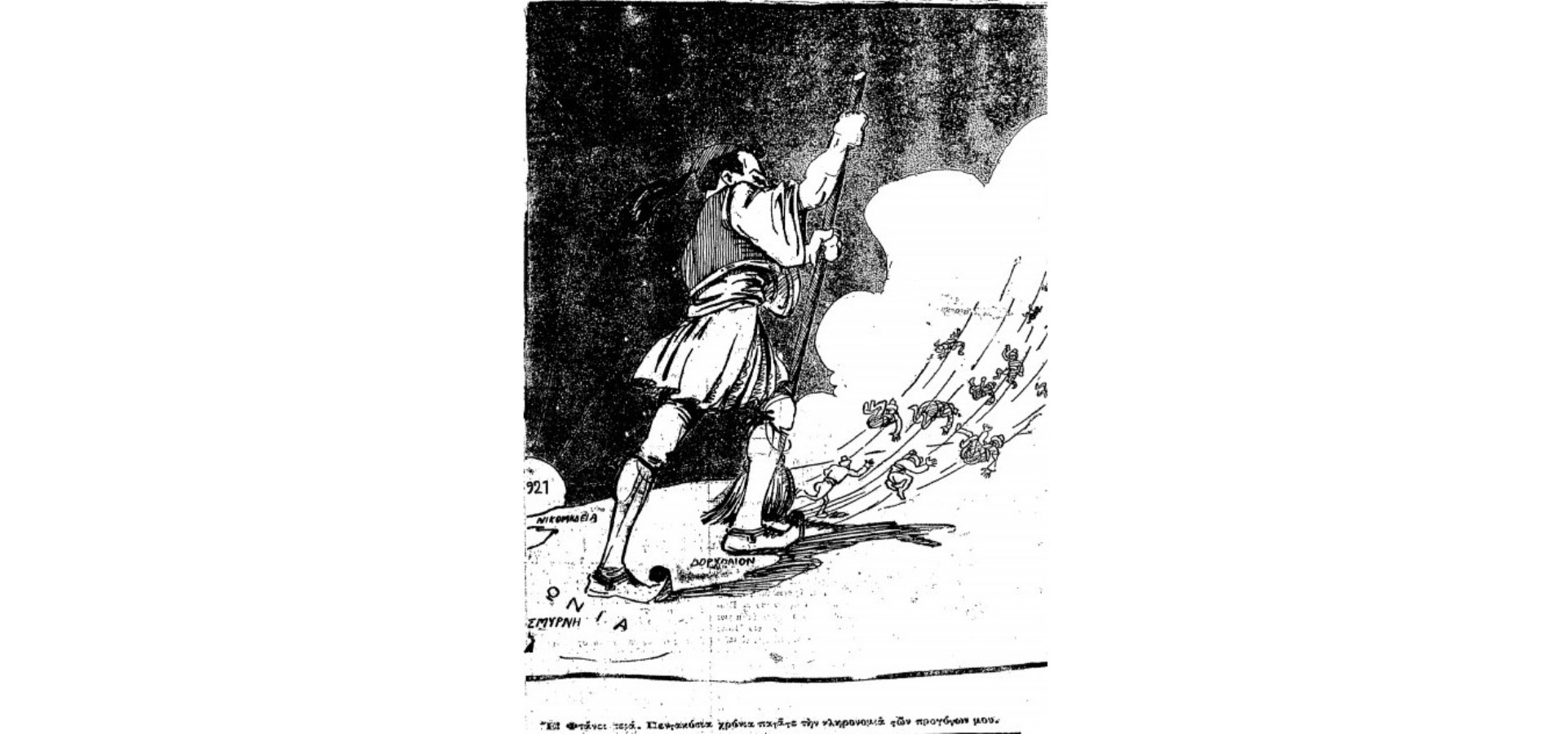
Enough! You have been squatting on my ancestors' civilization for 500 years. (Skrip, July 1, 1921)
Propaganda cartoons are inevitably somewhat shallow by their very nature. However, I must say that I find the Greek cartoons of the National Struggle period seriously bland, especially when compared to Turkish cartoons. Unlike Turkish cartoonists, who followed the agenda day by day and did not miss even the slightest mistake of the Greeks, Greek cartoonists built their narratives on prejudices that were quite shallow and far from reality. In addition to the content, Greek cartoons also lag behind Turkish cartoons in terms of drawing quality. It would not be a lie to say that the gap between Turkish and Greek cartoons surprised me quite a bit. Indeed, the Ottomans' introduction to cartoons took place thanks to the Greeks, and the first Turkish cartoon magazine, Diyojen, was published in 1870 by Theodoros Kasapis. However, it seems that the Turks have taken over the flag over time.
In my next article, I will cover Turkish cartoons during the years of the National Struggle.
Most Read

Striking picture for Özgür Özel's 'New Party'

The PKK opening and Özgür Özel’s path!..

How did the newspapers view Özgür Özel's farewell to the CHP?

He killed his wife by slitting her throat: Their children witnessed the moments

What did the CHP do?

Özel’s new party move in the world press

Fire at TUSAŞ engine factory in Eskişehir under control

The New CHP, against CEHAPE

From self-efficacy to despair

Kılıçdaroğlu's first message on Özgür Özel's new party announcement