



Turkish propaganda cartoons from the National Struggle period share similar characteristics with the Greek cartoons I covered in my previous article. Like the Greek cartoons, Turkish propaganda cartoons also sought to glorify the Turkish side and disparage the Greek side as much as possible.
During the years of the National Struggle, the majority of Turkish cartoonists resided in occupied Istanbul. This was a significant obstacle to their work. Indeed, their drawings were primarily inspected by Allied commissioners, and naturally, all cartoons against the Allied forces were censored.
The results of the November 1, 1920, elections in Greece would change these conditions. The defeat Venizelos suffered in the election and the rise to power of royalists—whom the Allied Powers, especially Great Britain, did not approve of—would result in Greece losing Allied support and becoming isolated. One of the advantages of this development for Turkey was the lifting of censorship on the press—specifically regarding Greece. By 1921, Turkish cartoonists, no longer silent, had become part of the total war initiated by Atatürk. The magazines Karagöz and Güleryüz would become the most prominent humor-based propaganda publications with their ruthless cartoons.
Founded by Ali Fuad Bey in 1908, Karagöz was already the most popular humor magazine of the Ottoman Empire and had served as a propaganda publication during the First World War years. Following Ali Fuad Bey's passing in 1919, Burhan Cavid (Morkaya) took over the magazine. Güleryüz, on the other hand, was founded in May 1921 by Sedat Simavi (who was using his surname at the time) and Halikarnas Balıkçısı Cevat Şakir (Kabaağaçlı). The magazine's sole purpose was to satirize the Greeks and glorify the Ankara movement.
The quality of Turkish propaganda cartoons during the National Struggle years is generally higher than that of the Greek cartoons. In my previous article, I stated that Greek cartoons were built upon shallow prejudices. Similar shallow prejudices are also encountered in Turkish cartoons. However, Turkish cartoonists also incorporated current developments and existing conditions into their drawings. These elements, which were often missing in Greek cartoons, added visual richness to the drawings.
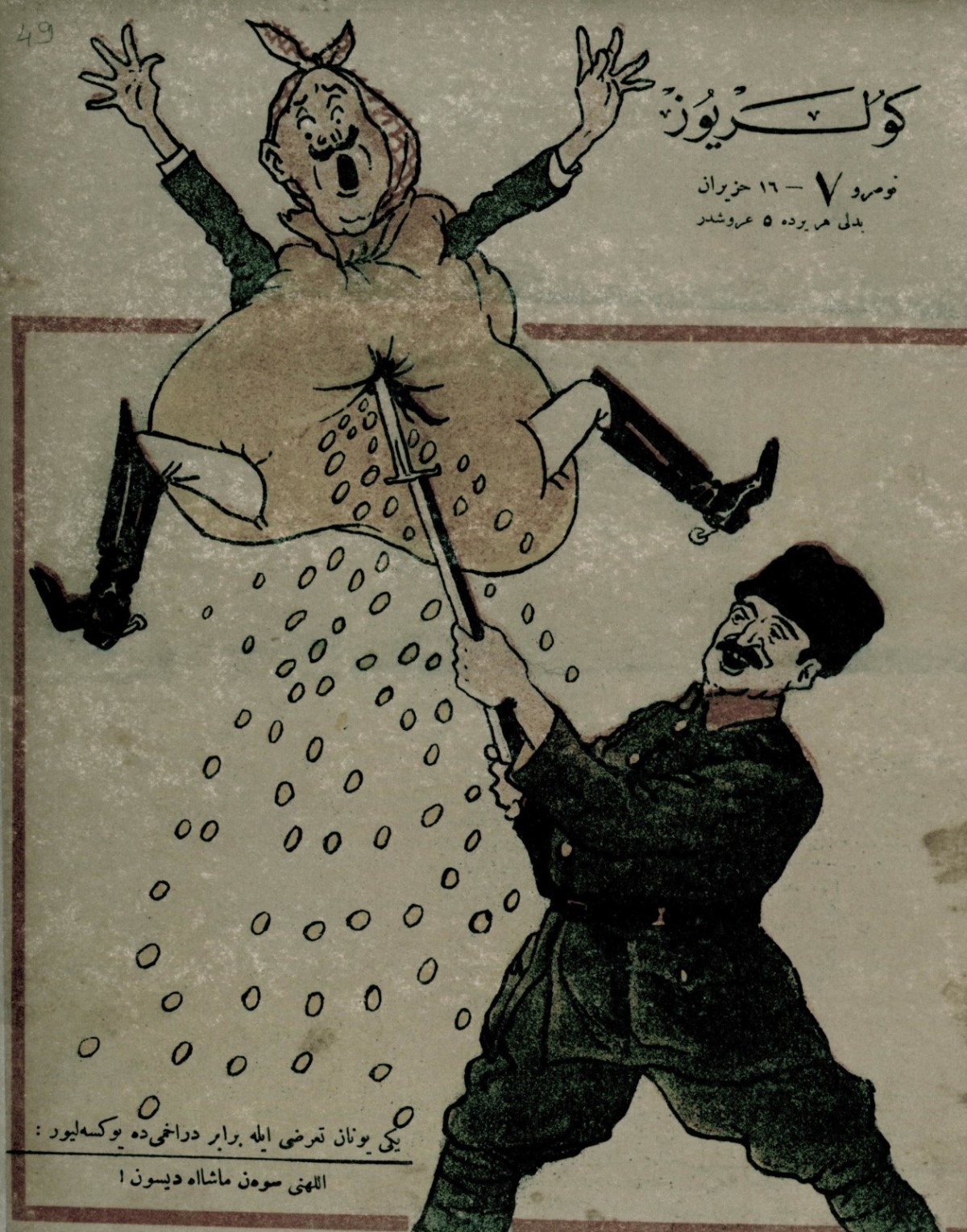
With the new Greek offensive, the Drachma is also rising: Whoever loves their God, say Mashallah! (Güleryüz, June 16, 1921)
For instance, the inflation in Greece resulting from the war did not escape the eyes of Güleryüz. Although Sedat Simavi approached the event from a humorous dimension, his drawing is a pinpoint observation that reveals one of the heavy costs of the war. Despite the fact that the Turks were trying to fight under more difficult economic conditions, I have not encountered a Greek cartoon that mocks the financial conditions of the Turkish side.
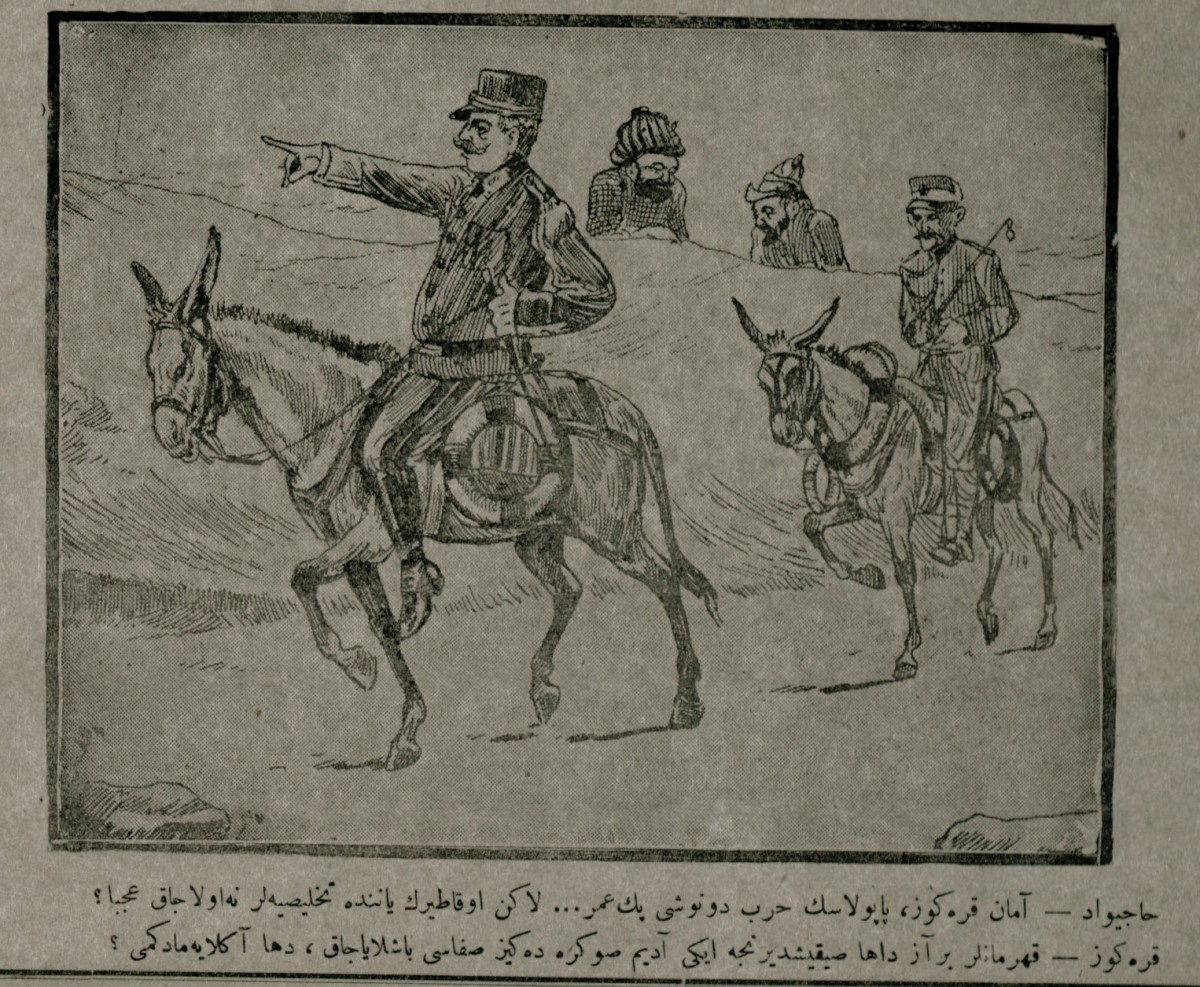
Hacivad: Oh Karagöz, Papoulas' return from the war is quite commanding... But what will happen to those lifebuoys next to the mules?
Karagöz: When the heroes squeeze a little more, the sea pleasure will begin in two steps, haven't you understood yet? (Karagöz, April 13, 1921)
The Karagöz cartoonists (Karagöz cartoons are unsigned), who also made their drawings by considering geographical conditions, added lifebuoys to the equipment of Greek officers and soldiers starting from mid-1921. In those days when the course of the war was uncertain, it was, of course, not very possible for the cartoonists to accurately predict how the Turkish-Greek war would end. However, the existing conditions offered unique images to illustrators with high imaginations.
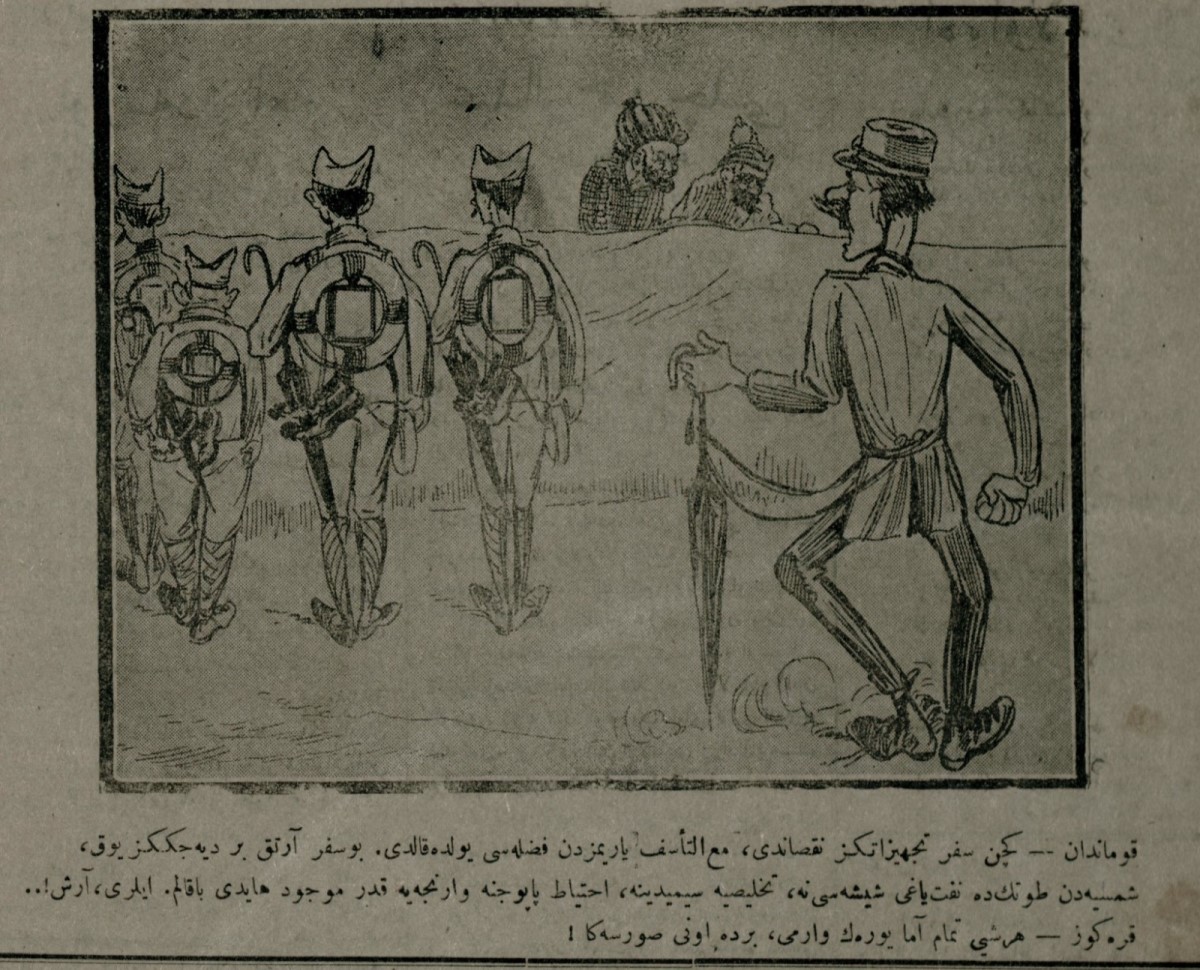
Commander: Last time your equipment was insufficient, unfortunately more than half of you were left on the road. This time you have nothing to say, everything is available from umbrellas to kerosene bottles, lifebuoys, and spare shoes, come on then. Forward, march!..
Karagöz: Everything is complete, but is there any heart, ask that too! (Karagöz, April 23, 1921)
Some cartoons were built upon proverbs. Especially the cartoonists of the Karagöz magazine loved using proverbs.
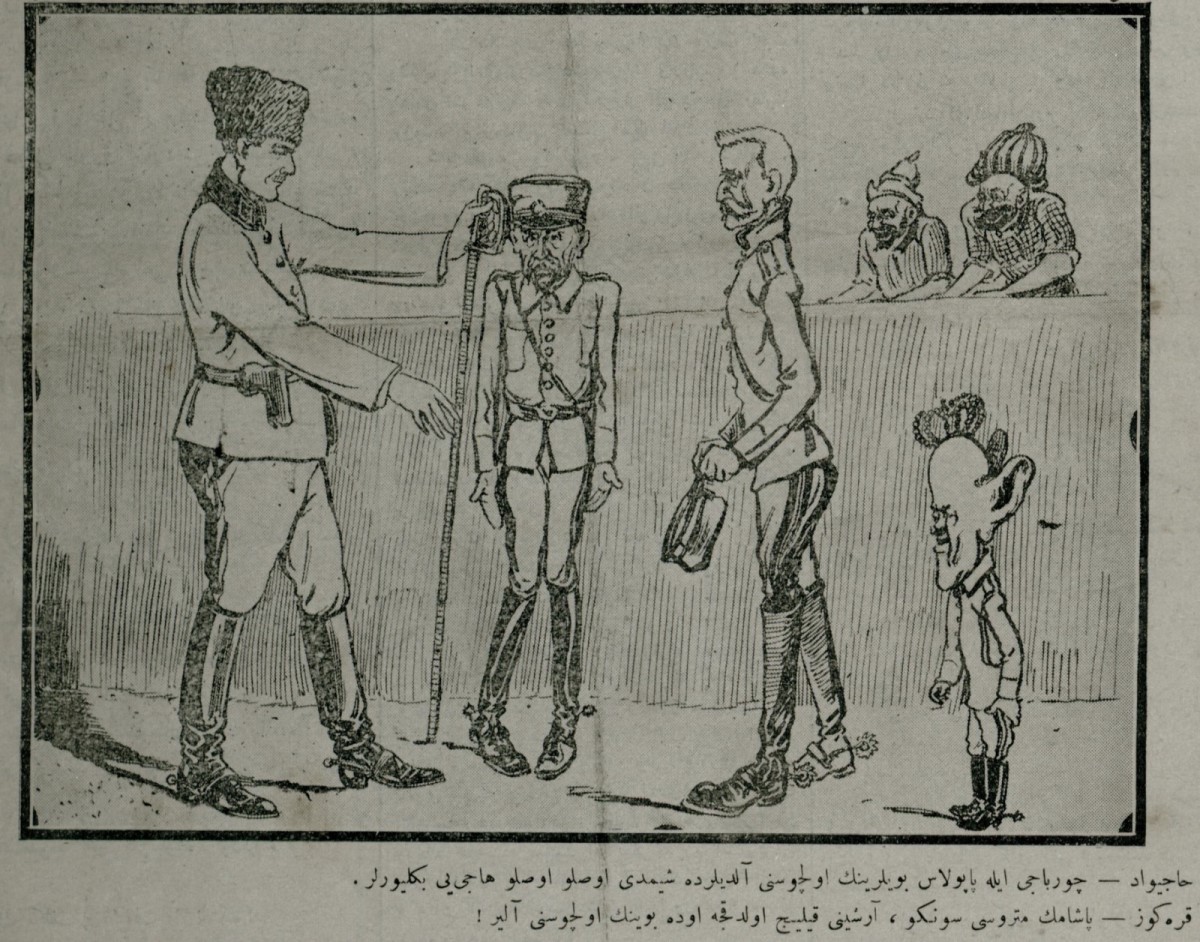
Hacivad: The Chorbadji [King Constantine] and Papoulas have taken the measure of their necks and are now waiting obediently for Hadji [Georgios Hatzianestis].
Karagöz: As long as my Pasha's meter is the bayonet and his yardstick is the sword, he too will get the measure of his neck! (Karagöz, June 28, 1922)
The drawings of both Karagöz and Güleryüz are of a nature that opposes the orientalist implications of Greek cartoons. In no cartoon was the National Struggle defined as an East-West war or a clash of civilizations. Although a sensitivity regarding the Western world's rude attitude towards the Ottoman Empire is noticeable in some cartoons, the Turkish society was depicted as a civilization belonging to or close to the Western world.
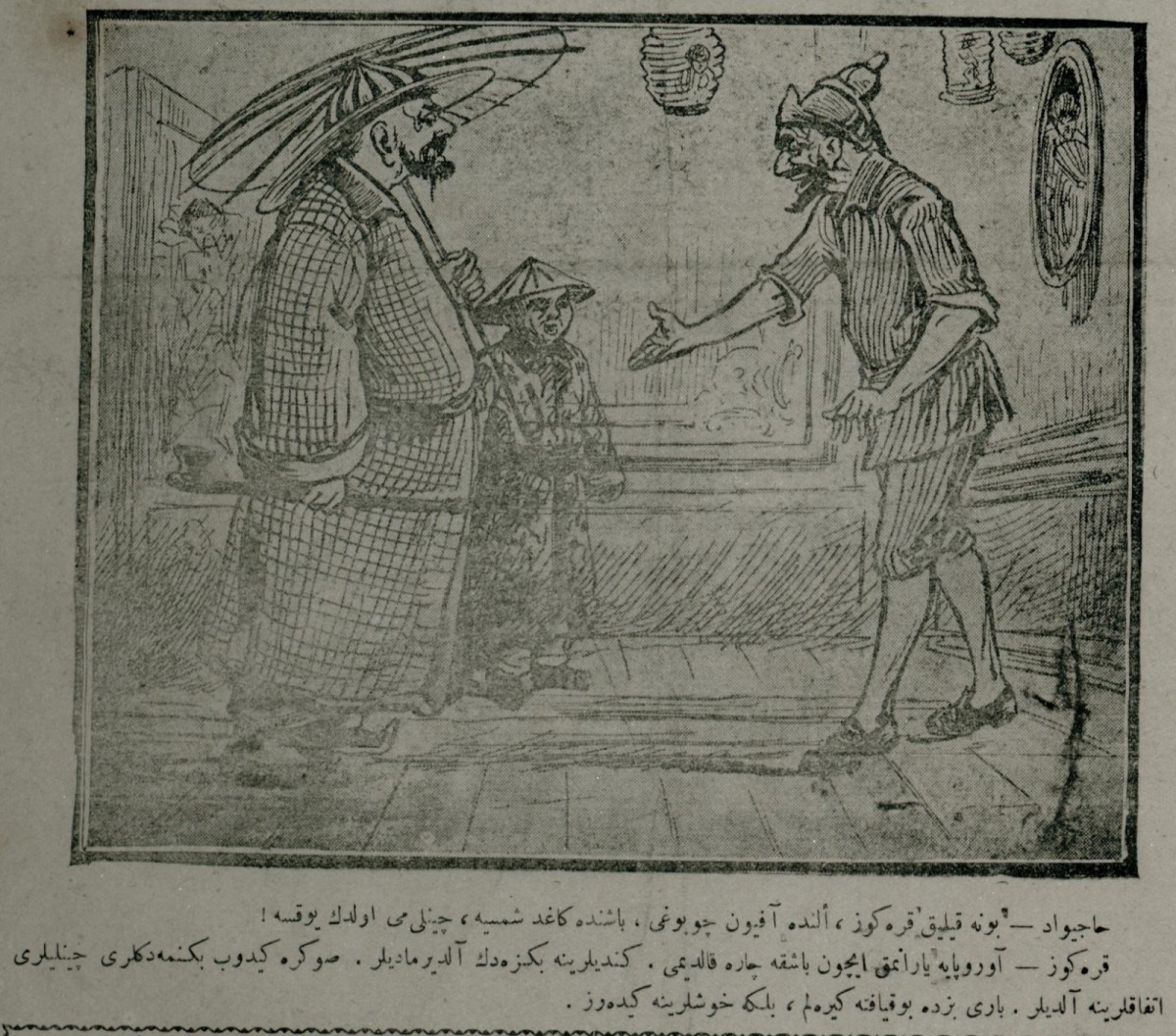
Hacivad: What is this state, Karagöz, with an opium pipe in your hand and a paper hat on your head, have we become Chinese!
Karagöz: There was no other way left to please Europe. We looked like them, they didn't care. Then they went and took the Chinese they didn't like into their alliance. At least let us put on this disguise, maybe they will like it. (Karagöz, December 14, 1921)
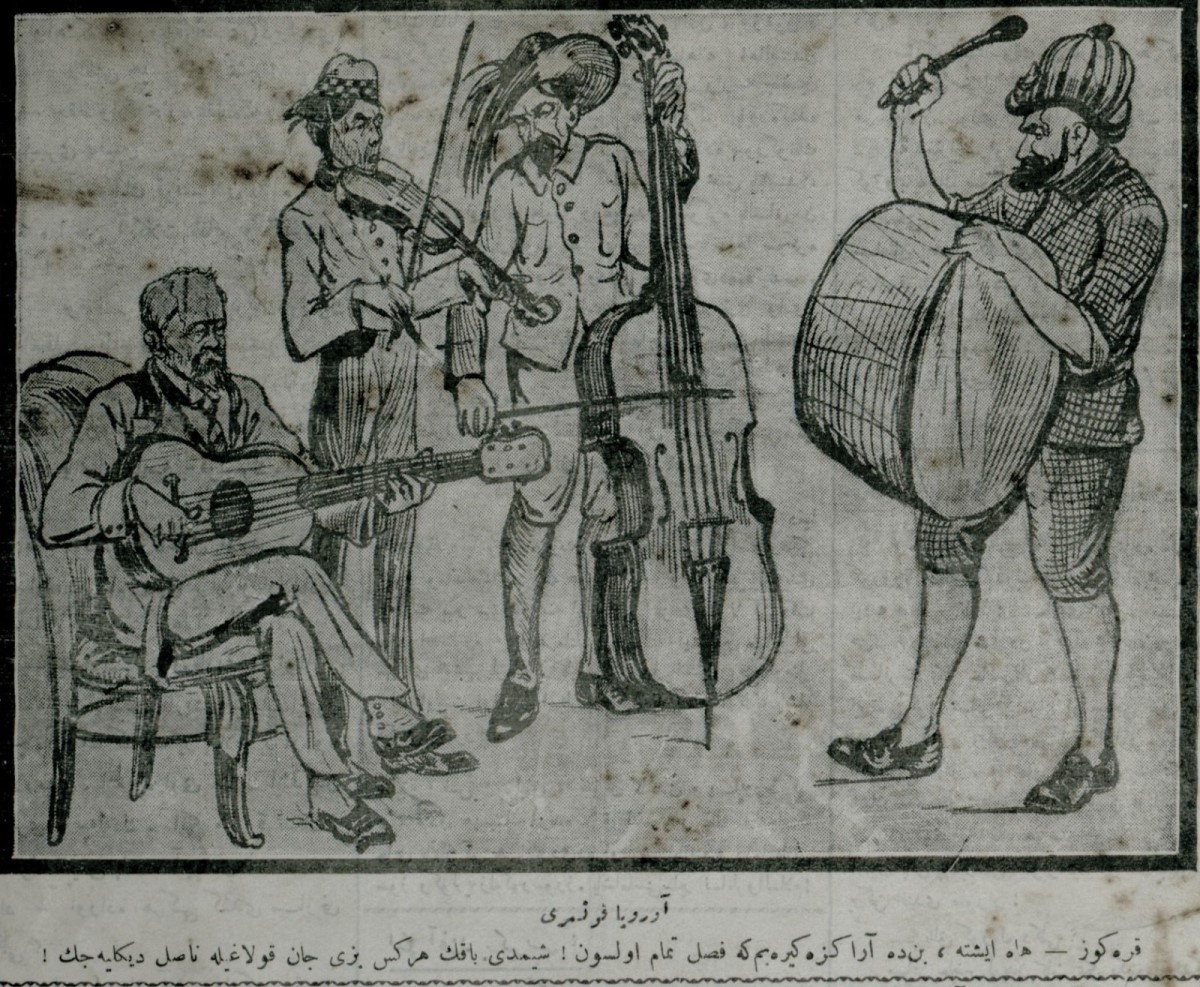 Concert of Europe
Karagöz: Ha, there, let me join you so the fasil is complete! Now look at how everyone will listen to us with all their ears! (Karagöz, November 25, 1922)
Although Turkish cartoons were more realistic and punchier than Greek cartoons, Turkish cartoons hit "below the belt" much more often than Greek ones. The effort of Turkish cartoonists to build their works on the vulnerabilities and the dire situations the Greeks fell into, rather than shallow prejudices, made the drawings more ruthless compared to Greek cartoons. Some examples are truly devoid of mercy.
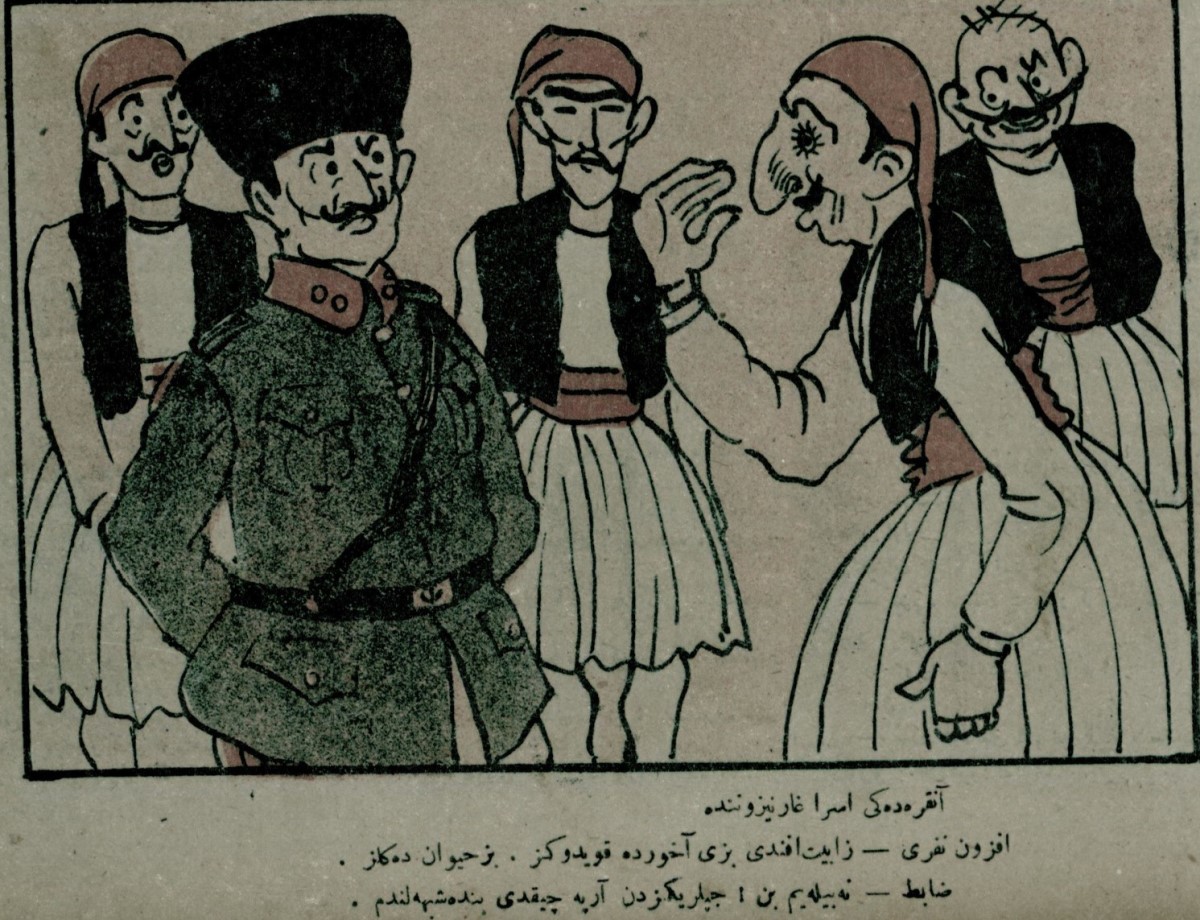
In the prisoner garrison in Ankara. Evzone soldier: Officer, you put us in the stable. We are not animals. Officer: How should I know! Barley came out of your pockets. I was suspicious too (Güleryüz, September 15, 1921)
For example, both Güleryüz and Karagöz magazines ruthlessly mocked the hunger problem that Greek soldiers faced during the Battle of Sakarya. The Greek logistics system collapsed in the middle of the battle due to the inadequacy of the area defense tactics implemented by the Turkish side. As a result of the Greek command's insistence on continuing the battle despite all the negatives, the army reached a point where it could not feed its soldiers after a while. The soldiers, out of desperation, began to boil and eat barley, which is essentially animal feed. The fact that barley was found on Greek soldiers captured towards the end of the battle was an unmissable propaganda material for the cartoonists. Güleryüz, in coordination with Karagöz, showed barley as a food that Greeks normally preferred, and in this context, defined the Greeks as animals. In a cartoon by Sedat Simavi, the Turkish officer dealing with the prisoners is confused and puts the Greek prisoners in the stable. In a cartoon in Karagöz magazine, Greek prisoners are restrained by being tied by their feet like cattle, and Atatürk orders them to be taken to a barley field to satisfy the prisoners' hunger.
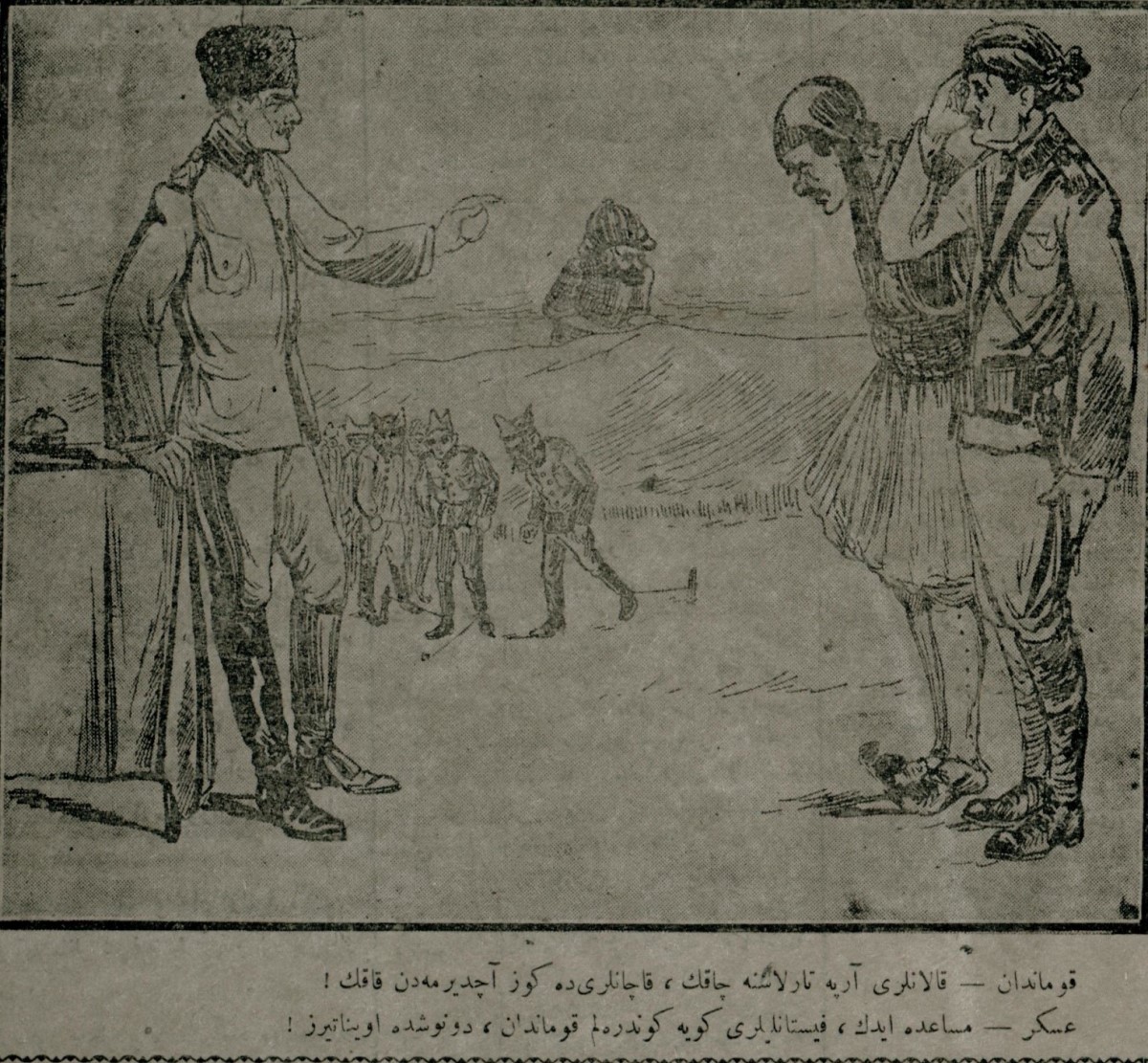
Commander: Take the rest to the barley field, and push those who run away without giving them a chance to blink!
Soldier: Allow me, commander, to send the skirted ones to the village, we will make them dance when they return! (Karagöz, September 17, 1921)
In times of war, propaganda is essentially exactly this. However, no matter what, I am against mocking people's suffering.
The heroes who will ruin the Turkish army! (Güleryüz, August 5, 1921)
In Turkish cartoons, the Greek soldier was most humiliated with the "skirt" element. The skirt (known by its Greek (or rather Italian) name fustanella, and in the Turkish of the period as fistan) is a part of the traditional attire of the Evzones, the elite Greek mountain units. Originally, the skirt was a male garment frequently seen in the Balkans until a certain date and also preferred by Muslims. However, by the 20th century, it had become an element considered traditional rather than popular, seen only in the guard or special units of the Greek and Albanian armies. The male figure wearing a skirt was probably not a symbol that was a subject of ridicule in Ottoman society until the mid-19th century. Indeed, many Albanian janissaries wore skirts. However, it seems that Ottoman modernization made the skirt a garment entirely specific to women. Turkish cartoonists did not forgive the Greeks for freezing time and using their traditional clothing as a uniform, and they depicted Greek soldiers as individuals who preferred women's clothing. All of the Greek soldiers in Güleryüz magazine and at least half of those in Karagöz wear skirts (in reality, this garment, which belongs only to the Evzones, is a ceremonial uniform, and the Evzones rarely entered combat in this attire). Although there are implications of femininity and dancing in these cartoons, there is no implication of homosexuality.
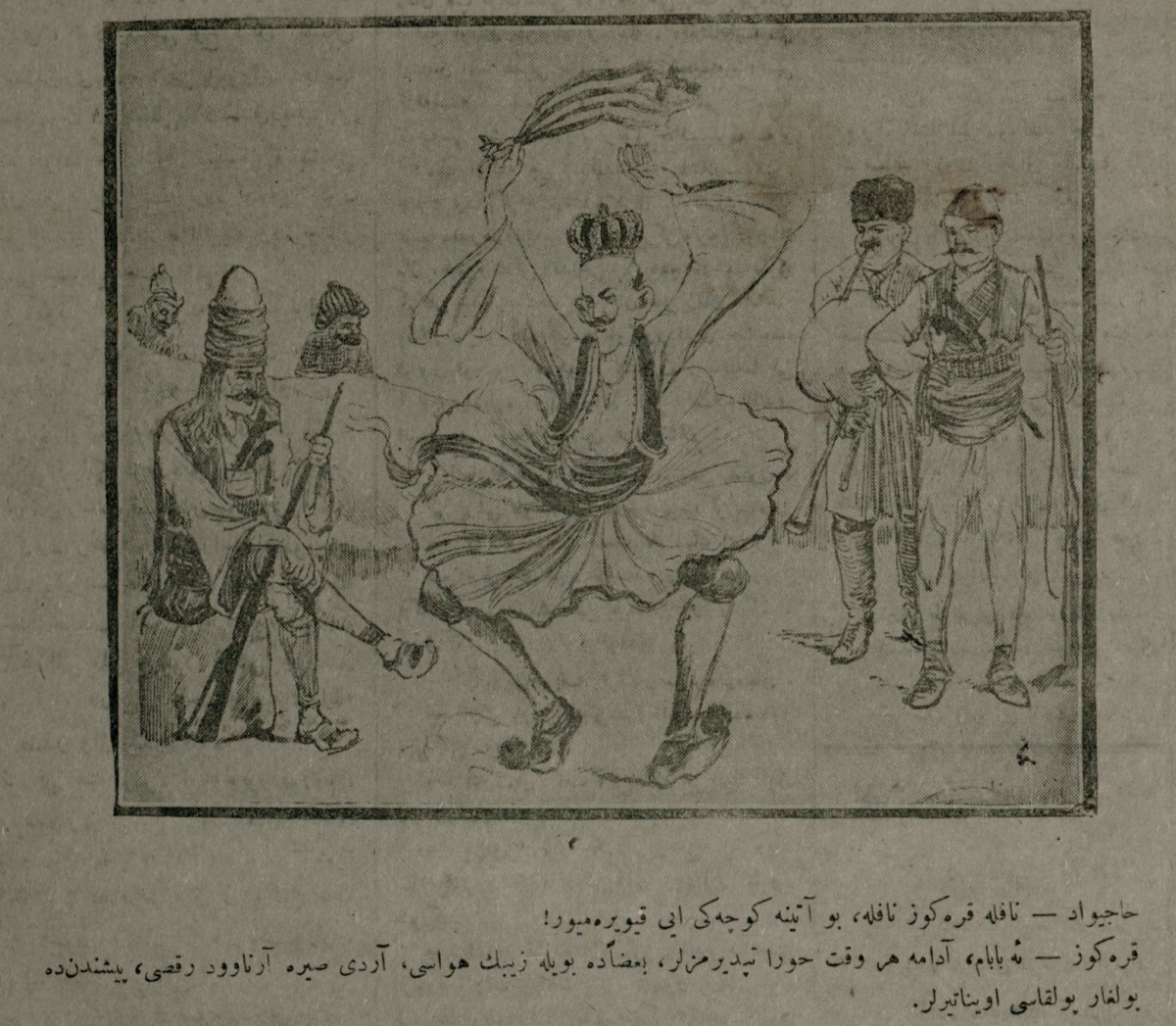
Hacivad: It's useless Karagöz, it's useless, this Athenian dancer cannot twist well!
Karagöz: What are you saying, father, they don't make a man dance the hora all the time, sometimes they make him dance this kind of zıbık air, then an Albanian dance, and after that a Bulgarian polka. (Karagöz, May 11, 1921)
Cartoons targeting the Greeks continued throughout 1922. With the arrival of 1923, the main subject of the cartoons became the Lausanne peace negotiations, and Greece fell off the cartoonists' agenda. After this date, cartoons disparaging Greece were rarely encountered.
Most Read

Striking picture for Özgür Özel's 'New Party'

The PKK opening and Özgür Özel’s path!..

How did the newspapers view Özgür Özel's farewell to the CHP?

He killed his wife by slitting her throat: Their children witnessed the moments

What did the CHP do?

Özel’s new party move in the world press

The New CHP, against CEHAPE

Fire at TUSAŞ engine factory in Eskişehir under control

From self-efficacy to despair

Kılıçdaroğlu's first message on Özgür Özel's new party announcement