



Individual borrowing in Turkey is no longer a preference or an indicator of prosperity; it has become a mandatory part of households' struggle to survive in the face of rising living costs. The November 2025 Monthly Bulletin of the Banks Association of Turkey Risk Center clearly reveals that debt has detached from long-term goals such as housing and investment, shifting instead toward financing daily life through credit cards, overdraft accounts, and personal loans.
In this period where wages are rapidly eroding against inflation, debt has ceased to be a tool for expanding consumption and has become the primary pillar for sustaining a livelihood. While the data shows that the increase in individual loans is not merely technical growth but rather that households are being pushed into debt under the pressure of income loss and deepening livelihood struggles, the stagnation in housing and auto loans reveals that the capacity for long-term investment has seriously weakened.
DEBT IS EVERYWHERE: Individual Credit is Becoming Socialized
Risk Center data shows that individual borrowing is no longer the preference of a limited segment; it has transformed into a normal part of daily life for broad sections of society. The individual loan balance, which was 3 trillion 805 billion TL in November 2024, has risen to 5 trillion 671 billion TL as of November 2025. This increase, reaching 49% on an annual basis, reveals that the expansion in borrowing has gained not only a quantitative but also a social character.
The rise in the number of people using individual loans from 41.7 million to 43.6 million in one year shows that debt has ceased to be an exceptional financing tool and has become almost the norm. Although the growth rate appears relatively limited, the level reached indicates that borrowing has turned into an unavoidable reality for households.
The average debt amount per person rose from 91,246 TL to 130,016 TL in the same period. While this increase of approximately 42.5% shows that the debt burden is deepening, the fact that the amount exceeds 4.5 times the current minimum wage reveals how much the gap between household incomes and debts has widened. The limited increase in average debt suggests that households are trying to survive not through high-amount loans, but through small yet continuous debts. Debt is both becoming widespread and permanent.
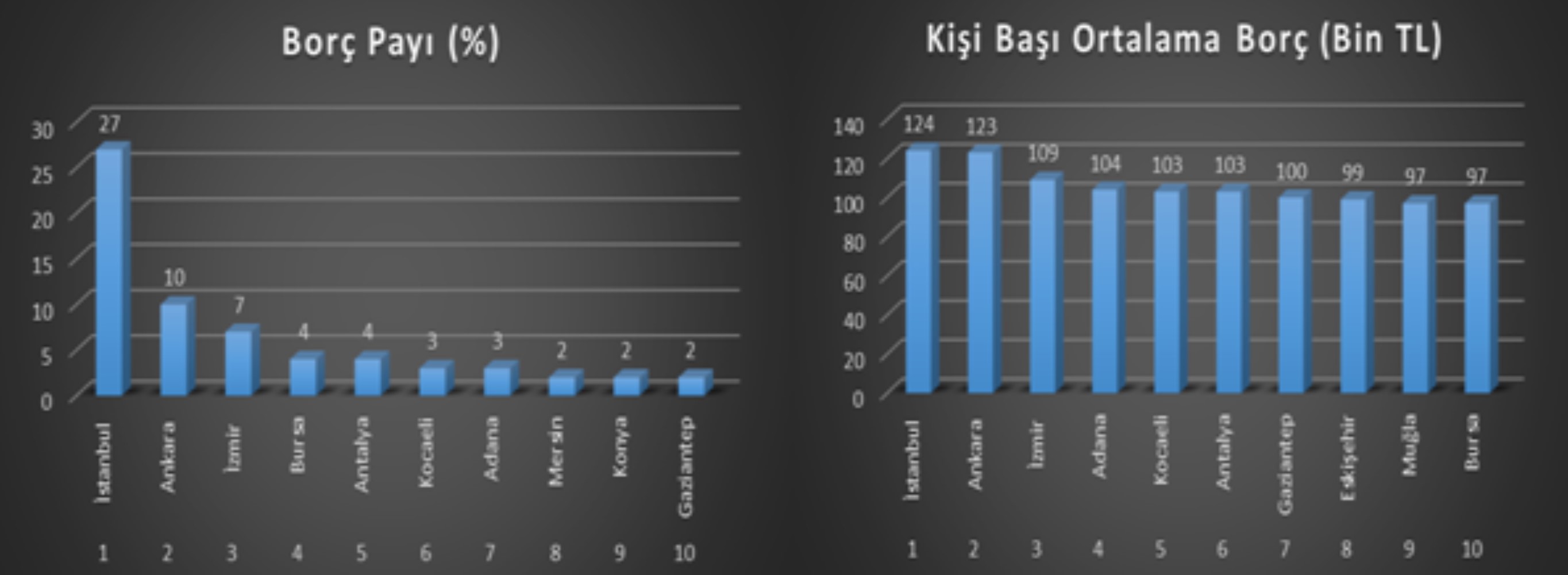
In the provincial distribution, Istanbul ranks first by a wide margin, followed by Ankara and Izmir. The fact that provinces with high concentrations of industry, tourism, and service sectors—such as Bursa, Antalya, Kocaeli, Adana, Mersin, Konya, and Gaziantep—are at the top shows that the pressure of borrowing has become more visible in regions where wage labor is concentrated. Although the total balance remains relatively low in Eastern and Southeastern Anatolian provinces, the fact that the increase in the number of people using credit is approaching the Turkey average reveals that borrowing is spreading to the base geographically as well. We are facing a picture where, regardless of income level, borrowing has become almost mandatory.
INDIVIDUAL CREDIT CARDS: Debt Transformed into a Livelihood Tool
Credit cards constitute the fastest-growing and most fragile area within individual borrowing. The Banks Association of Turkey Risk Center data shows that credit cards have ceased to be a tool that facilitates installment consumption and have become a direct livelihood tool for households. Individual credit card debt, which was 1 trillion 805 billion TL in November 2024, has risen to 2 trillion 828 billion TL as of November 2025. The 56.6% annual increase indicates that growth in this category has occurred well above inflation.
The number of people using credit cards rose from 38.5 million to 40.7 million in the same period. Although the growth rate appears limited, the level reached reveals that credit cards have turned into a form of borrowing that covers almost the entire society. What is truly striking is the jump in the average debt amount per person. The average credit card debt rose from 46,835 TL to 69,555 TL in one year. This increase suggests that credit cards are primarily used for mandatory and daily expenses.
The rise in limit utilization rates is one of the clearest indicators that households cannot balance their expenses with their current income. Credit cards no longer represent a forward-looking consumption preference, but a form of borrowing aimed at saving the day. For households trapped in the minimum payment cycle, debt is increasingly becoming an accumulating burden rather than something that can be rolled over.
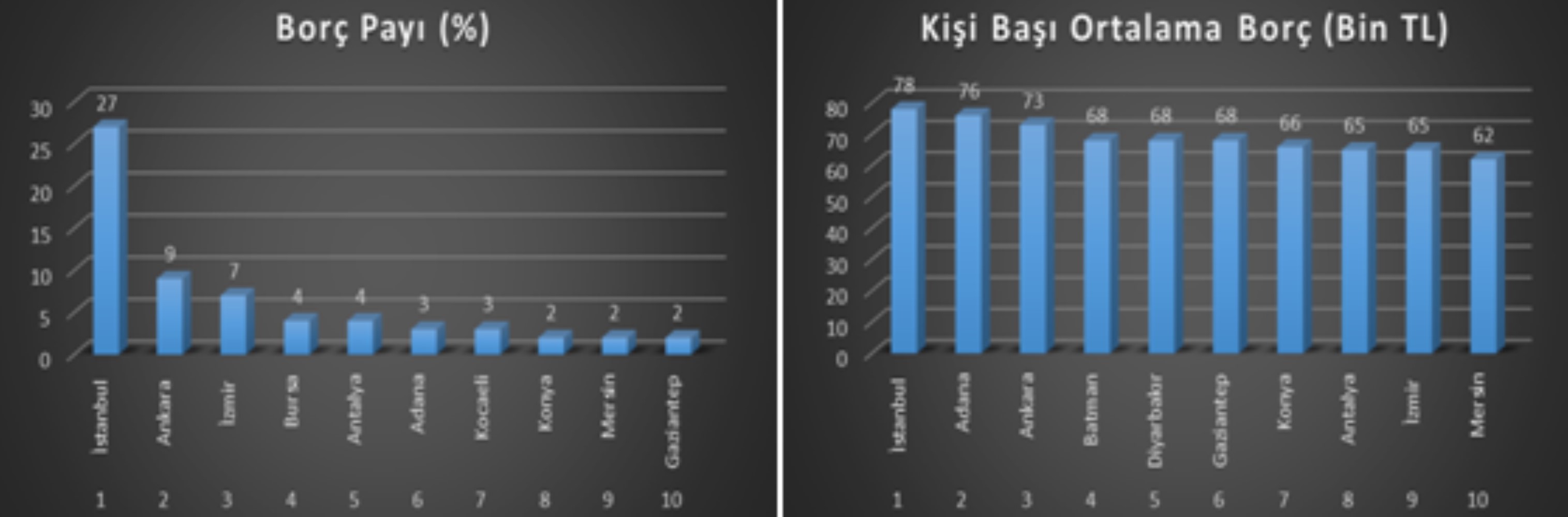
In the provincial distribution, Istanbul ranks first, followed by Ankara, Izmir, and Bursa. The rapid increase in credit card usage in provinces where irregular income structures are more common, such as Antalya, Adana, Kocaeli, Konya, Mersin, and Gaziantep, clearly reveals that this type of debt has ceased to be a preference and has turned into a mandatory livelihood tool.
OVERDRAFT ACCOUNTS (KMH): The KMH Trap; Silent Debt, Heavy Burden
Overdraft accounts (KMH) constitute one of the least visible but highest-cost areas of individual borrowing. Risk Center data reveals that this type of debt has ceased to be a temporary cash convenience and has turned into a chronic financing tool for households. The KMH balance, which was 415 billion TL in November 2024, rose by 76.8% to 734 billion TL as of November 2025. This rapid expansion clearly shows how much borrowing is shifting toward expensive channels.
The number of people using KMH rose from 30.2 million to 31.8 million in the same period. Although the growth rate is relatively limited, the level reached reveals that this type of debt has become a common financing method, not an exceptional one. What is truly striking is the increase in the average debt amount per person. The average KMH balance rose from 13,744 TL to 23,076 TL in one year. This 67.8% increase indicates that KMH usage has turned into a permanent and continuous form of borrowing, not a temporary one.
The high-interest structure of KMH makes this type of debt one of the most costly options for households. The fact that even employees with regular incomes are turning to this expensive debt channel just to make ends meet reveals the extent of the livelihood pressure. KMH stands out as a debt burden that often accumulates unnoticed and silently erodes the household budget.
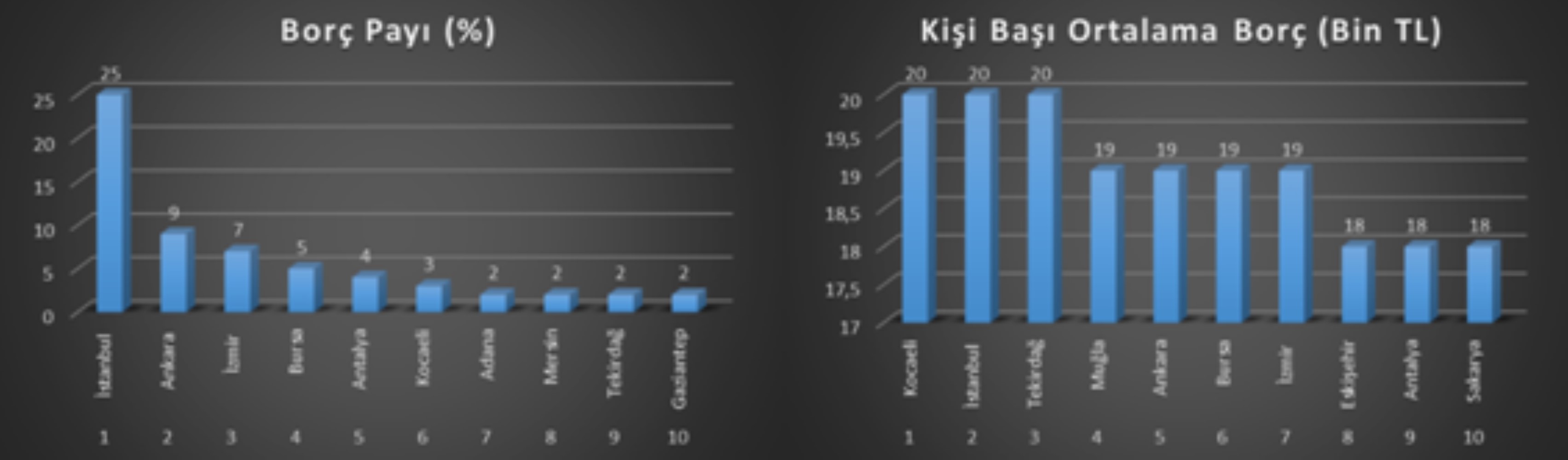
In the provincial ranking, Istanbul ranks first, followed by Ankara, Izmir, and Bursa. The spread of KMH usage in provinces where industry and service sectors are concentrated, such as Antalya, Kocaeli, Adana, Mersin, Tekirdağ, and Gaziantep, shows that wage labor is being attempted to be balanced with debt.
PERSONAL LOANS: Not a Need but a Necessity, Survival Loans
Personal loans stand out as one of the areas where individual borrowing has most clearly become "livelihood" focused. Risk Center data reveals that while the volume in this loan type is increasing, access is narrowing; borrowing is being carried out by fewer people but in higher amounts. The personal loan balance, which was 994 billion TL in November 2024, reached 1 trillion 376 billion TL as of November 2025, an increase of 38.4%.
Conversely, the number of people using personal loans fell from 11.9 million to 10.1 million in the same period. This decline, exceeding 15%, shows that access to credit has become more difficult and financing opportunities have narrowed. However, for those who can access it, the picture is more severe. The average personal loan amount per person rose from 83,743 TL to 135,869 TL in one year. This 62.2% increase suggests that personal loans are no longer used for secondary expenses but to cover basic living expenses.
This picture shows that households are becoming unable to make a living with their incomes and that borrowing is turning into an increasingly deeper necessity. Personal loans have ceased to be a temporary support as their name suggests; they have become a mandatory financing tool for sustaining life.
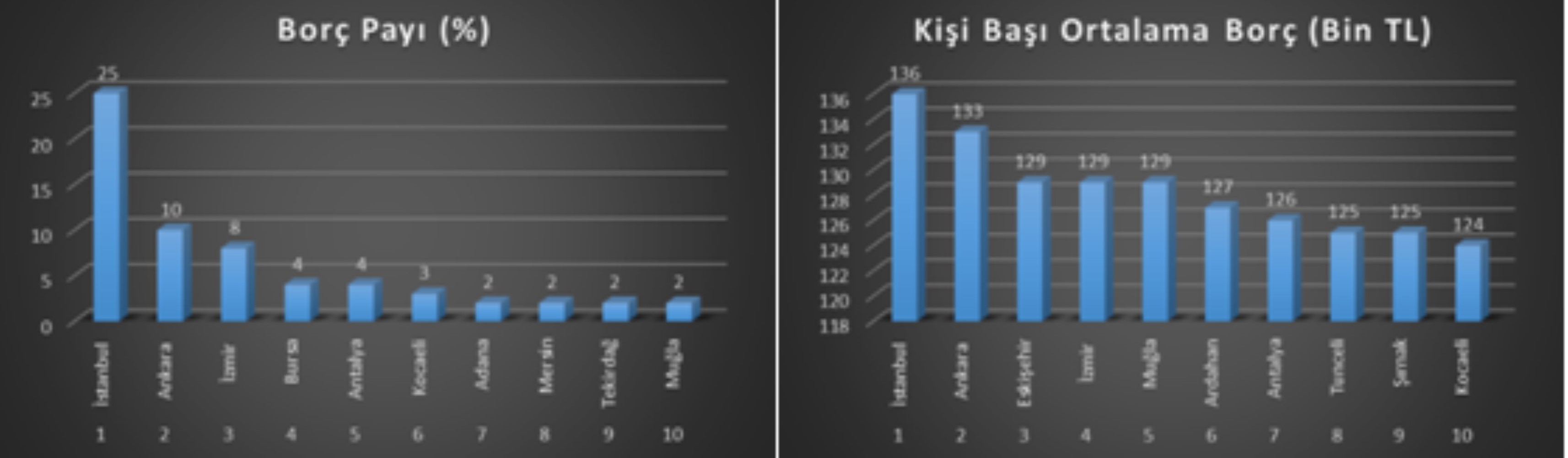
In the provincial distribution, Istanbul, Ankara, and Izmir rank first in total volume. The prominence of provinces with high populations of wage earners, such as Bursa, Antalya, Kocaeli, Adana, Mersin, Tekirdağ, and Muğla, indicates that the loss of real income is felt more severely in these regions. In this respect, personal loans stand out as one of the most concrete indicators of income erosion.
HOUSING LOANS: Inaccessible Shelter
Housing loans have become one of the most stagnant and limited areas within the individual borrowing picture. Risk Center data reveals that despite nominal increases, housing loans are effectively inaccessible for households. The housing loan balance, which was 502 billion TL in November 2024, rose by 32.6% to 666 billion TL as of November 2025. However, considering high inflation, this increase points not to a real expansion, but to a clear stagnation.
The number of people using housing loans fell from 1.8 million to 1.7 million in the same period. This 5.5% decline shows that broad segments of the public have lost the opportunity to access housing finance. In contrast, the average housing loan amount per person rose from 272,509 TL to 402,342 TL in one year. While the increasing loan amounts reflect the rise in housing prices, they also reveal that these amounts are becoming far from affordable with household incomes.
The data shows that the housing problem has reached a point where it can no longer be solved by credit mechanisms. High interest rates, increasing down payment requirements, and income insufficiency are turning shelter from a right into an inaccessible goal for broad segments. In this picture, housing loans have turned not into a solution, but into an indicator showing the limits of the crisis.
In the provincial distribution, Istanbul, Ankara, and Izmir rank first, while Bursa, Antalya, Kocaeli, Tekirdağ, Manisa, Adana, and Mersin are among the prominent provinces. These provinces stand out as regions where access to finance has become most difficult despite high housing demand.
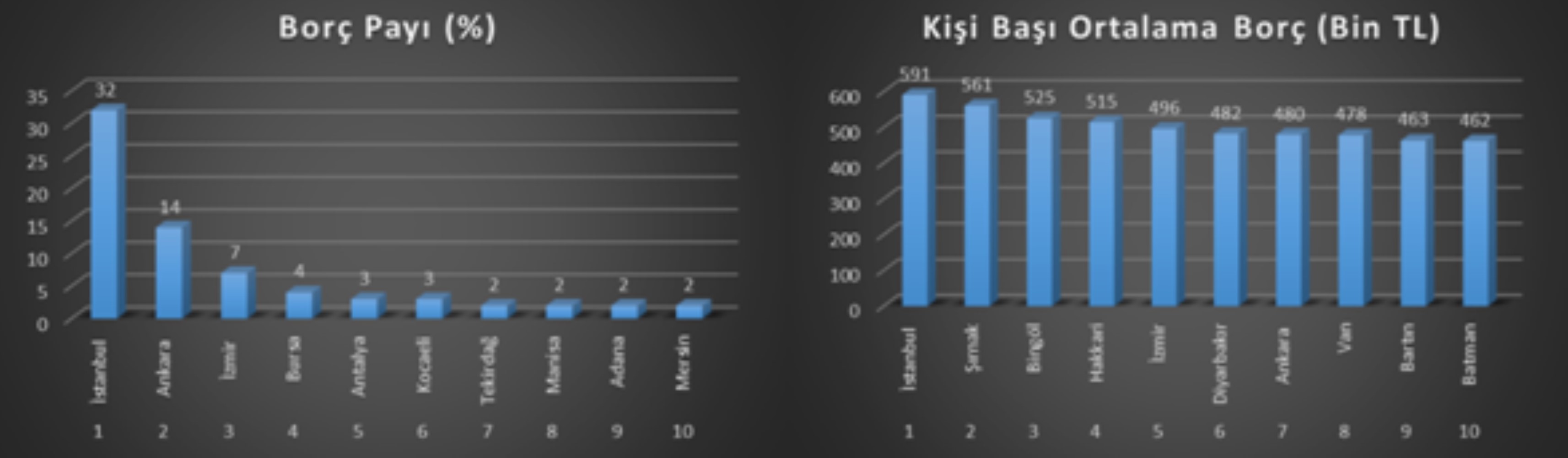
AUTO LOANS: The Car Has Become a Dream-Vehicle Demand is Postponed
Auto loans are one of the areas that most clearly reveal the sharp change in households' spending priorities. Risk Center data shows that for many households, a car is no longer an accessible necessity and demand is largely being postponed. The auto loan balance, which was 89 billion TL in November 2024, decreased by 25.8% to 66 billion TL as of November 2025.
The number of people using auto loans fell from 574 thousand to 393 thousand in the same period. This decline, exceeding 31.5%, clearly reveals that households are postponing car purchases in the face of high interest rates and rising living costs. As access to credit narrows, the idea of owning a car is becoming an increasingly distant goal.
The average auto loan amount per person rose from 154,771 TL to 167,110 TL. This limited increase suggests that in an environment where demand has narrowed, only the higher income group or a limited segment that can renew their existing vehicle can access credit.
In the provincial distribution, Istanbul, Ankara, and Izmir rank first, while Bursa, Antalya, Kocaeli, Adana, Mersin, Aydın, and Gaziantep are among the prominent provinces. However, even in these provinces, the decline in auto loans clearly reveals that the car has become a secondary or even postponed need in terms of the household budget.
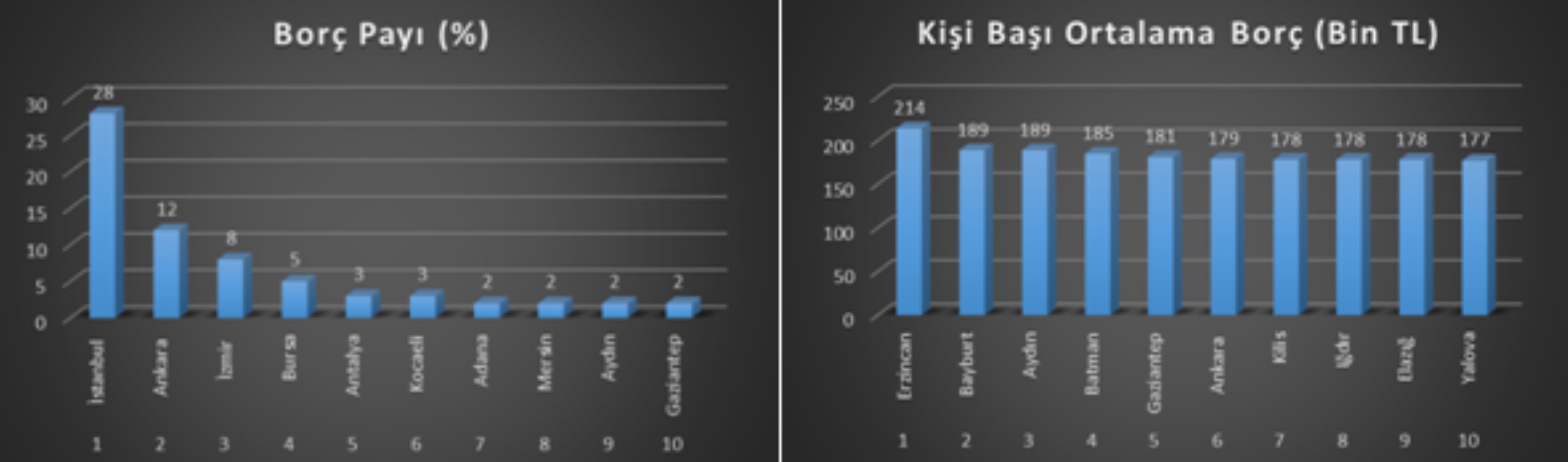
CONCLUSION: An Economy Growing with Debt Becomes Fragile- Debt is Increasing, Prosperity is Not
In Turkey, individual borrowing is increasing but prosperity is not expanding; debt is becoming a tool for saving the day, not for investing in the future. Daily life, turned over with credit cards and overdraft accounts, clearly reveals that incomes are not enough to cover living costs. While the Banks Association of Turkey Risk Center's November 2025 data shows that the total individual loan balance is approaching the 5.7 trillion TL threshold, it reveals that this growth is fed not by long-term asset acquisitions such as housing and vehicles, but by short-term and high-cost borrowing instruments.
Households are not getting rich by borrowing; they are trying to survive by borrowing. The increase approaching 60% in credit card balances, the spread in KMH usage, and personal loans exceeding 1.3 trillion TL reveal the extent of the livelihood pressure. In contrast, the limited 32.6% increase in housing loans shows that the housing problem cannot be solved with the credit mechanism under high interest and inflation conditions.
The resulting picture points not only to a financial imbalance but to a structural problem. The erosion of wages against inflation, the deterioration in income distribution, and insufficient social support are turning individual loans into temporary tools that replace social policy. Debt functions more as a buffer covering up the livelihood crisis than as a carrier of economic growth.
An economy turned over with debt is not sustainable. As long as the current trend continues, financial fragility will deepen; collection problems and social tensions will become more visible. In this respect, the Risk Center data is not just a set of statistics, but a strong warning: Debt is growing in Turkey, but this growth does not produce prosperity; it makes fragility permanent.
Most Read

Striking picture for Özgür Özel's 'New Party'

Özgür Özel gives a dated response regarding the number of resignations

Forest fire in Antalya brought under control

The PKK opening and Özgür Özel’s path!..

How did the newspapers view Özgür Özel's farewell to the CHP?

He killed his wife by slitting her throat: Their children witnessed the moments

What did the CHP do?

Özel’s new party move in the world press

The New CHP, against CEHAPE

Fire at TUSAŞ engine factory in Eskişehir under control