



Eid al-Adha and Eid al-Fitr are not merely religious obligations in Turkey; they are also social and economic phenomena with deep roots. These recurring periods trigger a broad economic cycle, from individual consumption habits to public spending, and from small tradespeople to large retailers. The "holiday economy" comes to the fore precisely at this point. So, what is this concept, and why does it create an economic vitality that affects millions of people every year?
Holiday Allowances: Big Love in Small Hands
The pocket money given to children during holidays is a micro-cycle that carries economic significance beyond being a cultural tradition. According to 2024 data, an average child collects between 300 and 600 TL in pocket money throughout the holiday. Considering that there are approximately 20 million individuals between the ages of 0-14 in Turkey, it can be estimated that the potential total pocket money economy is between 5 and 10 billion TL.
A significant portion of this pocket money turns into immediate consumption: spending on ice cream, toys, clothing, amusement parks, etc. This situation means a short-term revival, especially for local tradespeople and small-scale businesses.
Gift and Clothing Expenditures: The Ritualization of Consumption
Holiday shopping has now become a social ritual rather than a necessity. The traditional culture of buying "bayramlık" (holiday clothes) has been reshaped today by the campaigns of large clothing chains. According to sector analyses conducted before the 2025 Eid al-Fitr, approximately 18 billion TL was spent in the clothing and footwear sector alone. It is also a noteworthy piece of data that 70% of this expenditure was made via credit cards.
The density in shopping malls before the holiday, the record sales charts of e-commerce sites, and special discount campaigns show that consumption is now intertwined with cultural codes.
Visiting Culture and Intercity Mobility
Holidays are important social meeting spaces that allow family members from all over Turkey to come together. This social tradition also directly affects the transportation, tourism, and accommodation sectors.
• While there is an increase of nearly 150% in road transport during the holiday period, intercity bus companies are forced to add extra services.
• Hotel occupancy rates reach up to 90% in the Aegean and Mediterranean regions.
• While airline companies draw attention with price increases on domestic flights, 80% of tickets are sold out 2 weeks in advance during this period.
Sacrificial Animals and Food Consumption: Contribution to the Agricultural Economy
Specifically for Eid al-Adha, the livestock sector is one of the main actors of the holiday economy. Approximately 2 million small ruminants and 900 thousand cattle are sold during the holidays across Turkey. The monetary value of these sales reached approximately 35 billion TL in 2024.
In addition, there is a significant increase in food products, which are indispensable for holiday tables. Despite periodic price hikes of 30-50% in confectionery, desserts, and meat products, consumption does not decrease; on the contrary, it increases. The density in chain markets before the holiday and the emptying of shelves reveal this increase in demand.
Social Solidarity and the Informal Economy
Holidays are periods when not only consumption but also solidarity reaches its peak. Aid provided through municipalities, foundations, and charities ensures that low-income segments experience temporary economic relief.
Furthermore, informal income areas created for housewives through services such as house cleaning, making holiday baklava, and ironing clothes are also noteworthy. This sheds light on the invisible economic contribution of women's labor.
Economic Reflection of Cultural Codes
One does not go empty-handed to holiday visits; guests are offered candy, chocolate, or dessert; pocket money is given to the young who kiss the hands of elders; the hearts of the elderly are won. These customary behaviors are perfectly compatible with the consumption patterns of the modern capitalist system. The economy, integrated with culture, thus becomes more legitimate in the eyes of the public.
The Holiday Economy from a Regional Perspective: Revival City by City
Bursa: Economic Reflections of Textile and Visiting Culture
Bursa stands out in the production and sale of holiday clothing before the holiday with its strong structure in the textile sector. At the same time, due to internal migration from the Marmara region, there is a significant increase in intercity travel.
• Local brands shape their holiday collections according to this period.
• Holiday tourism experiences significant density in historical villages such as İznik and Cumalıkızık.
Bursa profiles itself as both a producer and a tourism-oriented consumer city.
Adana: Intra-city Consumption and Family Economy
In Adana, holidays are particularly prominent in terms of intra-family visits and neighborhood economy. Since the visiting culture is strong, shopping for treats is largely done from local grocers and markets.
• There is an increase of nearly 50% in candy and dessert sales in patisseries.
• Due to the influence of the young population in the clothing sector, holiday shopping is important; local boutique stores generate significant turnover.
The holiday economy in Adana is centered more on local tradespeople and family budgets.
Istanbul: Consumption Explosion in the Mega City
Istanbul is the center that determines Turkey's consumption habits. During holiday periods, the density in shopping malls pushes both retail sales and food expenditures to the peak.
• An increase of up to 60% in mall visitors is observed before the holiday.
• Luxury consumption and gift shopping are experienced most intensely in Istanbul.
• The number of people leaving the city during the holiday exceeds 3 million; this creates a decrease in public transport and fuel consumption in Istanbul, but an increase in the out-of-city accommodation and travel sectors.
Istanbul becomes both a "consumption base" and a "population-exporting" center during the holiday.
Gaziantep: The Flavor Center of the Holiday with the Baklava Economy
Gaziantep plays a strategic role in the holiday economy, especially with its baklava production. Approximately 40% of the baklava consumed across Turkey during Eid al-Fitr was produced in this city.
• An increase of up to 20% in pistachio prices is observed before the holiday.
• Small family businesses experience great economic activity with homemade baklava orders.
• At the same time, domestic tourists coming to the city also revive gastronomy tourism.
Gaziantep is an important focus in food-based micro-exports and domestic tourism during the holiday.
Konya: Food-Based Economic Movement and Sacrificial Animals
Konya is an important center in the cattle production and meat processing sector. During the Eid al-Adha period, a significant amount of sacrificial animal shipments are made from Konya to surrounding provinces.
• The rural segment engaged in livestock farming earns more than 50% of its holiday income during this period.
• At the same time, the production of bakery products and confectionery increases; Turkish delight and etli ekmek (meat bread) orders become part of holiday tables.
Konya represents the producer side of the holiday economy with agriculture and livestock.
General Assessment: Economic Diversity of the Holiday from Local to National
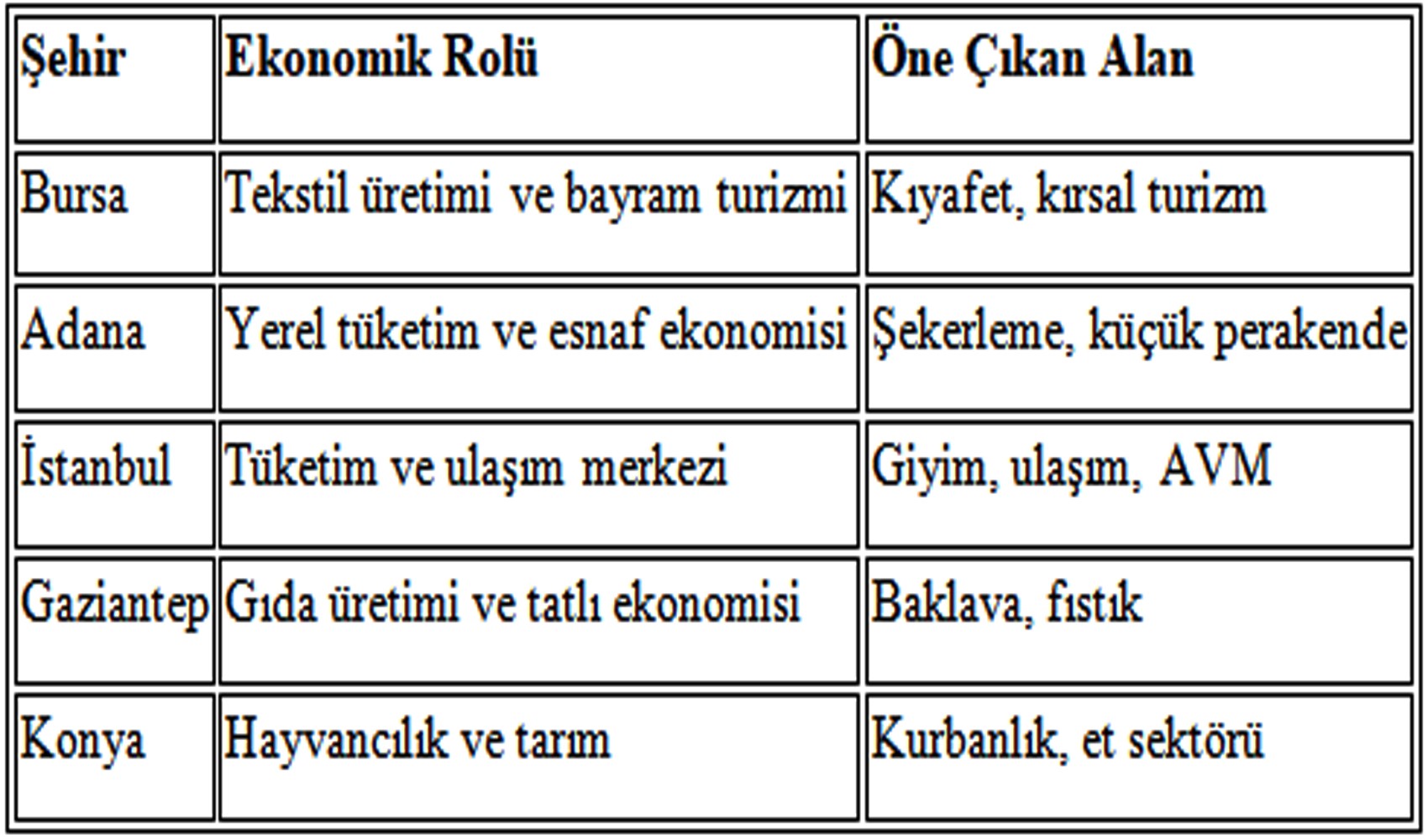
Conclusion: The Balance of Spirituality and Consumption
Holidays are rare times when cultural continuity and social bonds are reproduced in Turkish society. However, the economic equivalent of this spiritual atmosphere is becoming more visible every year. The holiday economy has now gained not only an "emotional" but also a "calculative" dimension.
This economic revival born from tradition offers an important window for understanding both the sociological and economic dynamics of Turkey. These special days, where consumption and solidarity, spending and remembering are intertwined, create not only memories but also an economic reality worth millions of liras.
On this occasion, I celebrate everyone's Eid al-Adha, and I wish for your holiday to be prosperous and for our economy to always be strong!
Most Read

Striking picture for Özgür Özel's 'New Party'

The PKK opening and Özgür Özel’s path!..

How did the newspapers view Özgür Özel's farewell to the CHP?

He killed his wife by slitting her throat: Their children witnessed the moments

What did the CHP do?

Özel’s new party move in the world press

The New CHP, against CEHAPE

Fire at TUSAŞ engine factory in Eskişehir under control

From self-efficacy to despair

Kılıçdaroğlu's first message on Özgür Özel's new party announcement