



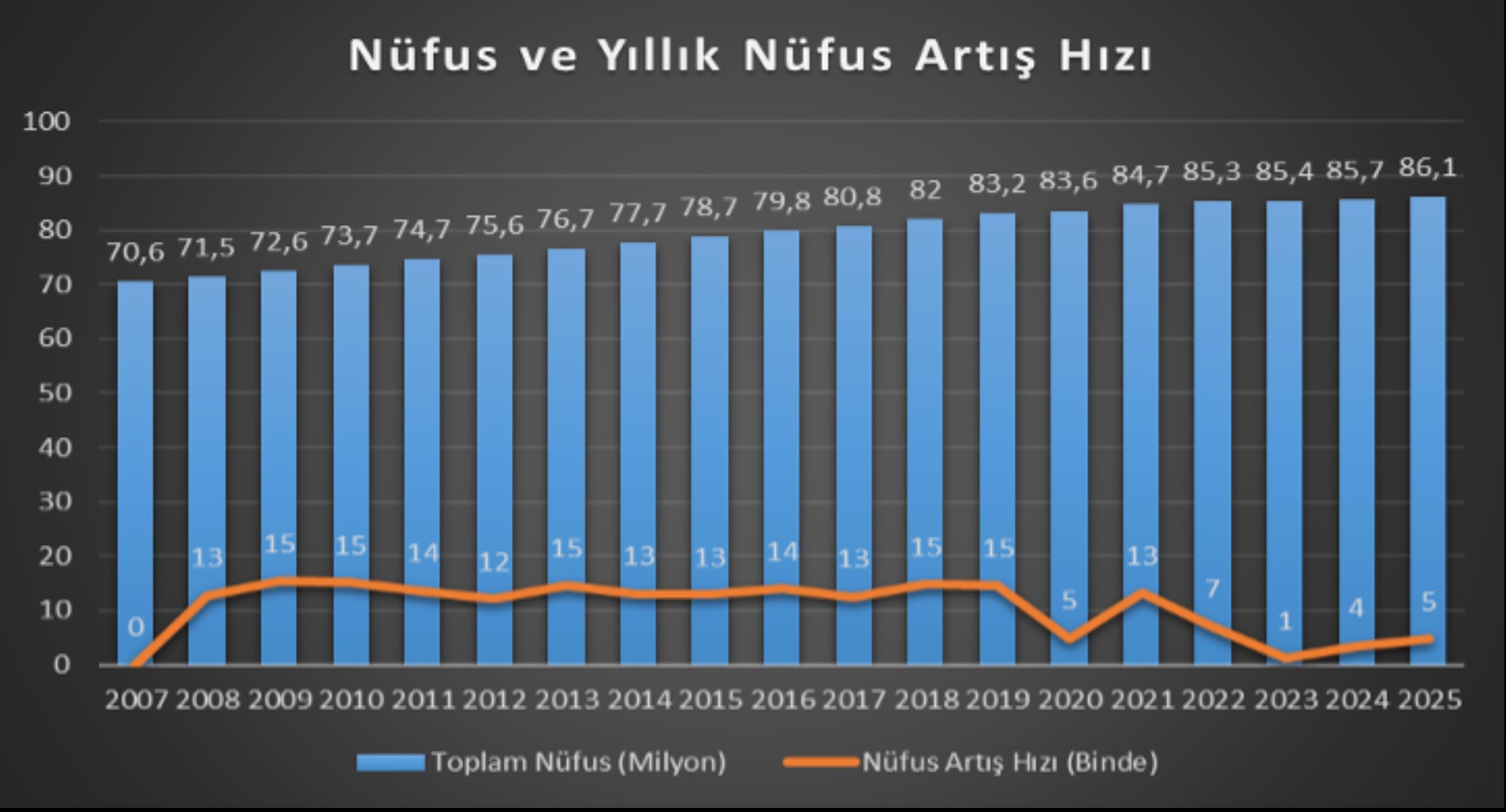
The results of the 2025 Address-Based Population Registration System (ADNKS) announced by the Turkish Statistical Institute show that Turkey has entered a new demographic phase where it is not only growing but also rapidly aging and concentrating in specific centers. As of December 31, 2025, the population reached 86 million 92 thousand 168 with an increase of 427 thousand 224 people, and the annual growth rate was 5 per thousand.
Although exceeding the 85 million threshold positions Turkey in the top league in terms of population size, what is truly remarkable is the quality of this growth. The weakening of the young population advantage, the increasing congestion in metropolitan areas, and changing dependency ratios reveal that Turkey is now at a critical demographic threshold where it must make strategic decisions based on the structure, distribution, and sustainability of the population rather than just numerical growth.
POPULATION IS INCREASING, DYNAMICS ARE CHANGING: Numerical Growth, Structural Transformation
As can be seen in the graph below, a limited recovery in the population growth rate is noteworthy. The annual growth rate, which was approximately 4 per thousand in 2024, rose to 5 per thousand in 2025. However, this increase is not due to a strong and permanent rise in fertility, but rather to migration movements, internal mobility directed toward city centers, and the demographic momentum created by past periods of high birth rates. Therefore, the current increase is a natural consequence of the demographic transition process rather than a structural revival in fertility.
Of the total population, 43 million 59 thousand 434 are men and 43 million 32 thousand 734 are women. 50.02% of the population is male and 49.98% is female. This table shows that the gender balance in Turkey is largely maintained.
The foreign population also continued its upward trend. The foreign population, which increased by 38 thousand 968 people compared to the previous year, reached 1 million 519 thousand 515. 49.3% of this group is male and 50.7% is female. This data clearly reveals that the demographic structure in Turkey is shaped not only by natural increase but also by international migration dynamics.
In conclusion, Turkey's population is growing; however, the source of this growth is changing. Demographic analysis must now be read not only through total numbers but also through age structure, migration movements, and spatial concentration.
URBANIZATION AND SPATIAL CONCENTRATION: Turkey is Almost Fully Urbanized
The 2025 data shows that Turkey has effectively completed its high urbanization phase. While the proportion of those living in provincial and district centers rose from 93.4% to 93.6% in one year, the proportion of those living in towns and villages fell to 6.4%. This table reveals that the overwhelming majority of the population is now gathered in urban settlements and that Turkey has sociologically become an urban society.
The new classification revealed by the Spatial Address Registration System (MAKS) shows that urbanization is deepening not only through administrative boundaries but also through the actual settlement fabric. 67.5% of the population lives in dense urban areas, 15.8% in medium-dense urban areas, and 16.8% in rural settlements. This distribution confirms that urban life has gained a dominant character.
The 30 provinces with metropolitan status house approximately 78% of the total population with a population of 67.3 million. The 5 most populous provinces account for 37% of the country's population, and the top 10 provinces account for approximately 51%. In other words, half of Turkey's population lives in only 10 provinces. This concentration clearly reflects the strong relationship between economic production capacity and demographic attraction.
Istanbul alone houses 18.3% of the total population with its population of 15 million 754 thousand 53. Ankara, Izmir, Bursa, and Antalya also maintain their demographic weight as major centers that attract millions of people.
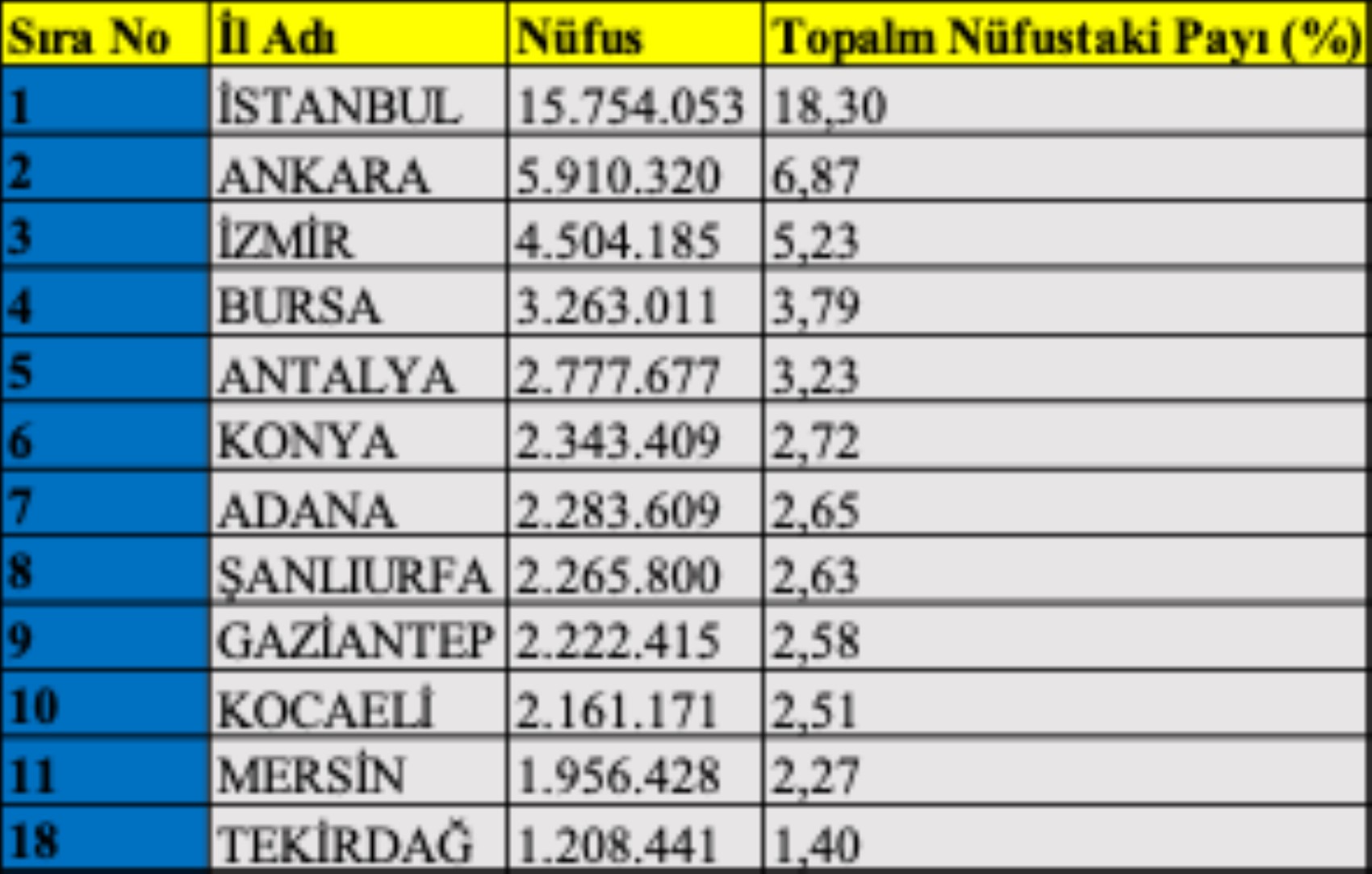
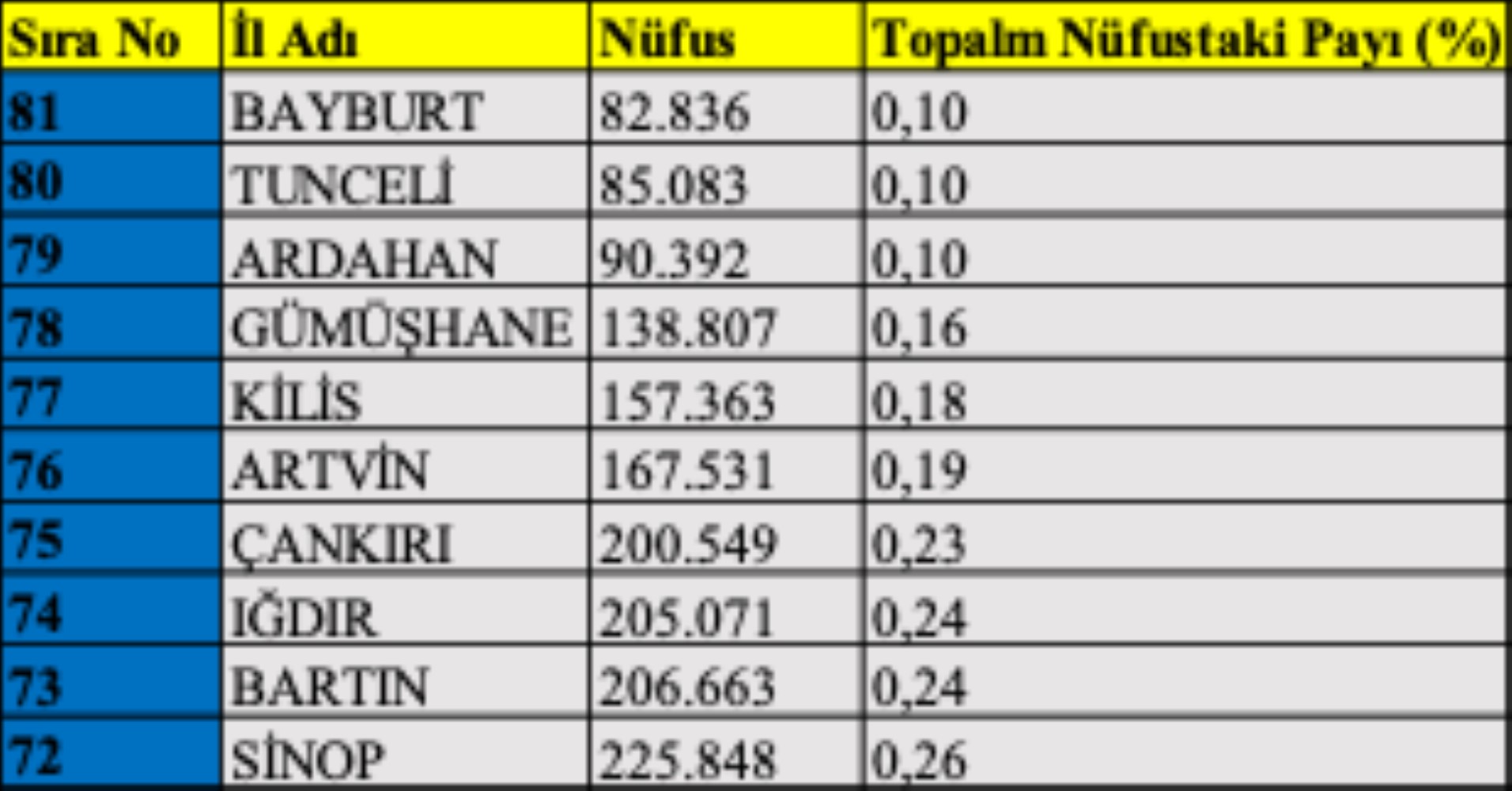
In contrast, provinces such as Bayburt, Tunceli, Ardahan, Gümüşhane, and Kilis are at the bottom of the list with low population sizes.
The fact that the population of 33 provinces decreased in 2025 shows that there is no homogeneous growth across the country. While provinces with high production and employment capacity attract population, regions with limited economic dynamism experience migration loss. This situation reveals that spatial development differences are directly reflected in the demographic structure.
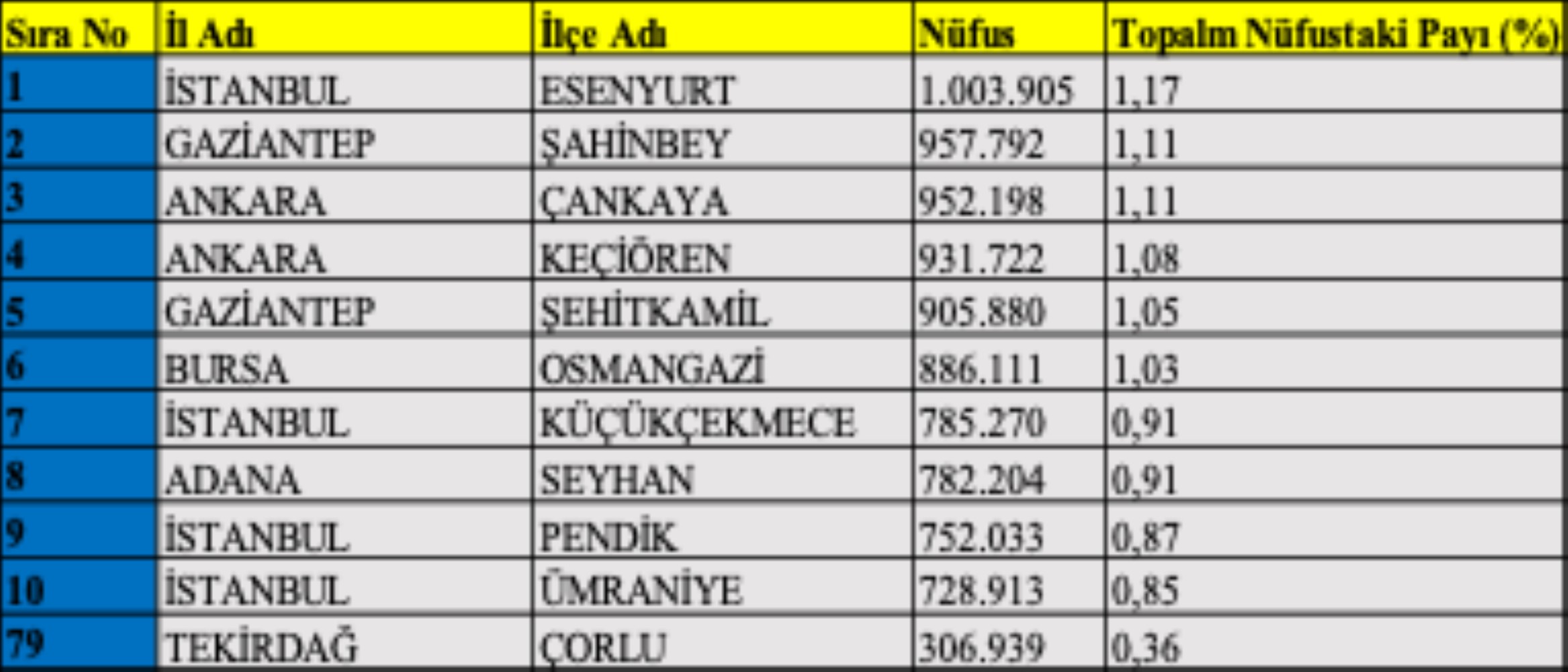
A similar picture is seen at the district scale. While Istanbul's Esenyurt district represents a new threshold with a population exceeding 1 million, the population in some districts has fallen to a few thousand people. On one hand, metropolitan districts with millions of people, and on the other, settlements with two or three thousand people... This sharp difference shows that demographic distribution in Turkey contains an increasingly distinct spatial inequality.
In particular, the Marmara Region reinforces its position as a demographic center of attraction by housing approximately one-third of the country's population on its own. This concentration creates a wide sphere of influence, from housing prices to infrastructure investments, and from labor competition to environmental pressures.
While the cost of public services per capita increases in metropolitan areas, housing and living costs rise, and competition in the labor market intensifies. Conversely, the fact that the population growth rate remains low or that there is a net migration loss in some internal and eastern regions clearly shows that spatial development differences are directly reflected in the demographic structure. Turkey is now moving toward a population structure that is not only urbanizing but also becoming excessively concentrated in specific centers.
AGE STRUCTURE: Young Population Advantage is Weakening
The most striking structural change in the 2025 ADNKS results is seen in the age composition. The median age in Turkey rose from 34.4 in 2024 to 34.9 in 2025. This increase shows that half of the population is now approaching the age of 35. The median age rose to 34.2 for men and 35.7 for women. Turkey, which has been defined as a "young population country" for many years, has reached a more advanced stage in the demographic transition process.
The decline in the child population ratio is the most obvious indicator of this transformation. The 0–14 age group ratio, which was 26.4% in 2007, fell to 20.4% in 2025. This decline of approximately 6 points reflects the long-term effect of the weakening in fertility rates. The decrease in the child population indicates that the growth rate of the labor supply may slow down in the future.
In contrast, the working-age population (15-64 age group) ratio is at 68.5% and still holds significant production potential. However, this ratio is moving away from being a sustainable advantage with the decrease in the child population and the increase in the elderly population. Indeed, the population ratio of 65 and over rose from 7.1% in 2007 to 11.1% in 2025. This increase of approximately 4 points clearly reveals that the aging process is gaining speed.
Differences between provinces are also noteworthy. While Sinop (44), Giresun (43.5), and Kastamonu (43.3) are among the provinces with the highest median age, Şanlıurfa (21.8), Şırnak (23.3), and Siirt (25) stand out as the provinces with the youngest population structure. This table shows that Turkey is aging not homogeneously, but with regional differences.
Turkey no longer has a demographic structure where the young population advantage automatically brings growth. The aging trend is becoming distinct, and the youth advantage is narrowing. This change makes it necessary to redesign economic and social policies.
DEPENDENCY RATIOS: Social Spending Burden is Increasing
The economic impact of demographic transformation is most clearly seen in dependency ratios. Although the total age dependency ratio, which was 46.1% in 2024, appears to have fallen to 46% in 2025, the real change is in the composition of the ratios. While the child dependency ratio fell from 30.6% to 29.7%, the elderly dependency ratio rose from 15.5% to 16.2%. In other words, every 100 people of working age in Turkey now look after approximately 30 children and 16 elderly individuals.
Although the decline in child dependency seems to have a relieving effect on public spending in the short term, the increase in the elderly dependency ratio is a harbinger of long-term fiscal pressure. This is because aging leads to more permanent and costly consequences in terms of health expenditures, pension financing, long-term care services, and social support programs.
The rise in the elderly dependency ratio makes the balance between production capacity and the social spending burden more fragile. If the aging trend continues at its current speed, the financial responsibility shouldered by the active working population will increase, and the pressure on public finance will become more visible.
Turkey is now exiting the demographic comfort zone where the young population is high and dependency ratios remain relatively low. In the new period, the main issue is to compensate for the decreasing young population advantage with productivity growth and to support the increasing elderly population with sustainable social policies.
DEMOGRAPHIC WEIGHT BY ADANA AND TEKİRDAĞ PROVINCES
ADANA: Strategic Position at the Metropolitan Scale
According to 2025 ADNKS data, Adana is Turkey's 7th most populous province with a population of 2 million 283 thousand 609. This size makes Adana a strong center in terms of demographics not only regionally but also on a national scale. The population of 2.28 million necessitates large-scale and sustainable planning in many areas from education to health, and from transportation to social services.
However, the population growth rate is not parallel to this size. Adana's growth rate of 1.4 per thousand remained significantly below the Turkey average of 5 per thousand, and the province ranked 45th in the growth ranking. This table shows that although the demographic volume is strong, the growth momentum remains limited.
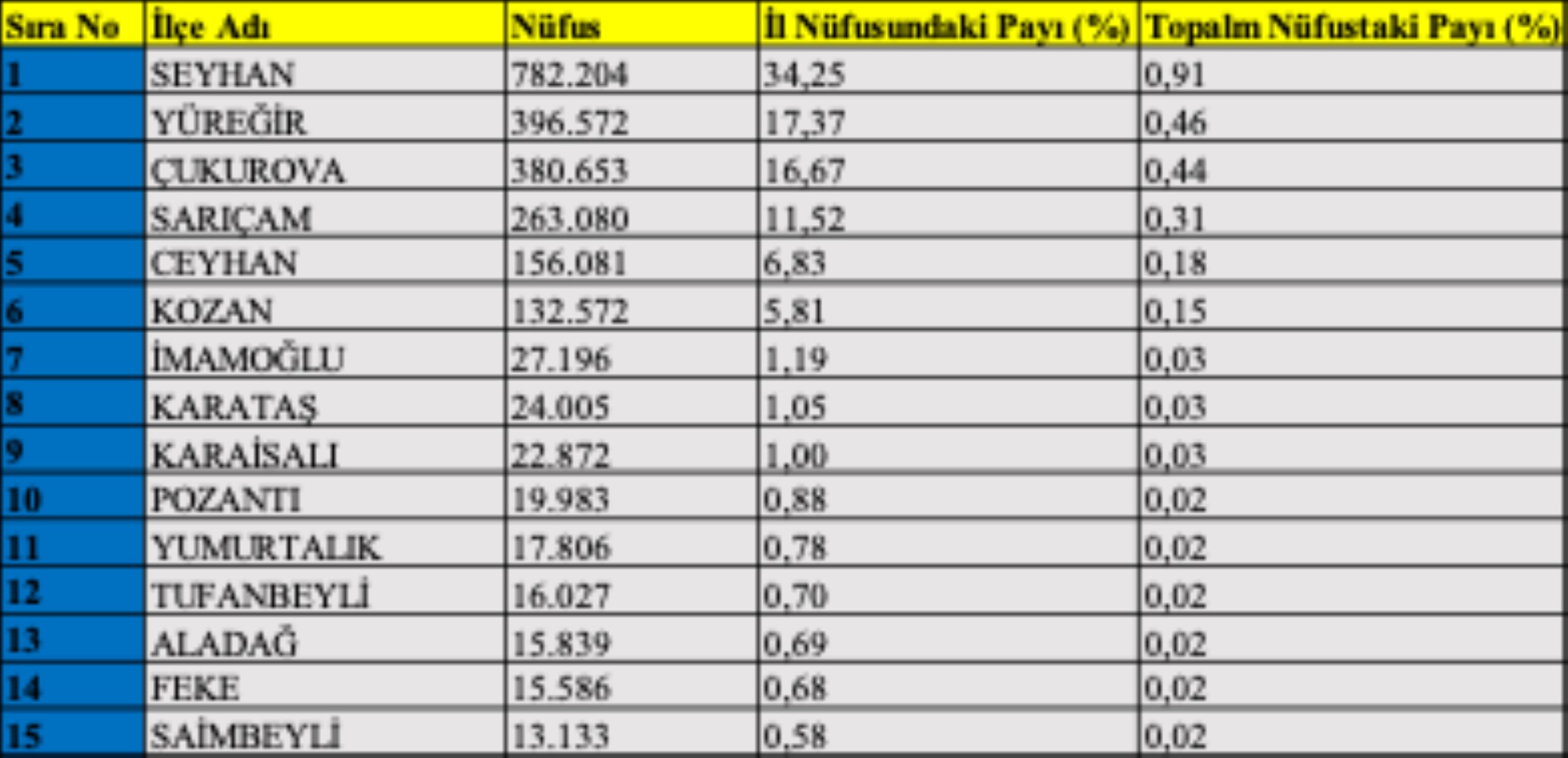
The district distribution clearly reveals the internal spatial concentration of the city. Seyhan ranks first by a wide margin with a population of 782 thousand 204; together with Yüreğir and Çukurova, it forms the main demographic core of the city. With the addition of Sarıçam, the four central districts house the majority of Adana's population. In contrast, the population in mountainous and rural districts falls below 20 thousand. This difference clearly shows the scale imbalance within the province.
The Adana example reveals that the intra-metropolitan concentration across Turkey is also becoming distinct at the local scale.
TEKİRDAĞ: Industrial Dynamism of Marmara
Tekirdağ is Turkey's 18th most populous province with a population of 1 million 208 thousand 441. However, what is truly remarkable is that it ranks second in Turkey after Antalya with a population growth rate of 18 per thousand. This rate shows that the province has a strong migration attraction capacity.
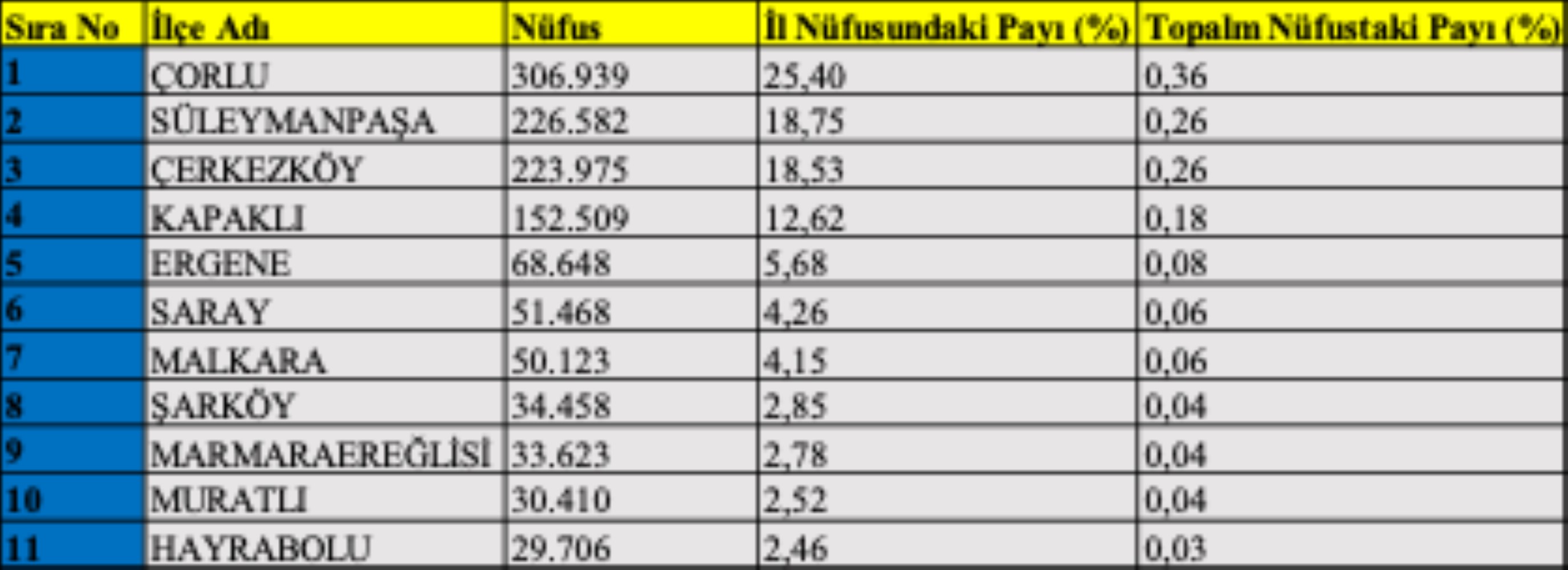
Proximity to Istanbul, organized industrial zones, and developed logistics infrastructure have made Tekirdağ an important part of the Marmara production basin. In particular, the Çorlu, Çerkezköy, and Kapaklı line constitutes the demographic reflection of industry-oriented growth. When these three districts and the provincial center Süleymanpaşa are evaluated together, it is seen that the majority of the population is concentrated on the production and logistics axis.
In contrast, the population is on a smaller scale in districts with strong rural and agricultural character. This situation clearly reveals the direct relationship between the spatial distribution of economic activities and population density.
CONCLUSION: Turkey is in a Process of Structural Demographic Transformation
The 2025 ADNKS data clearly reveals that Turkey has left behind the classic population growth period and has entered a process of structural demographic transformation. Although the population size exceeding 86 million offers strong potential, what is decisive is no longer how many people we are, but what kind of population we have. This structure, which is concentrated in city centers, is increasingly aging, and shows regional differences, makes it necessary to reconfigure economic and social policies.
In a period where the young population advantage is narrowing, elderly dependency ratios are rising, and demographic concentration is gathered in specific centers, the main issue for Turkey is the transition from quantity to quality. Quality improvement in education, stronger participation of women in the workforce, a productivity-focused production model, and sustainable social security systems are the keys to this process.
The examples of Adana and Tekirdağ clearly show that Turkey's demographic transformation is not progressing uniformly. On one hand, there are metropolitan cities with high population size but limited growth momentum; on the other, there are industrial centers that are smaller in scale but growing rapidly with strong economic attraction capacity. This table reveals that demographics are no longer shaped only by numerical size, but by production power, migration dynamics, and regional competitiveness capacity. Turkey's demographic map has become a mirror of its economic structure.
Demography is no longer just a statistical data field; it is the decisive axis of economic growth, social welfare, and regional balance. In the next decade, Turkey will either turn this transformation into a strategic advantage or will discuss its population size as a cost that needs to be managed.
Turkey is no longer a young and rapidly growing country; it is an urbanized, densified, and increasingly aging society. The economic and social success of the next decade will depend on how accurately we can read this new demographic reality and manage it with strategic policies.
And perhaps the real question is this: Will Turkey be a country that loses its youth, or will it turn into a maturing power by correctly managing its changing demographics?
Most Read

Striking picture for Özgür Özel's 'New Party'

The PKK opening and Özgür Özel’s path!..

How did the newspapers view Özgür Özel's farewell to the CHP?

He killed his wife by slitting her throat: Their children witnessed the moments

What did the CHP do?

Özel’s new party move in the world press

Fire at TUSAŞ engine factory in Eskişehir under control

The New CHP, against CEHAPE

From self-efficacy to despair

Kılıçdaroğlu's first message on Özgür Özel's new party announcement