



The Turkish economy grew by 3.3% in 2024, reaching a size of 44.6 trillion TL ($1.36 trillion), with GDP per capita recorded at 503,076 TL ($15,325). However, the truly decisive question is no longer the percentage of growth, but where this growth is concentrated within the country and for whom it translates into prosperity. TurkStat's provincial GDP data shows that production and income growth are concentrated in a limited number of metropolitan areas, primarily Istanbul; conversely, many provinces remain outside the growth process despite their potential. This picture shifts the focus from viewing growth solely as a measure of success to debating its sectoral composition, spatial distribution, and transformative impact on local economies.
Economic growth is often read through the lens of the "aggregate." Yet, which sectors are growing, which cities are driving production, and how growth spreads across geography are indicators as critical as the total volume. For this reason, provincial GDP data reveals not only the volume of production but also how development and economic opportunities are distributed across the country's geography. Regional inequalities, long debated in Turkey, are becoming more pronounced as industry and services accumulate in specific centers, with the metropolitan-periphery divide deepening in production, income, and employment indicators.
The 2024 provincial GDP data published by TurkStat in December 2025 presents this divergence with concrete figures while offering a powerful opportunity to assess the effectiveness and sustainability of development policies. This is because the geographical narrowing of growth creates acceleration in some provinces while increasing the risk of permanent stagnation in others. In this respect, provincial data points not only to today's map but also to the structural risks Turkey may face in the future and the opportunities that must be evaluated.
SUMMARY OF PROVINCIAL GDP, PER CAPITA INCOME, AND GROWTH PERFORMANCE IN 2024
According to GDP calculations at current prices at the provincial level, Istanbul reached the highest GDP in 2024 with 13 trillion 10 billion 693 million TL, accounting for 29.2% of the total GDP. Istanbul was followed by Ankara with 4 trillion 672 billion 844 million TL and a 10.5% share, and Izmir with 2 trillion 562 billion 758 million TL and a 5.7% share. At the bottom of the list were Gümüşhane with 41 billion 875 million TL, Ardahan with 35 billion 502 million TL, and Bayburt with 28 billion 137 million TL. The fact that the top five provinces with the highest shares produce 53.0% of the total GDP clearly shows that economic concentration continues.
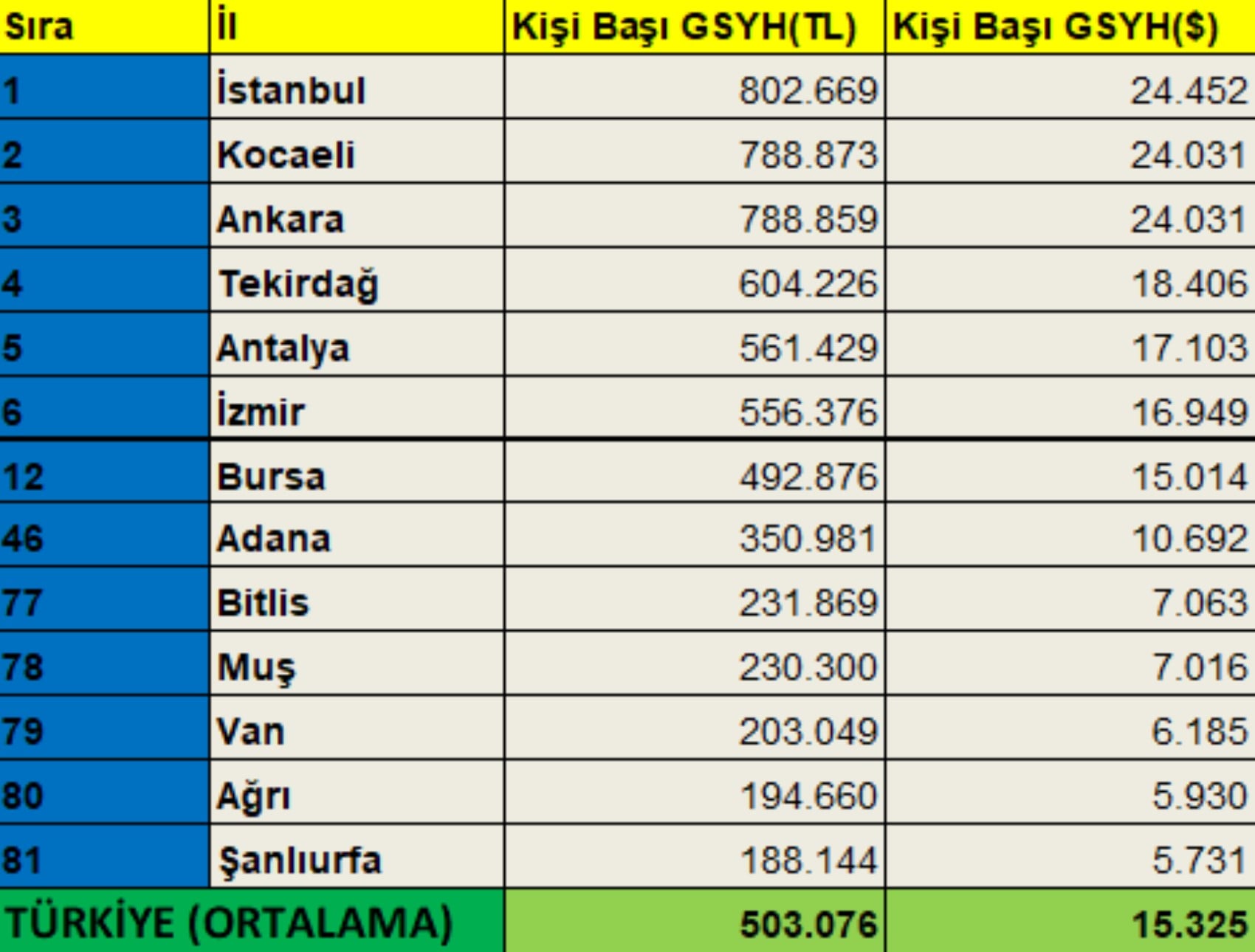
In terms of GDP per capita, Istanbul ranks first with 802,669 TL ($24,452). Istanbul is followed by Kocaeli with 788,873 TL and Ankara with 788,859 TL. The provinces with the lowest GDP per capita were Şanlıurfa with 188,144 TL, Ağrı with 194,660 TL, and Van with 203,049 TL. While the Turkish average was 503,076 TL ($15,325), Bursa ranked 12th with 492,876 TL ($15,014), remaining slightly below the average. Adana ranked 46th with 350,981 TL ($10,692), falling significantly behind the national average in terms of per capita income. The fact that GDP per capita was above the Turkish average in only 11 provinces in 2024 reveals that prosperity is not distributed evenly across the country.
According to the chained volume index, annual GDP increased by 3.3% in 2024 compared to the previous year, with 46 provinces recording growth above the Turkish average. The highest growth rates were recorded in Adıyaman (31.4%), Bayburt (17.1%), and Malatya (17.0%), while Erzincan (-7.9%), Kırşehir (-5.7%), and Bilecik (-2.4%) were the provinces experiencing the highest contraction.
Regarding the contribution to total growth, the province that contributed the most to the 3.3% increase in Turkey's GDP was Istanbul with 0.62%. Istanbul was followed by Ankara (0.44%), Hatay (0.16%), and Gaziantep and Mersin (0.14% each). It is noteworthy that Bursa contributed only 0.0098% to growth in 2024, ranking 48th. Erzincan (-0.017%), Kırşehir (-0.012%), and Adana (-0.011%) were among the provinces that made a negative contribution to annual growth.
THE CENTRALIZATION OF GDP: What Does Istanbul's Economic Weight Mean?
Data from 2024 reveals that Istanbul, with a production volume of 13.01 trillion TL, accounts for nearly one-third of the Turkish economy on its own. While its 29.2% share of the total GDP highlights the gap between Istanbul and other provinces, this magnitude also clearly demonstrates the sectors in which economic activities are concentrated.
Istanbul is the hub for high value-added fields such as finance, trade, logistics, and information and communication. With a GDP per capita of 802,669 TL ($24,452), which is well above the Turkish average (503,076 TL / $15,325), it is evident that this structure is reflected in prosperity. However, Istanbul's weight is not merely a "success" story; it also points to a centralization that exacerbates regional inequalities because similar momentum cannot be achieved in regions outside of Istanbul.
The sectoral breakdown presents a more striking picture: In 2024, Istanbul was the province with the highest share in all sectors except for agriculture, forestry, fishing, and other service activities. 64% of total information and communication activities and 59.3% of financial and insurance activities were produced in Istanbul. Istanbul also ranks first with a 39% share in professional, administrative, and support service activities; 39.8% in trade, transportation, accommodation, and food services; and 27.8% in construction.
Looking at the composition of Istanbul's own GDP, it is seen that the largest share belongs to the trade-transportation-accommodation-food services group at 33.9%. Industry ranks second with 15.1%, and professional-administrative-support services rank third with 7.2%. This composition confirms that the Istanbul economy is shaped predominantly by services. On the other hand, Istanbul is also the locomotive in terms of contribution to growth: In 2024, Istanbul's contribution to the 3.3% increase in Turkey's GDP was 0.62%. This shows that Istanbul is not only "large" but also a center that determines the dynamics of growth.
ANKARA AND IZMIR: High Share, Limited Multiplier Effect
Following Istanbul, Ankara and Izmir stand out as Turkey's second and third largest production centers. In 2024, Ankara accounted for 10.5% of the total GDP with a production volume of 4.6 trillion TL, and it exceeded the average in GDP per capita with 788,859 TL ($24,031). However, Ankara's economic backbone is shaped more around public spending and public investments compared to other metropolises. While this structure supports the level of production, it may not always provide the same scope for private sector dynamism to spread growth with a stronger multiplier.
The distribution of activities supports this situation: In 2024, Ankara ranked first in the field of "other service activities" with a 44.9% share. This picture clearly shows the decisive role of public-oriented services in the city's economic profile. Despite this, Ankara has shown a strong performance in contributing to growth; in 2024, it was the second province to contribute the most to national growth after Istanbul, with 0.44%.
Izmir, with a production volume of 2.5 trillion TL, has captured a 5.7% share of the total GDP, reaching a per capita GDP level of 556,376 TL ($16,949). Despite its strong industrial infrastructure, high port capacity, and extensive commercial connections, Izmir continues to operate with a relatively limited production weight under the intense economic pressure of other major metropolitan areas.
Although both cities hold significant shares in total production, Istanbul's distinctly dominant position leads to the strengthening of single-center growth dynamics in the Turkish economy.
TURKEY'S 10 LARGEST ECONOMIES: The Axis of Concentrated Production
According to TurkStat data, the provinces that stand out in terms of production volume after the top three metropolitan areas are listed in the table below:
Table: Production Distribution and Centralization of the Turkish Economy (Top 5 Provinces)
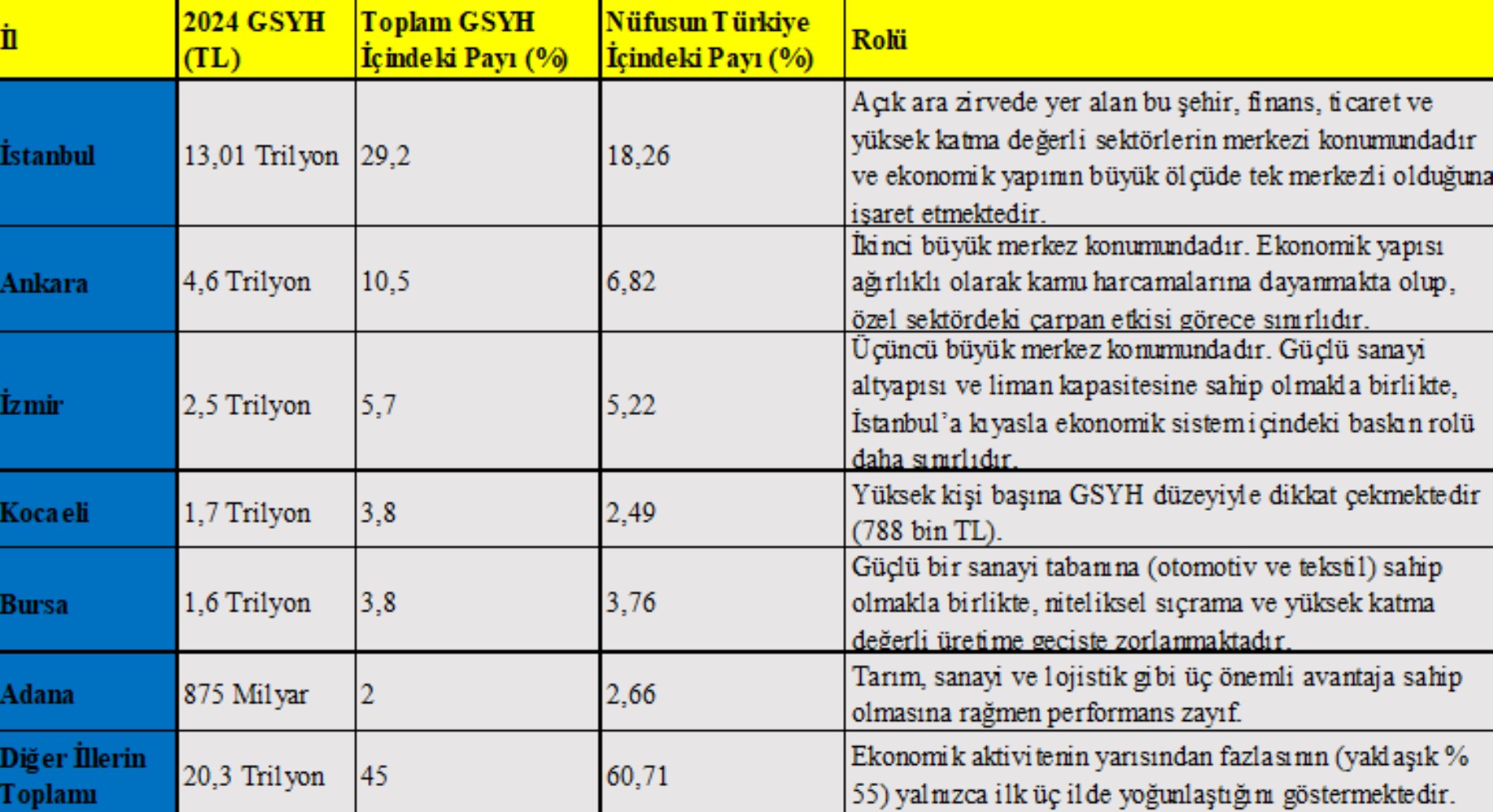
Kocaeli with 1.7 trillion TL and a 3.8% share (788,873 TL / $24,031 per capita). Bursa with 1.6 trillion TL and a 3.8% share (492,876 TL / $15,014 per capita). Antalya with 1.5 trillion TL and a 3.4% share (561,429 TL / $17,103 per capita). Mersin with 955 billion TL and a 2.1% share (444,761 TL / $13,549 per capita). Konya follows this group with 951 billion TL and a 2.1% share (388,841 TL / $11,845 per capita). Adana is at the level of 875 billion TL with a 2% share (350,981 TL / $10,692 per capita), and Gaziantep is at 830 billion TL with a 1.9% share (318,204 TL / $9,693 per capita).
The relatively high share of GDP in Ankara and Kocaeli, relative to their population weight, is particularly noteworthy.
The table above shows how GDP is geographically polarized, the dominant role of Istanbul, and the formation of a distinct production belt along the Marmara–Mediterranean–Central Anatolia axis. Transport infrastructure, production clusters, and the density of industry and trade are the primary advantages of this line. However, the concentration of production along this axis does not only create efficiency and scale effects; it also reinforces the center-periphery divide in terms of access to education, employment, and opportunities. Therefore, while this line acts as a backbone carrying growth, it also represents a spatial structure that limits the spread of growth across the country.
BOTTOM OF THE LIST: The Geography of Economic Fragility
Provinces at the lower end of the GDP ranking make the narrowness of production capacity and economic fragility more visible.
Bingöl is at 79 billion TL with a 0.2% share (276,713 TL / $8,429 per capita); Sinop is at 73 billion TL with a 0.2% share (321,023 TL / $9,779 per capita); Artvin is at 66 billion TL with a 0.1% share (390,108 TL / $11,884 per capita); Bartın is at 66 billion TL with a 0.1% share (318,484 TL / $9,702 per capita); Kilis is at 57 billion TL with a 0.1% share (253,567 TL / $7,724 per capita); and Iğdır is at 55 billion TL with a 0.1% share (264,690 TL / $8,063 per capita).
While Tunceli stands out with 42 billion TL and a 0.1% share (478,675 TL / $14,582 per capita), Gümüşhane with 41 billion TL, Ardahan with 35 billion TL, and Bayburt with 28 billion TL are at the very bottom of the list.
Table: The 5 Provinces with the Lowest GDP
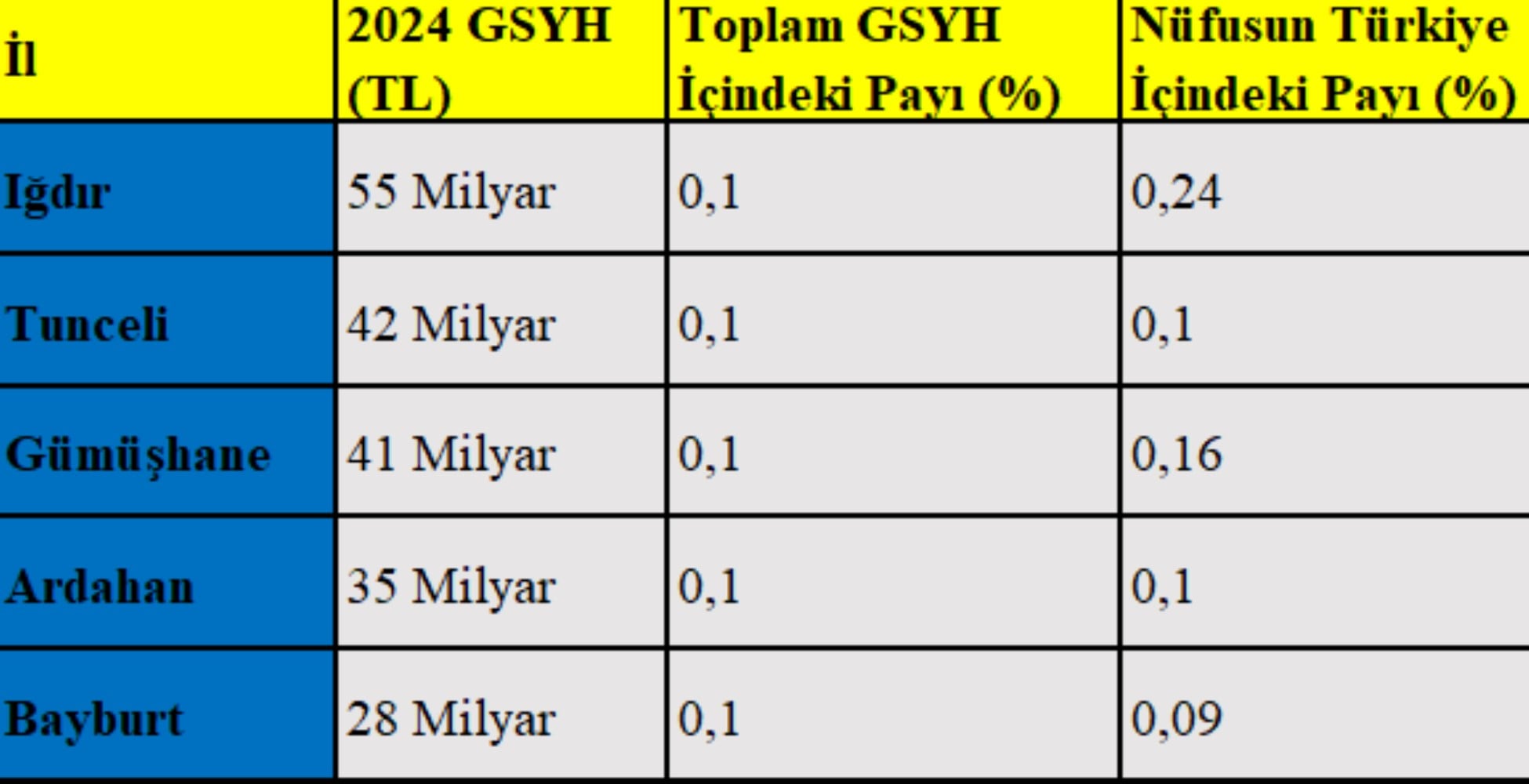
The examples of Gümüşhane, Ardahan, and Bayburt are particularly striking: The total production of these provinces remains far behind even when compared to the production volume of a single district in Istanbul. This gap shows that industrialization, production, and employment capacity remain limited in the East and Northeast geography; this suppresses income levels, increases the pressure of internal migration, and weakens local economic sustainability. The resulting inequality creates not only an economic but also a social and demographic risk area.
GDP PER CAPITA: The Prosperity Gap is Widening
Unlike total production volume, GDP per capita is a critical indicator for capturing the distribution of prosperity. The 2024 data shows that Istanbul ranks first with 802,669 TL ($24,452) per capita, followed by Kocaeli and Ankara at approximately 788,000 TL. These high values are related more to productivity, sectoral structure, and economic diversity than to production volume alone.
In contrast, the fact that GDP per capita remains in the 200,000 TL (around $6,000) band in provinces such as Van, Ağrı, and Şanlıurfa strikingly reveals the scale of the prosperity gap. The widening gap between Istanbul and the lowest-ranking provinces creates a broad area of inequality that extends beyond income to include education, employment, living standards, and opportunities.
Table: GDP Per Capita Peak and Trough: Turkey's Richest and Poorest Provinces
READING THROUGH THE LENS OF ADANA AND BURSA: Same League, Different Stories
Although Adana and Bursa appear to be two metropolitan cities of similar scale, TurkStat's 2024 GDP data shows that these two provinces are following very different economic paths.
• Bursa Economy: Industrial Power, Stagnant Leap
Bursa clearly stands out as one of the largest production hubs in the Turkish economy. Possessing a strong infrastructure in industrial production, particularly in automotive, machinery, and textiles, Bursa accounts for 3.8% of the total GDP with a production volume of 1.6 trillion TL (close to its population weight of 3.7%), ranking 5th nationwide. The GDP per capita in the city is 492,876 TL ($15,014), placing it 12th in Turkey. As a major province in terms of GDP volume according to TurkStat data, Bursa also ranks high in GDP per capita; the fact that this indicator is close to the Turkish average of 503,076 TL ($15,325) and surpasses many other large provinces demonstrates Bursa's production efficiency and the effectiveness of its industrial structure.
However, Bursa's contribution to growth according to the chained volume index remains at 0.0098%, ranking 48th, which makes the gap between its potential and performance visible.
Nevertheless, Bursa's production and prosperity profile is far from having the capacity to compete directly with Istanbul. Although its industrial infrastructure and production diversity are strong, the city needs new strategies to increase its share of economic growth. These strategies should be based on increasing technology investments, supporting SMEs, and strengthening export-oriented production.
• Adana: Potential exists, performance is weak
On the Adana front, the picture presents a more problematic outlook. With a production volume of 875 billion TL in 2024, Adana received a 2% share of the total GDP (well below its population weight of 2.66%), ranking 9th in Turkey. Conversely, its GDP per capita is 350,981 TL ($10,692), placing it 46th. These indicators reveal that despite Adana standing out in terms of total production size, it has not achieved a strong and permanent position in the league of top metropolitan areas regarding prosperity and productivity. In terms of GDP per capita, Adana remains significantly behind the provinces of the Marmara and Aegean regions.
Despite having three major advantages—agriculture, industry, and logistics—an integration that produces high value-added across these sectors has not yet been achieved in Adana. While value-added in agriculture remains limited in terms of processing, branding, and exports, technology-intensive investments in industry are insufficient, and the logistics advantage cannot be adequately linked to industrial production. This situation keeps Adana in the category of cities with high potential but relatively low performance.
On the other hand, Adana was among the provinces that made a negative contribution to annual GDP growth in 2024. Being the 3rd province to contribute the most negatively to growth in 2024 according to the chained volume index, with a rate of 0.011% following Erzincan and Kırşehir, makes the vulnerabilities in the city's economic structure even more visible. This picture clearly reveals Adana's need for structural transformations to strengthen its economic dynamics. Steps to increase value-added in agriculture, attracting qualified industrial investments, and diversifying the service economy stand out as critical topics to raise Adana's production capacity and prosperity level. Otherwise, the risk of its share in the national production pie remaining weak despite its potential will persist.
THE CENTER GROWS, THE LOCAL SQUEEZES: The Message of Provincial GDP to Local Governments
Provincial GDP data makes not only economic size but also the limits of municipal financial capacity indirectly visible. This is because the revenue structure of local governments in Turkey relies heavily on shares transferred from the central budget. While municipalities in provinces with weak local economies struggle to increase their own revenues, the economic vitality in cities with high GDP provides a wider scope for action for municipal budgets, albeit indirectly.
In cities with high production volumes such as Istanbul, Ankara, and Izmir, the tax base is broader, commercial activities are more intense, and the real estate market is more active. This structure offers municipalities a stronger financial foundation through property taxes, fees, and various local revenue items. In contrast, in cities like Adana, which have production potential but lag behind in prosperity and productivity indicators, municipalities are forced to respond to increasing social needs with limited resources. Consequently, while municipalities with the same legal powers provide services under very different economic realities, this situation deepens a structural inequality among them. For this reason, provincial GDP data clearly reminds us that local government reform must be addressed not only on an administrative basis but also on an economic one.
This picture also shows that local governments must be repositioned not just as administrative units producing infrastructure and routine services, but as active actors in economic development. It is not sustainable for municipalities to remain passive in a structure where regional inequalities are deepening.
The first step is for every municipality to accurately read the economic profile of its own city: which sectors are strong, which are fragile; which investment areas create a multiplier effect? Making decisions on zoning, transportation, infrastructure, and planning without regard for this reality leads to the inefficient use of resources. The unplanned expansion of industrial zones in Adana, despite its focus on agriculture and logistics, or the fact that technology and R&D infrastructure lag behind in Bursa despite its strong industrial density, are typical results of a lack of strategy at the local level.
Secondly, institutional mechanisms that will strengthen the capacity to attract investment must be built more robustly. It is impossible to transform the city economy without establishing regular, targeted partnerships with investment offices, university-industry collaborations, and development agencies.
The third heading is the strengthening of local revenues: while municipalities in provinces with low GDP are squeezed faster in the face of increasing social expenditures, steps to increase local economic vitality will create a multiplier effect that will also provide breathing room for municipal budgets in the medium term.
Fourthly, human capital needs to be placed at the center of the development strategy. Behind the provincial GDP differences lies not only capital accumulation but also the spatial distribution of qualified labor. While the concentration of the educated population in metropolitan areas weakens the production capacity of other provinces, it is now a necessity, not a choice, for municipalities to break this cycle through vocational training, local employment programs, and university-industry integration.
Finally, the relationship between local governments and the center needs to be redefined. Provincial data shows that central decisions often fail to adequately consider local economic realities. Municipalities must move beyond being structures that merely wait for central resources and instead transform into actors that present their own economic visions and can negotiate with the central administration based on those visions. Otherwise, local governments will continue to remain institutions that manage the outcomes of growth without being able to determine its direction.
In summary, provincial GDP data tells local governments this: The fate of cities left outside of growth can be changed. For this to happen, municipalities need to be empowered with an understanding that can read economic data, produce strategies, and mobilize local potential. Adana not losing its potential, Bursa being able to make a leap, and Turkey being able to expand its growth geography depend largely on the success of this local transformation.
POLICY PERSPECTIVE: What does provincial GDP tell us we need to do?
Provincial GDP data shows that the one-size-fits-all incentive approach has largely lost its functionality. The result of offering the same investment call and the same growth prescription to every province can be that Istanbul grows even further, mid-sized provinces stagnate, and weaker provinces fall even further behind. Therefore, the approach needed in the new era is a model based on provincial economic specialization and a selective incentive policy on a sectoral-regional basis.
For Bursa, the priority is technological transformation in industry, green production, and an increase in value-added exports. For Adana, a strategy that connects the agriculture-industry-logistics triangle, strengthens the processing industry, and supports the goal of becoming a regional trade hub stands out.
At the same time, it is necessary for local governments to position themselves not just as implementers but as economic actors in this process, and to strengthen their capacity to attract investment, establish cooperation with local industry, and develop human capital. Otherwise, it will be difficult to close the gaps in provincial GDP.
CONCLUSION: There is growth, but no balance — Turkey's economic map is sounding the alarm
The Turkish economy grew by 3.3% in 2024, reaching a size of 1.36 trillion dollars, with GDP per capita recorded at 15,325 dollars. However, TurkStat's 2024 provincial GDP data clearly reveals that this growth is not evenly distributed across the country. The fact that nearly one-third of production is concentrated in Istanbul, and that even Ankara and Izmir cannot approach this weight, shows that Turkey has still not been able to emerge from a single-centered economic structure. While this structure provides advantages in scale and efficiency in the short term, it deepens vulnerabilities such as the contraction of employment, the migration of qualified labor, and the weakening of local economies in the medium and long term.
This picture becomes more evident in cities like Adana, which possess high potential but fail to sufficiently mobilize their production capacity. As the gap between potential and actual performance widens, economic backwardness ceases to be temporary and takes on a permanent character. The example of Bursa highlights another structural problem: even cities with strong industrial infrastructure struggle to transition to high value-added production. Although Bursa ranks high in production, it has yet to achieve the expected leap in technology, innovation, and brand power. This situation is a local reflection of the 'producing much but failing to create enough value' problem that is widespread in the Turkish economy.
TurkStat's 2024 provincial GDP data tells Turkey the following: Growth figures may be positive, but as the geography of growth narrows, economic and social risks increase. Adana falling behind, Bursa failing to leap forward, and Istanbul becoming overly concentrated are different faces of the same structural problem. The fundamental question for the coming period is clear: Is it to merely increase growth, or to spread growth more fairly and balanced across the country? Provincial data strongly indicates that the second option can no longer be postponed. Otherwise, while Istanbul's economic weight will continue to increase, cities like Adana will continue to lose potential, and low-income provinces will remain further trapped in a cycle of migration and poverty.
Therefore, it is inevitable that development policies be redesigned with an approach that is based on provincial production capacity, encourages local specialization, places technology and human capital at the center, relies on selective incentive policies on a sectoral-regional basis, and makes local governments active actors in the process. TurkStat's 2024 provincial GDP data reveals that growth is concentrated in a few major cities, that strong production centers are unable to make a leap, and that cities with high potential are facing the risk of permanent backwardness.
These data do not just take a snapshot of growth; they serve as a clear warning for Turkey's economic future. Unless the geography of growth is expanded, even if Turkey continues to grow in numbers, a period of permanent backwardness rather than development will begin for many cities; as long as this imbalance persists, growth will produce deep and increasingly difficult-to-repair economic and social fault lines between cities instead of moving the country forward.
Most Read

Striking picture for Özgür Özel's 'New Party'

The PKK opening and Özgür Özel’s path!..

How did the newspapers view Özgür Özel's farewell to the CHP?

He killed his wife by slitting her throat: Their children witnessed the moments

What did the CHP do?

Özel’s new party move in the world press

Fire at TUSAŞ engine factory in Eskişehir under control

The New CHP, against CEHAPE

From self-efficacy to despair

Kılıçdaroğlu's first message on Özgür Özel's new party announcement