



Today, in a widerange spanning from narcotics to virtual gambling, and from illegal betting to "legal" games of chance, there is one unchanging reality: The house wins, and society loses. In a country, the drug dealer, the virtual gambling baron, and the illegal betting network all use the same sentence comfortabcan establish with ease: "Don't worry, the system is working forme."This phraseis nolonger aconfession of a crime;it is a reflection of how addiction has transformed into an economic, political, andcultural profit-making order.stugs' a clear summary.
Addiction, rather than a sign of individual weaknesshas gone far beyond its initial scope, becoming an invisible field of powerfueled by conscious choices. While the owner of the house may change from time to time, the resultdoes notchange: Indebtedyouth, brokenfamilies, an eroding sense of justice, and a society whose future has been systematicallymortgaged.Drugs, virtual gambling, legal games of chance, and illegal betting may advance through different channels; however, they all share the same social it serves decay, deepeningincome inequality, and a collective loss.
FEAR OF DRUGS, TOLERANCE FOR GAMBLING:Turkey's Deep Double Standard
In Turkey, the social reflex againstdrugs isis a triad, and this is a justifiedstance. No one would try to make this danger seem innocent with phrases like “a little heroin” or “controlledmethamphetamine.” However, when it comes to gambling and betting, that same clarity disappears.Online gambling addiction is spreading like a silent epidemic in Turkey today.
Online gambling addiction is spreading like a silent epidemic in Turkey today.in Turkey today like a silent epidemic.This addiction; it is a showofit manifests not through street dealers, but through credit card statements, foreclosure files, hidden debts,andbroken families. Young peoplefall into debt beforeachievinga stable income;families and childrenwhat they are experiencing often realize it too late.
Despite this, gamblingis still presented as a "matter of willpower." However, scientific data is clear, and gambling addiction is a condition that alters brain chemistry, dIt is a disease that impairs impulse control and hasneurological effects similar to substanceaddiction. Despite this, the fact that gambling isstill discussed as a moralfailing is a form ofsocietal denial.At this point, is the issue merely a cultural double standard
or something else?or is it a consciouspublic policychoice? The question becomesinevitable.Because thereflexes toward addictionare less about a country's moral rhetoric and more about what the state perceives as a risk versus a source of revenue.isshaped by. This difference only becomes visible when international comparisons are placed side by side.It is precisely for this reason that
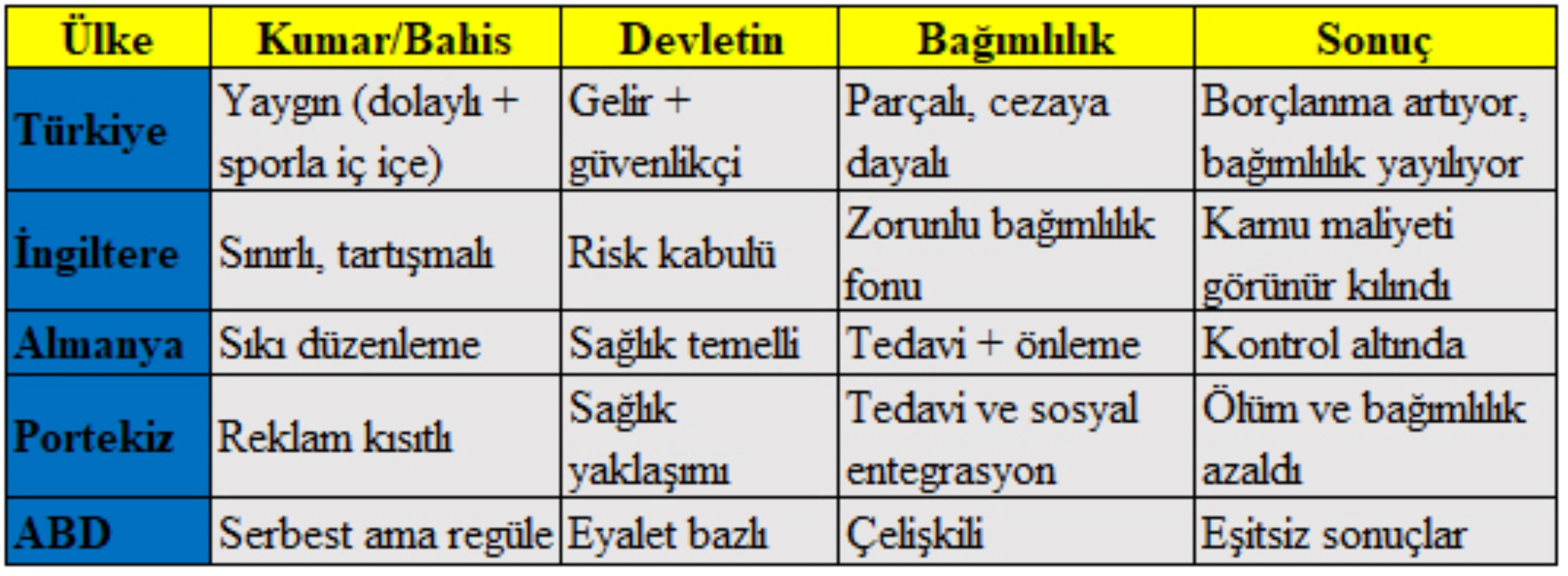
looking at how different countries approach gambling, betting, andnarcotics helps us understand the“fear” in Turkey.shows that theimbalanceis nota coincidence.The realityrevealed bythe tablebelowAccording to the data, Turkey neither defines addictionas an absolute threat nor addresses it with a consistent health policy. This approach, trapped between punishment, treatment, and revenue, instead of solving the problem, renders it invisible.Every type of addictionviewed as a source of revenueimposes its coston the individual and the family.
Table: Addiction in CountriesComparison of Approaches to Addiction
LEGAL DOES NOT MEAN INNOCENT: The Language Established by the State, ProducedRisk
When it comes tostate-regulated games of chance,the issue isthe languagehardlychanges and terms like "entertainment","a little excitement","luck" are brought to thefore. However, the target audience for this language is notcoincidental.is not. The marketing of games of chance, ismostly aimed atsegments with weakincome security and narrow channels for social mobility.The hope ofrising byworking is weakin a country where dreams built on chancefind easier buyers.
At this point, the state's dilemmabeginsgrows. While on one handthey claim to be fightingillegal betting,on the otherhand, they create acultural climate that normalizes gambling. For children growing up in this climate,gambling is not a forbidden danger;it is a normal part of life.becomes a state. Any contradiction made without resolving the regulation remains incomplete, and every campaign remains performative.
FOOTBALL, BETTING, AND THE EROSION OF COMPETITION: The Innocence of Sport Is Over
The recent association of footballers, technical staff, and some club executives with online betting is often presented to the public as a "personal mistake" or "unethical behavior." However, these cases are not merely isolated moral issues; they are part of the economic and pare the signal flaresof a larger system that has infiltratedthe administrative structure.Because in a sports order that has come into contact with betting,
we are no longer talkingmerely about a fewrule violations, but ratherthe erosion of competition itself.we offer. The reason for the existence of sportis uncertainty, and this is related to the fact that the result is not known in advance, that laboris rewarded, and that the sense of justice is preserved. Betting, on the contrary, tries to make this uncertaintymanageable and even manipulatable.The real question is how much these two logics can coexist at the same time. It is precisely at this point that the frequentlyvoiced defense comes into play, claiming that the contact between sport and bettingis a matter ofit is claimed to beinevitable.At first glance, this arg
ument may seem convincing.Global leagues, sponsorships, broadcast revenues, and digital platformsaregrowing.In today's world, contact with betting being completely eliminated may indeed be difficult. However, the issue is not the existence of contact; but rather where, how, and within what boundaries this contact is kept. Because some countries regulate this relationship strictly to protect competition, while someothers prefer to ignore, postpone, or "manage" the situation.
This difference determines whether sports are truly protectedit clearly demonstrates.
Table: Sports and Betting; Where is Competition Protected?
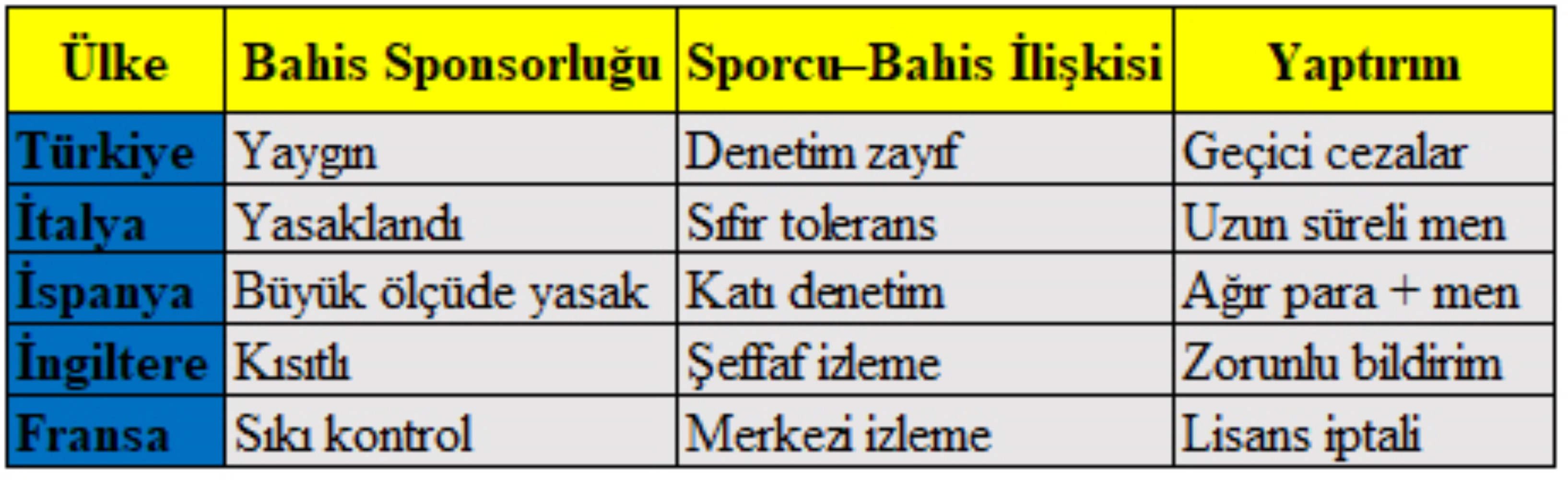
The comparison presented by the table is strikingis alarming. The prevalence of betting sponsorships in Turkey, and the athlete–betting relationship is unregulated and sanctions arelargely temporary in nature. In contrast,in countries such as Italy, Spain, and France, betting–sports relationship is systematically restricted; in case of violation, long-term bans and license revocations have been implemented. England, on the other hand, keeps this area under constant surveillance through transparent monitoring and mandatory reporting mechanisms.
This picture tells usthis: While sports in Turkey are forced to coexist with betting,Europe's major leagues are, on the contrary, tryingto save sports from betting. While competition is a 'managed' concept here,it is treated as a public value that must be protected there. This difference directly affects not only the game on the field but also society's sense of justice.
Because the implicit message given to young athletes is that the system's back doorsyield results faster thanhard work, discipline, and fair competition.is. As this message becomes widespread,what is lost is not just sporting ethics; social confidence itself iseroded.
CELEBRITIES, DRUGSAND THE SILENT DANGER OF NORMALIZATION
Another area of risk is through celebrities and digital culture is being shaped. Drug use is sometimes presented by turning it into tabloid fodder, and at other times by masking it with concepts such as "freedom", "creativity" or "rebellious stance". This form of presentation creates a serious normalization effect, especially among young people. Drugs are no longer perceived as something to be feared, but as a choice that can be "experienced." The way the media and social platforms circulate these patterns without filtering
This form of presentation creates a serious normalization effect, especially among young people.Drugs are no longer perceived as something to be feared, but as a choice that can be "experienced." The way the media and social platforms circulate these patternswithout filteringputting it into circulation, is becoming a modern form ofevadingresponsibility.The issue here is not the individual's private life;
it is the messageproduced in the public sphere.It is. Because every message either legitimizes or limits a behavior.DIGITAL PLATFORMS: Addiction Built with Algorithms
Virtual betting and gambling, unlike classic criminal organizations, operate with algorithms.
User behavior is analyzed, weak moments are targeted, and the sense of loss is systematicallyexploited.This creates a cycle of dependency. The platforms are designed to keep the user engaged at all costs.Ultimately, the house always wins while the individual and society pay the price.fueled from within. The digital world nowgenerates addiction not from the streets, but from the individual's pocket, screen, and credit card. In Turkey, however, digital oversight remains
stuck on superficial toolslike access bans.Yet, without financial tracking, auditing advertising algorithms, establishing effective cooperation with social media platforms, andbringing payment systems under control, it is impossible to address the root of the problem.without being taken into account, breaking this network isnotpossible. While algorithms amplify addiction,public oversight oftenfails to keep up withthe speed andcomplexity of this process.
At this point, the problem is not just what digital platforms are doing. The real issue is under which public left free within a frameworkand how the resulting damage is defined. Because algorithms do notbear responsibility on their own; responsibility lies in the political choices that either limit them or fail to do so.
In the fight againstaddiction, the language, priorities, and tools used by the central administrationthe gaptoolsto understandfor to this questionone must honestly answer: Does the state, in the face of gambling and betting profits,see itself as a regu-lator, or as a de facto revenue part-as a dependency?
The answer to this question isoften not in the legal texts; but in thebudget items, in the content of the reportsshared with the public,andin especially in which data is disclosedand which is systematicallywithheld fromdisclosure. Because what a state measures,whatit prioritizes;what it what it does notmeasure shows what itis willing toignore.In
somecountries, gambling and betting are onlynot just as an activity that generates revenue, but also in terms ofhealthcare expenditures, indebtedness, familybreakdown, and loss of productivityas costs imposed on society.Therefore,public authorities must account for the social destruction caused by every unit of revenue generated from gambling. For this reason, public authorities must also record the social damage created by every unit of income obtained from gambling.
Some in countries, this calculation is nevermade. Because when no calculation ismade, responsibility also becomesinvisible.
Table: The State's Relationship with Gambling; Revenue or Loss?
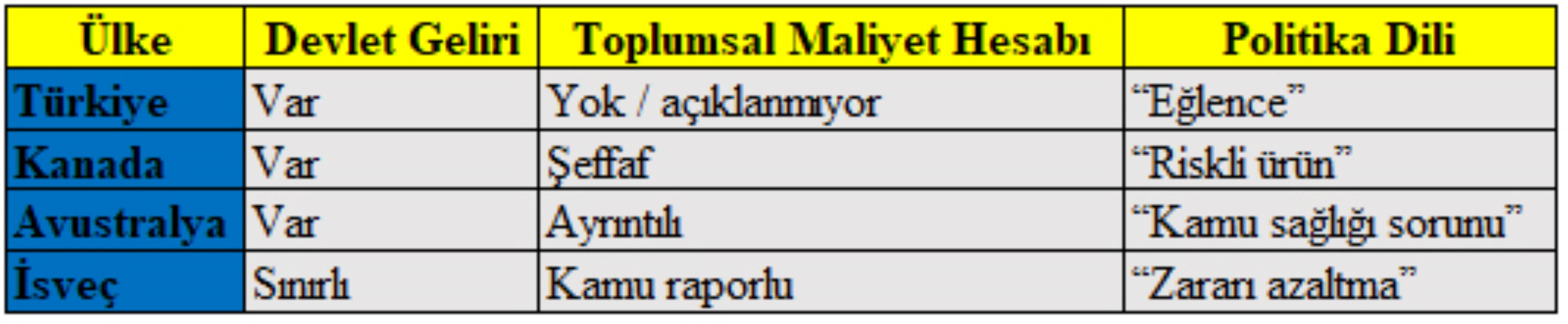
The reality revealed by the tableThe facts are clear. In Turkey, the state discloses the revenue generated from gambling and betting to the publicin away thatdiscusses it; while the resulting indebtedness,addiction, mental health expenditures, and socialcosts are often overlooked. chooses not to systematically calculate the cost ofdisintegration. However, in countries such as Canada, Australia, and Sweden,gambling is not categorized under "entertainment"; it is defined as arisky product or a public health issue, and a corresponding reporting languageis established accordingly.
This difference is not a mere technical detail. Because harm that is not measured is politically ignoredis.
Every ignored harm is removed from thescope of public policy and left to the individual's fate.
CENTRALADMINISTRATION: Security-oriented reflexes are not enough, social policy is needed Condition
CentralThe central administration'scontinued relianceprimarily onsecurity-oriented reflexesin the fight against addictionnarrows the scope of the problem. However, addiction is not reduced by police, but through education, health, and social policy.
Advertising bans, sponsorshipregulations, addiction funds, mandatory treatment programs, and digital finance audits, if not addressed as awhole, will notbesuccessful, and advancement will not bepossible.is not. The fightagainst addictionshould notbe basedon budget increases; it should be plannedbased onsocial cost calculations.
LOCAL ADMANAGEMENTPOLICIES: Addiction begins in the neighborhood and ends in the neighborhood
Municipalities are the institutions that best know the trueface of addiction.Because the problem is not in abstract reports; it is in the neighborhood, in the park, and in theyouth center.It is happening right there.is experienced.
Local governments must act with an approach that expands, rather than restricts, social spaces.Sports, art, and culture are not just activities; they are the antidote to addiction.Municipalities that engage with families and develop early warning systems are the most important partners of central policies.policiesof the most pcan be acomplementary factor.
If the observation that addiction begins in the neighborhood is correct, the solution must alsosprout in the same place. However, at this point, the real distinction emerges not through declarations of intent, but through implementationcapacity. Localgovernments' adWhile the role incombating addiction is theoretically accepted byeveryone, the path followed in practice varies significantly from country to country and evenfrom city to city.Some in theworldexamples demonstrate howmunicipalities,when equippedwith the righttools,can createa transformative impact.clearlydemonstratesin anopen manner.
Iceland–What did the municipalitiesdo?
Sports and arts activities made free of charge. Families were mandatorily included in the process. Digital usageand nighttimecontrols wereincreased.As aresult, the addiction rate among youthis over 50% focused onit.
Turkey–What are the municipalities doing?
Debates over authoritycontinue. Project-basedand sporadic practices come to the fore. The fight against addictionis far from being a priority in the budget.Ultimately; the problem continues to grow in the neighborhood.
This comparison, the fight against addictionit is not just a matter of authority; it shows that it has increasingly become a matter of priority and continuity. Iceland model forexample, while municipalities take on the responsibility and do notleave the field empty; in Turkey, the sameproblem, mostof the time, the centralbetween central administration and local governmentsis turning into a file that is passed back and forth.Every gap that emerges in the fieldis filled without delay by addiction.
CIVIL SOCIETY: Structures That Stay in the Field, Not Those That Just Submit Files
The struggle of civil society organizations against addictionrole in the struggle is vital but has beenweakened. Projectprojections, funding calendars, and report language oftenmask thereality on the ground.
AdAddiction requires continuity. It requires trust. It requires human connection. NGOs cannot be effective unless they view the addict not as a "target audience," but as a human being.
MEDIA AND ACADEMIA: Ignoring is also a choice
The media, admust address addiction with responsibility, not sensationalism. Academia, for its part, must move this issue beyond being merely a subject for academic papers andbring it to the center of public debate.Because there is no such thing as neutralityon this matter. You are either on the side of the human being or on the side of the house.
FINAL WORD: The House ShouldNot Win, People Should
Confronting addiction begins not by judging an individual's willpower, but by courageously questioning the system that surrounds them. As long as the invisible power field behind gambling, betting, and drugs is not debated, the winner will not change; the house continues to grow while society continues to lose. Security-oriented reflexes, performative bans, and moralizingnudges are not enough to transform this system. True transformation is one that centers on the human being; makes the harm visible andis possible only with a consistent public will that prioritizes social cost rather than revenue.is possible.
When we define addiction still as a personal weakness, when we present gambling as innocent entertainment, and when we surrender sports, media, and the digital space to this decay, the loss isgrows. Some countries have made progress because they acknowledged that addiction is a systemic problem, not an individual one. As long as we do not accept this, this system, which generates income for some, will continue to produce indebted youth, fractured families, and eroding social trust. And then the issue will cease to be about “who is winning” and instead become outcomes; the real question is this: What else are we willing torisklosing?
Becauseaddiction is not a matter of individual willpower; it is a profit system built on consciouschoices. This structure, which extends from narcotics to virtual gambling, and from betting to sports,generates income for one segment while the cost is borne by society. makes them pay. As long as it is confined tosecurity, its economic and political dimensionsremain invisible. Thissystemgrows thecofferswhile deepening social loss.Every step taken without acknowledging that addiction is a systemic problem remains incomplete, and every mthe struggle would remain temporary. Because in this system, the loser is notonly the addicts, but society itself.
Most Read

Striking picture for Özgür Özel's 'New Party'

The PKK opening and Özgür Özel’s path!..

How did the newspapers view Özgür Özel's farewell to the CHP?

He killed his wife by slitting her throat: Their children witnessed the moments

What did the CHP do?

Özel’s new party move in the world press

The New CHP, against CEHAPE

Fire at TUSAŞ engine factory in Eskişehir under control

From self-efficacy to despair

Kılıçdaroğlu's first message on Özgür Özel's new party announcement