



The economic crisis into which Turkey has been dragged is no longer just a matter of statistics; it is a painful reality rising from dinner tables, wallets, and daily life. TÜRK-İŞ's September 2025 data clearly reveals that the minimum wage is far from meeting even the hunger threshold, let alone the poverty line. The minimum wage of 22,105 TL falls behind the 27,971 TL required for food alone, dragging millions of people into a spiral of hunger and debt. This picture, in which income inequality deepens and a healthy, dignified life becomes the privilege of a narrow minority, serves as a serious alarm for social sustainability.
Today, millions of low-income households cannot access healthy food; they are trying to survive by borrowing and consuming cheap, low-nutrition products. This is not just an economic crisis, but a harbinger of a collapse that shakes the foundations of the social structure.
It is precisely at this point that the concept of social municipalism comes into play. Practices such as city restaurants, low-cost daycare centers, and support for education and housing are not just temporary relief; they stand out as permanent solutions that strengthen social solidarity. However, for these services to be effective and sustainable, local governments must be supported financially and institutionally by the central government.
WHAT DO THE TÜRK-İŞ SEPTEMBER 2025 HUNGER AND POVERTY THRESHOLD DATA SAY: Minimum Wage is 5,866 TL Below the Hunger Threshold
The “September 2025 Hunger and Poverty Threshold Research” by TÜRK-İŞ reveals, with the figures in the table below, that we are on the verge of not only an economic but also a social and moral collapse.
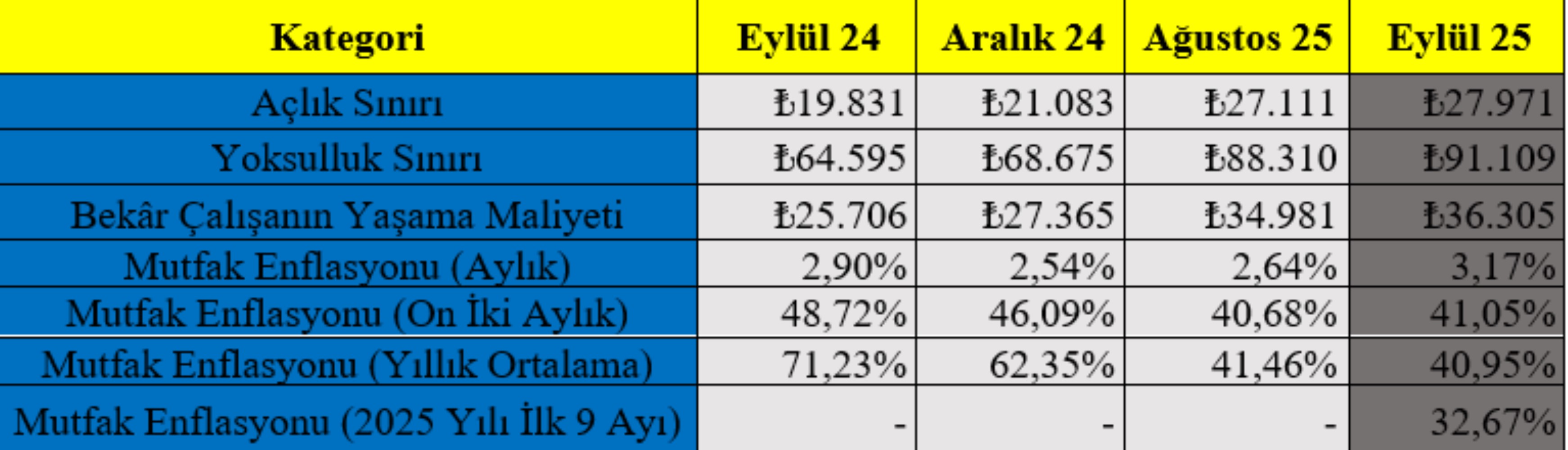
According to the research, the monthly food expenditure required for a family of four to eat a healthy and balanced diet—the hunger threshold—has risen to 27,971 TL. This amount only covers kitchen expenses. When mandatory needs such as housing, transportation, health, education, and clothing are added, the poverty line exceeds 91,109 TL. These figures are no longer just statistics; they represent a sharp line drawn between a humane life and hunger.
In contrast, the net minimum wage determined at the beginning of 2025 remained at 22,105 TL. In other words, it is far from covering even the food expenses of a family of four, falling 5,866 TL short of the hunger threshold. This situation proves that poverty has become the common fate not only of low-income segments but of the vast majority of society.
On the other hand, the cost of living for a single worker has reached 36,305 TL. The 14,200 TL gap between this and the minimum wage is a harbinger of a structural, not individual, collapse. The concept of “making a living” has been replaced by a struggle for “survival.”
CONSUMER PRICES AND FOOD INFLATION: Real Inflation is in the Market, the Greengrocer, and the Bill
To see the problem more clearly, one must look at the data from TÜİK and ENAG in more detail. Although the September figures had not yet been announced at the time of writing, the August 2025 results offer important clues. As can be seen in the table below, while TÜİK announced the annual increase in consumer prices (CPI) as 32.95%, ENAG calculated inflation at 65.49% for the same period. This difference shows the gap between official data and the real inflation felt by the public. When considered alongside TÜRK-İŞ's kitchen inflation data, the picture reveals not only the rise in prices but also the concrete crisis reflected in the public's kitchen and wallet.
According to TÜİK's August 2025 data, consumer prices increased by 2.04% compared to the previous month, and annual inflation was announced as 32.95%. While the cumulative increase since the beginning of the year reached 21.5%, inflation was measured at 39.62% according to twelve-month averages. However, the Inflation Research Group (ENAG) shared much higher rates for the same period. According to ENAG, inflation increased by 3.23% monthly and 65.49% on an annual basis in August.

The annual increase rates announced by TÜİK for expenditure items are also noteworthy: a 33.28% increase in food and non-alcoholic beverages, 24.86% in transportation, 53.27% in housing, and 60.91% in education. According to TÜİK, food prices rose by 3.02% in August alone, while TÜRK-İŞ calculated kitchen inflation at 3.17% for the same period. Even these seemingly small differences lead to a serious erosion of household budgets on an annual scale.
As a result, the gap between official inflation and the inflation felt by the citizen reveals how the economic crisis is experienced by different segments of society. Especially for fixed-income citizens, inflation is not just data consisting of statistical tables; it is a concrete struggle for life that they encounter every day in the market, at the grocery store, and in their bills. Real inflation speaks the language of the pocket and the dinner table; moreover, this voice echoes far beyond official figures.
FIRE IN THE KITCHEN, SILENCE IN THE WALLET: The True Face of Inflation
TÜRK-İŞ data reflects not just a table of numbers, but the public's daily struggle for life in all its nakedness. In September 2025, kitchen expenses increased by 3.17% in just one month; over the last twelve months, this increase reached 41.05%. This means that a meal prepared with the same ingredients last year can now be made at almost double the cost.
Grocery shopping has turned from meeting needs into determining which products to give up. Every shopping trip turns into an internal reckoning: “Can we buy milk this month? What can we put in place of meat? Can we get by with just tea and bread for breakfast?” People are forced to cut back not only on food products but on the most basic right to life.
While basic protein sources such as meat, milk, and cheese have long since turned into luxuries that are hard to reach, even fruits and vegetables are burning pockets at the market. For most families, the issue is no longer what they eat, but whether they can put food on the table at all. Moreover, this burden is increasing at the same rate in rent, electricity, water, natural gas, transportation, and education expenses. With incomes remaining fixed while expenses multiply every month, the constant decline in purchasing power makes life unsustainable for a large segment of society.
CRISIS DEEPENS, POVERTY SPREADS: Debt Begets New Debt, Households in a Spiral
While Turkey was once referred to as “one of the seven countries that can feed itself,” today tables have become dependent on imports, and agricultural production has fallen into a state of near-death. The high costs farmers face in basic inputs such as diesel, fertilizer, seeds, and pesticides make production more unsustainable every day. Inadequate agricultural support and unplanned policies leave not only the producer but also the consumer face-to-face with a heavy price. When production falls, supply narrows, and the narrowing supply inevitably pushes prices even higher.
The fact that agriculture has been removed from being a national issue and left to the mercy of the market, and that small producers, peasants, and cooperatives have been ignored, has become one of the most fundamental causes of the current food crisis. Turkey has now reached the point of importing its own tomatoes, wheat, and lentils. This shows that not only the kitchen but the country's future is under threat.
On the other hand, debt has become a new means of subsistence. Millions of people are clinging to credit cards and consumer loans to make ends meet. However, debt begets new debt, the interest burden grows, and the balance of payments is disrupted. As a result, millions of households lost in an ever-deepening debt spiral are paying a heavy price for survival.
AVERAGE INCOME IS MINIMUM, STANDARD OF LIVING IS HUNGER: Social Despair Deepens
In today's Turkey, where the minimum wage has effectively become the average wage, high inflation, injustice in income distribution, and the continuous erosion of purchasing power condemn millions of citizens to live below the hunger and poverty threshold. It has become mandatory to struggle for survival rather than just doing the math at the beginning of every month.
Yet, the definition of minimum wage states that it should be an income sufficient to meet a person's basic needs. Today, this definition has turned into almost an irony. The minimum wage, set at 22,105 TL, neither meets basic needs nor makes a humane life possible. On the contrary, by remaining below even the hunger threshold, it turns into a symbol of social exclusion and economic despair.
Moreover, the problem is not limited to workers. Teachers, nurses, civil servants, tradespeople, and retirees are also in the same vortex. All fixed-income segments are asking the same question with increasing volume: “How will we make ends meet?” This is no longer an individual search; it has become an expression of a common despair shared by large segments of society.
FROM ECONOMIC CRISIS TO PSYCHOLOGICAL DESTRUCTION: Silent Despair with an Empty Stomach at School, Empty Wallet in Life
The crisis being experienced is deeply wounding not only wallets but also minds and souls. Children are forced to go to school without breakfast; students who can only buy a simit from the canteen are no longer an exception but have become a common sight. Families are forced to postpone health expenses, and cutting back on children's education expenses is becoming a greater necessity every day. The distance between people now arises not only from income differences but from the widening gap of hope.
Unemployment, anxiety about making a living, debt burden, unpaid bills, and unaffordable medicine have become clear indicators of a social collapse and psychological destruction beyond economic problems. The silence is growing; because people are too exhausted to even speak out. The invisible face of poverty brings with it not only material but also spiritual exhaustion.
THIS COLLAPSE IS NOT FATE, BUT THE RESULT OF CHOICES: If It Changes in Favor of the People, the Future Will Change Too!
Although the current picture reflects a deepening crisis, it is not fate. When the right policies are implemented with determination and an approach that prioritizes the public interest is adopted, this trend can be reversed. Turkey's resources, human power, and potential are strong enough to overcome this crisis; as long as choices are made in favor of the people.
First and foremost, it is unacceptable that the minimum wage of 22,105 TL remains below the hunger threshold of 27,971 TL. The minimum wage should not only cover basic food needs but also make a humane life possible; it should be updated at least every six months, not once a year, and should be determined above living standards by taking regional cost differences into account. Human labor cannot be disciplined by hunger.
Furthermore, the tax burden on basic food products is crushing low-income segments. To facilitate citizens' access to basic needs, VAT on food products should be significantly reduced, and it should be completely zeroed out on products such as bread, milk, and oil. The purpose of tax policies should be to increase justice, not hunger.
Agricultural policies also need a radical transformation. Food security is not only an economic issue but also a national security issue. Therefore, agriculture should be declared a strategic sector again; direct, sustainable support that encourages production should be provided to farmers. A society that cannot produce on its own land condemns its future to imports.
The right to housing is also a basic need that must be protected. It is imperative that rents in large cities be brought under control. The housing sector, left to the mercy of the free market, is dragging thousands of people into a housing crisis. Without public oversight and regulation, the restoration of social justice is impossible.
Finally, the deep gap in income distribution must be bridged. As the difference between the rich and the poor grows, not only the economic crisis but also the social collapse deepens. The tax burden on high-income groups should be increased, and the burden on laborers should be lightened. Social solidarity should be seen as the responsibility of not only individuals but also the state.
In short, this crisis is the result of wrong policies and unjust choices. But it is also an opportunity that shows what kind of country can be built with the right choices. Because this trend is not fate, but a product of choices. And when choices are changed, the direction of the future can also be changed.
SOCIAL MUNICIPALISM: Not Temporary Support, But a Structural Pillar of a Dignified Life
The structure of the free market order, which prioritizes individual interests, makes the most vulnerable segments of society increasingly invisible and deepens the problems of disadvantaged groups. At this point, while the concept of the social welfare state imposes an obligation on the state to produce social assistance and services, social municipalism stands out as the most concrete reflection of this understanding at the local government level. Projects implemented by local governments create a multi-faceted support network reaching poor households, children, the disabled, the elderly, and women.
In the economic and humanitarian crisis we are in, social municipalism policies function as a vital lifeline. Services such as City Restaurants, Public Markets, free daycare centers, public transportation support, rent assistance, and student scholarships are not just aid that saves the day; they are structural interventions that rebuild a dignified life. These practices are more than aid to the poor; they are concrete indicators of social conscience, the reflex of solidarity, and a sense of shared responsibility. Social municipalism is no longer a choice, but a mandatory public service that fills the void created in areas where the state has withdrawn.
Social assistance, services, and socioeconomic support offered by municipalities play a critical role in mitigating the social costs of crises. Practices such as food, fuel, scholarship, and clothing assistance, and direct income support to retirees, farmers, and those in need are of vital importance, especially in meeting the basic needs of the most vulnerable groups. These supports not only contribute directly to household income but also strengthen social solidarity by reducing the feeling of poverty and social exclusion. While social municipalism projects mitigate the effects of socioeconomic inequalities, they also play an indispensable role in building a fairer and more inclusive society.
CONCLUSION: The Scream Rising from Empty Pots Can Turn into Hope
The crisis Turkey is experiencing is now read not only from empty pots but also from exhausted hopes. The silence rising from kitchens is actually the echo of a deep scream. Because an empty pot represents not only hunger but also social inequality, injustice, and the despair that has accumulated for years. This picture is a concrete reflection of wrong policies, social indifference, and a moral bankruptcy beyond economic indicators. From the student who can only buy a simit in the canteen to the retiree who postpones their medicine; from the teacher trying to make it to the end of the month with a credit card to the tradesperson who cannot put goods on their shelf, large segments of society are carrying the burden of a structural, not individual, collapse. As different segments of society move away from each other, this crisis not only deepens but becomes permanent.
It is no longer necessary to ask for “patience,” but to produce solutions. The need for a new social contract that institutionalizes solidarity, honors labor, and is based on social justice is clearer than ever. Because no people are condemned to poverty, despair, and silence. Hope is hidden in producing together, sharing fairly, and building an egalitarian order where everyone can live a humane life.
Millions of citizens, where the minimum wage has become the average wage and who are crushed under high inflation and the hunger-poverty threshold, are demanding stronger social and economic policies from central and local governments. The steps to be taken today are the key to building not only today but also the fair, inclusive, and strong Turkey of tomorrow. Strengthening the understanding of the social state and supporting local governments with a solidarity-based vision are the most fundamental conditions for social peace and sustainable development. Because the issue is no longer “making do with the minimum”; it is to guarantee the humane life that every citizen deserves. When the silence is broken and the pots boil again, not only the tables of this country but its future will be rebuilt.
Most Read

Striking picture for Özgür Özel's 'New Party'

The PKK opening and Özgür Özel’s path!..

How did the newspapers view Özgür Özel's farewell to the CHP?

He killed his wife by slitting her throat: Their children witnessed the moments

What did the CHP do?

Özel’s new party move in the world press

The New CHP, against CEHAPE

Fire at TUSAŞ engine factory in Eskişehir under control

From self-efficacy to despair

Kılıçdaroğlu's first message on Özgür Özel's new party announcement