



The world is not just going through a “difficult period,” as has been said for a long time; it is living within a new regime itself. The name of this regime is not democracy, and it is certainly not a welfare state. As Oxfam’s latest Global Inequality Report clearly reveals, the order that prevails today is an oligarchy that institutionalizes the rule of the rich. While wealth, power, and decision-making mechanisms are concentrated in the hands of a narrow minority to an extent unprecedented in history, life is becoming more expensive, more precarious, and more oppressive for billions of people every year. It is no longer possible to explain this picture through the natural functioning of the market or temporary global fluctuations; the reality we face is a permanent regime of inequality that is the product of conscious political choices.
The crisis experienced today represents not only the deterioration in economic indicators but also the systematic hollowing out of democracy and the concentration of political power in a group of a few thousand people. The fact that the wealth of the world’s 12 richest people is equal to the total savings of the poorest half of the global population is a striking summary of this order. On one side, there is a narrow minority multiplying its wealth, and on the other, there are billions of people struggling with poverty, hunger, and preventable diseases. Oxfam data clearly shows that inequality is no longer just an economic problem; it has turned into a structural threat that narrows the political sphere, erodes the equal right of citizens to speak, and fuels authoritarianism.
As wealth concentrates, democracy is increasingly confined to a formal framework. Research reveals that the widening gap in income and wealth is one of the factors that most strongly increases the risk of democratic dissolution. The picture in Turkey is no different. Far from wealth growth spreading to broad segments of society, income and wealth inequality are deepening dramatically. The rise in the number of millionaires appears not as a result of productive transformations or structural reforms, but as a result of economic instability, inflationary processes, and financial distortions. This trend clearly reveals that inequality in Turkey is no longer just economic, but has also turned into a political and social fracture.
WEALTH EXPLOSION: A World of 3 Thousand, a Price of 8 Billion
Oxfam data reveals that the rupture in global wealth distribution has reached undeniable proportions. For the first time, the number of billionaires worldwide has exceeded 3 thousand. Since 2020, the total wealth of billionaires has increased by 81%, recording a growth of 8.2 trillion dollars. As of November 2025, the total wealth of this narrow group, which exceeds 3 thousand in number, reached 18.3 trillion dollars, breaking a historical record. The 2.5 trillion dollars added to their wealth in just the last year strikingly reveals for whom the crises experienced on a global scale mean destruction and for whom they mean opportunity.
Moreover, this increase is not only large but also occurring at an extraordinary speed. The 16.2% wealth increase in the last year corresponds to exactly three times the average growth rate seen since 2020 in the post-pandemic period. While wars, climate disasters, high inflation, and the rise in the cost of living create a heavy burden for broad segments of society, this period has turned into a new “golden age” for the world’s richest.
The wealth explosion is not limited to certain countries. Although the sharpest increase is seen among US billionaires, billionaire wealth is also growing at double-digit rates in the rest of the world. The Oxfam report emphasizes that policies implemented during the Trump administration in the US, which loosened regulations and undermined initiatives to increase corporate taxes on a global scale, were decisive behind this picture. These choices accelerated wealth concentration by producing results in favor of the wealthiest segments not only in the US but on a global scale.
The concentration of wealth in such a narrow minority makes the picture even more striking. While the world’s 10 richest billionaires control a total wealth of 2.4 trillion dollars, the wealth owned by the world’s 12 richest people is equal to the total savings of the poorest half of the world’s population. The additional wealth gained by billionaires in just the last year is large enough to distribute approximately 250 dollars to every individual on earth.
In contrast, hunger, poverty, and the housing crisis continue to deepen. While billions of people struggle to access basic needs, the concentration of wealth in the hands of such a narrow segment is no longer just an economic or moral problem. This picture shows that political power is also increasingly concentrated in the same minority. As Oxfam underlines, the period we are in is not called the “decade of billionaires” for nothing; because in this process, the influence and determinative power of a few thousand people over our lives have increased more than ever before in history.
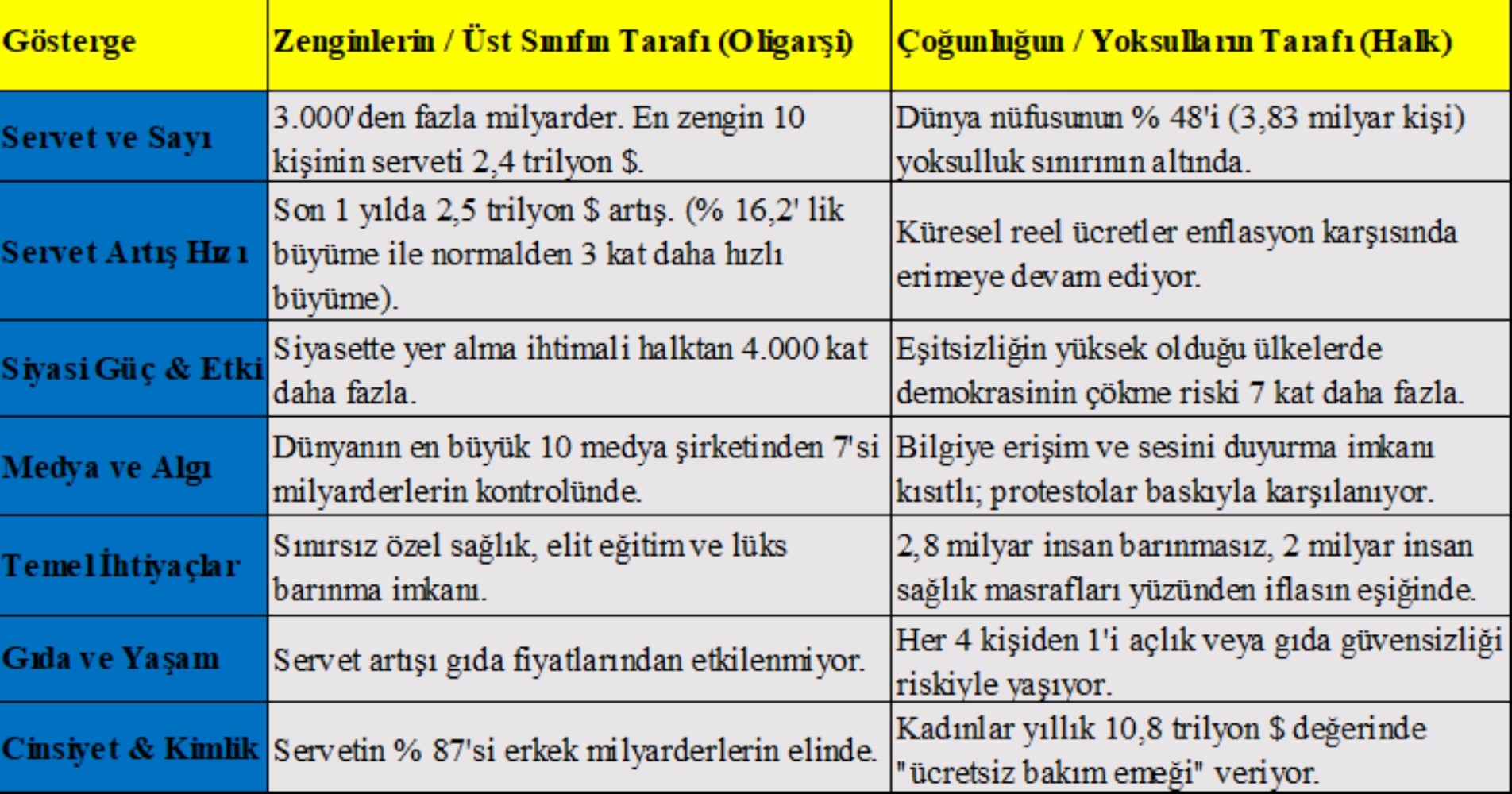
Table: Global Inequality, The Chasm Between Two Worlds
WHY DOES POVERTY NOT DECREASE WHILE WEALTH INCREASES?
For many years, defenders of the global economic order relied on a simple narrative that presented inequality as a secondary problem: “What matters is the reduction of poverty.” Oxfam’s Global Inequality Report clearly reveals that this discourse has lost its validity. After 2020, global poverty, far from decreasing, has started to rise again in many regions. As of 2022, almost half of the world’s population, that is, 3.83 billion people, live in poverty. If the current trend does not change, it is predicted that even in 2050, 2.9 billion people—about one-third of the world’s population—will not be able to escape poverty.
This picture reveals a fundamental contradiction regarding the functioning of the system. While billionaires add wealth to their wealth, billions of people struggle with poverty, hunger, and preventable diseases. Today, one in four people in the world experiences moderate or severe food insecurity; they have to skip meals regularly. The population experiencing hunger and food insecurity has increased by 42.6% in the 2015–2024 period. While food prices hover well above wage increases in almost every country, healthy nutrition is becoming a luxury for millions of households.
Moreover, this situation is not limited to low-income countries. Even in the world’s richest regions such as Europe and North America, tens of millions of people lack food security. This reality clearly shows that the problem does not stem from “insufficient resources,” but from for whom and with what priorities resources are mobilized. The global economy, instead of spreading the produced value to society as a whole, systematically concentrates it in a small minority at the very top.
Inequality is not limited to income levels; it also deepens in the fields of housing, health, and education. Today, approximately 2.8 billion people worldwide lack adequate housing conditions. In low-income countries, one-third of school-age children and youth cannot access education. While no significant progress has been made in access to universal health services in recent years, approximately two billion people face “catastrophic” health expenditures that exceed 10% of their household budget.
The burden of poverty is not distributed equally across all segments of society. Women and individuals with disabilities are affected much more severely by inequality. While women provide a total of 12.5 billion hours of unpaid care work that contributes at least 10.8 trillion dollars in value to the global economy every day, the value of this labor is almost never made visible in the economic system. Thus, inequality is reproduced not only through income differences but also through social roles and invisible labor.
The emerging picture is clear: While billionaires’ wealth increases at record speeds, poverty, hunger, housing, and health crises become permanent for billions of people. This situation is no longer a temporary social problem; it points to a structural regime of inequality that shows in whose favor economic resources and political choices work.
ECONOMIC INEQUALITY TURNS INTO POLITICAL INEQUALITY: The Danger of Oligarchy
One of the most critical findings at the heart of the Oxfam report is that economic inequality has now turned directly into political inequality. As wealth concentrates, democracy is reduced to a mere formal framework; inequality becomes one of the main dynamics fueling authoritarianism. Research reveals that the widening gap in income and wealth is one of the factors that most strongly increases the risk of democratic dissolution. Indeed, a comprehensive study examining 23 cases of democratic backsliding in 22 countries shows that the probability of democratic dissolution in countries with the highest inequality increases up to seven times compared to more equal countries.
The mechanism behind this transformation is quite clear. Extreme wealth does not only mean luxury consumption or economic privilege; it provides direct influence over politics, media power, and legal immunity. Today, the probability of billionaires reaching political office is thousands of times higher than that of ordinary citizens. According to Oxfam’s estimates, this ratio is at least 4 thousand times. The fact that more than 11% of billionaires worldwide have either held a political office directly or attempted to do so clearly shows how intertwined the relationship between economic power and political power is.
Super-rich individuals use three main channels to convert their economic power into political power. The first of these is the direct financing of politics. Large wealth owners support political parties and candidates with high-amount donations, effectively moving the will of the majority away from the “one person, one vote” principle and closer to a “one dollar, one vote” system. The fact that donations made by 100 billionaire families in the US for federal elections in 2024 alone reached 2.6 billion dollars reveals the extent this relationship has reached.
The second channel is concentrated control over the media. A large part of the global media is owned by billionaires. While billionaires own 7 of the world’s 10 largest media companies, 9 of the 10 largest social media platforms are managed by only six billionaires. The concentration of digital platforms, social media, and artificial intelligence companies around a few names in this way narrows public discourse; it reduces the visibility of different voices and weakens accountability. Under these conditions, it is becoming increasingly difficult to speak of a “free public opinion.”
The third and perhaps most direct way is for billionaires to enter political decision-making mechanisms themselves. The combination of economic power with political duties creates a structure that makes inequality permanent and institutional. The example of Najib Mikati, the former prime minister of Lebanon and also one of the country’s richest names, stands out as one of the striking examples of this intertwining. Such examples show that an order is being established where political power is increasingly fed by wealth, not by citizens.
The emerging picture is clear: As economic inequality deepens, political inequality also becomes permanent. In an order where wealth is concentrated to this extent, democracy ceases to be a system based on the equal right of citizens to speak; it turns into a narrow sphere of power where capital is decisive. Oligarchy is no longer an abstract concept; it is a concrete and growing danger facing today’s democracies.
REPRESSION INSTEAD OF REDISTRIBUTION: New Authoritarian Waves
Along with the cost of living, debt crises, and austerity policies, the liquidation of the welfare state leads to mass reactions and widespread protests all over the world. However, as Oxfam also underlines, the response of governments to these reactions is often not redistribution policies, but repression. The social anger created by inequality is tried to be suppressed with security-oriented policies instead of being resolved with social justice.
In recent years, the number of countries where the right to protest is restricted, unions are targeted, and journalists and civil society are systematically pressured has increased rapidly. Demands against inequality, instead of being treated as a legitimate part of public debate, are increasingly criminalized with “public order” and “stability” discourses. Thus, democratic demands are presented as a security problem, narrowing the political sphere.
The Oxfam report also reveals concrete examples of this trend. The harsh and disproportionate interventions against protests organized against austerity measures imposed by the IMF in Kenya in 2024; the heavy state violence and legal restrictions applied to anti-inequality demonstrations in Colombia, Argentina, and Pakistan are among the striking cases showing that the preference of governments in the face of economic crises is not redistribution, but repression. These examples reveal that the suppression of social reactions has now become not an exception, but a structural management practice.
This picture clearly shows that the link between inequality and authoritarianism is not coincidental. In an order where wealth and power are concentrated in a narrow minority, silencing society becomes almost mandatory for the system to be sustainable. As inequality deepens, democracy ceases to be a right for those who govern; it begins to be seen as a risk that must be managed. Political powers prefer to suppress the results of inequality rather than eliminate its causes.
In this process, immigrants and social minorities are also consciously targeted. Far-right parties and media platforms, often funded by the super-rich, declare immigrants and vulnerable social groups as scapegoats, distracting public attention from the root causes of extreme inequality. Responsibility for economic crises and social discontent is directed at the most vulnerable segments rather than the policies that shape the system. Thus, inequality not only deepens; it also becomes a useful tool for authoritarian politics.
GROWING WEALTH, DEEPENING INEQUALITY IN TURKEY
When looking at the global picture from the Turkish front, the scene becomes even more striking. Turkey is among the leading countries that have announced high growth rates in recent years; however, it is one of the countries that cannot reflect this growth to the living conditions of broad segments of society. While wealth distribution is rapidly deteriorating, income injustice gains a permanent character. Economic growth takes on a structure that serves not the increase in welfare, but the deepening of inequality.
National and international wealth reports reveal that Turkey is one of the countries where the number of millionaires is increasing the fastest. Despite this, Turkey maintains its place among the countries with the highest income inequality among OECD countries. In other words, wealth is increasing; but this increase goes to a very narrow segment of society. An economic structure where the minimum wage effectively turns into the average wage and working poverty becomes widespread is becoming increasingly permanent.
In Turkey, high inflation rapidly erodes the purchasing power of fixed and low-income segments, while segments with access to financial assets, foreign currency, and real estate not only protect their wealth but also grow it. While food prices, housing costs, and energy expenditures suffocate the budgets of households, the crisis environment turns into an opportunity for wealth owners. This situation causes the global inequality trend to be experienced much more harshly and destructively in Turkey.
More importantly, economic inequality in Turkey progresses hand in hand with political inequality. While the political representation power of impoverished broad segments of society weakens, the influence of capital groups on policy-making processes increases. While the tax system puts a disproportionate burden on low-income earners through indirect taxes; wealth, rent, and financial gains are not taxed sufficiently. This structure works as a mechanism that reproduces inequality.
The emerging picture is nothing but the reflection of the “rule of the rich” model that Oxfam describes on a global scale in Turkey. This order, where wealth is concentrated in a narrow minority and broad segments of society face increasing living costs and precariousness, points not only to an economic but also to a political and social fracture.
OLIGARCHY OR DEMOCRACY: Turkey is at the Same Crossroads
The Oxfam report reminds us again of a fundamental truth that was voiced a hundred years ago but has become much more burning today: Extreme wealth accumulation and true democracy cannot coexist. In any order where wealth and power are concentrated in a narrow minority, political equality is inevitably eroded. Turkey is standing exactly at this crossroads today. Either a strong welfare state and a fair tax system that corrects income and wealth distribution will be built, or deepening inequality will further fuel political tensions and authoritarian tendencies.
Therefore, the issue is not limited to economic growth or welfare indicators; it is directly a democratic issue. The fact that poverty, precariousness, and income injustice become permanent in Turkey does not only mean a decline in living standards. It also results in the weakening of citizens’ influence in the political sphere, the narrowing of representation channels, and the public sphere becoming increasingly closed.
As inequality deepens, politics ceases to be a space of solution for broad segments of society. While the demands of citizens with limited economic power find less place on the public agenda, the priorities of capital groups become decisive in policy-making processes. This situation imprisons democracy in a formal structure reduced only to the ballot box; it hollows out a political order based on equal right to speak.
For Turkey, the critical question is now clear: Will a transformation that reduces inequality and centers labor and social welfare be preferred; or will an order that normalizes wealth concentration and the accompanying political narrowing become permanent? This choice, beyond a technical economic debate, is the fundamental political decision that will determine the country’s democratic future.
WHAT SHOULD BE DONE FOR A MORE EQUAL FUTURE?
The Oxfam report emphasizes that global inequality is no longer a manageable side effect; it has become a structural crisis that directly threatens democracy, fundamental rights, and social peace. Therefore, the proposed set of solutions cannot be reduced to limited reforms or temporary social support. What is needed is a holistic approach that aims to redesign the economic and political order on the basis of equality.
The first and most fundamental step is the radical reduction of economic inequality. According to the report, high wealth concentration and permanent poverty have become the main driving force behind the erosion of rights and freedoms. Therefore, it is recommended that all countries create “National Inequality Reduction Plans” that have a time limit and are monitored regularly. The main goal of these plans should be to reduce the Gini coefficient in income distribution to below 0.3 and to permanently push back wealth inequality. The way to do this passes through a wide set of policies ranging from effectively taxing the super-rich to breaking up monopolistic corporate structures; from increasing the wages of low- and middle-income groups to expanding free and qualified public services. Especially in Global South countries, alleviating the pressure created by the debt crisis stands out as one of the prerequisites for the fight against inequality.
The second fundamental step is to limit the political power of the super-rich. Oxfam emphasizes that economic power does not automatically turn into political power; this largely depends on the regulatory framework established by countries. Therefore, a strong “firewall” that cuts off the influence of wealth on politics needs to be built. In the report, measures such as reducing the economic power of the super-rich by taxing them effectively, strictly regulating lobbying activities and “revolving door” relationships between the public and private sectors, closing election campaigns to large donations, and limiting concentration in media ownership stand out. Ensuring algorithmic transparency in media and digital platforms is also considered a critical element in terms of the pluralism of public debate.
The third and perhaps most critical step is the reconstruction of the political power of broad segments of society. According to the report, the fight against inequality can be possible not only with top-down policies but with the real and continuous participation of citizens in decision-making processes. For this, legal and administrative obstacles in front of unions, civil society organizations, and grassroots movements must be removed; rights to expression, organization, and protest must be guaranteed. Oxfam emphasizes that the strongest antidote to authoritarianism is a vibrant, participatory, and inclusive civil space. Participatory budgeting practices in Latin America or models that strengthen the political representation of indigenous peoples are among the concrete examples of this approach.
Finally, the report draws attention to the fact that the fight against inequality should be institutionalized at the international level. Similar to the role played by the IPCC in the climate crisis, it is proposed to establish an independent International Inequality Panel that monitors global inequality, shares data transparently, and develops policy recommendations. Such a structure will not only make the dimensions of inequality visible; it will also create a permanent accountability pressure on governments.
According to Oxfam, the issue is not just a fairer income distribution; it is a clear choice between oligarchy and democracy. In a world where inequality is so deep, one will either resign oneself to the concentration of wealth and power in a small minority or a more egalitarian order that centers the voice and political influence of citizens again will be built.
The inequality experienced in the world and in Turkey today is neither an unfortunate deviation nor an inevitable fate; it is the result of clear and conscious political choices. Every order that turns a blind eye to the concentration of wealth in the hands of a few thousand people erodes the equal right of citizens to speak while reducing democracy to a formal shell. Therefore, the issue is not just a demand for a fairer income distribution; it is a matter of who governs, who is excluded, and whose voice is heard. The choice ahead is clear: We will either normalize an oligarchic order or we will courageously build a new social contract based on equality, justice, and democracy.
CONCLUSION: Inequality is Not an Accident, It is a Choice
The inequality experienced in the world and in Turkey today is neither an unfortunate deviation nor an inevitable fate; it is the result of clear and conscious political choices. Every order that turns a blind eye to the concentration of wealth in the hands of a few thousand people erodes the equal right of citizens to speak while reducing democracy to a formal shell. Therefore, the issue is not just a demand for a fairer income distribution; it is a matter of who governs, who is excluded, and whose voice finds a response in the public sphere.
Oxfam’s Global Inequality Report reveals this truth with all its clarity. The inequality experienced today is not an unexpected side effect of the system; it is the natural result of an economic and political order that prioritizes capital, not labor; rent, not production; and maximum profit, not social welfare. As long as this logic does not change, it is not realistic to expect poverty to decrease, the middle class to strengthen, or democracy to deepen. Because democracy does not strengthen unless inequality decreases; inequality becomes permanent unless democracy strengthens.
The picture in Turkey is no different. While high inflation, low wages, and precarious working conditions impoverish broad segments of society, wealth owners can turn even crisis periods into an advantage. The injustice in the tax system and the weakening of the welfare state turn this process not only into an economic but also into a political inequality.
At the point reached today, the fight against inequality is also a struggle to defend democracy. Effectively taxing the super-rich, limiting wealth concentration, strengthening public services, and protecting labor are not just technical economic topics, but democratic necessities. The choice ahead is clear: We will either normalize an oligarchic order where wealth and power are concentrated in a narrow minority or we will courageously build a new social contract based on equality, justice, and democracy.
True welfare growth is possible with the rise of the standard of living of the entire society.
True wealth is hidden not only in the size of the wealth; but in how and with whom it is shared.
Most Read

Striking picture for Özgür Özel's 'New Party'

The PKK opening and Özgür Özel’s path!..

How did the newspapers view Özgür Özel's farewell to the CHP?

He killed his wife by slitting her throat: Their children witnessed the moments

What did the CHP do?

Özel’s new party move in the world press

Fire at TUSAŞ engine factory in Eskişehir under control

The New CHP, against CEHAPE

From self-efficacy to despair
Kılıçdaroğlu's first message on Özgür Özel's new party announcement