



We are entering the year 2026 in an economic order where high inflation has become permanent and the minimum wage has ceased to be an exception, effectively turning into the average wage. Despite nominal increases, the minimum wage, which remains below the hunger and poverty thresholds, has moved away from being a livelihood guarantee for millions of workers; it has become synonymous with the struggle to survive.
As the purchasing power of wages erodes rapidly, the deterioration in income distribution deepens, and the increase in prosperity is replaced by permanent impoverishment. The minimum wage announced for the 2026 fiscal year has remained well below expectations despite high inflation, real wage losses, and rising living costs. The increase of the net minimum wage from 22,104 TL in 2025 to 28,075 TL with a 27% hike points to an income level that remains below even the hunger threshold. Moreover, the fact that this amount has effectively become the average wage makes it more visible that the problem is not temporary, but structural.
While the proportion of minimum wage earners is limited in developed countries, the fact that the majority of workers in Turkey earn income at or around the minimum wage—with approximately 62% of private sector employees receiving wages up to 20% above the minimum wage or less—shows that the middle class is rapidly eroding and the cost-of-living crisis has acquired a social character. This picture clearly reveals that the problem has deepened too much to be solved only by wage increases; for central and local governments, stronger, holistic social and economic policies have become not a choice, but a necessity.
INCREASING WAGE, DECREASING PURCHASING POWER: How Real is the Minimum Wage Increase Against Inflation?
The net minimum wage, which will be effective from January 1, 2026, was announced as 28,075 TL. This amount represents a 27% increase compared to the 22,104 TL minimum wage determined at the beginning of 2025 and kept constant throughout the year. At first glance, this rate, as seen in the table below, remains above the revaluation rate of 25.49% to be applied for 2026 and corresponds to approximately the same level as the food inflation of 27.44% announced according to TURKSTAT's December 2025 data. However, the same rate of increase remains significantly behind the annual inflation forecast of approximately 32% by TURKSTAT and 57% by ENAG.
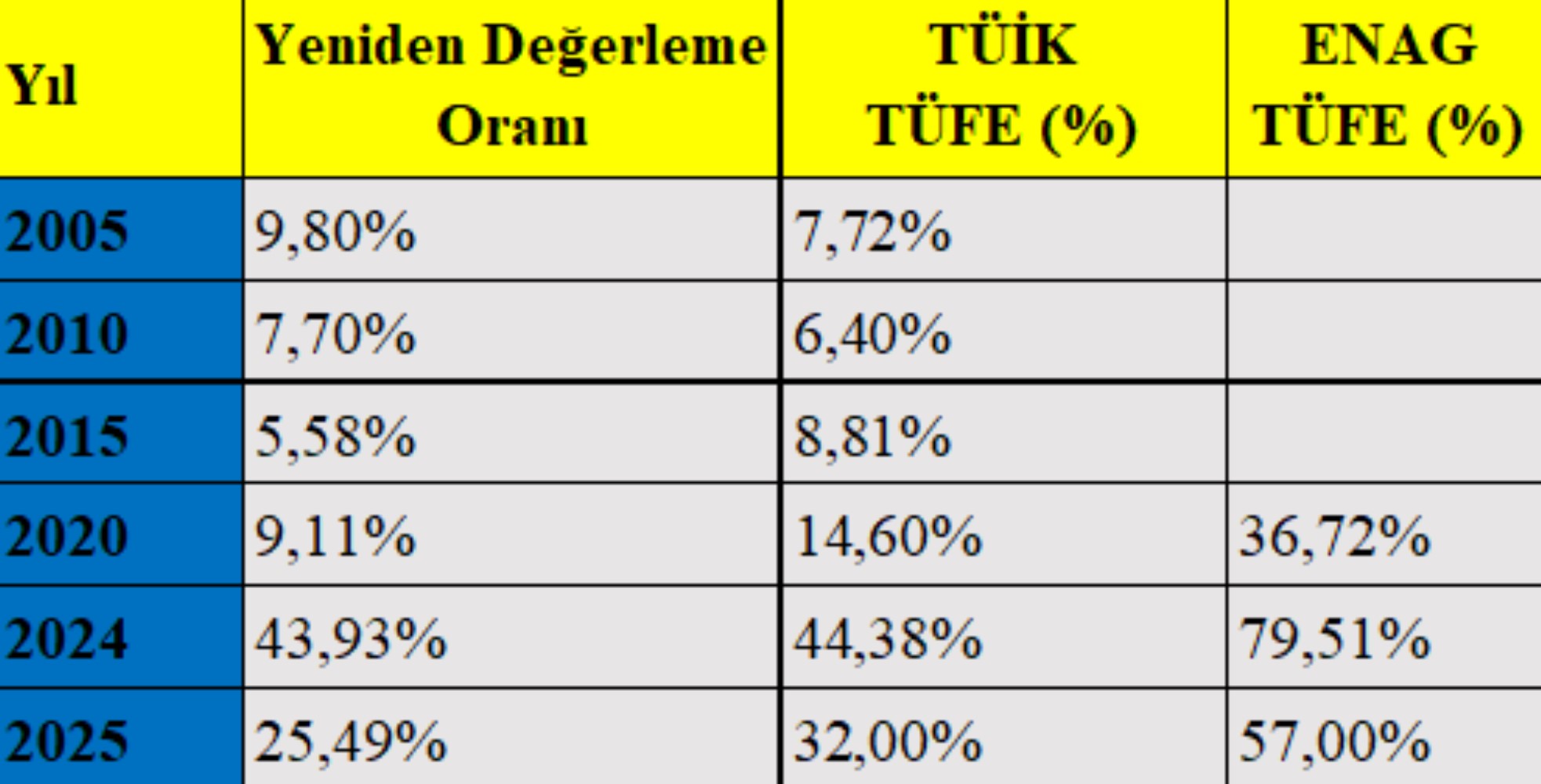
Table: Revaluation and CPI Rates for 2005-2025
Keeping the minimum wage constant throughout 2025 led to a significant erosion in the purchasing power of workers. Excluding November, the minimum wage lost approximately 3% of its real value almost every month. This picture reveals that the increase made for 2026 is more of a limited compensation for the loss accumulated during the year than a real increase in prosperity. Moreover, the fact that the minimum wage is determined only once a year appears as one of the fundamental problems that makes real income loss permanent and structural, let alone protecting the purchasing power of low-income segments.
A similar picture is seen in the 2024 and 2025 data. While inflation was 44.38% in 2024, the minimum wage increase remained at 30%; this caused a real loss of approximately 15% in the purchasing power of minimum wage earners. Assuming that 2025 inflation will be at the 32% level, when the cumulative losses of the last two years are taken into account, the inadequacy of the 27% increase determined for 2026 becomes much clearer.
Therefore, the issue is not just the announced nominal increase rate. The real problem is the real position of the minimum wage against living costs and its share in social welfare. The fundamental question that needs to be answered is this: Does this increase provide a permanent improvement in the living standards of workers, or does it offer only a temporary correction that compensates for a small portion of past losses?
ONE RAISE A YEAR, CONSTANT LOSS: Minimum Wage Melting Against Gold and Dollar
When looking at the long-term trend of the minimum wage, the extent of the erosion in purchasing power is seen much more clearly. According to CBRT data, while approximately 19 grams of gold could be purchased with the minimum wage in 2005, this amount fell to 10 grams in 2010 and 2015, and to 7 grams in 2020. Although it reached the 10-gram level again in 2024, this amount fell to 3.5 grams in 2025; as of the beginning of 2026, it has become possible to purchase approximately 4.6 grams of gold with the minimum wage. Considering that the minimum wage will remain constant throughout the 2026 fiscal year and the upward trend in gold prices will continue, it seems inevitable that this purchasing power will fall even further by the end of the year.
In dollar terms, the picture looks different at first glance. The minimum wage rose to the 260 dollar level in 2005 and 390 dollars in 2010; it remained at approximately the same level in 2015 and 2020. The wage, which rose to 660 dollars in 2024, fell to 520 dollars at the end of 2025; it reached the level of approximately 655 dollars at the beginning of 2026. However, considering that the minimum wage will remain constant throughout the year and exchange rate pressure will continue, it is likely that its dollar equivalent will fall again at the end of the period.
This picture shows that although the minimum wage appears to have increased from time to time in dollar terms, these increases are largely due to exchange rate movements. There is no corresponding improvement in the real position of the wage earner against basic needs. In this respect, gold stands out as an indicator that reveals the real value loss of the minimum wage over time more clearly. When the 27% increase for 2026 is converted into its gold equivalent, it corresponds to an increase of only about 1.1 grams on a monthly basis; this is far from compensating for the loss accumulated over the last twenty years.
When evaluated together with TÜRK-İŞ's kitchen expenditure data, the picture becomes even more striking. In an environment where the annual increase in food expenditures remains high, the increase in the minimum wage is defeated by kitchen inflation at the very first stage. For this reason, the fact that the wage appears to have risen in dollar terms is not enough to compensate for the real loss experienced by the wage earner.
While gold is one of the simplest indicators measuring the real value loss of the minimum wage over time, the dollar only reflects the nominal equivalent of the wage on an international scale. However, considering the cost of living and mandatory expenditures at home, it is clear that these nominal increases do not point to a permanent improvement in the welfare of the wage earner. When these two indicators are read together, it is clearly revealed that the wage-earning segment is facing a structural impoverishment process in the long term.
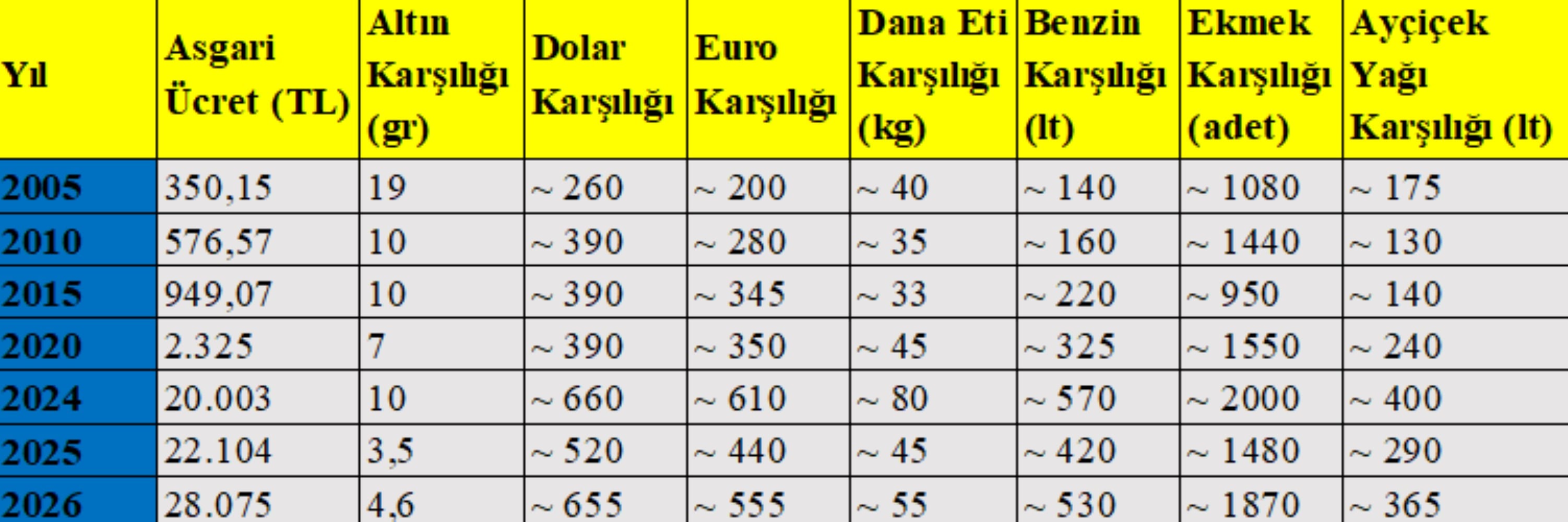
Table: The Equivalent of the Minimum Wage's Eroding Purchasing Power Over Time
These comparisons made over the 2005–2026 period show that although the minimum wage appears to have increased in dollar and euro terms in some years, interpretations that there is an improvement in the real living conditions of families who have to allocate a large part of their income to food expenditures remain incomplete. Comparisons based on changes in purchasing power, taking into account the increase in mandatory expenses, especially food, reveal the differences in minimum wage between periods much more realistically.
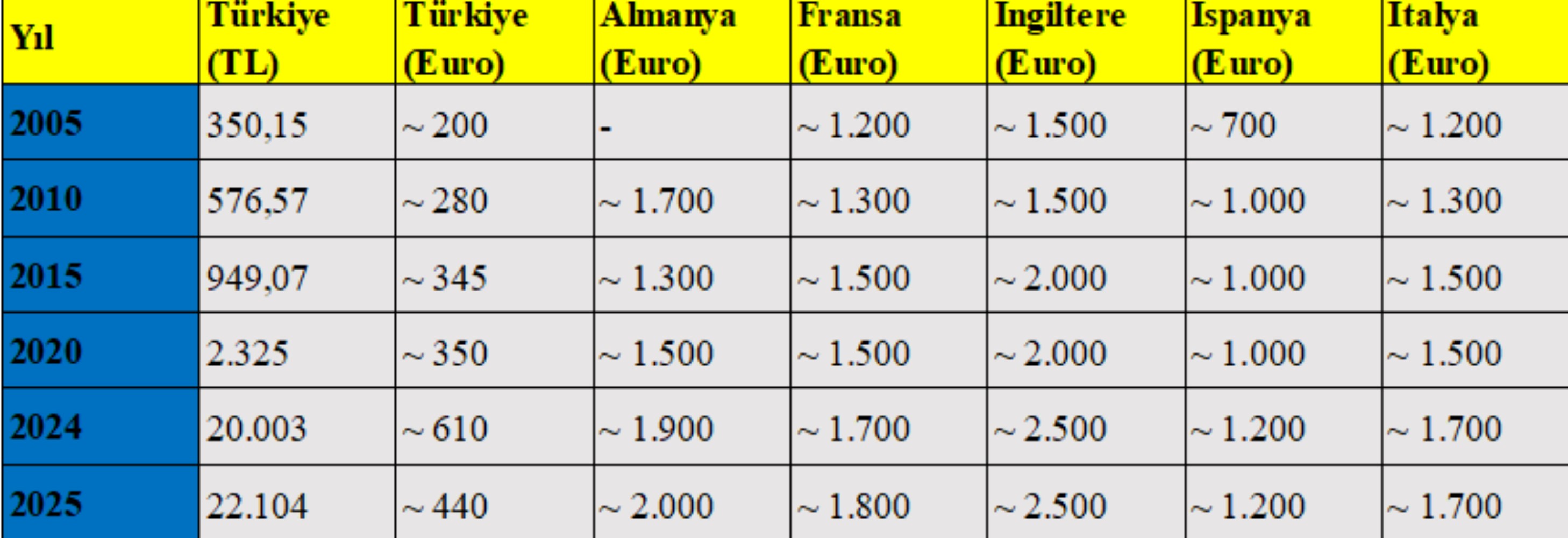
Table: Minimum Wage Changes in Turkey and Some European Countries
The table above reveals that the gap between the minimum wage in Turkey and European countries has widened significantly over the years and that the wage exhibits a fragile structure that is extremely dependent on exchange rate movements. The minimum wage in Turkey does not follow a stable increase in Euro terms; on the contrary, it is shaped by volatile and temporary rises. This volatile course causes the gap between Turkey and European countries to widen gradually. The difference, which was relatively limited in 2005, becomes much more pronounced as of 2024–2025, with the minimum wage in Turkey remaining at about one-fourth of that in Germany and France, and one-fifth of that in the UK. This picture clearly reveals that exchange rate-driven increases cannot be read as an increase in prosperity.
Despite periodic rises in Euro terms, high inflation and rising living costs rapidly erode the real earnings of minimum wage earners. As a result, the table shows that the minimum wage in Turkey is not only low compared to Europe; it also has a structure that is open to exchange rate and inflation shocks and has weak income security. In contrast, the minimum wage in European countries continues to function as a more predictable and protective income tool.
NOT A LIVING WAGE: Minimum Wage Below the Hunger and Poverty Threshold
At the point reached today, the minimum wage is stuck at an income level that cannot even cover the hunger threshold of a four-person household. The gap between it and the poverty threshold is widening every month. This picture completely removes the minimum wage from being a “living wage,” making it an incomplete and fragile income that does not even make it possible to live alone.
TÜRK-İŞ's November 2025 data reveals this reality indisputably. According to TÜRK-İŞ's November 2025 data, the monthly food expenditure amount required for a family of four to be able to eat healthy, balanced, and adequately (HUNGER THRESHOLD) has reached 29,828 TL, and the total amount of other monthly expenditures mandatory for clothing, housing (rent, electricity, water, fuel), transportation, education, health, and similar needs along with food expenditures (POVERTY THRESHOLD) has reached the level of 97,159 TL. The minimum cost of living for a single worker is calculated as 38,752 TL.
In light of this data, the minimum wage determined as 28,075 TL remains below the hunger threshold before the salary even enters the household. Moreover, considering that this wage will remain constant throughout 2026, the picture becomes not only severe but alarming. The minimum wage has now turned into an income level that describes not poverty, but direct hunger.
This situation shows that low-income segments are rapidly moving away from meeting their basic needs. Especially in an environment where food prices cannot be controlled, the purchasing power of the minimum wage earner erodes a little more each month. This disconnect between income and living costs turns the cost-of-living crisis from an individual problem into an open area of social risk.
TÜRK-İŞ data reveals that this picture points to a structural collapse, not a temporary one. The gap between the hunger threshold and the minimum wage is the result of not just a single raise period, but of welfare loss accumulated over years. As wage increases fall behind prices, each new raise actually turns into a declaration that the previous loss could not be compensated.
Precisely for this reason, social municipalism, which is the local leg of the social state, has now become not a choice, but a mandatory area of public intervention that slows down social disintegration.
SOCIAL MUNICIPALISM: Local Intervention in the Cost-of-Living Crisis
The structure of the free market economy, which prioritizes individual interests, deepens the problems of disadvantaged and fragile segments as income distribution deteriorates. Poverty and food insecurity are no longer an individual inadequacy; they appear as a direct public issue. This picture imposes a more active and decisive responsibility on local governments within the framework of the social welfare state concept.
In periods of economic crisis, food security for local governments becomes not just a social policy heading; it becomes one of the fundamental elements of public health and social solidarity. Policies aimed at affordable and accessible food go beyond classic social assistance and have the character of a structural intervention that directly reduces the pressure on the household budget.
In this context, the widespread city restaurants (kent lokantaları) stand out as a permanent support mechanism that responds directly to the basic nutritional needs of low-income segments, beyond the understanding of social assistance. These practices, which limit food expenditures, assume an important public function that reduces social fragility in crisis conditions.
The practices recently implemented by the Bursa Metropolitan Municipality offer a concrete example of public interventions developed against the deepening cost-of-living crisis in Turkey. Looking at the current service prices of the municipality, it is clearly seen how living costs are tried to be lowered through public support. Accordingly, while water is offered at 5 TL, tea at 10 TL, and Bursa kazan simidi at 20 TL in BURFAŞ cafes, which is one of the municipality's 8 subsidiaries, a meal can be covered for 80 TL in the City Restaurant.
When compared with the daily food costs calculated by TÜRK-İŞ, these prices go beyond just being “cheap”; they create a critical support area that determines the survival threshold for the minimum wage earner. In an environment where even a single meal in the market is far above these figures, city restaurants effectively function as a buffer mechanism between hunger and poverty.
Let us assume that a family of four, which is the sample used in TÜRK-İŞ's hunger threshold calculation, lives in Bursa and that this family regularly benefits from the public services of the Bursa Metropolitan Municipality. The picture that emerges when considering a nutritional regimen where family members cover two of their meals a day at the City Restaurant and have breakfast with tea and simit in the mornings is noteworthy.
In these facilities of the Bursa Metropolitan Municipality, the monthly food expense of a family of 4 will be 22,800 TL:
In the event that a family of four's daily two meals, lunch and dinner, are covered at 80 TL per person, the daily meal expenditure reaches 80*2*4=640 TL, and the monthly meal expenditure reaches 640*30= 19,200 TL.
When 10 TL of tea and 20 TL of simit are consumed per person for breakfast, the daily breakfast cost for a family of four at the same prices as the previous year is (10+20)*4=120 TL. When this amount is calculated on a monthly basis, the breakfast expense reaches 120*30=3,600 TL.
With this calculation, the total monthly food expenditure of a family of four benefiting from these public services offered by the Bursa Metropolitan Municipality is at the level of 22,800 TL. When compared with the 29,828 TL hunger threshold determined for a family of four according to current TÜRK-İŞ data, it is seen that a reduction of approximately 7,000 TL is achieved in food expenditures thanks to these public supports. This indicates that the hunger threshold can be pulled down by ((29,828-22,800)/29,828))*100= 23.56% specifically in Bursa.
In this context, considering the net minimum wage of 28,075 TL, the amount remaining for the minimum wage earner after only food expenditures are covered is limited to approximately 5,275 TL. This picture clearly reveals why social supports are no longer complementary but serve a vital function.
The scope of these services is also noteworthy. The fact that more than 400 thousand people have benefited from city restaurants in Bursa within a year shows that these practices correspond to a wide social need, not a limited segment. Similarly, the 10 thousand suspended meal (askıda yemek) practice reveals that solidarity is evolving from individual donations to a corporate and sustainable structure. While there are currently 7 city restaurants across the city, the increase in the number of restaurants operated directly by the Metropolitan Municipality to 3 shows that this approach is adopted not as a temporary project, but as a permanent livelihood policy.
While the emerging picture clearly reveals how critical a role social support mechanisms play, especially on food expenditures, it also reveals why these supports are increasingly becoming a mass need.
WHY DO LOCAL GOVERNMENTS BEAR THIS BURDEN?
Under normal conditions, the fight against hunger and affordable nutrition policies should be in the primary responsibility area of the central government. However, in an economy where the minimum wage remains structurally insufficient, this responsibility has effectively been placed on the shoulders of local governments.
The fact that the poverty threshold announced by TÜRK-İŞ is approaching 100,000 TL clearly reveals why this burden has remained with the municipalities. When the central wage policy becomes unable to cover even the minimum cost of living, local governments turn into the last line of defense that slows down social collapse.
This picture points to the income distribution problem in the country rather than the success of the municipalities. The spread of city restaurants, the institutionalization of suspended meal practices, cheap water, and basic food services emerge as tools to compensate for the deepening loss of welfare, not for the increase in welfare.
If the minimum wage remains below the hunger threshold, and if city restaurants turn into a mandatory lifeline rather than a social preference; the problem is not that municipalities are “too social,” but in central policies that cannot protect labor. Local governments are building the last buffer that delays hunger today. However, the permanent solution does not pass through the kitchens of municipalities, but through a fair, predictable, and living-cost-based wage policy of the central government. Otherwise, social municipalism will continue to be a tool for continuing the fight against poverty, not for sharing prosperity.
CONCLUSION: There is a Raise, No Solution, Solidarity is Mandatory
In 2026, although the minimum wage appears to have increased on paper, it continues to shrink in the kitchen. This wage, which remains below the hunger threshold before it even enters the household, loses its quality of being a “living wage” by eroding against inflation throughout the year. The loss against gold, foreign currency, and food prices clearly reveals that the problem stems not only from periodic raise rates but from a structural impoverishment process.
Although the determined minimum wage increase gives workers a limited breath in the short term, it seems far from offering a living standard that permanently rises above the poverty threshold in the long term. When evaluated together with TÜRK-İŞ's hunger and poverty threshold data, it is seen that wages have declined in real terms and the cost-of-living crisis has ceased to be an exception and turned into a social norm. In this picture where the minimum wage has effectively become the average wage, the livelihood problem is now a widespread and permanent reality for millions of workers.
These conditions show that citizens are demanding stronger, more inclusive, and permanent social and economic policies from both the central government and local governments. Social municipalism practices also stand out as concrete responses to this demand. City restaurants, affordable basic services, and food supports create a de facto ground for solidarity aimed at compensating for the deepening loss of welfare, not for the increase in welfare. These practices play a vital role in limiting the effects of socioeconomic inequalities and keeping social solidarity alive.
However, this picture points to the inadequacy of the current wage policy rather than the success of the municipalities. The solidarity networks established by local governments cannot replace a fair and sustainable wage order. The permanent solution is the construction of an economic structure where the minimum wage can constantly exceed the hunger and poverty thresholds and where workers can meet their basic needs without being dependent on social supports.
Nevertheless, under current conditions, strengthening the social policies of local governments is not a choice, but a necessity. Expanding city restaurants, increasing free or low-cost nursery services, making social assistance more planned and inclusive, and increasing the financial and administrative support of the central government to local governments are the main headings of this process. Allocating a larger share to social expenditures in municipal budgets will pave the way for permanent improvements for fragile and disadvantaged segments.
In this framework, the creation of a transparent and comparable “Social Municipalism Index” that measures the social policy performance of municipalities could also be an important tool. Such data-driven mechanisms will serve as a guide for both the public and policymakers.
As a result, social municipalism practices developed to alleviate the destruction caused by economic crises should be handled as long-term strategies that strengthen social justice, not as temporary assistance mechanisms. However, this picture reveals the inadequacy of the current central wage policy rather than the success of the municipalities. A permanent solution is possible not with policies focused on managing poverty, but with the establishment of a fair and sustainable economic order where labor is secured with an income sufficient to live humanely.
Reaching this goal depends on strong cooperation between central and local governments and the implementation of a fair wage policy based on living costs. This cooperation is not a choice; it is a mandatory condition for Turkey to reach a more egalitarian, resilient, and sustainable social structure.
Most Read

Striking picture for Özgür Özel's 'New Party'

The PKK opening and Özgür Özel’s path!..

How did the newspapers view Özgür Özel's farewell to the CHP?

He killed his wife by slitting her throat: Their children witnessed the moments

What did the CHP do?

Özel’s new party move in the world press

Fire at TUSAŞ engine factory in Eskişehir under control

The New CHP, against CEHAPE

From self-efficacy to despair

Kılıçdaroğlu's first message on Özgür Özel's new party announcement