



A state's fiscal reputation is measured not only by the revenue it collects, but also by the principles and priorities it follows when spending that revenue. Public borrowing is an inevitable tool for modern economies; however, this tool also has a limit. That limit forms the security line of fiscal sovereignty.
The fact that the Treasury's borrowing limit in Turkey has been effectively exceeded recently shows that budget discipline has ceased to be a technical issue and has turned into a problem of institutional trust. The Treasury borrowing limit is not just a balancing element when financing the budget deficit; it is also one of the fundamental pillars of fiscal discipline, predictability, and institutional seriousness.
For a country's Treasury, the borrowing limit is an indicator of the state's fiscal discipline and democratic oversight over the public's budget. This limit was established to prevent arbitrary spending, election-driven economics, and populist fiscal policies. However, in recent years, it has been observed that this framework is increasingly being stretched, and even effectively breached. Legal limits have now become more of a "suggestion" than a rule.
This picture shows that economic management is strengthening the tendency to turn to borrowing rather than generating revenue. The increasing debt stock, shortening maturities, and rising interest burden clearly reveal that fiscal discipline has been replaced by financing policies that only save the day.
This situation, which is also reflected in the latest reports of the Ministry of Treasury and Finance, is no longer just a debate about budget deficits; it points to a critical breaking point where the state's fiscal morality, institutional reputation, and trust in the future are being tested.
LEGAL BASIS: The Meaning and Purpose of the Treasury Borrowing Limit
The Treasury's borrowing authority is not unlimited. Article 5 of Law No. 4749 on the Regulation of Public Finance and Debt Management clearly stipulates that the net borrowing to be made in a fiscal year cannot exceed the amount of that year's budget deficit. This regulation requires public finance to operate within a discipline proportional to its own budget size. In other words, if a deficit of 2 trillion TL is projected in the budget, the Treasury can borrow a net amount of no more than this figure.
The law makes it possible to stretch this limit only in exceptional circumstances. The Minister of Treasury and Finance can increase the borrowing limit by a maximum of 5%; if deemed necessary, the President can also authorize an additional increase of the same rate. Thus, the total annual increase rate is limited to a maximum of 10%. However, in recent years, this exception has turned into an almost permanent practice. Expanding the borrowing limit every year through these powers shows that the legal framework is no longer a tool for oversight, but a formality that is easily bypassed.
This trend marks a period where the fiscal rule has become "present in the law but absent in practice." Fiscal policy is moving away from predictability and focusing on short-term cash management instead of maintaining budget balance. Thus, while the institutional foundation of fiscal discipline is eroding, trust in public finance is also being damaged.
DEBT STOCK OUTLOOK WITH CURRENT DATA: Discipline or Arbitrariness?
According to the 2025 Central Government Budget Law published in the Official Gazette dated December 31, 2024, and numbered 32769 (Repeated), approximately 14 trillion 606 billion TL in appropriations have been allocated to public administrations within the scope of the general budget, while 12 trillion 670 billion TL in revenue has been targeted. The difference of approximately 1 trillion 935 billion TL represents the budget deficit projected for 2025, and therefore the Treasury's borrowing requirement.
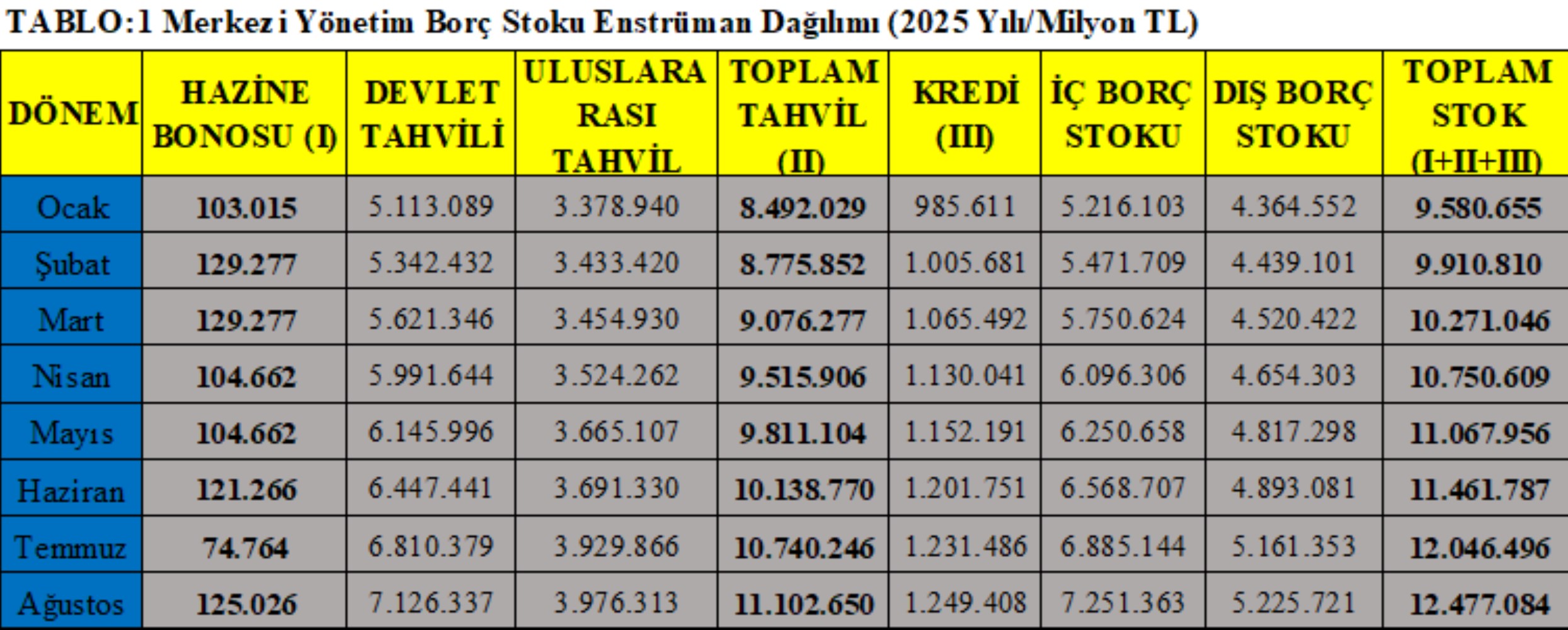
However, the increase in borrowing in the first eight months of the year has exceeded these limits. The nominal debt stock increase was 2 trillion 900 billion TL, and the net increase was at the level of 2 trillion 52 billion TL. Yet, by law, this amount should be limited to the projected budget deficit, i.e., approximately 1 trillion 935 billion TL. According to the additional powers granted by the law, the Minister of Treasury and Finance can increase this limit by 5%; the President can also reach an upper limit of approximately 2 trillion 130 billion TL in total with an additional 5% increase. However, the current picture reveals that this legal framework has been effectively breached.
Another piece of data showing that the appetite for borrowing continues is the Ministry of Treasury and Finance's domestic borrowing strategy for the October–December 2025 period. Accordingly, the Treasury aims to make 538.5 billion TL in new domestic borrowing against 466.8 billion TL in domestic debt for the three-month period. In other words, a net borrowing of approximately 15% above the old debt is planned.
On a monthly basis, the picture is clearer: In October, 290.1 billion TL in new borrowing is projected against 263.6 billion TL in repayments, which means a debt rollover ratio of 110%. In November, 117.6 billion TL in new borrowing is targeted against 95 billion TL in debt. In December, 130.8 billion TL in new borrowing is expected against 108.2 billion TL in debt. These data point to an increasing borrowing pace and a rising debt rollover ratio every month.
The August 2025 data clearly show the acceleration in borrowing. According to Ministry of Treasury and Finance reports, the central government debt stock increased by 430 billion TL in August to 12 trillion 477 billion TL. Of this amount, 7 trillion 251 billion TL consists of domestic debt, and 5 trillion 225 billion TL consists of external debt items.
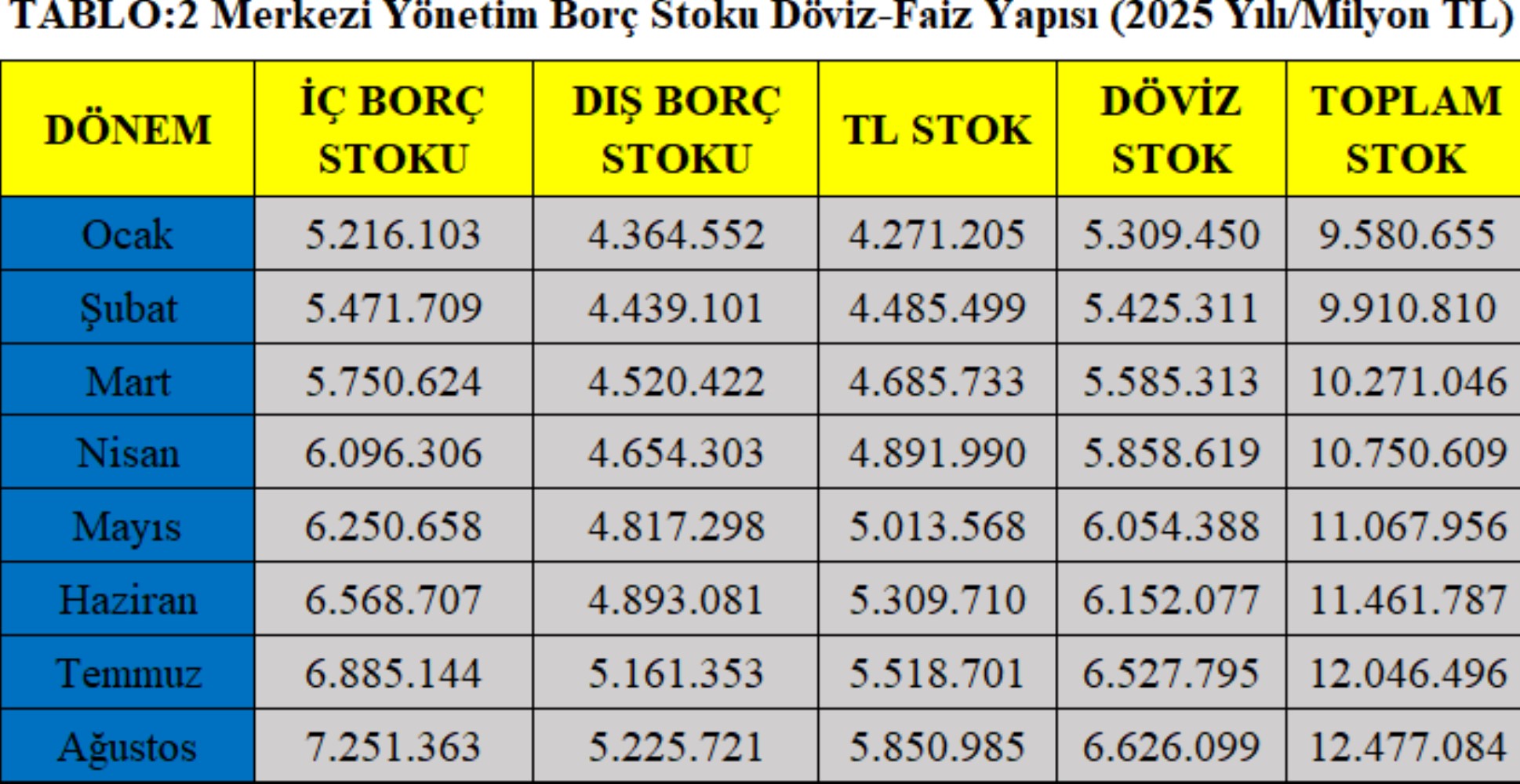
At the end of 2024, the total debt was at the level of 9.58 trillion TL; therefore, an increase of approximately 30% occurred in eight months. This rapid rise is noteworthy in two respects: The speed of the increase points to the most severe borrowing period of the last decade. The change in the debt structure increases fiscal fragility.
As of August, 47% of the total debt stock is in TL and 53% is in foreign currency. This ratio makes the Treasury more vulnerable to fluctuations in exchange rates.
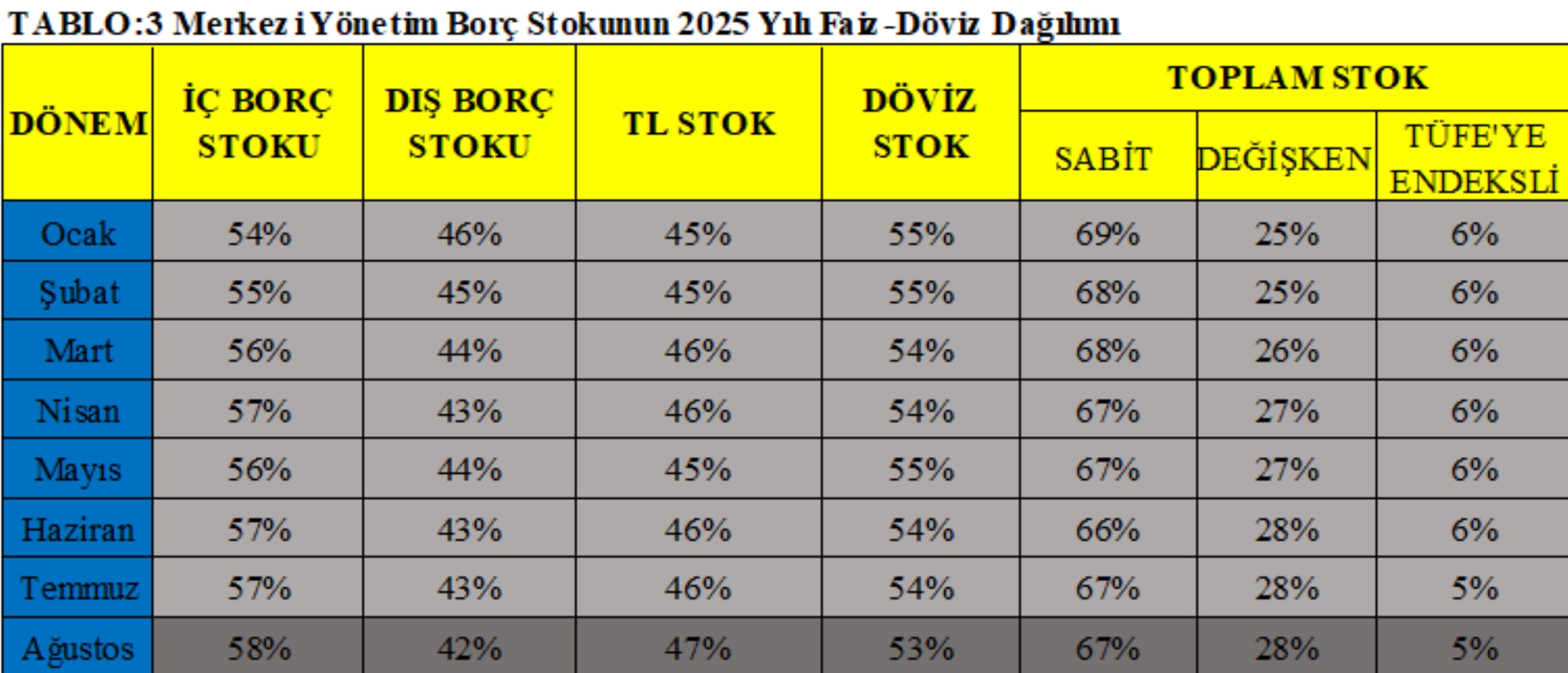
Furthermore, 28% of the debt is variable-rate and 5% is indexed to the CPI, which means a debt that is repriced every month in a high-inflation environment. Thus, interest payments are increasing rapidly beyond budget planning; borrowing is no longer just a financing tool, but has become an element of fiscal pressure.
MATURITIES ARE SHORTENING: The Cycle of Rolling Over Debt with Debt
The maturity structure of the debt stock is one of the most important indicators showing a country's debt management quality. According to Ministry of Treasury and Finance data, while the average maturity was in the 2–3 year range at the beginning of the 2000s, it had extended to 5.6 years in 2013. This period was when public debt became more predictable and sustainable. However, in recent years, the picture has reversed again.
As of August 2025, the average time to maturity of the domestic debt stock has fallen to 2.9 years. This is the lowest level seen since 2020. The average maturity of the external debt stock has also fallen to 6.3 years, thus maturities that reached almost 10 years in 2017 have dropped to their shortest point in twenty years. The average maturity of the total debt is around 4.3 years.
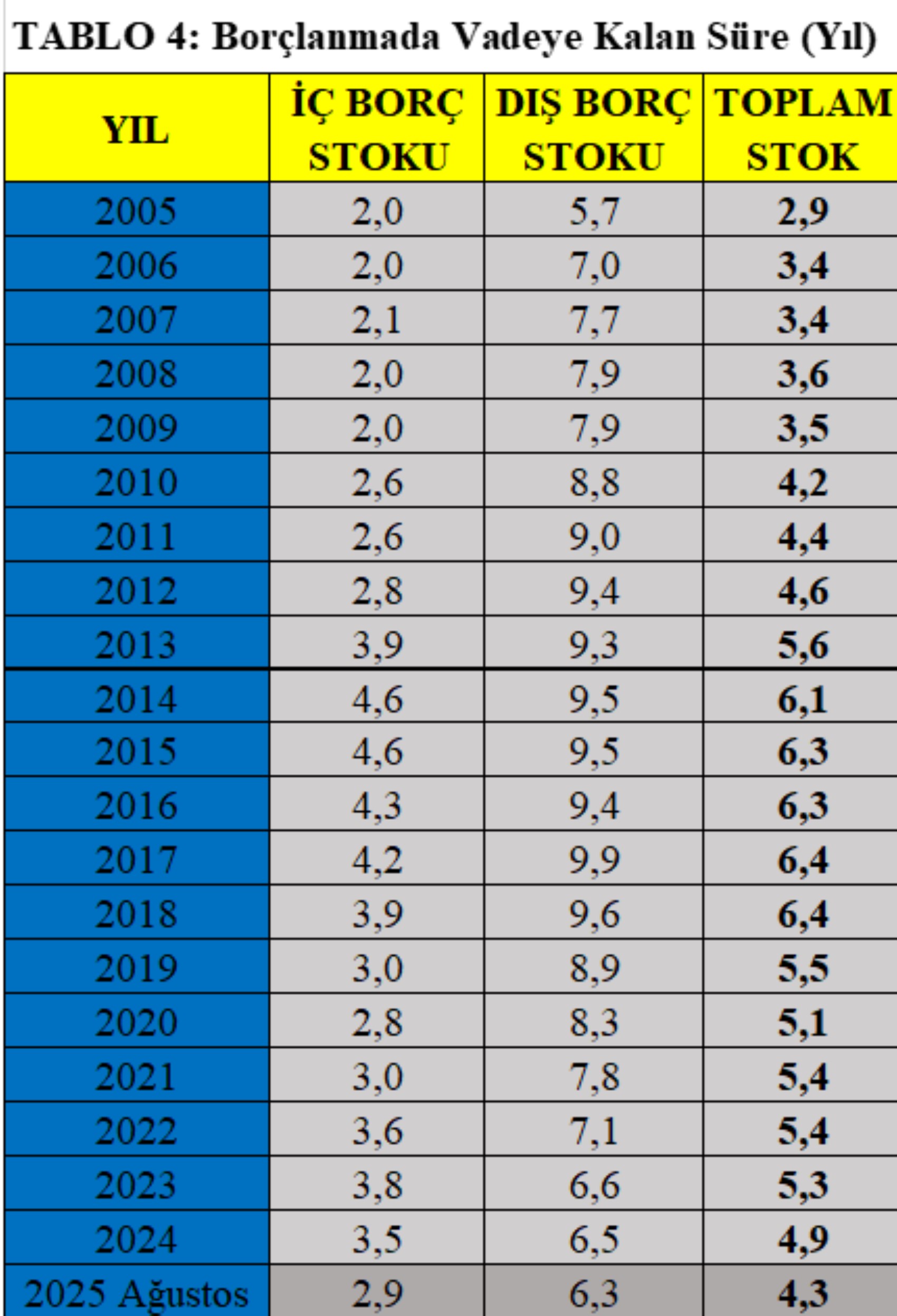
This picture shows that the Treasury has to renew its debt every few years, meaning the debt has largely turned into a rollover structure. New debt is issued without paying off the old debt; thus, the system has entered a spiral of "rolling over debt with debt."
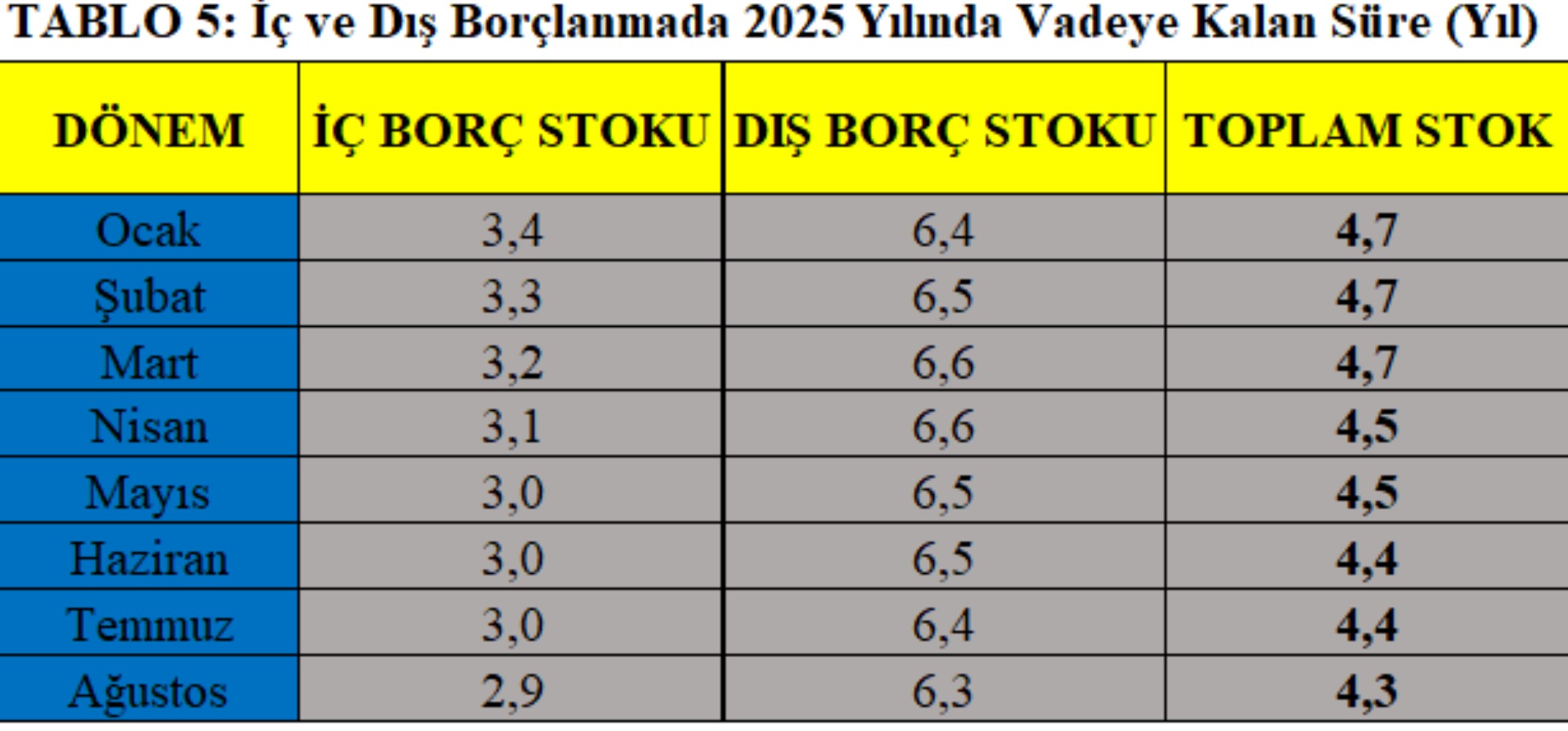
Short-term borrowing may seem to provide fiscal flexibility at first glance, but in reality, it increases risk. In a period when interest rates remain high, the shortening of maturities means that the debt costs more with each renewal. Moreover, the change in debt composition further increases risk: only 27% of the total debt is in fixed-rate TL.
The Treasury has to pay increasingly higher interest to roll over the debt. Indeed, while the share of fixed-rate domestic debt in total debt was 28% in August 2024, this rate rose to 32% in 2025. This increase shows that the interest burden is becoming rapidly heavier.
The high share of exchange rate and variable-rate debt brings another danger: every exchange rate or interest rate fluctuation is directly reflected in the budget due to the short-term debt structure. As a result, as maturities shorten, debt sustainability weakens; debt management turns into a constant effort to renew debt rather than strategic planning.
INTEREST EXPENSES: The Budget's Invisible Deficit
The most direct and burning consequence of the increase in debt stock is the rapidly increasing weight of interest payments on the budget. In the first eight months of 2025, interest expenses constituted a significant portion of public expenditures.
During this period, while 1 trillion 426 billion TL in interest payments were made, total budget expenditures were at the level of 8 trillion 900 billion TL, and tax revenues were at 6 trillion 872 billion TL. In other words, more than 1 lira out of every 5 liras of tax collected went to interest on debt.
This picture is the invisible but most damaging result of fiscal discipline. Because interest payments take precedence over social assistance, education investments, and public services. To cover the cost of debt, the state either increases taxes or resorts to new borrowing. Thus, the cycle of "paying debt with debt" is deepening.
In the long run, this structure distances public finance from productive investments. As interest expenses grow, the budget's investment items shrink; public investments decrease, and growth potential weakens. Fiscal policy turns into a structure focused on carrying the existing debt burden rather than increasing social welfare.
However, the main purpose of fiscal discipline is to reduce interest payments and direct resources to efficient, productive areas. At the point we have reached today, the picture has reversed: interest has become the largest, albeit invisible, deficit of the budget.
MACROECONOMIC EFFECTS OF BORROWING
The increase in debt stock is noteworthy not only for the breach of legal limits but also for its chain effects spreading throughout the economy. According to legislation, the Treasury's net borrowing limit can be increased to a maximum of approximately 2 trillion 130 billion TL with the Minister of Treasury and Finance's 5% increase authority and the President's additional 5% approval. However, the net debt increase of 2 trillion 52 billion TL realized as of August 2025 has already exceeded the 5% authority limit that the Minister can use.
This picture shows that even if the President's additional authority is activated for the remainder of the year, the legal limit will remain insufficient until the end of the year. Therefore, the issue is now beyond a technical limit breach and concerns the institutional credibility of fiscal discipline.
The state's increasing borrowing need puts upward pressure on interest rates by increasing the supply of bonds in the market. This rise in interest rates also increases the private sector's credit costs. Ultimately, while the investor prefers to lend to the state in a risk-free manner, real sector investments are pushed back (crowded out). This situation negatively affects production capacity and employment.
Furthermore, high public borrowing disrupts the balance between monetary policy and fiscal policy. As long as fiscal policy remains expansionary while the Central Bank implements tightening to combat inflation, price stability cannot be achieved. This contradiction makes inflation expectations permanent.
Another element of fragility is foreign currency-denominated debt. The fact that approximately half of the debt stock is in foreign currency makes the fiscal structure vulnerable to exchange rate shocks. Every 1 TL increase in the exchange rate imposes an additional burden of hundreds of billions of liras on the budget.
As a result, exceeding the borrowing limit has turned into a multi-dimensional macroeconomic problem that affects not only budget discipline but also interest rates, investment, employment, and price stability simultaneously. In short, this acceleration in borrowing is pushing the limits not of the fiscal structure, but of economic integrity.
THE SILENT COLLAPSE OF THE FISCAL RULE: From Rule to Arbitrariness
The "fiscal rule" debate has been on the agenda in Turkey for many years. This rule aims to remove fiscal management from political influence by setting an upper limit on public debt and budget deficits. The goal is to institutionalize fiscal discipline and place public finance within a predictable and sustainable framework. However, this understanding has never been fully implemented.
At the point reached today, the effective breach of the Treasury borrowing limit is a clear indicator that the fiscal rule has silently collapsed. It is no longer the law that determines the limits of the budget, but the financing need. The Treasury shapes its borrowing decisions not according to long-term strategies, but according to short-term cash pressures; this weakens fiscal predictability.
This trend points not only to an economic problem but also to the erosion of institutional balances. Decisions that increase the executive's borrowing authority weaken parliament's oversight power over the budget and effectively disable democratic fiscal control. With the suspension of the fiscal rule, the budget process has been increasingly left to the initiative of the executive, and the Assembly's fiscal sovereignty has been pushed to the background.
Ultimately, the understanding of fiscal discipline secured by law is being replaced by a pragmatic and "cash-focused" management style. This erodes the trust that both markets and citizens have in public finance.
The silent collapse of the fiscal rule is not just a technical failure, but an institutional breakdown. Because fiscal discipline is not just budget balance, but also the state's contract of reliability. When this contract is damaged, fiscal policy ceases to be a management tool; it becomes a reflex that postpones the crisis.
WARNING FOR THE FUTURE: The Sustainability Threshold
In the short term, high borrowing may create a comforting effect in terms of closing budget deficits. However, the price of this temporary comfort appears in the long run as a higher interest burden and increasing external fragility. The 2025 data reveal that Turkey's public debt structure is once again taking on a short-term, high-interest, and foreign currency-weighted appearance. This picture is a serious alarm in terms of fiscal sustainability.
Re-disciplining debt management, making the fiscal rule operational, and prioritizing spending policies are no longer a choice, but a necessity. Otherwise, public debt will cease to be a tool supporting economic growth and will become a burden that suppresses growth. As long as fiscal policy continues to expand, the tightening effect of monetary policy will also weaken; this will make the price stability target impossible.
The real solution lies not in more borrowing, but in effective resource use, broadening the tax base, and increasing spending efficiency. Every new borrowing made without questioning which areas public resources are directed to mortgages not only today but also the future.
Therefore, sustainability is not just a matter of fiscal balance; it is a matter of institutional morality, management discipline, and intergenerational justice. The Treasury's exceeding of the borrowing limit is no longer a technical problem; it is a warning sign indicating that the state's fiscal management approach needs to be redefined.
CONCLUSION: As Fiscal Discipline Collapses, Trust Also Erodes!
The Treasury borrowing limit is not just a technical threshold; it is a symbol of the trust placed in a state's fiscal management. Exceeding this limit shows, beyond budget balance, the extent to which the state adheres to the rules it has set for itself. The violation of the limit sends the same message to a wide segment from capital markets to citizens: "Rules can be stretched." This perception erodes trust before it erodes figures; it raises credit costs, delays investment decisions, and disrupts economic expectations.
In the short term, this distrust leads to an increase in the risk premium and a rise in the Treasury's borrowing costs. The banking system reflects this cost to the private sector; loans become expensive, and investments slow down. Households also cut their spending in the face of uncertainty; domestic demand weakens. Thus, exceeding the borrowing limit turns into a chain reaction that affects not only public finance but also the real economy.
In the medium term, the problem gains an institutional dimension. The influence of Parliament and oversight bodies decreases, and the budget process is increasingly left to the initiative of the executive. While democratic fiscal oversight weakens, fiscal policy is reduced to short-term cash management. The increase in the share of foreign currency-denominated liabilities in the debt stock makes the economy more vulnerable to external shocks; exchange rate fluctuations increase interest expenses and make debt rollover riskier.
In the long run, the picture is more permanent: Debt sustainability is impaired, public investments decrease, and growth potential is limited. The economy is increasingly trapped in a "high debt–high interest" spiral. The way out of this cycle is to re-establish fiscal discipline. For this, transparency, accountability, and predictability in debt management must be strengthened. The Treasury should announce its borrowing strategy to the public with clear targets; it should reduce refinancing risk by extending the maturity structure and increasing the share of fixed-rate instruments. Efficiency should be the basis for public spending, and resources should be directed to productive investments rather than short-term expenses.
Fiscal discipline is not just a numerical target; it is the guarantee of institutional trust and fiscal morality. Just as the Central Bank's independence is the basis of trust in monetary policy, rule-based discipline serves the same function in fiscal policy. When this discipline is established, the risk premium falls, borrowing costs decrease, and the economy becomes predictable. Resilience against external shocks should be ensured through strong reserve management, effective foreign exchange protection tools, and balanced policy sets.
In conclusion, the Treasury's exceeding of the borrowing limit is not a budget technique; it is a violation of the state's fiscal ethical boundaries. This limit, which is breached with every new borrowing, is actually an advance taken from the welfare of future generations, and a further weakening of democratic oversight. A state's power lies not in the debt it holds, but in the discipline it maintains despite its debt. The Treasury gains trust not as it borrows more, but as it remains loyal to the limit it has set for itself.
True fiscal discipline begins with loyalty to trust before the balance of revenue and expenditure. Because fiscal discipline is not just about numbers; it is a set of values — it is the most solid foundation of trust in the future, stability, and sustainable development.
Most Read

Striking picture for Özgür Özel's 'New Party'

Özgür Özel gives a dated response regarding the number of resignations

Forest fire in Antalya brought under control

The PKK opening and Özgür Özel’s path!..

Houthis strike Saudi-owned tanker

How did the newspapers view Özgür Özel's farewell to the CHP?

What did the CHP do?

Özel’s new party move in the world press

The New CHP, against CEHAPE

4 drones shot down near US Consulate General in Erbil