



At a time when "recovery" rhetoric is circulating on a global scale, the Hanke Misery Index, published during this period, strikingly reveals just how severe and alarming the picture facing the Turkish economy is. Prepared by economist Steve H. Hanke for the Independent Institute, this study evaluates the economic performance of countries not through abstract growth figures, but through the total impact that inflation, unemployment, interest rates, and growth have on the daily lives of individuals.
While the 2024 results reveal that misery is deepening, particularly in low- and middle-income countries, and that relative stability is being maintained in developed economies, Turkey—despite its production capacity and potential—has risen to become the fifth most miserable economy in the world, placing it in the same league as countries experiencing war, internal conflict, and state collapse. High inflation, a heavy interest burden, employment pressure, and deepening income loss show that prosperity has become the exception while misery has become the norm of daily life; the resulting picture clearly demonstrates that the problem is not one of temporary fluctuations, but a structural crisis stemming directly from policy choices. The Hanke Index makes this picture visible not only through numbers but through the economic reality directly felt by society.
WHAT DOES THE HANKE INDEX MEASURE AND WHAT DOES IT MAKE VISIBLE? The Mathematics of Misery through Inflation, Unemployment, Interest, and Growth
The Hanke’s Annual Misery Index (HAMI) is a composite indicator that aims to reveal the extent to which an economy is "livable" for its citizens, rather than its performance on paper. The index's fundamental approach is to evaluate economic well-being not through abstract growth rates, but through the total impact of inflation, unemployment, interest, and growth dynamics directly felt in the daily lives of individuals. In this respect, HAMI is a powerful measurement tool that makes the gap between economic success and social welfare visible.
The intellectual foundations of the misery index date back to the 1960s with American economist Arthur Okun. The first index developed by Okun was based solely on the sum of inflation and unemployment rates. The goal was to measure the state of the US economy in a simple and quick manner. As the index rose, it was accepted that economic conditions were deteriorating and the welfare loss of citizens was increasing.
This approach was expanded in 1996 by Nobel laureate economist Robert Barro. The Barro Misery Index took into account long-term government bond interest rates and the deviation of economic growth from its trend, in addition to inflation and unemployment. Thus, the index gained a more comprehensive structure that evaluates economic welfare not only through prices and employment but also through interest rates and growth performance.
Steve H. Hanke made the changes in 2009 that brought the index closest to its current form. He based it on bank lending interest rates instead of long-term bond yields, and on real GDP growth per capita instead of the growth gap. In this way, the index became a measurement tool that more directly reflects individuals' borrowing costs and welfare gains. Hanke also applied the index on a global scale, providing an opportunity for comparative analysis for a large number of countries.
With the last major update in 2022, the weight of the unemployment rate was doubled to more accurately reflect the devastating impact of unemployment on individuals. Thus, the current Hanke Misery Index began to be calculated with the following formula:
HAMI = (Unemployment Rate × 2) + Inflation Rate + Interest Rate – Growth Rate
The inclusion of both inflation and interest rates in the index reflects a conscious choice. This is because individuals feel economic losses much more heavily compared to gains. Conversely, economic growth is subtracted from the index as a misery-reducing factor. The resulting value expresses the net and felt outcome of economic policies on society with a single number.
Today, the Hanke Misery Index is a global comparison tool covering more than 160 countries. By bringing together fundamental macroeconomic indicators such as inflation, unemployment, interest, and growth, the index reveals the concrete impact of economic management on citizens' living standards in a simple, fluid, and striking manner.
THE PEAK OF GLOBAL MISERY: Crises are Becoming Permanent, Misery is Deepening
Hanke’s 2024 Annual Misery Index clearly reveals that the fragility in the global economy has ceased to be a temporary stagnation in some geographies and has turned into a picture of deep and permanent misery. The study, which covers 162 countries, shows that economic prosperity is not distributed equally across the world; on the contrary, crises, conflicts, and misguided policy choices are dragging certain countries into a chronic impasse.
According to Steve Hanke, the 2024 results clearly underline three fundamental dynamics that determine the level of misery in countries: civil war and political instability, high and uncontrolled inflation, and widespread unemployment. While armed conflicts shrink production capacity and increase unemployment, the loss of value in currencies makes inflation chronic, rapidly eroding household welfare. When examining the countries at the top of the index, it is seen that misery is largely deepened by the combination of these three elements. When these conditions come together, economic problems produce devastating results that are felt not just in the numbers, but by the entire society.
Table: The World's 10 Most Miserable Countries

According to 2024 data, the countries with the highest levels of misery in the world are Sudan, Argentina, Syria, Yemen, Turkey, Venezuela, Zimbabwe, Lebanon, Malawi, and Eswatini. The fact that most of the countries in the top 20 show similarities with the previous year's list indicates that structural problems and chronic crises have acquired a permanent, rather than temporary, nature.
Sudan, which is at the top of the list, is among the countries that most strikingly reveal the extent to which misery has reached. In the country, where the civil war has entered its second year, the unemployment rate reaching 58 percent and annual inflation exceeding 200 percent show that the economic crisis has long since turned into a humanitarian catastrophe. With the sharp contraction in real income per capita, Sudan's Hanke Misery Index value has reached an extraordinary level of 374.8. This picture reveals that misery in the country is no longer a temporary situation, but has become a normal part of daily life.
Sudan is followed by Argentina. High inflation, sharp interest rate hikes, and uncertainty in monetary policy have kept the Argentine economy in a crisis spiral for a long time. With inflation exceeding 100 percent and lending interest rates reaching 60 percent, household welfare is rapidly melting away, and the country's HAMI value is calculated at 195.9. The case of Argentina clearly shows how quickly price instability alone can destroy social welfare.
Countries such as Syria and Yemen are among those experiencing the devastating effects of long-standing war conditions on the economy in the most severe way. The destruction of production infrastructure, the collapse of labor markets, and the dysfunction of public finance are permanently pushing unemployment and inflation upward in these countries. The unemployment rate reaching 55 percent in Syria and inflation around 60 percent are among the main reasons why the country is at the top of the misery index.
For these countries, misery is no longer a temporary economic fluctuation; it has become a permanent reality that permeates every aspect of social life. However, the most striking aspect of this picture, which should be emphasized, is that the top of the list includes not only countries experiencing war and state collapse, but also countries that are in a peaceful environment and possess significant production capacity. Turkey's positioning within this picture constitutes one of the strongest and most jarring warnings of the Hanke Misery Index.
THE LEAST MISERABLE COUNTRIES: The Key to Prosperity is "Stability"
The countries at the bottom of the Hanke Misery Index clearly show that prosperity in the global economy is possible not only through high growth rates, but through stability. 2024 data reveals that countries such as Japan, Switzerland, Taiwan, and Thailand are able to keep their misery levels low thanks to predictable economic policies, even if they do not exhibit rapid growth performance. In these countries, inflation is relatively limited, interest rates are stable, and labor markets exhibit a more resilient structure against sudden shocks.
Thailand is at the very bottom of the index, as the country experiencing the least misery. In Thailand, which draws attention with its 1 percent unemployment and 1.1 percent inflation rates, the 2.6 percent growth in real GDP per capita brings the HAMI value down to the level of 5. This picture shows that limiting welfare loss, rather than high welfare gain, is the determining factor for the misery index.
Table: The World's 10 Happiest Countries Experiencing the Least Misery

Taiwan stands out with its balanced macroeconomic structure and strong growth performance. When the 5.2 percent real growth rate per capita is combined with low unemployment and controlled inflation, the country's HAMI value comes in at 6.7. In Togo, low inflation and infrastructure investments that support employment play a decisive role in keeping the misery level limited. The country's HAMI value is calculated at 7.7.
Countries with different economic structures such as Switzerland, Bahrain, Qatar, China, Vietnam, and Japan are also among the countries experiencing the least misery. This diversity shows that low misery is not dependent on a single economic model, but on the simultaneous provision of price stability, employment, and a predictable policy framework.
This comparison holds an important lesson for Turkey. The problem is not just to grow; it is to implement policies that will ensure growth occurs within a stable, balanced, and predictable framework. Otherwise, as growth figures increase, it becomes inevitable that misery will deepen at the social level.
IN PEACE BUT IN MISERY: Which Indicators are Sounding the Alarm in Turkey
Hanke’s 2024 Misery Index is not just a negative ranking for Turkey, but also serves as a strong warning. The fact that a country not experiencing civil war, state collapse, or widespread armed conflict has risen to become the fifth most miserable economy in the world clearly shows that the problem cannot be explained by ordinary economic fluctuations. Despite its industrial infrastructure, young population, and production capacity, Turkey is in the same league as countries in severe crisis such as Sudan, Argentina, Syria, and Yemen.
Table: Turkey's Hanke Misery Index by Year
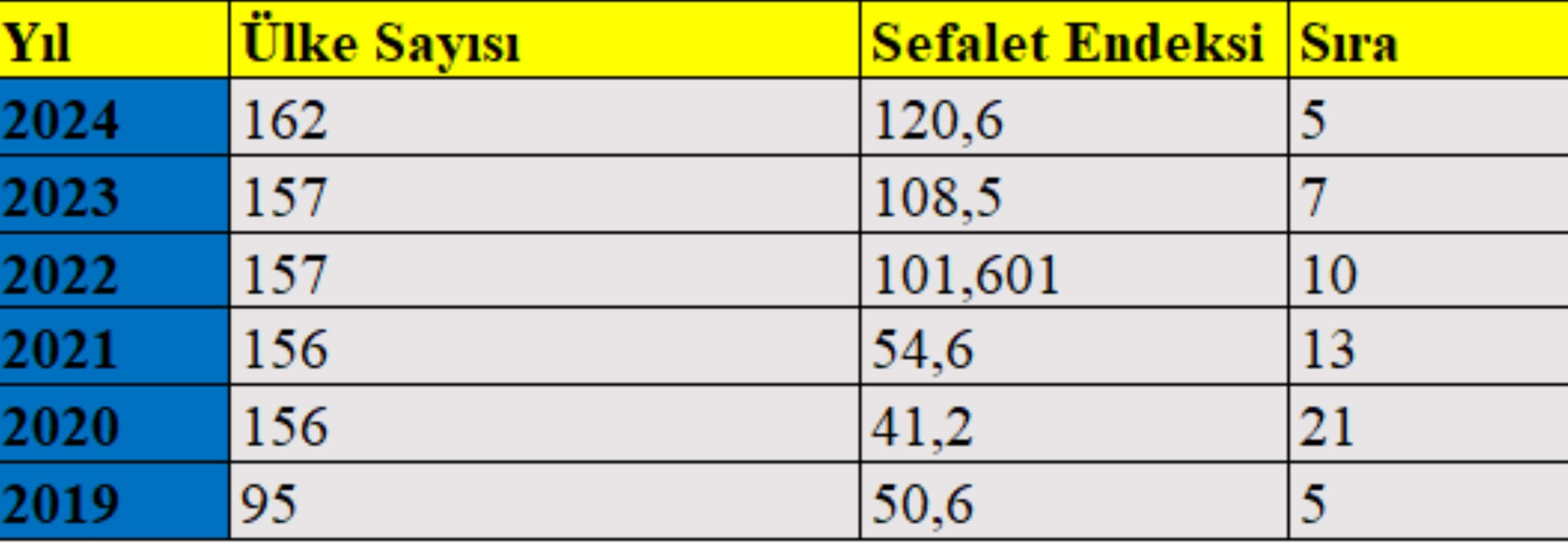
Turkey's rise in the index shows a remarkable speed. Turkey, which was the seventh most miserable country out of 157 countries with 108.5 points in 2023, has climbed to fifth place out of 162 countries in the 2024 data, rising to 120.6 points. This ranking shows that misery is ceasing to be a temporary situation and carries the risk of deepening and becoming permanent.
The table below is created based on inflation, unemployment, and growth data published by TURKSTAT and interest rates sourced from Investing. The growth data for 2025 reflects the year-end growth forecast, not the actual realization.

Households and the Real Sector in the Interest Rate Trap: According to the report, the most decisive factor pushing the misery index up in Turkey has been rapidly rising lending interest rates. The high-interest environment, combined with inflation pressure and the unemployment problem, creates a heavy burden on both households and the real sector. Interest rates in Turkey have ceased to be a tool that balances inflation and have turned into a mechanism that generates economic pressure on its own. This situation shows that the problem is not limited to price stability, but points to a deeper monetary and institutional crisis.
High financing costs make it seriously difficult for small and medium-sized enterprises, in particular, to access credit. Investments are postponed, production costs increase, and the capacity to create employment weakens. From the perspective of households, the fact that housing and vehicle loans have become almost inaccessible makes it difficult to roll over existing debts and deepens the loss of welfare. The fact that wage increases remain behind official inflation rates makes the felt impoverishment even more visible.
The Problem of a Single Tool in Fighting Inflation: The Turkish example also reveals the limitations created by reducing the fight against inflation almost entirely to interest rate policy. However, structural elements such as volatility in food prices, dependence on energy imports, exchange rate pass-through, and the weight of indirect taxes continue to feed inflation permanently. Instead of solving these problems, interest rate hikes can indirectly reproduce inflation by increasing production costs. Thus, the economy is trapped in a vicious cycle where high interest rates and high inflation are experienced simultaneously.
Income Distribution and Working Poverty: Another important factor behind the misery index being so high for Turkey is the deterioration in income distribution and the spread of working poverty. While high-interest policy relatively protects segments that possess financial assets, it leads to a serious loss of welfare for wage earners and fixed-income groups. Misery is becoming a daily reality not only for the unemployed but also for the working segments.
This picture shows that the economic difficulties experienced in Turkey are not fate, but largely the result of preferred policies. In this respect, the Hanke Misery Index is not just a ranking, but a strong warning about the effects of economic management on social welfare.
CONCLUSION: Is Misery for Turkey Fate or a Choice?
The picture of misery that Turkey is facing today is neither an unfortunate coincidence nor an inevitable fate. The fact that a country that does not experience war, has strong production capacity, a young population, and a strategic location has entered the top five most miserable economies in the world clearly shows that the problem stems not from a lack of potential, but from how this potential is managed. The resulting picture is a natural consequence of long-preferred economic policies.
Hanke’s 2024 Misery Index makes this reality visible not only with numbers but with the cost-of-living crisis felt in the daily lives of millions of people. Reducing the fight against inflation to almost a single tool, interest rate hikes, weakens production, investment, and employment, while making the deterioration in income distribution and working poverty permanent. Addressing inflation, interest, employment, and income policies in a disconnected manner leads to the further deepening of misery at the social level.
The real risk for Turkey is the normalization and acceptance of this picture. However, the picture presented by the Misery Index is a strong warning that should be taken seriously, not ignored. The fact that misery has become measurable offers an important opportunity to open it up for discussion instead of hiding it. Unless the quality of economic growth, the importance of stability, and the social sharing of prosperity are re-evaluated, it seems inevitable that this place in the ranking will become permanent.
Misery is not a fate for Turkey. This picture can be reversed if a holistic economic approach is adopted that prioritizes stability, strengthens production and employment, and centers on fair income distribution with the right policy choices. Otherwise, the Hanke Misery Index, which is read as a warning today, will turn into tomorrow's ordinary reality. The choice is still Turkey's.
Most Read

Striking picture for Özgür Özel's 'New Party'

The PKK opening and Özgür Özel’s path!..

How did the newspapers view Özgür Özel's farewell to the CHP?

He killed his wife by slitting her throat: Their children witnessed the moments

What did the CHP do?

Özel’s new party move in the world press

The New CHP, against CEHAPE

Fire at TUSAŞ engine factory in Eskişehir under control

From self-efficacy to despair

Kılıçdaroğlu's first message on Özgür Özel's new party announcement