



The Turkish economy has been making headlines in recent years with growth figures, export records, and rhetoric about declining inflation. However, the gap between the announced data and the reality citizens feel in their daily lives is widening. This is because the economy is not just about numbers; it finds its true reflection in the marketplace, rent, utility bills, and people's struggle to make ends meet at the end of the month. In an environment where salaries are rapidly eroding, the middle class is weakening, and anxiety about the future is increasing, the problems being experienced seem to have gone beyond a temporary slowdown.
It is precisely for this reason that the Hanke Annual Misery Index stands out as one of the most striking indicators showing the real impact of the economy on society. The 2025 data reveals that Turkey is among the countries with the highest misery scores in the world due to high inflation, a heavy interest burden, and income losses.
THE ANALYTICS OF MISERY: Where Does an Index Touch Society?
The Hanke Annual Misery Index measures not only how much economies grow, but also how this growth reflects on the living standards of society. The basic logic of the index is quite clear: as inflation rises, the cost of living increases; as unemployment rises, income security weakens; and as interest rates rise, production and investment come under pressure. Conversely, sustainable growth alleviates economic pressure.
According to Steve Hanke's current methodology, the index is based on four key variables:
• Inflation
• Unemployment
• Lending interest rates
• Real growth per capita
The formula is quite clear:
HAMI = (Unemployment × 2) + Inflation + Interest – Growth
The message of this formula is clear: while high inflation, high interest rates, and rising unemployment increase economic pressure on society, sustainable growth can alleviate this burden. However, in economies where growth does not reflect in income distribution, purchasing power cannot be maintained, and price stability is lost, growth figures alone are not enough to generate prosperity.
In the current index, prepared using 2025 data and published in 2026, 178 countries were evaluated. The resulting picture shows that economic vulnerabilities are deepening, especially in low- and middle-income countries. High inflation, rising financing costs, and distortions in the labor market directly suppress the living standards of millions of people.
COUNTRIES WHERE MISERY IS MOST INTENSE
What Does the Global Picture Say?
The top of the list is mostly occupied by economies struggling with war, political instability, hyperinflation, or weak state capacity. However, what makes the picture truly remarkable is that some countries not experiencing active war are also in the same category. Turkey's high ranking among these countries is extremely striking in terms of showing the extent of the economic pressure reached.
Table 1: The 10 Countries with the Highest Misery Scores in the World
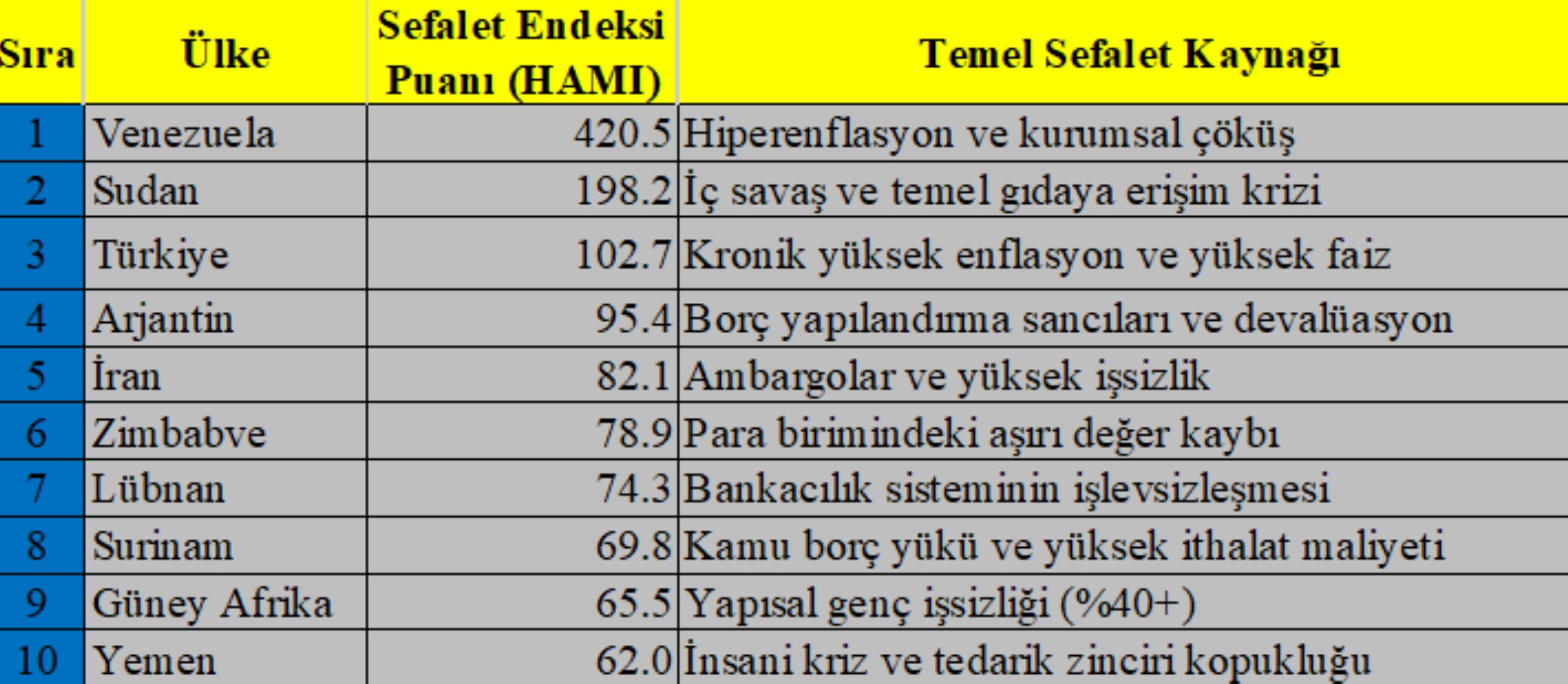
Common areas of vulnerability stand out in economies with high misery scores:
• Uncontrollable inflation,
• High interest burden,
• Unemployment and precarious work,
• Problems with access to finance,
• Deterioration in income distribution.
Global comparisons also clearly reveal the impact of economic management on social welfare. The difference between Venezuela, at the top of the index, and low-misery economies at the bottom of the list cannot be explained solely by income level. The truly decisive factors are price stability, institutional trust, and predictable economic policies. Because misery is the result not only of poverty but also of economic instability.
It is noteworthy that in countries at the top of the list, lending interest rates reach double digits, and in some cases, triple digits. This threatens not only current consumption but also future production capacity. As financing costs rise, businesses downsize their investment plans, production capacity shrinks, and pressure on employment grows.
Why is Turkey at the Top?
Turkey's high ranking in Hanke's 2025 Misery Index reveals not only a negative economic ranking but also the point reached by structural vulnerabilities that have been accumulating for many years. The fact that a country not experiencing civil war, severe political chaos, or state collapse is shown among the economies with the highest misery scores in the world clearly shows that the problem cannot be explained by ordinary economic fluctuations.
Despite having a strong industrial infrastructure, a young workforce, and significant production capacity, Turkey has become one of the countries where economic pressure is felt most intensely by society. The main reason for this is not just high inflation. The real problem is the loss of confidence that has spread to almost every area of the economy. Because economic actors no longer act according to today's conditions alone, but according to tomorrow's uncertainties. Citizens postpone their spending, businesses suspend investment decisions, and young people look for ways to build their futures in other countries. For large segments of society, the economic agenda has become not about increasing prosperity, but about maintaining the current standard of living.
Housing costs are swallowing up income gains. While access to finance becomes difficult, the middle class is shrinking, and the young population carries serious concerns about the future. The interest-inflation spiral, especially in recent years, stands out as one of the most important sources of economic pressure. The sharp interest rate hikes that followed low-interest policies created a dual burden on the economy. On one hand, high inflation eroded purchasing power, while on the other, rising financing costs suppressed production and investment capacity.
Even if official data points to a decline in inflation, the high cost of living is still strongly felt by large segments of society. Because for the citizen, what is decisive is not just the announced rates, but the real cost of daily life. Especially the rise in credit costs has made the pressure on the real sector more visible. While commercial loan interest rates have reached levels that make investing difficult in many sectors, businesses are struggling even to maintain their current production capacity. Today, not only citizens but also tradesmen, farmers, industrialists, and SMEs are trying to survive under a heavy financing burden.
The vulnerability in the economy is also clearly felt in the labor market. Although there are periodic improvements in official unemployment rates, broad-based unemployment data reveals that the reality on the ground is much more severe. Because millions of people are either working in low-income and precarious jobs or living having lost hope of finding a job. Especially youth unemployment and anxiety about the future among university graduates have reached remarkable dimensions. The fact that income security cannot be provided even as education levels rise shows that the economic system cannot sufficiently meet social expectations.
For this reason, the economic problem in Turkey is no longer an issue that can be explained solely by growth figures. Even if the economy grows, the fact that prosperity is not reflected in large segments of society in a balanced way, that income losses cannot be compensated, and that living costs are constantly rising creates serious pressure on the citizen's daily life. For many people today, the issue has become not about living better, but about surviving economically. From food prices to energy costs, from education expenses to the housing crisis, many fundamental areas make the economic pressure on society more visible.
Therefore, the announced growth data does not create the same sense of prosperity in society. The gap between economic indicators on paper and the reality citizens feel in their daily lives is widening. It is also for this reason that Turkey being mentioned in the same category as countries experiencing war presents a striking picture. Because what is decisive here is not just production capacity, but the extent to which economic stability is reflected in the living standards of society. The message Hanke's Index gives for Turkey is quite clear: the problem is not a temporary economic slowdown, but the heavy pressure created on society by structural vulnerabilities that have been accumulating for a long time.
THE HAPPIEST ECONOMIES: Prosperity is No Accident
On the other side of the index are countries that have made economic stability sustainable. Countries such as Luxembourg, Switzerland, Singapore, Taiwan, and the Netherlands stand out with low misery scores thanks to low inflation, strong institutions, and high productivity.
Table 2: The 10 Countries with the Highest Prosperity and Lowest Misery
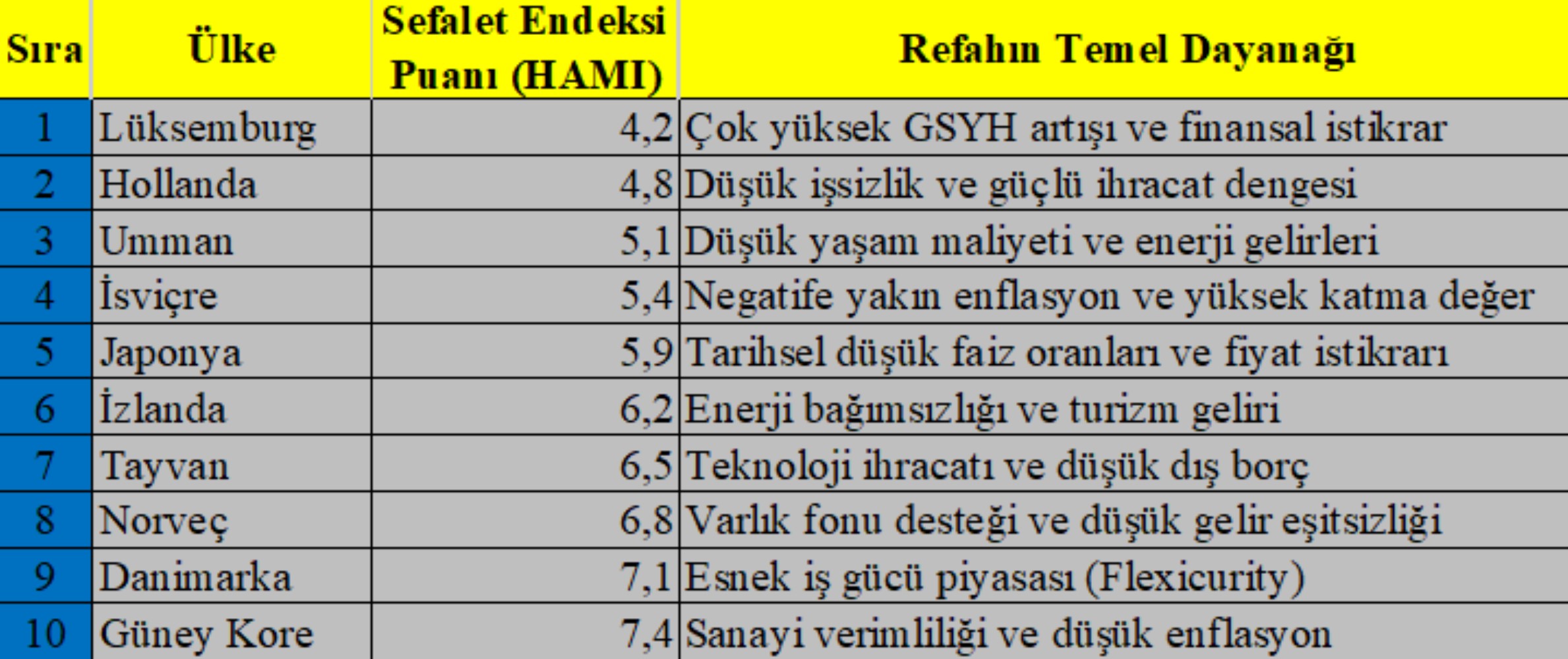
The common characteristics of these economies are noteworthy:
• Low and controlled inflation,
• Manageable interest policies,
• Strong production and productivity capacity,
• Employment-focused growth,
• Institutional trust and predictability.
In these economies, success is not measured only by national income figures. Quality of life, income distribution, education, health services, and the social security system are also considered integral parts of economic performance. Because sustainable prosperity is possible only when large segments of society feel economically secure.
The fundamental difference here is that economic stability is supported not by temporary policies, but by strong institutions and a trustworthy management approach. Both investors and citizens can make healthier decisions in economies where they can see the road ahead. The predictability of the law, independent institutions, and stable economic policies form the common denominator of low-misery economies.
The common success of low-misery economies is their ability to develop policies that prioritize long-term stability over short-term growth targets. Because lasting prosperity is possible not only by producing, but by being able to share the produced value fairly.
Therefore, the global comparison presented by the Hanke Index shows not only the current problems for Turkey but also the fundamental principles upon which the way out must be built. Because low misery is the result not of coincidence, but of stability, production quality, and trustworthy economic management.
CONCLUSION: The Human Beyond the Data
The picture revealed by the Hanke Annual Misery Index makes visible not only an economic ranking for Turkey but also the society's increasingly difficult struggle for livelihood. Because the economy is not just about growth rates, interest rate decisions, or technical indicators. It finds its real reflection in the citizen's kitchen, rent expenses, purchasing power, and expectations for the future.
The fundamental problem Turkey faces today is not just high inflation or heavy financing costs. The real issue is that economic vulnerability has begun to produce a permanent sense of insecurity in large segments of society. The erosion of real incomes, the sharp rise in housing costs, the growing anxiety about the future among young people, and the weakening of the middle class show that economic pressure has now settled at the center of daily life.
Therefore, the announced growth data does not create the same sense of prosperity in society. Because people feel the economy not just from the announced numbers, but in the market, on their bills, in access to credit, and in their living standards. If life remains expensive even if inflation falls, if prosperity cannot spread to large segments of society even if growth continues, it is not possible to say that economic problems have been fully resolved.
However, the resulting picture is not unchangeable. Turkey is still one of the countries with significant potential with its strong production capacity, young population, and strategic advantages. For this potential to turn into reality, it is necessary to go beyond the search for short-term balances; predictable economic policies, institutional trust, fair income distribution, and a high value-added production approach must be strengthened.
Because lasting prosperity is possible not only by growing, but by being able to make the entire society feel that growth. Without establishing an economic structure where citizens can look to the future with confidence, receive the reward for their labor, and maintain their standard of living, it is not easy for the announced data to produce a social response on its own.
This is the clearest message the Hanke Misery Index gives for Turkey today: the problem is not a temporary economic slowdown, but the impact of structural vulnerabilities that have been accumulating for a long time on society. However, it is still possible to reverse this picture with the right economic policies, strong institutions, and a trustworthy management approach. Because economies gain their true meaning not only with numbers, but with how much confidence and quality of life they offer to people.
Most Read

Striking picture for Özgür Özel's 'New Party'

The PKK opening and Özgür Özel’s path!..

How did the newspapers view Özgür Özel's farewell to the CHP?

He killed his wife by slitting her throat: Their children witnessed the moments

What did the CHP do?

Özel’s new party move in the world press

Fire at TUSAŞ engine factory in Eskişehir under control

The New CHP, against CEHAPE

From self-efficacy to despair

Kılıçdaroğlu's first message on Özgür Özel's new party announcement