



Turkey’s socio-economic landscape is not just a table of figures; it is a story of change in every field, from production to migration, and from education to environmental transformation. The Socio-Economic Development Ranking of Provinces and Regions (Provincial SEGE-2025), prepared by the Ministry of Industry and Technology, opens a new page in this story. The data shows that while major cities still maintain their strength, production hubs like Bursa are under pressure to transform, and rising cities like Adana are on the verge of entering a new league. The issue is no longer just growth, but the ability to build cities that are resilient to crises, digitalizing, adapting to a green economy, and aiming for sustainable development.
THE SEARCH FOR A NEW BALANCE IN INTER-PROVINCIAL DEVELOPMENT
For many years, the development disparities between Turkey's provinces have shaped a wide sphere of influence, affecting not only economic indicators but also voting behavior, migration dynamics, investment trends, and debates on social inequality. For this reason, Provincial SEGE data shows not only Turkey's current situation but also which provinces have growth potential in the future and which are at risk of losing their current position. Reading the Provincial SEGE-2017 and Provincial SEGE-2025 data together makes it possible to analyze the economic fluctuations, regional fractures, shifts in production geography, and the quiet but effective transformations occurring in moderately developed provinces during this period.
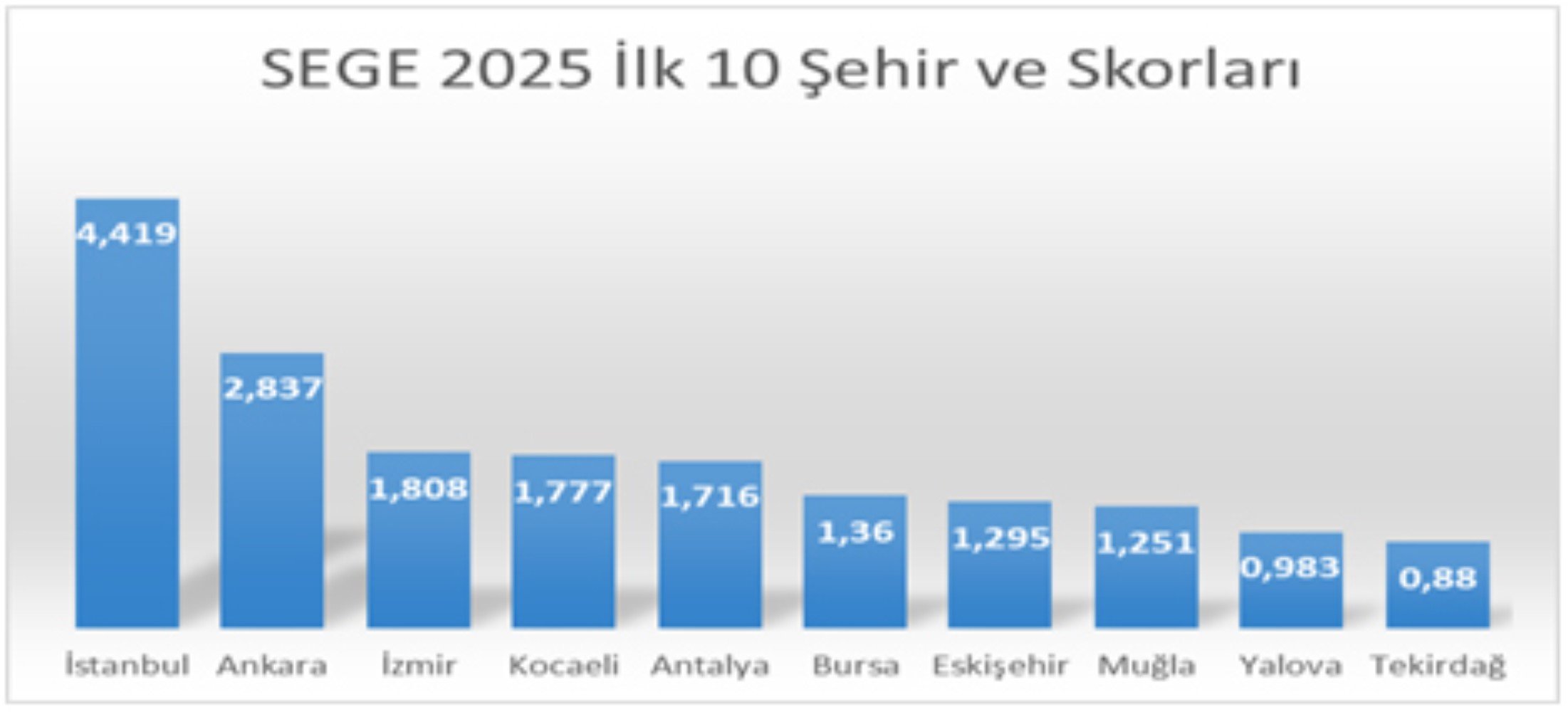
The time frame from Provincial SEGE-2017 to Provincial SEGE-2025 has been a period in which the Turkish economy was tested not only by exchange rate and inflation shocks, but also by the pandemic, the February 6 earthquakes, disruptions in global supply chains, and the pressure of green transformation. Despite this, major cities such as Istanbul with a SEGE score of 4.419, Ankara with 2.837, and Izmir with 1.808 maintained their superiority in the development ranking, securing their places in the top three. Meanwhile, cities such as Yalova with a score of 0.983, Tekirdağ with 0.880, Mersin with 0.688, Çanakkale with 0.627, and Balıkesir with 0.597 rose to approach the upper group from the middle league. Production hubs like Bursa, with a SEGE score of 1.360, maintained their positions but are now standing at a threshold due to green transformation, digitalization, and migration pressure. On the other hand, the picture has not changed in provinces such as Ağrı with a SEGE score of -1.826, Muş with -1.797, Şırnak with -1.497, and Hakkâri with -1.471; the socio-economic gap has not closed, but rather become more pronounced.
METHODOLOGICAL STRUCTURE OF SEGE: How were Dimensions and Variables Measured in Provincial SEGE-2017 and Provincial SEGE-2025?
SEGE studies analyze the development level of provinces with a multi-dimensional perspective rather than reducing it to a single economic indicator. In both the Provincial SEGE-2017 and Provincial SEGE-2025 research, provinces were evaluated based on 8 main themes and 52 variables that reflect the socio-economic structure more realistically. Measuring the development capacity of a province or region is not possible by focusing solely on income level; it requires addressing different dimensions such as demography, employment, education, health, competitive and innovative capacity, finance, accessibility, and quality of life together.
The variables used in this context were gathered under 8 main headings to evaluate the development potential of the provinces holistically, and each was constructed to represent a specific aspect of the socio-economic structure. Thus, SEGE studies have not only produced a ranking but also provided an analytical framework for understanding structural differences, strengths, and weaknesses between provinces.
In line with this analytical framework, the socio-economic development levels of the provinces were evaluated comparatively in the Provincial SEGE-2017 and Provincial SEGE-2025 studies using some common indicators such as population density, net migration rate, unemployment and employment rates, literacy rate among women, net secondary school enrollment rate, number of hospital beds per hundred thousand people, exports per capita, share of bank loans within Turkey, and residential electricity consumption per capita.
Furthermore, in the Provincial SEGE-2025 study, the same dimensions and a largely similar set of variables were used to maintain comparability with the Provincial SEGE-2017 results. However, to reflect the dynamics of digitalization, innovation, and quality of life that have gained importance in the socio-economic structure in recent years, some new indicators such as the share of R&D expenditures within Turkey, intellectual property applications per capita, number of e-commerce transactions, and the ratio of public open spaces have also been integrated into the index.
RANKING ACROSS TURKEY: The Unchanging Weight of the Top 10, Deep Fracture at the Bottom
Although the Provincial SEGE-2025 data shows that there is no radical change in the main axis of Turkey's socio-economic geography, it is clearly seen that there are quiet but meaningful movements in the middle-ranking provinces. Istanbul (4.419), Ankara (2.837), and Izmir (1.808), which occupy the top three places in Turkey's development league, maintain their positions and continue to be the country's economic, academic, administrative, and cultural centers. While Istanbul leads with a very high level of per capita income, foreign trade volume, financial depth, R&D expenditure, and education and health infrastructure, Ankara maintains its second-place position due to public services, education level, public R&D centers, university density, and health investments per capita. Izmir maintains its third place with its quality of life, port trade, tourism, highly educated population, and renewable energy investments.
This trio is followed by Kocaeli (1.777) in 4th place, Antalya (1.716) in 5th place, and Bursa (1.360) in 6th place. Kocaeli continues to be the country's production base with its industrial production, organized industrial zones, industrial electricity consumption per capita, port capacity, and foreign trade balance. Antalya solidifies its place in the top five thanks to health tourism, accommodation capacity, number of foreign tourists, airport connections, and agricultural production. Bursa, as the center of the automotive and machinery sectors, performs well above the national average in manufacturing industry employment, the furniture industry, exports, and R&D centers.
One of the notable developments in the Provincial SEGE-2025 results is that Yalova (0.983) and Tekirdağ (0.880), despite having fallen one place compared to Provincial SEGE-2017, have entered the top ten. Yalova ranks 9th due to bank deposits per capita, exports per capita, renewable energy investments, R&D centers, and regional integration resulting from its proximity to Istanbul. Tekirdağ ranks 10th with its industry concentrated on the Çorlu-Çerkezköy line, port connection, number of OIZs, rail freight transport, and labor productivity. Eskişehir (1.295) in 7th place and Muğla (1.251) in 8th place continue to be in the top ten, as seen in the graph below, especially with their education levels, density of cultural activities, quality of life, and per capita income indicators.
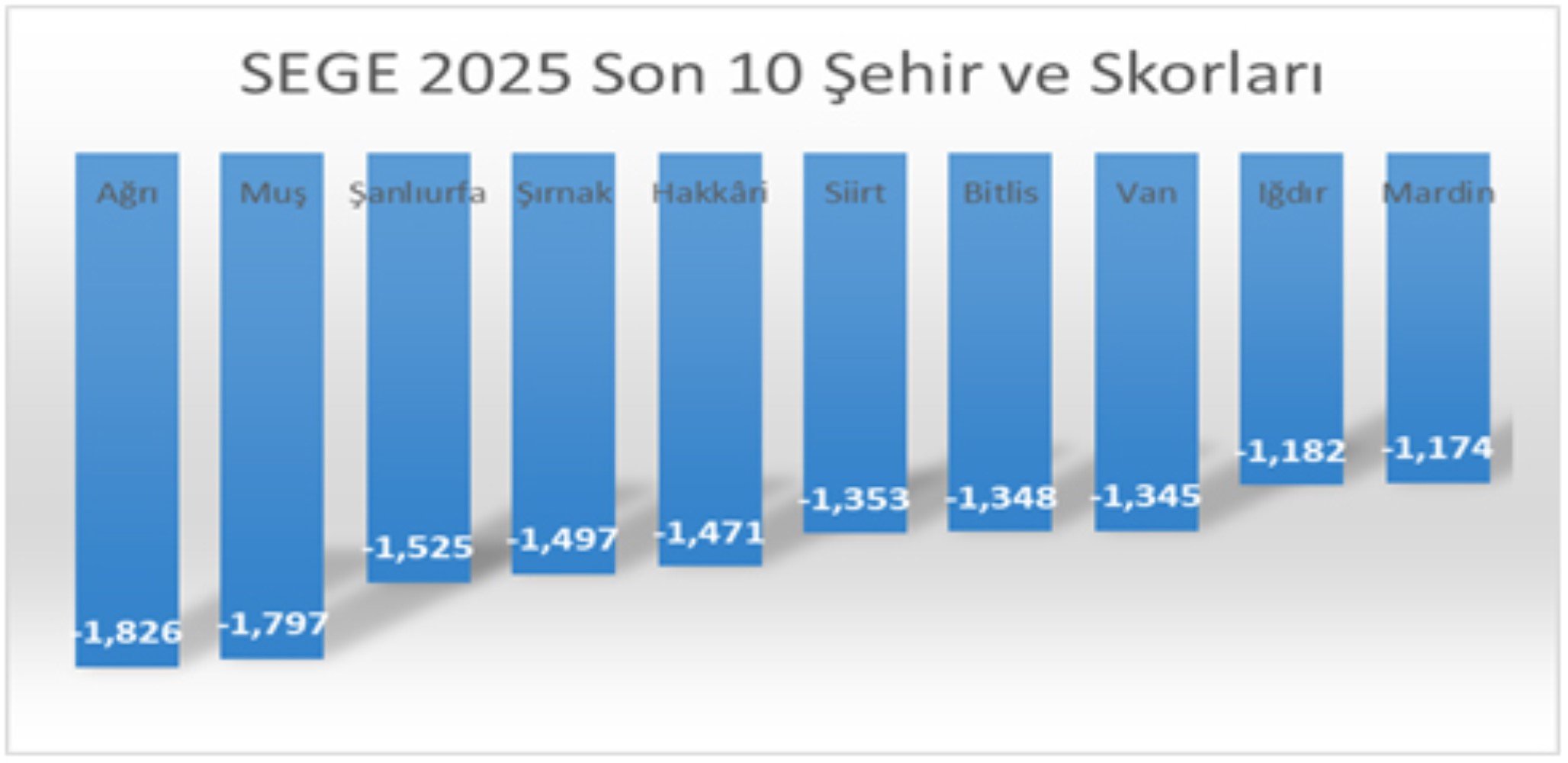
On the other hand, according to the graph below, there is significant stability in the last ten places of the list. Ağrı (-1.826) in 81st place, Muş (-1.797) in 80th, Şanlıurfa (-1.525) in 79th, Şırnak (-1.497) in 78th, Hakkâri (-1.471) in 77th, Siirt (-1.353) in 76th, Bitlis (-1.348) in 75th, Van (-1.345) in 74th, Iğdır (-1.182) in 73rd, and Mardin (-1.174) in 72nd are at the bottom of the development index. In these provinces, education indicators are weak, health infrastructure is insufficient, the female labor force participation rate is low, income per capita is well below the Turkey average, and an economic structure based largely on agriculture and public transfers prevails instead of a production economy. The fact that there has been no significant change in ranking in these provinces in the process from Provincial SEGE-2017 to Provincial SEGE-2025 is a clear indicator that regional development policies have remained ineffective and the loss of human capital has accelerated.
PROVINCIAL SEGE-2025 ANALYSIS SPECIFIC TO ADANA AND BURSA
ADANA: A Quiet Rise from the Middle Class to the Upper Step
Adana's rise from 27th place with a 0.353 SEGE score in Provincial SEGE-2017 to 22nd place with a 0.441 SEGE score in Provincial SEGE-2025 may seem modest at first glance; however, this rise points to a significant transformation in the province's industrial production, logistics capacity, and financial indicators. Adana, which has made a leap in terms of industrial electricity consumed and organized industrial zone employment across Turkey, has increased its score especially thanks to agriculture-based industry, plastics-chemicals, food production, and energy investments. While banking credit usage, the number of tradesmen-artisan businesses, and employment rates in small and medium-sized industries have increased, Adana has also strengthened its central position in regional trade with its connection to the Mersin port and Çukurova Airport.
However, Adana's most important structural problem is unemployment. According to the Labor Statistics report for September 2025, published by TUIK on October 27, 2025, the unemployment rate in Turkey is 8.6%. On the other hand, according to the latest report including unemployment rates at the provincial level, the Labor Statistics for 2024 dated March 20, 2025, this rate was 11.4% in Adana, which is the 11th province with the highest unemployment rate. This high rate stems particularly from youth unemployment and low female labor force participation; this situation reinforces the image that the province "produces industry but cannot create employment." In education, although the high school graduation rate is high, the university graduate population rate is limited, and human capital has not reached a level to compete with provinces like Bursa, Kocaeli, and Ankara. Adana performed poorly in terms of health indicators in the Provincial SEGE-2017 index; this picture has largely continued in Provincial SEGE-2025. Although an increase has been achieved in the number of physicians per ten thousand people and an improvement has been recorded in the infant mortality rate, Adana still remains behind the Turkey average in access to health services and general health indicators.
This picture shows that Adana has not fully converted its potential into performance, but with the right policies, it could become one of the strongest industrial centers outside of Marmara. When the strengthening of agriculture-industry integration, investments in food technologies, renewable energy, logistics, and storage infrastructure are combined with strategic projects such as the Eastern Mediterranean Container Port planned in Ceyhan and the SASA Yumurtalık Special Industrial Zone, it seems possible for Adana to rise into Turkey's top 15 provinces in SEGE rankings by 2030 if supported by appropriate incentive mechanisms.
The table below shows the rankings of Adana within the scope of the eight main themes used in SEGE studies.
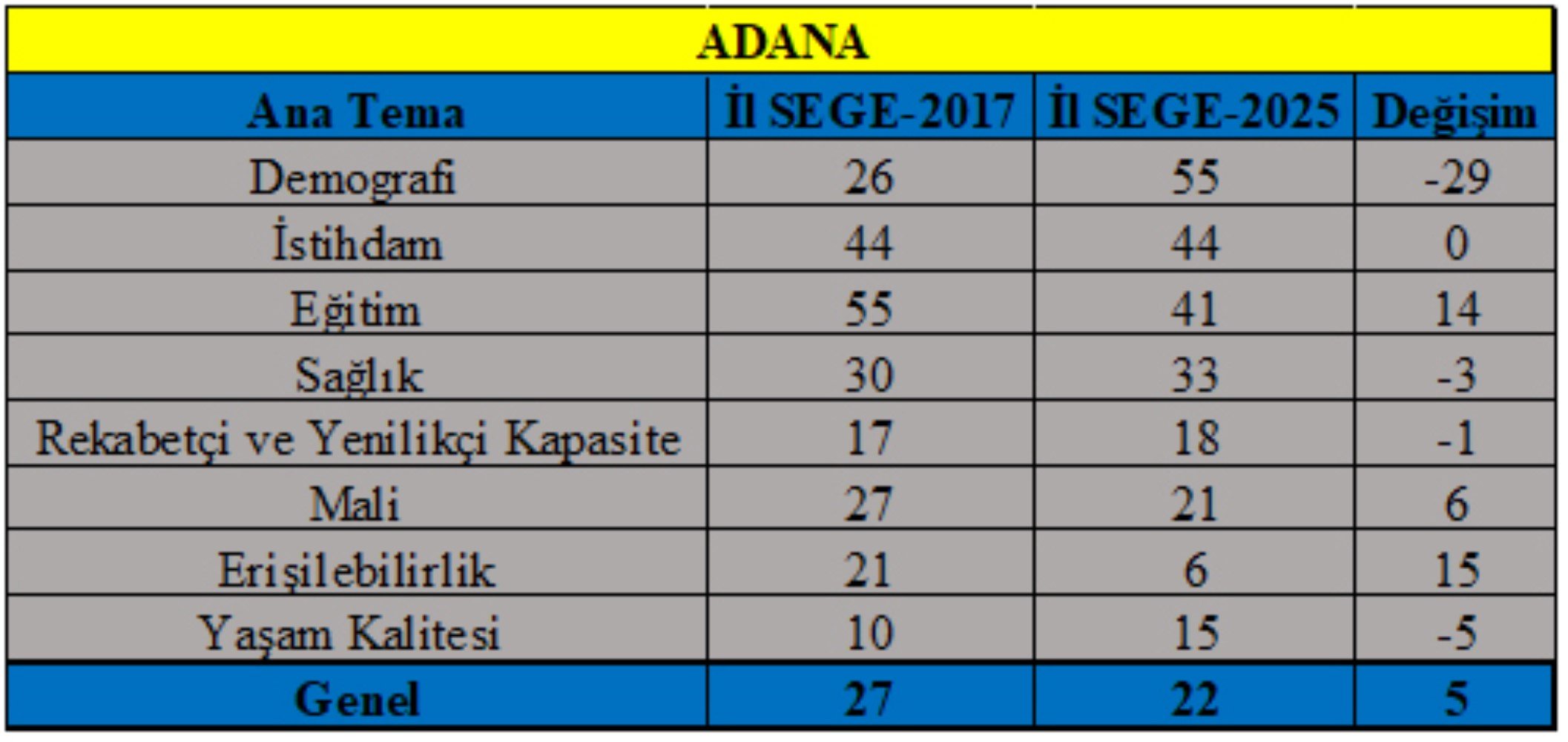
According to the table, Adana has made progress in terms of socio-economic development by rising from 27th to 22nd in the Provincial SEGE-2025 general ranking. The locomotives of this progress have been the Accessibility theme, which jumped from 21st to 6th, and the Education theme (from 55th to 41st), which showed significant improvement. These strengths support Adana's potential to become a regional center and develop its human capital. However, critical structural problems that limit the city's leap forward persist: stagnation in the employment ranking (remaining in 44th place) and a 29-place drop in the Demography theme to 55th place show that Adana is experiencing deep problems that need to be solved urgently in the areas of population structure and unemployment. In short, Adana must convert its strong infrastructure and education indicators into concrete economic performance by addressing these structural weaknesses in Demography and Employment.
BURSA: A Strong but Pressured Center
With a 1.360 Provincial SEGE-2025 score, Bursa has become Turkey's 6th most developed province in Provincial SEGE-2025, just as it was in Provincial SEGE-2017. This stability is an indication that it is standing at a threshold, alongside a great success. Being the center of automotive production, the strong structure of the machinery-metal, textile, and white goods sectors, the furniture industry, high export capacity, and extensive transport connections still keep Bursa in the position of Turkey's production capital. Indicators such as bank deposits per capita, industrial electricity consumption, number of organized industrial zones, and the number of R&D centers and technoparks prove that Bursa is well above the Turkey average.
However, Bursa's problems are no longer problems of growth, but of transformation. The population arriving through migration is driving up housing prices, straining transport infrastructure, and increasing air pollution and carbon emissions. Within the scope of the Green Deal, exporting companies need to reduce their carbon emissions, transition to digitalization, and increase energy efficiency. Even if Bursa's current industrial structure provides high employment, there is a lack of high value-added production. In short, Bursa continues to produce, but producing is no longer enough; smarter, cleaner, and more technological production has become mandatory.
The table below shows the rankings of Bursa within the scope of the eight main themes used in SEGE studies.
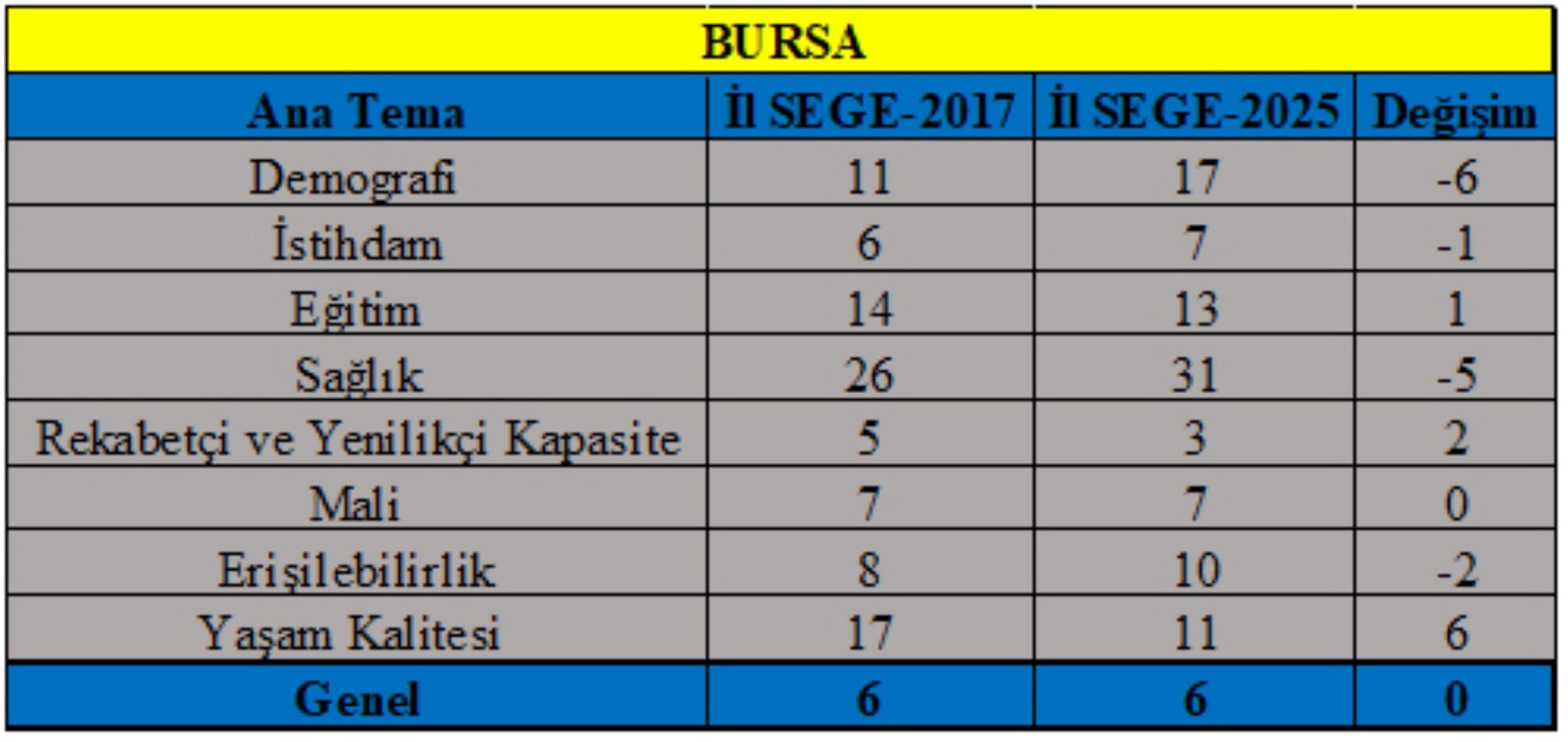
According to the table, Bursa maintains its strong position among Turkey's most developed provinces by retaining its 6th place in the Provincial SEGE-2025 General Ranking. The province's greatest success is its rise from 5th to 3rd place in the Competitive and Innovative Capacity theme and a significant leap in Quality of Life (from 17th to 11th); this shows that the city is successful in its sustainable development and technological adaptation goals. However, despite this strong performance, Bursa is facing the pressures brought by being a production center: the declines in the Demography (from 11th to 17th) and Health (from 26th to 31st) rankings are noteworthy. These regressions show that the province requires careful management in the areas of population density, urban pressure, and service quality, and that it must focus on urban sustainability to cross the 'transformation threshold'.
REASONS FOR THE CHANGE FROM PROVINCIAL SEGE-2017 TO PROVINCIAL SEGE-2025: Earthquake, Migration, Incentives, Digitalization, and Green Economy Pressure
The six-year period between Provincial SEGE-2017, prepared with 2013-2014 data and published in 2019, and Provincial SEGE-2025, prepared with 2020-2025 data and published in 2025, was a process in which Turkey was tested seriously not only through economic indicators but also in terms of social vulnerabilities. The most devastating event of this period, the February 6, 2023 earthquakes, deeply shook the socio-economic structure of the affected cities and was directly reflected in the SEGE rankings.
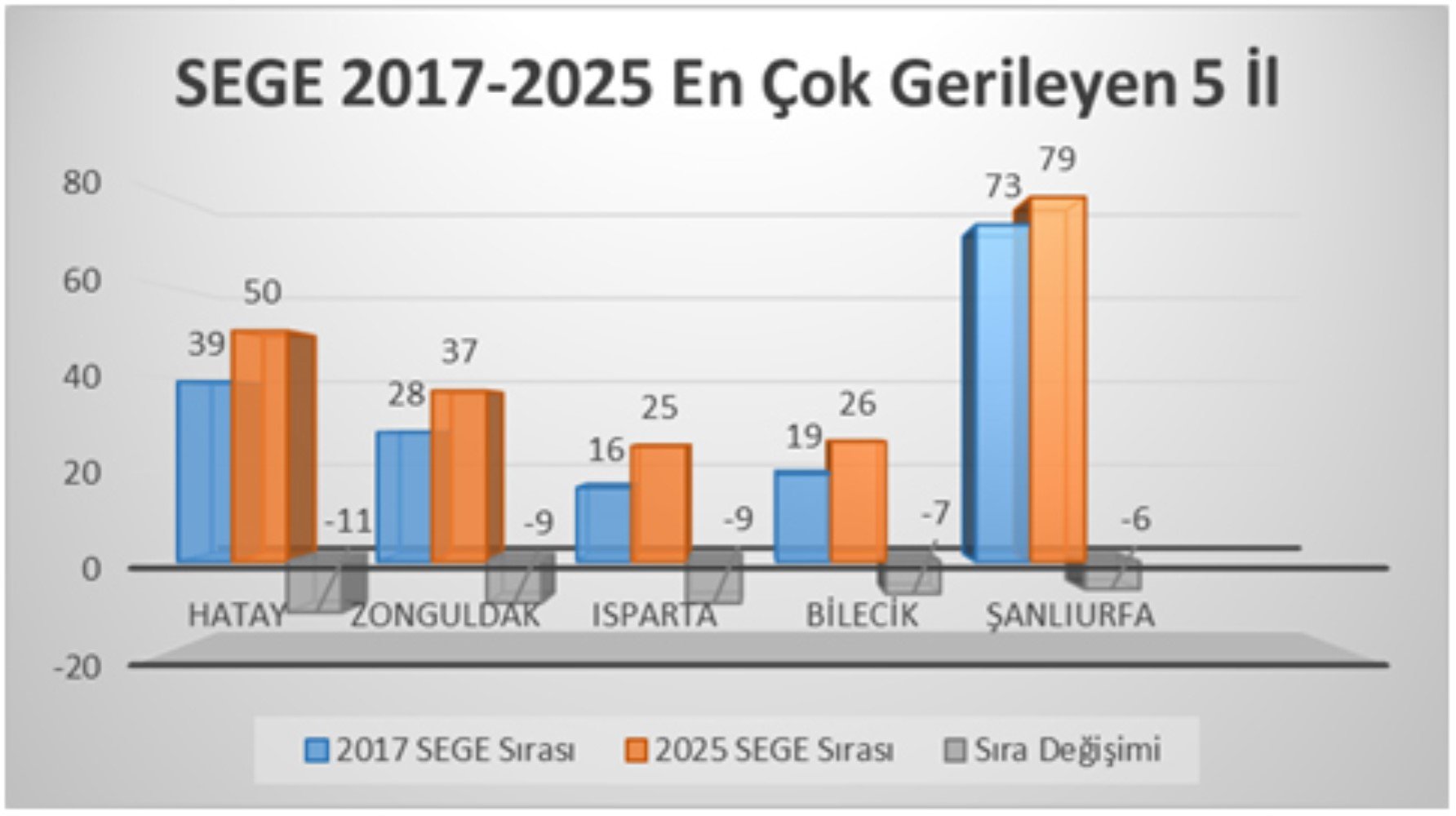
Kahramanmaraş, the epicenter of the earthquake, ranked 58th with a -0.416 SEGE score in Provincial SEGE-2017, but fell to 63rd place in Provincial SEGE-2025 as its score dropped to -0.580. Hatay was in 39th place with a 0.017 SEGE score in Provincial SEGE-2017, but fell to 50th place in Provincial SEGE-2025, dropping to -0.247. Adıyaman was in 66th place in Provincial SEGE-2017 with a -0.926 SEGE score, and fell to 69th place in Provincial SEGE-2025 with a -0.944 SEGE score. In Malatya, both resilience and vulnerability were seen together; the city, which was in 44th place in Provincial SEGE-2017 with a -0.113 SEGE score, remained in 44th place in Provincial SEGE-2025 with a -0.159 SEGE score, but experienced a significant drop in its SEGE score.
These data reveal that the earthquake did not only bring physical destruction, but also left permanent effects on the development levels of the provinces through indicators such as health, employment, education, migration, and income distribution.
While some of these provinces fell rapidly in the rankings compared to Provincial SEGE-2017, others experienced temporary rises depending on post-earthquake investment plans. The earthquake caused a concrete fracture in Turkey's SEGE map where a natural disaster directly affected the development index for the first time.
Migration was a factor at least as decisive as the earthquake. In the Provincial SEGE-2017 data, the migration movement from the East and Southeast to Marmara and the Aegean had become evident; this became more dramatic in Provincial SEGE-2025. While provinces like Şırnak, Hakkâri, and Ağrı lost population, population pressure due to internal migration increased in provinces like Bursa, Kocaeli, Tekirdağ, and Yalova. This pressure both drove up housing prices and created a serious burden on transport, environment, and infrastructure. However, migration also brought a dynamism to these provinces in terms of industrial labor, service sector expansion, and cultural diversity.
Incentive systems have been another important determinant of this period. Investment Incentive Zones, which form the basis for the issuance of the Investment Incentive Certificate, consist of six stages. While the First Region covers the most developed provinces, the Sixth Region consists of the least developed provinces and is the region where support elements are applied at the highest level.
The regional incentive system, which aims to reduce development disparities between provinces and increase the production and export potential of provinces, and which entered into force with the "Decision on State Aids in Investments" dated 15/06/2012 and numbered 2012/3305, has expanded its scope after 2017. However, the tax reduction, insurance premium support, and investment allocations provided to 4th, 5th, and 6th region provinces have not fully achieved the expected structural transformation.
In contrast, there has been a significant increase in industrial investments in Konya, Çanakkale, and Yalova, which are among the 2nd Region provinces. This situation reveals that just providing incentives is not enough, and that investment cannot turn into permanent production in provinces when infrastructure, logistics, qualified labor, and financial access are not planned in a balanced way.
Digitalization and e-commerce were among the factors fully included in the index for the first time in the Provincial SEGE-2025 data. Provinces with high e-commerce transaction volume and broadband internet usage rates are also positioned in the upper ranks in the Provincial SEGE-2025 ranking due to the effect of digital infrastructure advantages.
Among the provinces that grew fastest in the Competitive and Innovative Capacity theme, where the e-commerce variable is located, Yalova, Mersin, Kayseri, and Çanakkale stand out. Within the scope of the Accessibility theme, where the broadband internet usage rate variable is located, provinces such as Trabzon, Kayseri, Mersin, and Adana stood out among those showing the fastest growth. On the other hand, the provinces with the weakest internet infrastructure, e-commerce usage, and access to digital services were in Eastern Anatolia and Southeastern Anatolia.
Finally, the pressure of the green economy and environmental sustainability created a new threshold, especially for industrial cities. Variables such as waste services and the ratio of public open spaces were included in the Provincial SEGE-2025 index for the first time. It was observed that industrial cities like Yalova, Tekirdağ, and Kocaeli lagged behind in these indicators due to high carbon emissions; instead, provinces with higher environmental adaptation capabilities such as Nevşehir, Trabzon, Edirne, Balıkesir, and Aydın increased their quality of life scores.
In addition, the graphs below reveal the cities that showed the most rise and decline among the provinces according to the Provincial SEGE-2017 and Provincial SEGE-2025 data.

CONCLUSION: From Development to Resilience – Turkey is Entering a New Crossroads
The Socio-Economic Development Ranking of Provinces and Regions (Provincial SEGE-2025) report, prepared by the Ministry of Industry and Technology, signals a paradigm shift in Turkey's development goals. The definition of development is no longer limited to mere economic production; factors such as the resilience of cities against crises, their power to produce innovation, and their capacity to adapt to green transformation are becoming decisive. Turkey's future will be shaped in cities that can achieve not only growth but also sustainable development and resilience dynamics simultaneously.
While major cities like Istanbul, Ankara, and Izmir maintain their positions as the country's economic, academic, health, and cultural centers, production hubs like Kocaeli, Bursa, and Tekirdağ form the backbone of the system with their export and industrial power. However, these production cities must urgently transition to a new industrial model due to challenges such as green transformation, energy efficiency, and the housing crisis.
On the other hand, provinces like Adana are rapidly growing their potential to become one of the future production centers thanks to agriculture-industry integration, energy investments, port access, and geographical location. Nevertheless, this potential is limited by structural problems such as high unemployment and a lack of human capital. Provinces like Şırnak, Muş, Ağrı, and Hakkâri, on the other hand, still cannot produce economically sustainable growth and mostly survive on public expenditures; this makes the socio-economic gap more visible. Although rankings have been presented at the provincial level, it should not be ignored that there is no balanced distribution in terms of development among districts.
In this context, Turkey's strategy can no longer be just "growth." The new goal must be a "resilience economy." This necessitates a new incentive system that evaluates cities not only according to income and production, but also in terms of disaster resilience, digitalization capacity, innovation power, human capital quality, and environmental adaptation. Ultimately, the issue is not so much reaching the highest level of development, but being able to build cities that can survive, transform, and maintain their competitiveness despite crises.
Most Read

Striking picture for Özgür Özel's 'New Party'

The PKK opening and Özgür Özel’s path!..

How did the newspapers view Özgür Özel's farewell to the CHP?

He killed his wife by slitting her throat: Their children witnessed the moments

What did the CHP do?

Özel’s new party move in the world press

The New CHP, against CEHAPE

Fire at TUSAŞ engine factory in Eskişehir under control

From self-efficacy to despair

Kılıçdaroğlu's first message on Özgür Özel's new party announcement