



Turkey has reached a critical threshold in its history of digital transformation. The "Artificial Intelligence Statistics, 2025" report, published by TurkStat on October 1, 2025—a first in the institution's history—presents a comprehensive and striking picture of the country's digital capacity by revealing, through official data, the relationship both businesses and individuals have established with artificial intelligence. Based on the use of information technologies in enterprises and households, this study shows that while AI awareness in Turkey has increased rapidly in recent years, it also points to a widening digital divide between large enterprises and SMEs, the young and the elderly, and the educated segment and disadvantaged groups. The report not only reveals the promising momentum of technological progress but also exposes the critical challenges Turkey faces in its digital transformation process due to structural obstacles such as a lack of expertise, cost pressures, and social inequalities.
AN UNEQUAL TABLE IN DIGITAL TRANSFORMATION: 7.5% of Enterprises Declared Using Artificial Intelligence
According to TurkStat data, the rate of enterprises using artificial intelligence, which was only 2.7% in 2021, rose to 7.5% in 2025. While this increase over four years shows that technological awareness is spreading rapidly, Turkey is still behind the global average. Approximately 13% of businesses in the European Union and 40% in the USA are actively using artificial intelligence.
As seen in the graph below, the data reveals that AI usage increases significantly as business size grows. While the rate is 6.6% in small enterprises with 10–49 employees, it rises to 9.6% in medium-sized enterprises with 50–249 employees, and up to 24.1% in large enterprises with 250 or more employees. This picture shows that digital transformation is concentrated in favor of large capital and that SMEs are not sufficiently integrated into the transformation process.
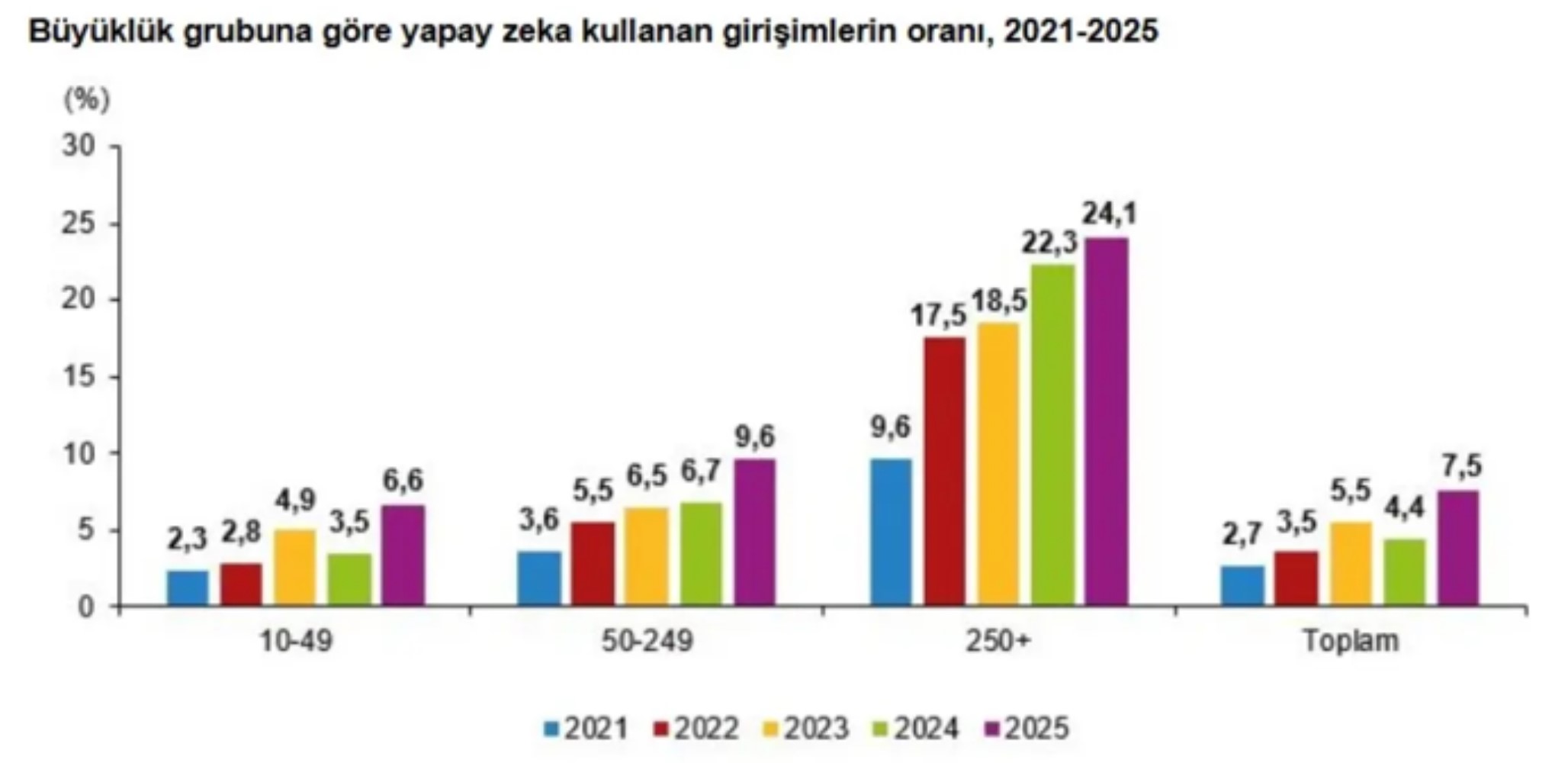
In short, AI investments in Turkey are turning into a privilege shaped by capital power rather than an opportunity. This situation further deepens digital inequality, which is the most fragile point of digital transformation.
DIGITAL SECTORS AT THE TOP, REAL SECTOR FALLING BEHIND: The Champion of Artificial Intelligence is Information and Communication
TurkStat's sector-based analyses strikingly reveal the digitalization gap in the Turkish economy. As will be seen in the graph below, as of 2025, the sector that uses artificial intelligence the most is information and communication activities with 47.1%. This field is followed by finance and insurance with 21.1%, and the repair of computers and communication equipment with 15.2%.
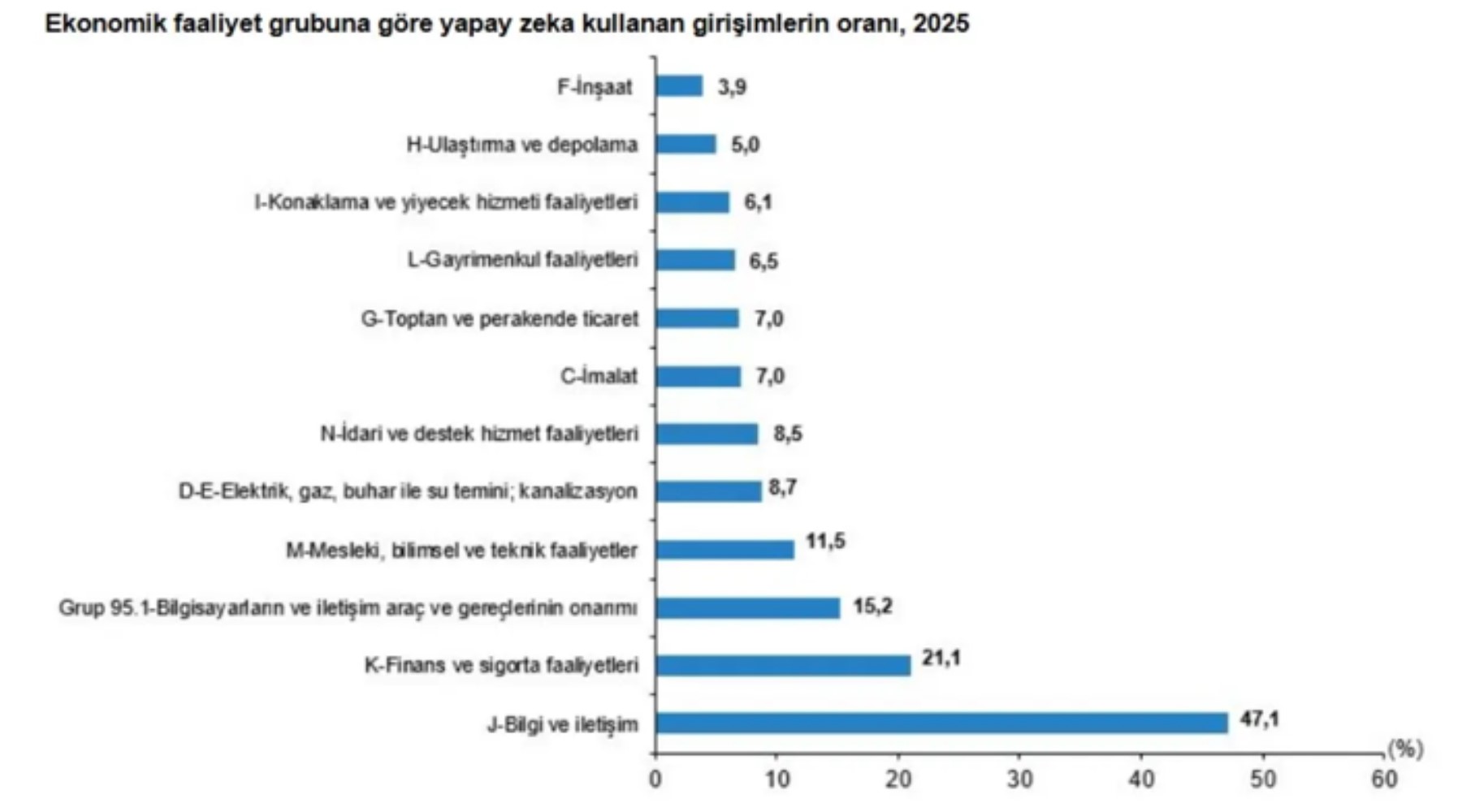
In contrast, rates drop significantly in sectors where digital transformation is more limited. While usage in professional, scientific, and technical activities remains at 11.5%, it falls to 8.7% in energy and water supply and sewage services, and to 8.5% in administrative and support services. While the rate hovers at 7% in manufacturing and retail-wholesale trade sectors, it drops to 6.5% in real estate activities, 6.1% in accommodation and food services, 5% in transportation and storage, and only 3.9% in construction.
This picture shows that artificial intelligence is spreading rapidly, especially in digital-based sectors, but remains at a low level in traditional sectors such as production, services, and trade. In other words, digital transformation in Turkey is not progressing simultaneously and in a balanced manner; while high-tech intensive sectors are modernizing, a significant portion of the real sector remains outside this transformation.
This situation also contradicts the holistic transformation goal of the "National Artificial Intelligence Strategy." The fact that artificial intelligence remains predominantly on the axis of information technologies carries the risk of further deepening the existing gap between Turkey's production power and digital innovation.
ARTIFICIAL INTELLIGENCE IS USED MORE AS A SALES TOOL THAN A STRATEGY: The First Choice of Enterprises is Marketing and Sales
The 2025 data clearly reveals the priorities of enterprises using artificial intelligence. 46.5% of businesses use this technology in marketing and sales activities. This shows that artificial intelligence is adopted in Turkey primarily to improve customer relations and increase revenue. This marketing-oriented approach is followed by production or service processes (41.1%), R&D and innovation activities (41%), and business and management organization (40%), respectively.
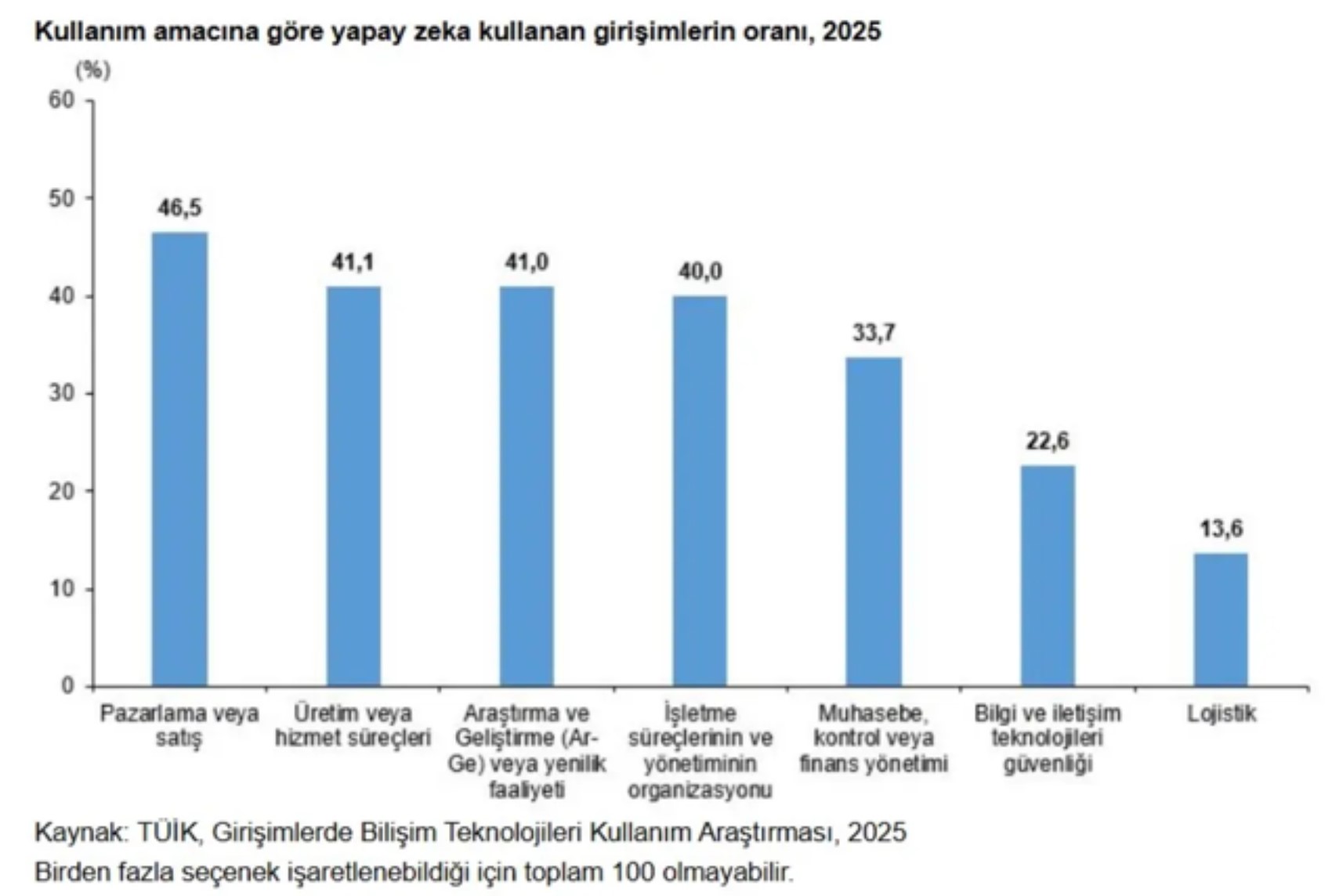
While the use of artificial intelligence in accounting, control, and financial management is at the 33.7% level, its use in the field of information security remains at 22.6%, and its use in logistics activities at 13.6%. This distribution shows that businesses evaluate artificial intelligence more for short-term commercial gains and cannot sufficiently position the technology as a productivity-enhancing or innovative production tool.
The limited nature of AI applications, especially in areas that directly affect competitiveness such as production, quality control, and supply chain management, also weakens Turkey's potential to close the productivity gap. In other words, the AI economy in Turkey still functions more as an operational support mechanism focused on marketing than as a strategic development tool.
WHO IS READY FOR THE DIGITAL FUTURE? Large Enterprises Accelerate, SMEs Fall Behind
9% of enterprises that do not use artificial intelligence technology plan to invest in this area in the near future. This trend differs significantly according to business size: while the rate remains at 8.4% in small enterprises with 10–49 employees, it rises to 10.4% in medium-sized enterprises with 50–249 employees, and to 18.2% in large enterprises with 250 or more employees.
The data reveals that large-scale companies, in particular, now see artificial intelligence as a strategic investment area. However, for this transformation to spread to SMEs, technology incentives, tax advantages, and technical consultancy support must be made more comprehensive and accessible. Otherwise, the digital divide will not only be maintained but will deepen further, disrupting Turkey's digital transformation process.
THE WEAK LINK OF DIGITAL TRANSFORMATION: Lack of Expertise Slows Down AI Adaptation
74.2% of enterprises that do not use artificial intelligence state that the biggest obstacle to adopting this technology is the "lack of expertise." This is followed by high costs at 67.4% and concerns regarding legal uncertainties at 62.4%. Concerns about data protection and privacy violations are expressed at 61.8%; incompatibility with existing equipment, software, and systems at 61.7%; and problems regarding data quality and accessibility at 54.7%. While ethical concerns remain at 43.6%, the belief that artificial intelligence will not provide benefits to the business stands out as the lowest reason at only 16.1%.
This picture clearly shows that the most critical obstacle to digital transformation is not economic, but based on human resources. It does not seem possible for Turkey to make a healthy transition to the digital economy without overcoming the lack of technical knowledge and qualified labor. Costs may decrease over time; however, as long as the expert gap is not closed, this problem may become chronic. For this reason, it seems inevitable that AI literacy will become a basic educational subject in a wide range of areas, from university curricula to vocational training programs.
GENERATIONAL GAP IN ARTIFICIAL INTELLIGENCE DEEPENS: The Young Fly, the Elderly Stay Away
TurkStat's individual usage data clearly reveals the generational gap, which is one of the most prominent dimensions of digitalization in Turkey. While 19.2% of individuals between the ages of 16–74 use generative artificial intelligence, this rate increases significantly in younger age groups. The usage rate peaks at 39.4% in the 16–24 age group; it drops to 30% in the 25–34 age group and to 15.5% in the 35–44 age range. As age increases, usage drops sharply: the rate is 7.1% in the 45–54 age group, 3.1% in the 55–64 age range, and only 1.7% in the 65–74 age group.

This difference is closely related not only to age but also to education and professional profile. While young people actively use artificial intelligence in communication, learning, and content production, older age groups still view this technology from a more cautious and distant point. This situation shows that digital transformation is not progressing at an equal speed in all segments of society; while the younger generations drive the transformation, the older generations are increasingly left behind.
If the current trend continues, Turkey may face a serious risk of "digital exclusion" in the near future. For this reason, education and awareness programs that will increase the social inclusiveness of digitalization are of vital importance.
AS EDUCATION RISES, DIGITAL COMPETENCE INCREASES: Education is the Key to AI Usage
The data reveals that the use of artificial intelligence is directly linked to the level of education. In 2025, while 36.1% of higher education graduates benefited from generative artificial intelligence, this rate drops to 22.8% for high school and vocational high school graduates, and to 17.2% for primary and secondary school graduates. The usage rate drops to 2.2% for primary school graduates and to only 0.3% for those who have not completed any school.
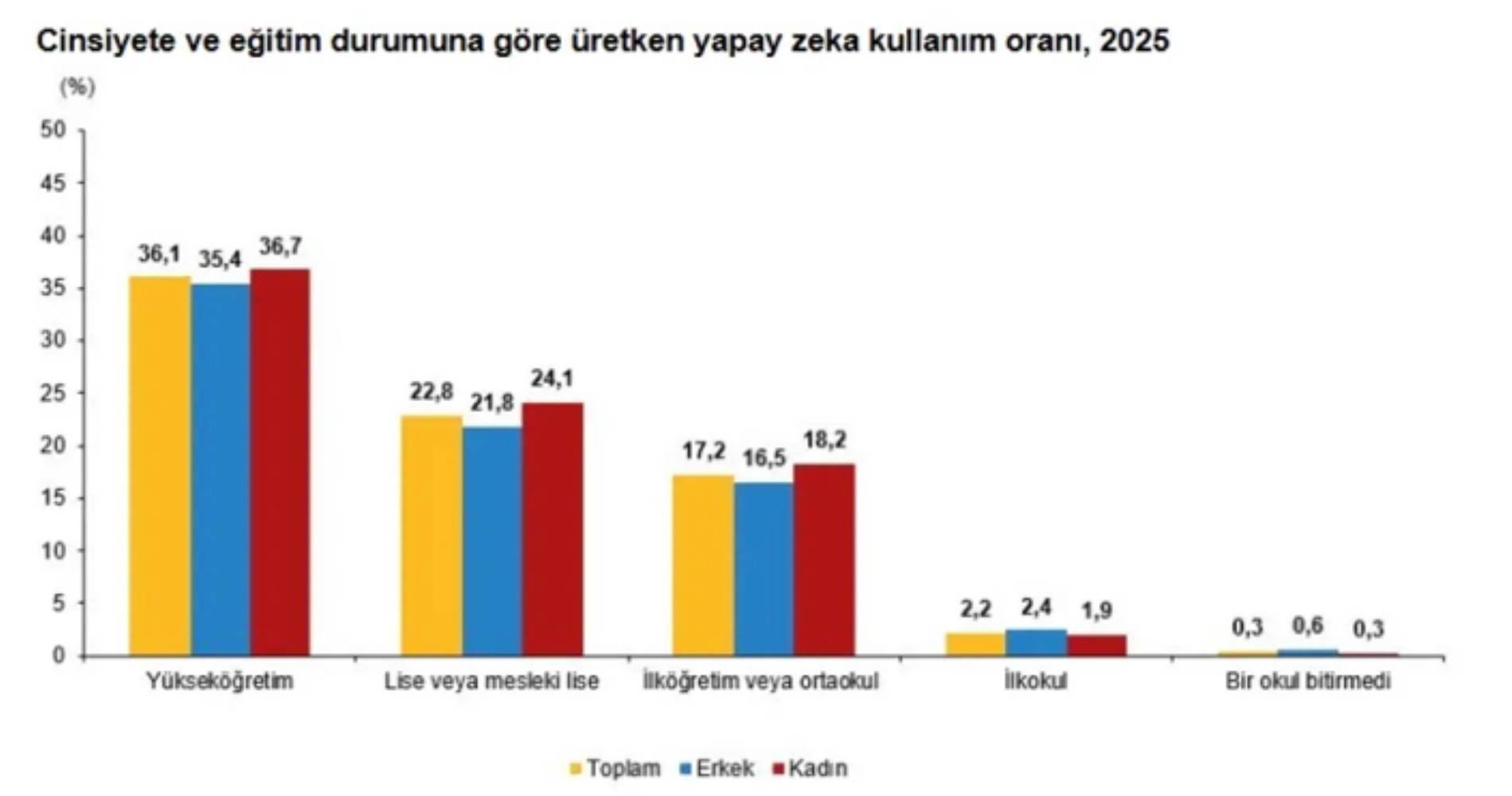
The fact that digital skills and technology awareness increase as the level of education rises shows that digitalization in Turkey is not only a technical issue but also a deep educational policy issue. Another striking finding is that the AI usage rate of female higher education graduates is higher than that of men. This indicates that the digital gender gap is beginning to close among the educated segment.
On the other hand, the breadth of the population with a low level of education limits Turkey's potential to create an AI-based workforce. This picture clearly shows that a comprehensive strategy based on education is needed for the digital transformation process to be sustainable.
ARTIFICIAL INTELLIGENCE IS STILL A PERSONAL TOOL: 79.7% of Users Use the Technology for Private Purposes
The vast majority of individuals who use artificial intelligence benefit from the technology primarily for their personal needs. While 79.7% of users use artificial intelligence for private purposes, the rate of professional use remains at 33.8%, and the use for formal education purposes at 31.4%. The gender breakdown also reveals striking differences: while private use reaches 81.9% and professional use reaches 37.7% in men, these rates are 77.4% and 29.5% in women, respectively. In terms of use for formal education purposes, the picture reverses; the usage rate of women, which is 36.6%, is significantly above the 26.7% level of men.
These data show that there is a gender-based divergence in the use of artificial intelligence. While men adopt the technology more in professional processes and as a productivity tool, women exhibit a more active usage, especially for learning, access to information, and personal development. This situation indicates that digital transformation is also progressing at different speeds in terms of gender.
Furthermore, these data reveal that artificial intelligence has not yet been fully integrated into business life in Turkey and is used by individuals more at the level of personal curiosity and experience. Although generative artificial intelligence is gaining an increasingly prominent place in daily life, it has not yet become a systematic and widespread tool in professional business processes.
DIGITAL AWARENESS ALARM: Most of the Population Does Not Need Artificial Intelligence
63.3% of individuals who do not use artificial intelligence state that they "do not need" to use this technology. 18.7% of participants state that they do not know how to use artificial intelligence, and 12.4% state that they are not aware of the existence of such technology. The rate of those who have privacy, security, and safety concerns remains at 5.5%.
These data show that digital awareness in Turkey is still not at the desired level and that a significant part of society positions artificial intelligence outside of their daily lives. However, reducing this situation only to the level of education is not enough. Technological transformation in Turkey is progressing socially unequally; while the urban and young population adapts rapidly to digitalization, those living in rural areas and older generations still follow technology from a distant point.
For this reason, the focus of AI policies should not only be to produce technology but also to increase digital participation and strengthen inclusiveness. Otherwise, digitalization may become a process that deepens social differences rather than reducing them.
CONCLUSION: Turkey is at a Digital Threshold—TurkStat Data Shows Steps That Must Be Taken Urgently
TurkStat's first artificial intelligence statistics reveal both the progress made and the structural limits in Turkey's digital transformation journey with all clarity. While the data shows that the young and educated population adopts technology rapidly and large enterprises evaluate artificial intelligence as a strategic tool, it also exposes that chronic problems such as lack of expertise, low education level, SMEs remaining in the background, and social inequalities slow down this process. For Turkey to turn this digital threshold into a real development move, it needs to take decisive steps in three main areas: a comprehensive education reform that will train qualified human resources, a strong support ecosystem that will include SMEs in the transformation, and a widespread digital literacy strategy that will increase social inclusiveness.
Artificial intelligence is no longer a technology preference, but the new standard of economic growth and competitiveness. This transformation is reshaping not only production but also access to information, public services, employment, and the habits of daily life. Turkey's ability to fully utilize this potential depends on implementing a holistic strategy that includes education, law, ethics, and social policies beyond technology investments. It is not possible for digital transformation to achieve lasting success without creating a framework where data security is strengthened, legal uncertainties are resolved, and ethical principles are embraced on a social scale.
TurkStat's data is actually a clear call: Turkey must become a country that not only follows but also manages and shapes artificial intelligence. The determinant of the digital future will not be the data possessed; it will be the level of vision, skill, and inclusiveness to make sense of that data.
Most Read

Striking picture for Özgür Özel's 'New Party'

The PKK opening and Özgür Özel’s path!..

How did the newspapers view Özgür Özel's farewell to the CHP?

He killed his wife by slitting her throat: Their children witnessed the moments

What did the CHP do?

Özel’s new party move in the world press

Fire at TUSAŞ engine factory in Eskişehir under control

The New CHP, against CEHAPE

From self-efficacy to despair

Kılıçdaroğlu's first message on Özgür Özel's new party announcement