



The Turkish economy has reached a historic crossroads. The 2026-2028 Medium-Term Program (MTP) marks the beginning of an "economic marathon" with the goal of single-digit inflation and permanent stability. This three-year journey will be a process where not only figures but also willpower and determination will be tested.
The MTP, which outlines the framework of fiscal discipline for the public sector and serves as a guide for the private sector, stands out as a fundamental policy document covering macroeconomic aggregates, revenue-expenditure estimates, budget balance, debt status, and reform priorities.
With the disinflation process that began in 2024, Turkey has taken its place among high-income countries by the end of 2025, with a national income exceeding 1.5 trillion dollars and a per capita income of over 17 thousand dollars, independent of income inequality. The new program announced at this threshold aims to maintain economic stability to make growth sustainable, bring per capita income close to 21 thousand dollars, increase exports and tourism revenues, reduce unemployment to below 8% with 2.5 million additional jobs, and lower inflation to single digits. However, in a global environment where protectionism is rising, growth in Europe is slowing, and geopolitical risks remain high, achieving these goals will not be easy.
GROSS NATIONAL PRODUCT (GNP) AND GROWTH: Are the targets a realistic roadmap or a difficult marathon?
According to the MTP, the Turkish economy is projected to grow by 3.8% in 2026, 4.3% in 2027, and 5% in 2028. This growth path is above the global average of 3.1%, but slightly behind the average of around 4% for developing countries. By the end of the program, nominal national income is targeted to approach 1.9 trillion dollars. The table below presents the MTP growth targets, realization estimates (RE), program projections (P), and actual realizations for the 2019-2028 period. The table also reveals the striking deviations between annual plans and realizations.
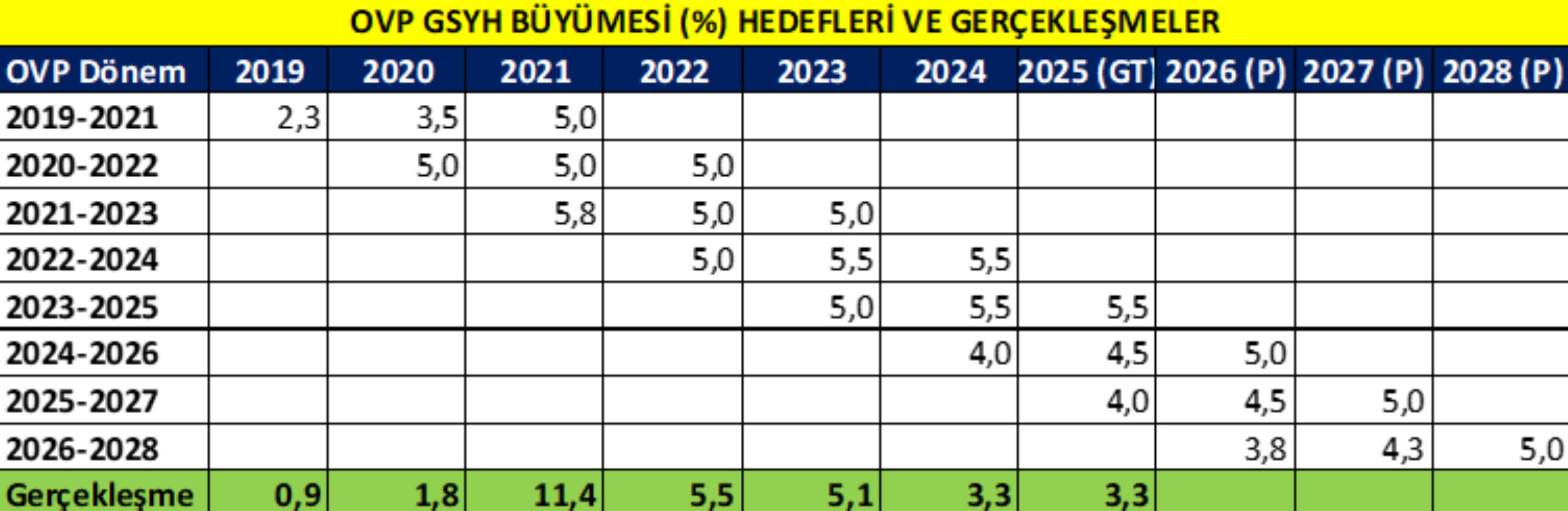
The truly critical point is the quality of growth. A growth model weighted toward domestic demand could create inflationary pressure again. To reduce this risk, the MTP prioritizes export-oriented, technology-focused, and productivity-enhancing investments. However, the fact that low-tech products still have a large share in Turkey's exports shows how critical this transformation is. Unless this structural change is achieved, the sustainability of growth will remain debatable.
Looking at the global picture, India is expected to grow by 6.4% and China by 4.2% in 2026. Turkey presents the appearance of an economy growing faster than developed countries but slower than the rising Asia. IMF and World Bank forecasts also support this picture: global growth is estimated to be 3.1% in 2026, with developed economies at 1.6% and developing countries at around 4%. These data reveal that the MTP contains both ambitious goals and vulnerabilities.
PER CAPITA NATIONAL INCOME: Figures are rising, risks persist
Per capita national income, which is 17,748 dollars in 2025, is projected to rise to 18,621 dollars in 2026, 19,710 dollars in 2027, and 20,987 dollars by the end of the program in 2028. This increase aims to make Turkey permanently part of the high-income country league. However, two main risks stand out:
• Exchange Rate Risk: Since these calculations are made in dollars, the depreciation of the Turkish Lira could rapidly pull the figures down. Achieving the target is strictly dependent on exchange rate stability.
• Income Distribution: Even if average income increases, this prosperity may not be distributed equally among all segments. The gap between the richest 10% and the poorest 10% in Turkey is still well above the OECD average. High-income country status may not reflect on the living standards of the broad masses at the same speed.
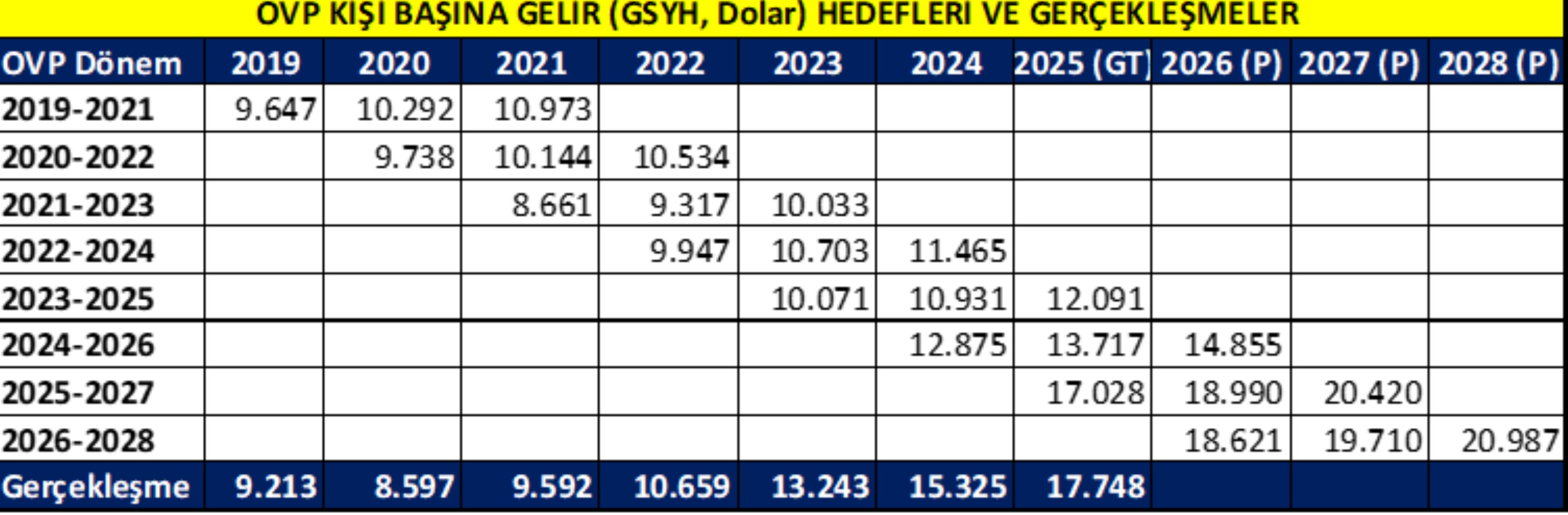
The table above clearly reveals the striking differences between the annual plans envisaged in the MTP and the realizations. According to the World Bank, countries are considered high-income when per capita income exceeds 15 thousand dollars. Turkey's goal is not only to cross this threshold but to make it permanent. However, this will be possible not only with nominal increases but with a real improvement in purchasing power. In global comparison, although Turkey will make a significant leap with its 21 thousand dollar target, it will still remain behind the USA ($89,000), Germany ($56,000), and South Korea ($35,000). The real test will be how much this increase reflects on kitchens, dining tables, and broad segments of society.
INFLATION: Single-digit target, a challenging journey
One of the most ambitious goals of the MTP is to reduce inflation to single digits by 2028. The CPI, which is expected to be 28.5% at the end of 2025, is projected to fall to 16% in 2026, 9% in 2027, and 8% in 2028. This target is based on an uninterrupted and determined disinflation policy.
However, considering Turkey's history of chronic inflation, the risks are significant.
• Food and Energy: Agricultural costs increasing with climate change and energy prices stemming from geopolitical tensions threaten price stability.
• Wage Dynamics: Determining minimum wage and public salary increases indexed to inflation increases price rigidity.
• Expectations: The habit of pricing based on past inflation is still strong, which makes the disinflation process fragile.
The table below presents the MTP inflation targets, realization estimates (RE), program projections (P), and actual realizations for the 2019-2028 period. The table clearly shows the gap between targets and reality, reminding us that the real test is given in field implementation rather than plans on paper.
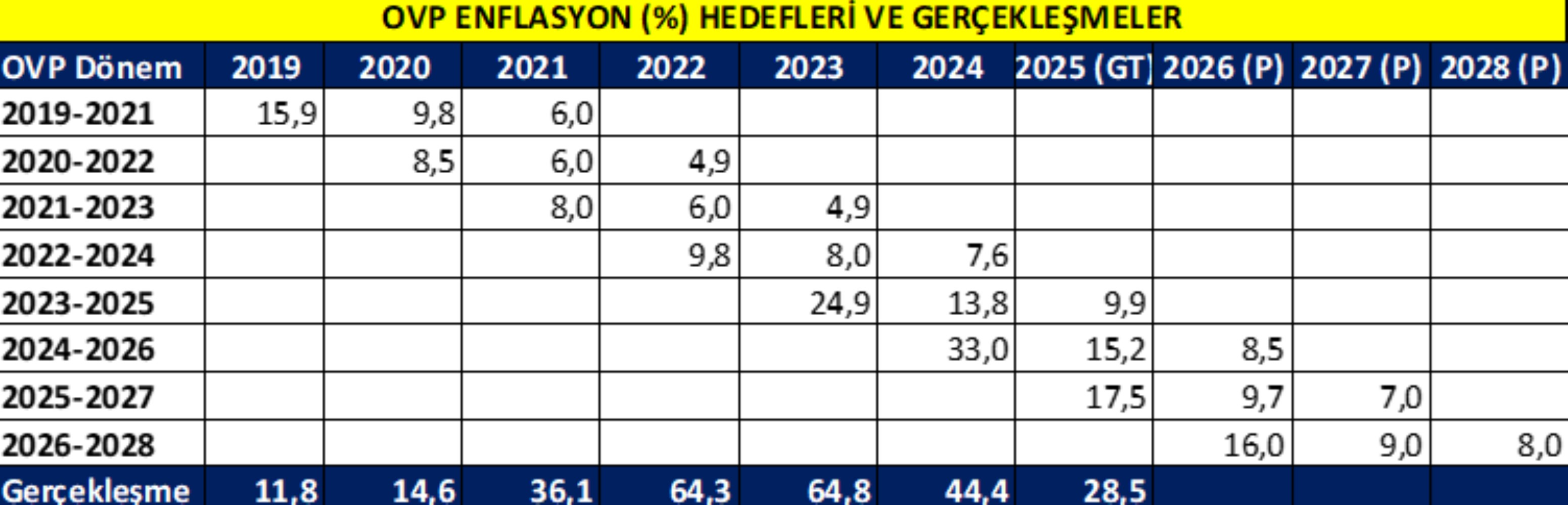
For this reason, the single-digit inflation target must be supported not only by monetary policy but also by structural reforms that will increase productivity in agriculture, energy independence, and competition. On a global scale, Turkey is still struggling with inflation above the average. According to the IMF's 2025 forecast, inflation will be 2.5% in developed economies and 5.4% in developing countries. Turkey's 8% target even in 2028 is well above these averages.
While OECD and EU countries have managed to keep inflation in the 2-3% band over the last decade, the single-digit targets of MTPs in Turkey have mostly not been realized. The fact that inflation exceeded 30% in the post-2021 period clearly revealed the vulnerabilities created in the economy by the incompatibility between monetary and fiscal policies and exchange rate volatility.
Therefore, the disinflation process must be supported not only by interest rate hikes but also by expectation management, selective distribution of loans, and permanent reforms that strengthen food and energy supply security. So, will Turkey be able to reach its goal and make price stability permanent in this challenging marathon?
UNEMPLOYMENT AND EMPLOYMENT: Figures are improving, problems persist
As summarized in the table below, the MTP projects that the unemployment rate, which is 8.5% in 2025, will fall to 8.4% in 2026, 8.2% in 2027, and 7.8% in 2028. This means that for the first time in Turkish history, unemployment will permanently fall below 8%. The program also aims to create 2.5 million additional jobs. However, considering the deviations between the figures planned in past MTPs and the realizations, it is seen that these targets will face a serious test in practice.
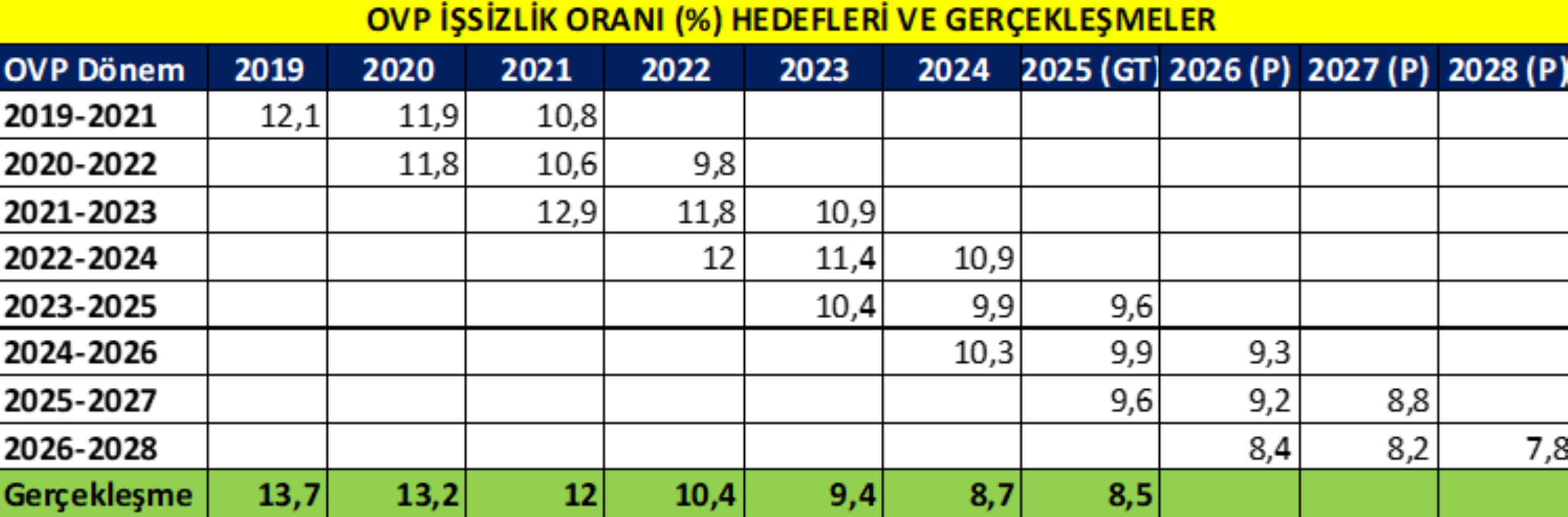
The data point to three critical points:
• Youth Unemployment: According to TURKSTAT's July 2025 data, although general unemployment has fallen to 8%, the rate is still around 15% in the 15-24 age group.
• Women's Employment: The labor force participation rate of women is at 33%, well behind the OECD average (62%).
• Quality of Employment: A significant portion of the jobs created are in low-wage and insecure sectors. This shows that the quality problem persists even as employment increases.
In international comparison, Turkey's 7.8% target remains above developed countries such as the EU (5.9%), OECD (4.9%), and especially Japan (2.2%). Reducing unemployment to single digits will be possible not only by continuing growth but also by strengthening the education-employment link and implementing social policies that will increase youth and women's employment. The real test is to be able to turn employment into a transformation that makes itself felt not only in figures but also in lives.
EXCHANGE RATE AND FINANCIAL STABILITY: Exchange rate volatility is the weakest link of the MTP
The MTP does not announce a direct dollar exchange rate target; however, national income and per capita income targets assume that the TL will follow a relatively stable course. It is possible to reach implicit exchange rate estimates by dividing the GDP in TL by the GDP in dollars in the "Basic Economic Aggregates" tables.
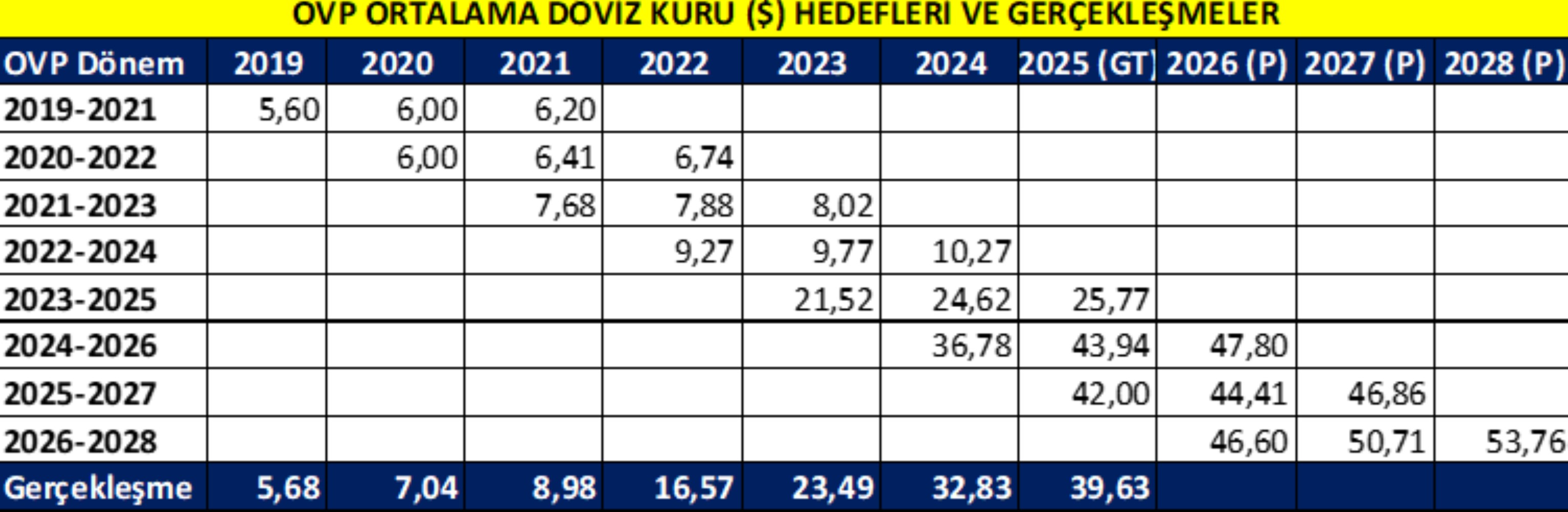
The table above contains the MTP's implicit exchange rate ($) targets, realization estimates (RE), program projections (P), and actual realizations for the 2019-2028 period. The table clearly shows the gap between targets and realizations, reminding us that the MTP's biggest test is given in implementation rather than plans on paper.
Developments that stand out as of 2025 give important signals on the exchange rate side:
• FX-Protected Deposit (KKM) Stock: It decreased by 1.2 trillion TL compared to the previous year to 397 billion TL, and its share in total deposits fell to 1.7%.
• TL Deposit Share: The share of TL in total deposits rose to 60.7%, showing that confidence in the TL has partially recovered.
• Reserves: Central Bank reserves reached a historic peak of 178 billion dollars.
Despite this positive picture, Turkey is still dependent on external financing. The volatility that global interest rate cuts may create in capital flows could put pressure on the TL. For this reason, exchange rate stability remains the most critical point of vulnerability in the success of the program.
In international comparison, Turkey's reserve/GDP ratio is 11%, well behind China (25%), India (18%), and Russia (30%). This reveals that the buffer capacity against external shocks is limited. In other words, a sharp wave in the exchange rate could derail the entire program; the success of the MTP depends on keeping the ship balanced in this stormy sea.
CURRENT ACCOUNT DEFICIT AND FOREIGN TRADE: Balanced outlook, fragile reality
As summarized in the table below, the current account deficit, which is 1.4% of national income in 2025, is targeted to fall to 1.3% in 2026, 1.2% in 2027, and 1% in 2028 according to the MTP. This rate is well below Turkey's long-term average of approximately 4% and points to a relatively balanced picture.
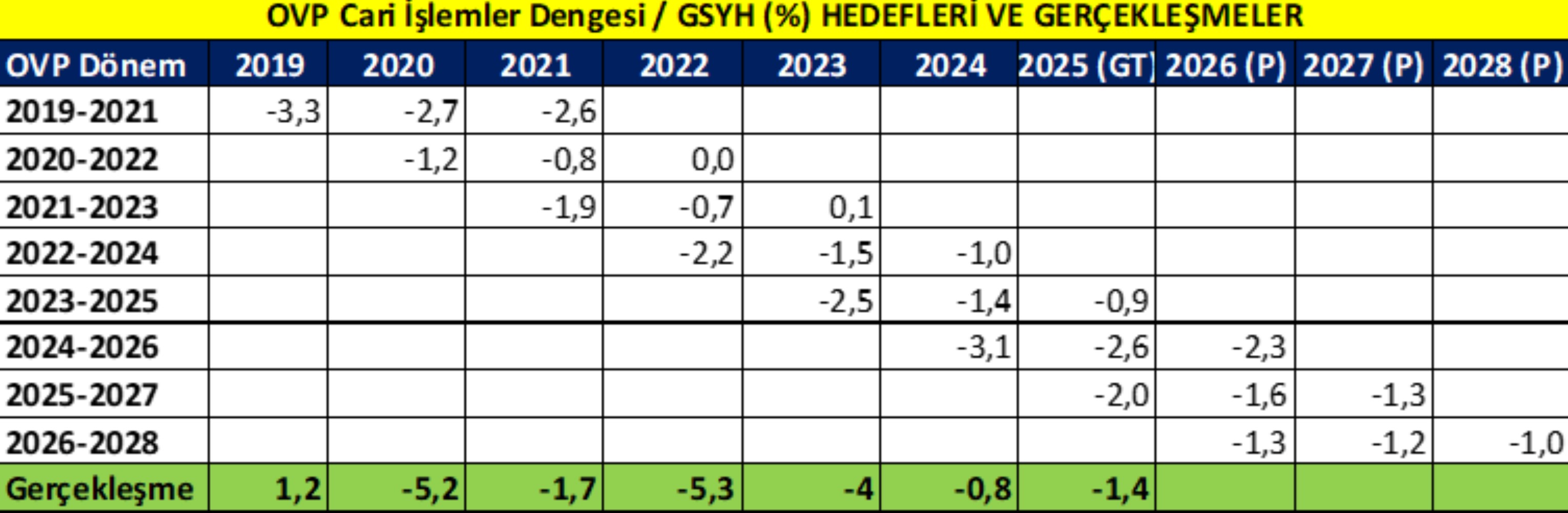
The main goal of the program is to permanently reduce the foreign deficit by increasing the product and market diversity of exports. However, structural problems stand out here:
• Structure of Exports: The share of high-tech products in total exports is still around 5%, which keeps the added value limited.
• Import Dependency: A large part of the intermediate goods and energy used in industry is imported. As long as this dependency continues, every increase in global energy prices can increase the current account deficit again.
• Dependency on Europe: More than 40% of exports are made to the EU. The slowdown in the European economy can directly affect Turkey's export revenues.
In global comparison, while the USA constantly runs a current account deficit of around 4%, Germany stands out with a 6% surplus and China with a 2% current account surplus. Although Turkey's 1% target looks positive, the continuation of structural dependencies shows how fragile this balance is. If this vulnerability is not eliminated, current account deficit targets can suddenly reverse and shake economic balances.
FISCAL POLICY AND BUDGET: Fiscal discipline and risks
The budget deficit, which rose to 4.7% in 2024 due to the earthquake (1.7 points of which were earthquake expenditures), is projected to fall to 3.6% in 2025, 3.5% in 2026, 3.1% in 2027, and 2.8% in 2028. This target is based on savings in public expenditures, broadening the tax base, and strengthening the fight against the informal economy.
However, increasing public expenditures and populist social transfers during election periods are the most important risks threatening budget discipline. These practices, which provide political gain in the short term, can weaken fiscal stability and sustainable growth in the long term. In addition, the debt burden of local governments and obligations arising from public-private partnership projects can make the budget outlook more fragile.
Looking at the global scale, the budget deficit is on average 3.5% in EU countries and 6.4% in the USA. Turkey's 2028 target of 2.8% is consistent with the Maastricht Criteria and points to a more disciplined fiscal situation than most developed countries. According to Maastricht, the ratio of public debt to GDP should not exceed 60%, and the budget deficit should not exceed 3%. Although Turkey's target shows that fiscal discipline can be maintained, this requires uninterrupted political determination. As a result, if budget discipline cannot be maintained, all balances of the MTP can be disrupted at once and the program can go off the rails.
IMPORTANCE OF STRUCTURAL TRANSFORMATIONS: The key to sustainable development
Turkey's ability to reach its 2026-2028 targets is possible not only with short-term economic policies but with deep-rooted structural transformations. These transformations focus on four critical areas:
• Modernization in Agriculture: Despite being an important sector for Turkey, productivity in agriculture is still low. Thanks to the use of technology, sustainable production methods, and digitalization, productivity will increase, external dependency will decrease, and food security will be strengthened.
• Energy Independence: A large part of energy needs relies on imported sources. Renewable energy investments and increasing domestic production capacity will support both economic stability and environmental sustainability.
• Technology Leap in Industry: Turkey's global competitiveness remains limited unless the share of high-tech production increases. Industry must be made more efficient and higher value-added with digital transformation, artificial intelligence, and automation technologies.
• Education-Employment Compatibility: The education system must be reshaped according to the needs of the labor market. Vocational training and digital skills should be strengthened to increase the participation of the young population in employment.
Determined steps to be taken in these areas will permanently improve not only economic indicators but also social welfare.
THE MTP'S OPTIMISTIC GOALS AND CHALLENGES
The MTP offers an ambitious economic vision for Turkey; however, achieving these goals requires serious structural transformations. Although macroeconomic indicators are impressive, these figures may remain just an optimistic wish if the right policies and strong institutional infrastructure are not provided.
• Economic and Institutional Reforms: In the next three years, not only economic policies but also institutional capacity needs to be strengthened. Consolidating the rule of law, increasing investment security, and strengthening judicial independence and transparency are critical for long-term growth.
• Inflation and Unemployment: Inflation is still above the average of developed countries. Although the unemployment rate is approaching single digits, it is behind OECD averages. This reveals the necessity of policies to increase employment and permanent reforms in the labor market.
• Income Distribution and Welfare Gap: Even if per capita income increases, income distribution is still poor. For sustainable development, more inclusive policies must be implemented in areas such as social assistance, education, and access to health services.
If Turkey overcomes these challenges, the MTP can turn into a roadmap that shapes the country's economic future, not just a table of goals.
CONCLUSION: Will the MTP gather dust on shelves, or will it guide the economy?
Turkey has entered a historic turning point with the 2026-2028 Medium-Term Program (MTP). The goals of single-digit inflation, permanent employment, balanced current account deficit, and fiscal discipline offer a vision that will reshape the country's economic route. However, achieving these goals is possible by ensuring exchange rate stability, implementing structural reforms, and sharing social welfare fairly. If the right policies and a strong will for implementation are shown, the MTP can be not just a plan, but a new page in Turkey's economic story.
The goals on paper are promising: inflation will fall to single digits, growth will gain stability, and the current account deficit will decrease. However, in the real world, bringing this picture to life requires strong policy coordination, determined reform steps, and social support. The more ambitious the goals, the tougher the test in implementation will be.
While the IMF and OECD underline that reforms must accelerate and monetary-fiscal policies must work in harmony, the World Bank draws attention to productivity increases in energy and agriculture. Academics emphasize the lack of a social dimension in the program, stating that social trust cannot be established without ensuring justice in income distribution.
The solution lies in long-term strategies rather than steps that save the day. A clear harmony must be ensured between monetary and fiscal policies; structural reforms should be planned according to the country's real needs, not the election calendar. Productivity in energy and agriculture must be increased, and social policies that will improve income distribution must be put into effect. These transformations will permanently strengthen not only economic indicators but also social welfare.
The MTP is a mirror of a period in which Turkey is being tested again in the economy. This program will either turn into a roadmap that gives confidence to the country or will go down in history as a document that will gather dust on shelves. The compass is now clear, but it will be the captain's will that determines the route.
Most Read

Striking picture for Özgür Özel's 'New Party'

Özgür Özel gives a dated response regarding the number of resignations

Forest fire in Antalya brought under control

The PKK opening and Özgür Özel’s path!..

How did the newspapers view Özgür Özel's farewell to the CHP?

What did the CHP do?

Özel’s new party move in the world press

The New CHP, against CEHAPE

From self-efficacy to despair

The return of craftsmanship in the age of artificial intelligence