



Turkey is experiencing a silent but devastating social transformation within a deep cost-of-living crisis that extends from the kitchen to the wallet, and from the market to the dinner table. With the hunger threshold approaching 30,000 TL and the poverty threshold nearing 100,000 TL; rapid price increases in basic food products and the minimum wage remaining even below the hunger threshold are condemning millions of people to a struggle for "survival" instead of "making a living." As the gap between official inflation and the reality felt by the public grows, kitchen inflation is dragging low-income households into an ever-deeper spiral of debt and poverty every month. The fact that the economic crisis is now visible not only through statistics but directly through the depletion of dinner tables and the erosion of wallets points to a structural fracture that threatens the access of broad segments of society to healthy food and basic necessities.
TÜRK-İŞ's November 2025 data reveals the dimensions of this fracture in a striking way. The fact that the 22,105 TL minimum wage remains behind even the 29,828 TL required for food alone shows how deep income inequality has become, while also revealing that a healthy and dignified life is turning into a privilege accessible to an increasingly narrow segment. Millions of low-income households cannot access healthy food; they are trying to survive by going into debt and consuming products with low nutritional value. This picture is no longer just an economic deterioration, but a harbinger of a collapse that is shaking the social fabric.
Under these conditions, social municipalism practices are becoming one of the most critical pillars that allow society to breathe. Services such as city restaurants, affordable daycare centers, and education and housing support are not just temporary solutions; they stand out as permanent social policies that strengthen social solidarity. However, the effectiveness and sustainability of these services depend on local governments being supported financially and institutionally by the central government.
WHAT DO THE TÜRK-İŞ NOVEMBER 2025 HUNGER AND POVERTY THRESHOLD DATA SAY: Minimum Wage is 7,723 TL Below the Hunger Threshold
TÜRK-İŞ's November 2025 data reveals the real crisis brewing in Turkey's kitchen in all its nakedness. While the monthly food expenditure required for a family of four to eat healthily, i.e., the hunger threshold, has risen to 29,828 TL, the poverty threshold, including housing, transportation, and other mandatory expenses, has reached 97,159 TL. As the distance between hunger and a humane life widens every month, the 22,105 TL minimum wage remains 7,723 TL behind even the kitchen expenses alone. This is the clearest indicator that the cost-of-living crisis has now turned into a concrete and palpable reality for broad segments of society.
The fact that the cost of living for a single worker has risen to 38,752 TL reveals that even those living alone cannot escape economic pressure. The fact that kitchen inflation has reached 4.98% monthly and 45.07% annually confirms that wages are eroding against rising prices and that vulnerability is deepening. These data, which TÜRK-İŞ has put into a table, are not just an economic situation, but a harbinger of a larger collapse that threatens the social structure.
The study by TÜRK-İŞ does not only present economic indicators; it also reveals with its data table that the threshold of a social and moral collapse has been reached:
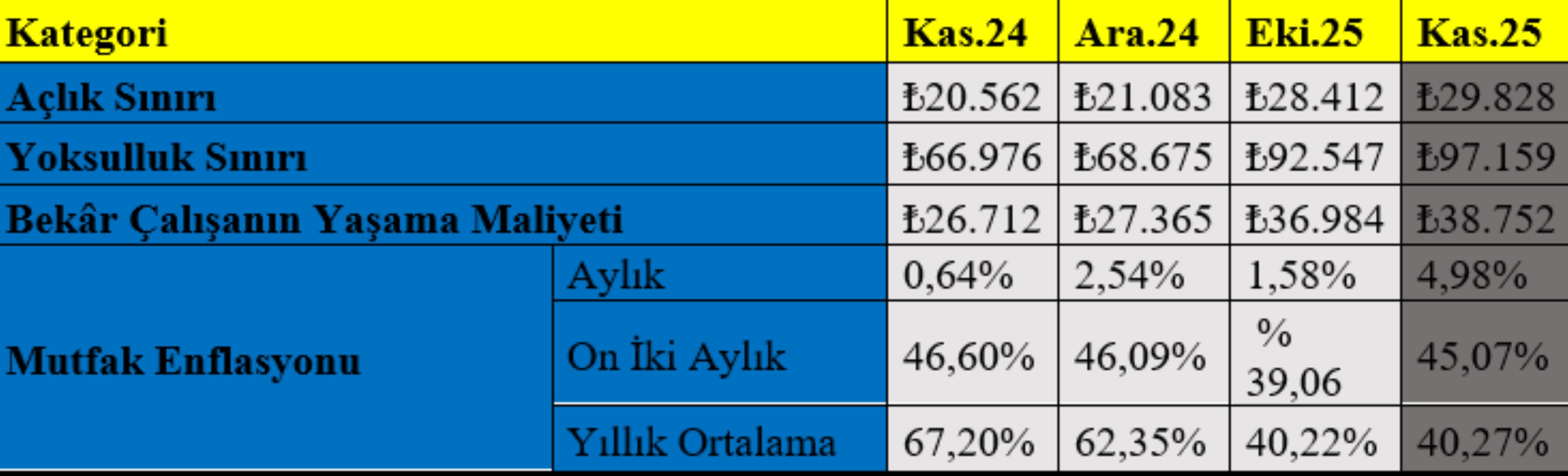
The data does not just paint an economic picture; it shows that a high cost of living that inflicts deep wounds on the daily life of society has become permanent. As food, energy, and housing costs rise sharply, the struggle for livelihood is now felt in every home, at every dinner table.
At this point, the gap between official inflation and the reality experienced by the citizen is even more remarkable. While TURKSTAT (TÜİK) announced annual inflation at 31.07% and food inflation at 27.44%, the 56.82% annual increase by ENAG and the 38.28% rate announced by the ITO for Istanbul reveal that prices in the field are rising much faster than official figures.
In short, the pot boiling in the kitchen speaks with a louder voice than the numbers. The market bag, supermarket shelves, and the bills that arrive every month clearly explain that the inflation felt by society is not as "moderate" as in the TURKSTAT tables. The visible face of the crisis is now where everyone's hand touches: at the table, in the wallet, and in the shopping cart.
HOUSEHOLD FOOD BASKET: The Cost Required for a Family to Survive Now Pushes the Limits
The hunger threshold data reveals with all clarity the heavy economic burden a household is under just to be able to eat. The minimum food expenditure for a family of four reached 29,828 TL in November 2025. This figure draws attention with its increase, which has approached nearly double in just one year.
The nutritional costs of family members make the picture even more striking: Adult male: 8,951 TL, Adult female: 7,228 TL, 15–19-year-old youth: 8,839 TL, and Small child: 4,808 TL. While each item creates a burden that strains the family budget on its own, the fact that the total food expenditure has reached approximately 1.4 times the minimum wage reveals the most visible form of the cost-of-living crisis in the kitchen.
For this reason, the hunger threshold is not just a technical indicator; it is the name of the real, concrete, and scientifically calculated cost required for a family of four to eat healthily three meals a day. This amount of 29,828 TL is proof that the economic crisis is felt most clearly at the dinner table.
ANATOMY OF KITCHEN INFLATION: Vegetables Reached 80 TL, Fruit 108 TL, TASE Reached 1120
TÜRK-İŞ's November 2025 data reveals once again that the fire in the kitchen is now an undeniable reality. Not only general inflation rates, but also the increase in the prices of the most basic food products show how heavy the burden has become for low-income households. The average vegetable price per kilogram has reached 74 TL, and the fruit price has reached 108 TL. The 84 TL, which is the weighted average of the two groups, concretely explains the pressure every product entering the kitchen puts on the family budget.
The fact that kitchen inflation increased by 4.98% in November, reaching 41.48% since the beginning of the year and 45.07% in the last 12 months, proves that the rise in prices is not temporary, but the result of an increasingly deepening cost chain. The continuity of the rate of increase spread over months shows that the burden felt in the kitchen is getting heavier with each passing month.
The data that makes this picture most strikingly visible is TASE (Hunger Threshold Index). The index, which rose to the 1120.28 level in November 2025, was 332.93 at the beginning of 2023. This index, which has increased more than three times in two years, reveals most clearly how the cost of basic nutrition alone for a family of four has multiplied.
The labels changing every day on supermarket shelves, the eroding purchasing power, the difficulties citizens face in accessing basic food... This whole picture explains why the real inflation in the field is so different from official statistics. While the sharp rise in food prices deepens income inequality, it leaves Turkey facing an increasingly distinct food crisis.
All indicators confirm that millions of workers are struggling to live on the hunger threshold every month. The minimum wage has ceased to be a means for a worker to make a living; it has regressed to a point where it does not even meet the "survival" line, let alone the "livability" threshold. We are going through a period where poverty is becoming commonplace and the cost-of-living crisis is turning into a permanent social reality.
MEAT PRICES AND THE INVISIBLE LAYERS OF THE COST CHAIN
The rapid rise in meat prices has been one of Turkey's most burning agenda items for a long time. However, this increase is not a fluctuation specific to a single product group; it is the result of a multi-layered cost chain that feeds the entirety of food inflation, which is invisible but whose impact is getting heavier every day. Meat is at the center of the discussions because it is the most visible price item in the market; yet the real picture is hidden in a wide cost network extending from feed to energy, from exchange rates to logistics.
The fact that approximately 60% of feed costs in Turkey are based on imported inputs makes every increase in foreign currency directly reflected in feed prices, and from there to a wide range of food from meat and dairy products to eggs. Rising transportation costs and disruptions in the cold chain added to this picture increase the cost of not only animal products but also vegetables and fruits. Thus, the increase in meat prices actually turns into the most visible face of structural vulnerabilities in the entire food chain.
Short-term interventions are occasionally put into effect to alleviate this pressure. While meat prices received an average hike of 60 TL in the last month due to cost increases and the effects of foot-and-mouth disease, the prices of some products were fixed until the end of the year in Istanbul and Ankara with the cooperation of the Meat and Milk Board (ESK) and PERDER: Ground beef: 485 TL, Cubed meat: 510 TL, and Butter: 384 TL.
Although these steps give the consumer a temporary breath, it does not seem possible to ensure permanent price stability as long as structural cost pressures in the production chain are not resolved. The path to a solution goes through holistic policies that target the entire cost chain from production to logistics, not just price fixings.
The depth of the problem becomes even more evident with global comparisons. Brazil has a strong share in world supply with approximately 3 million tons of beef exports in 2024. Large pasture areas, low feed costs, and high productivity allow it to maintain price stability in the domestic market. In Europe, modern production techniques and strong agricultural subsidies keep costs under control.
In Turkey, the picture is different: 2024 beef production is at the 1.4 million ton level. Small-scale production structure, high dependence on imported inputs, increasing logistics costs, and volatile exchange rates cause cost increases to be felt much more severely. For this reason, global price movements show their effect in Turkey twofold; when internal vulnerabilities combine with external pressures, price increases grow exponentially.
Meat prices are only the visible part of the food crisis experienced today. The real crisis is moving toward a much deeper, much more complex, and increasingly unsustainable point with the cost burden accumulating in every link of the production chain.
MEAT IS NOW A LUXURY IN TURKEY: Consumption is Below the World Average, Protein Gap is Growing
Although Turkey has increased its live animal and red meat imports in recent years, it still struggles to deliver sufficient amounts of meat to the citizen's table. The fact that annual red meat consumption per capita remains at 16.6 kilograms is the clearest indicator of this problem. According to the OECD-FAO Agricultural Outlook 2024–2033 report, red meat consumption is at 34.8 kg in OECD countries, 34.5 kg in Europe, and 18.1 kg worldwide. The fact that Turkey remains below all these averages points not only to the limitation in production capacity but also to serious inequalities in economic access.
A similar picture appears in white meat. Annual white meat consumption per capita in Turkey is 11.6 kilograms, while it is 21.8 kg in the OECD and 17.1 kg in Europe. Although Turkey is slightly above the world average, the difference between it and developed countries is remarkable.
These data clearly reveal that the low level of meat consumption in Turkey cannot be explained only by production and import policies. Low income levels, rapidly rising prices, and deepening economic inequalities lead to meat becoming an increasingly luxury food. The sharp rise in prices makes it difficult to get enough protein, especially for children, the elderly, and individuals with chronic illnesses. Meat, which is one of the basic elements of healthy nutrition, is now becoming a product that high-income groups can consume regularly. While this situation creates a serious risk in terms of public health, it highlights malnutrition as one of the most visible forms of poverty.
The picture encountered in the field also confirms this situation: Many families can no longer consume red meat regularly; the number of households that cannot buy meat even once a month is increasing rapidly. As red meat moves away from dinner tables, the access of broad segments of society to basic protein sources is restricted.
Increasing meat consumption in Turkey and making it accessible seems possible only with structural reforms. Strengthening sustainable production models, implementing policies to reduce feed costs, supporting small and medium-sized producers, and reducing dependence on imports are of critical importance in terms of both price stability and access to healthy nutrition.
Otherwise, it seems that meat will continue to disappear from the society's health before it disappears from the table.
TURKSTAT SAYS ONE THING, THE MARKET SAYS ANOTHER: TURKSTAT-ENAG Inflation Gap is Widening
According to TURKSTAT's November 2025 data, annual inflation is 31.07%, and food inflation is 27.44%. However, the annual price increase calculated by ENAG for the same period is 56.82%. The approximately 25-point difference between them reveals how much the gap between the high cost of living felt by the citizen in the market and the official inflation figures has widened.
This divergence directly affects the lives of large masses beyond a simple methodology debate. Many critical decisions, from wage increases to pensions, from social support programs to the scope of public policies, are shaped by the figures announced by TURKSTAT. However, when evaluated together with TÜRK-İŞ's kitchen inflation data, it is clearly seen that prices in the field are far above official indicators. The real cost increases in the market, in the supermarket, and in the kitchen hit millions of households much harder than what official figures say.
Below is the comparison of TURKSTAT and ENAG's annual inflation data:

The data that ENAG collects directly from the field shows that the increase in food prices, in particular, is far above official inflation. For this reason, indicators that directly affect the household budget, such as the hunger and poverty threshold, offer a much more realistic picture for society than TURKSTAT's general inflation figures.
As a result, the gap between official inflation and the inflation felt by the citizen clearly reveals how the economic crisis is experienced by different segments of society. For millions of fixed-income earners, inflation is no longer a statistic; it is a daily struggle for survival that manifests itself in the market, in the supermarket, and in every bill that arrives. Real inflation speaks the language of the pocket and the table — and at a much higher tone, far beyond official figures.
AVERAGE INCOME IS SQUEEZED TO THE MINIMUM: Millions Live at the Hunger Threshold
In an economic order where incomes remain stagnant and expenses rise rapidly in Turkey, life is becoming more and more unsustainable for millions of people every day. The fact that the minimum wage has effectively regressed to the position of "average wage," combined with high inflation and the uninterrupted erosion of purchasing power, condemns broad segments of society to live below the hunger and poverty thresholds. Today, the issue is no longer making ends meet; even being able to meet basic needs has turned into a struggle in itself.
Yet, the minimum wage, by definition, refers to the minimum income that will meet a person's basic needs. However, the current minimum wage of 22,105 TL is not enough for a single worker to live a humane life, let alone a family; it remains below even the hunger threshold and turns into a symbol of social exclusion and economic despair.
Moreover, the problem is not limited to the working class. Teachers, nurses, civil servants, tradesmen, and retirees are also trapped in the same narrowing income circle. Although their living conditions are different, everyone is now asking the same question: "How will we make a living?"
This question has ceased to be an individual search; it has become an expression of a common despair felt in broad segments of society, and even a silent social rebellion.
The current economic picture shows not only that purchasing power has eroded, but also that the general standard of living of society has rapidly declined. Income levels that do not even meet minimum conditions push millions of people into a life that is insecure, fragile, and has lost hope for the future. The economic crisis no longer speaks the language of numbers, but directly the language of people's lives — and this language is becoming harsher every day.
CONCLUSION: As the Crisis Deepens, the Solution Lies in the Political Will that Strengthens the Social State
The picture extending from Turkey's kitchen to its market, from its wages to its basic living costs, is no longer a temporary fluctuation; it is a clear indicator that a structural crisis that deepens social inequalities has become permanent. Millions forced to live below the hunger threshold are not struggling with the price hikes renewed every day on the shelves, but with the injustice that has accumulated for years. While real inflation is felt at the dinner tables and the struggle for livelihood is felt in every moment of life, living a humane life is turning into a privilege accessible to an increasingly narrow segment.
Reversing this trend is possible only with a strong political will that prioritizes income justice, strengthens production, and aims to get the social state back on its feet. Otherwise, the cost-of-living crisis experienced today will lay the groundwork for a much heavier social collapse of tomorrow.
The sharp rise in food prices clearly reveals that economic imbalance has now become visible in every household's kitchen. The fact that the hunger threshold is approaching 30,000 TL and the poverty threshold is nearing 100,000 TL shows that millions of people are struggling not only to make ends meet but even to eat healthily. The kitchen crisis, combined with the erosion of real wages, turns life into a daily struggle for survival for the minimum wage earner.
These conditions increase not only today's picture but also tomorrow's nutrition, health, and education problems. While the entire chain from production to consumption is under cost pressure, permanent price stability does not seem possible. This is exactly why Turkey is at a critical threshold:
It will either reduce vulnerability by strengthening agriculture, production, logistics, and social support policies, or it will be dragged into a deep spiral of inequality where more people cannot access healthy food.
The crisis in the kitchen is not just today's cost-of-living struggle; it is a structural fracture that shapes the country's future. Every delayed step increases the social cost a little more. For this reason, what is needed is not temporary solutions that try to "manage" food inflation; but a strong social state understanding that solves the problem at its source.
While millions of households cannot reach healthy food today, they are forced to continue their lives with cheap but non-nutritious products. This situation is no longer just an economic crisis; it is a serious alarm that threatens social sustainability. The expectation of society from central and local governments is therefore clear: stronger social policies, more inclusive support mechanisms, and a fairer income distribution.
In a period where the minimum wage has turned into the average wage and millions live at the hunger and poverty thresholds, the expectation from both central and local governments is higher than ever. Social municipalism practices such as city restaurants, daycare centers, and housing and education support respond to the need in the field; however, the effectiveness and sustainability of these services are possible with the financial and institutional support of the central government.
A fairer, more egalitarian, and inclusive Turkey can be built with an understanding where central and local governments work in harmony and prioritize long-term social welfare, not daily troubles.
The issue is no longer settling for the "minimum"; it is building an order that will guarantee every citizen a dignified and healthy life. Turkey's future can be written not in poverty but in justice, not in despair but in hope — as long as economic and social policies meet the real needs of society.
Most Read

Striking picture for Özgür Özel's 'New Party'

The PKK opening and Özgür Özel’s path!..

How did the newspapers view Özgür Özel's farewell to the CHP?

He killed his wife by slitting her throat: Their children witnessed the moments

What did the CHP do?

Özel’s new party move in the world press

Fire at TUSAŞ engine factory in Eskişehir under control

The New CHP, against CEHAPE

From self-efficacy to despair

Kılıçdaroğlu's first message on Özgür Özel's new party announcement