



When Uğur Dündar brought up an anecdote that has been circulating on the internet and social media for years and is attributed to Can Yücel, he was evaluating the messages sent by CHP Chairman Özgür Özel to Keçiören Mayor Mesut Özarslan:
“We witness much harsher words in Parliament. As I was reading them, I remembered a trial of Can Yücel. He says to the judge, ‘Sir, in Turkish, a spade is a spade.’”
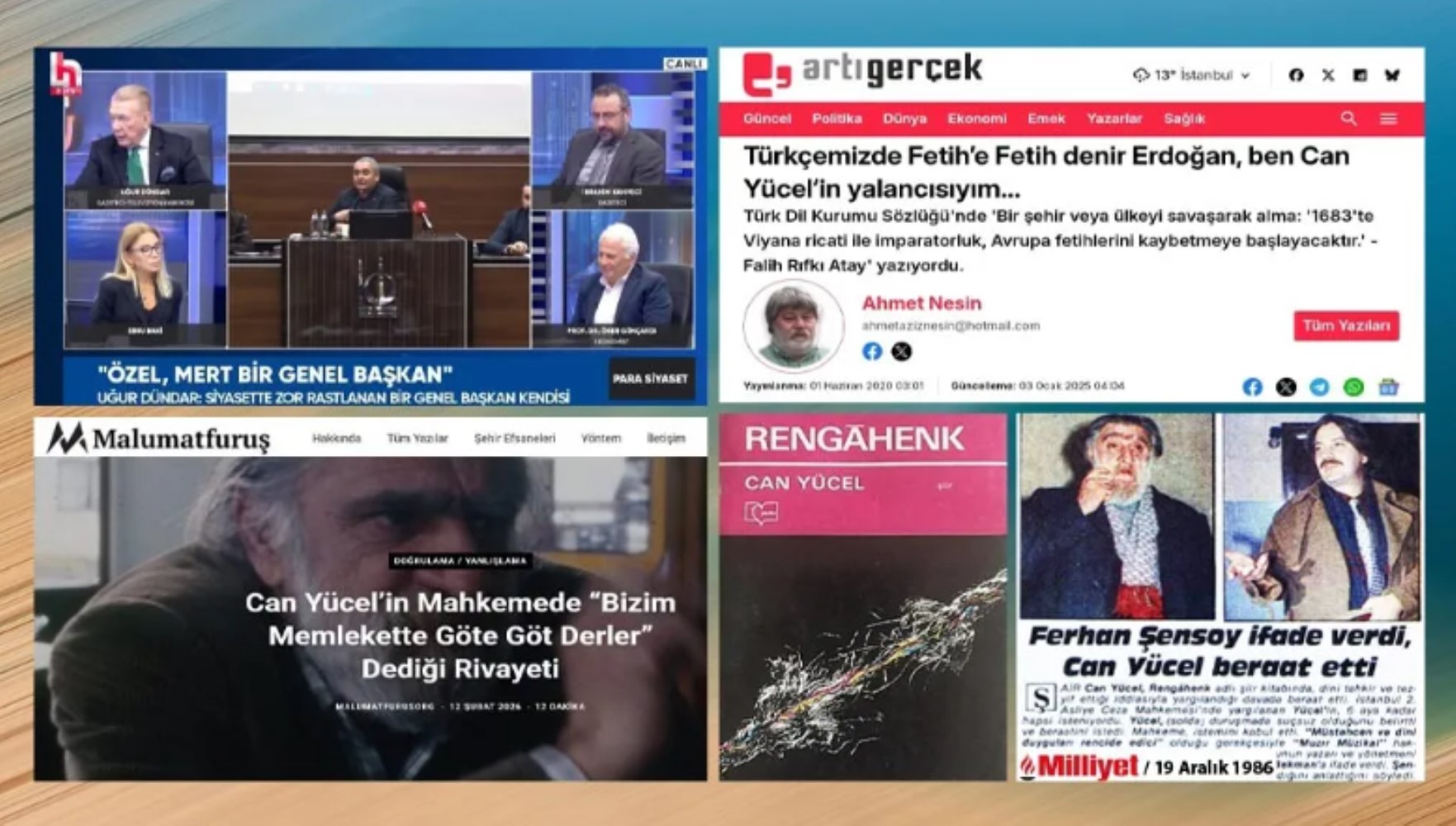
Uğur Dündar, by recounting that anecdote attributed to Can Yücel in detail on his program on Halk TV, normalized and even supported Özgür Özel’s insult toward Özarslan. Due to this narrative by Uğur Dündar, RTÜK issued a penalty to Halk TV. Ahmet Hakan also wrote that “this anecdote is not true” and “has not been legally proven.”
Upon this, I searched for the source of those words that have been in circulation for years. I found that in some publications, it is pointed out that this refers to the trial in which Can Yücel was judged for his book “Rengâhenk,” published by Yazko in 1982 and collected on July 18, 1984, on the grounds of “obscenity,” and for which he was acquitted in 1986. Indeed, there is a poem titled “Götümser” (Ass-timist) in that book. However, Can Yücel does not mention this anecdote even in his writings collected by Tevfik Taş in the book titled “Düzünden.”
When I couldn't make much progress, I asked for help from the friends at Malumatfuruş, and they also examined the issue. They found Ahmet Nesin’s article in Artı Gerçek. In his 2020 article, Ahmet Nesin recounts that one day after the September 12 coup, Can Yücel came to the Journalists’ Club while he was eating:
“‘I’m coming from the ass trial, I was acquitted,’ he said. A poem by Can Yücel had been published in the Yazko Edebiyat magazine, and the martial law military prosecutor’s office filed a lawsuit because the word ‘ass’ appeared in it. Let me relay the rest almost word for word from Can Baba’s mouth.
‘I also took the Turkish Language Association’s dictionary to the court. When the presiding judge asked me what I had to say, I opened the ‘G’ section and said to the panel, ‘Mr. President, honorable court panel, in our Turkish language, a spade is a spade, it is like that in the dictionary.’”
Before Ahmet Nesin, in 2017, Metin Celal also recounted a meeting with Can Yücel in 1985 in his article in Cumhuriyet, stating that he was acquitted in the trial for his poems in the book Rengâhenk by saying, “If we don’t call a spade a spade, what are we going to call it?”
Ahmet Nesin’s testimony and Metin Celal’s account are important pieces of information regarding the fact that Can Yücel said those words. Of course, these cannot be accepted as definitive evidence like court records or Can Yücel’s own writings, but after these accounts, one cannot say “it definitely did not happen.”
In any case, as in many events, the pro-government media mixed truths with falsehoods in the resignation of Keçiören Mayor Özarslan. They presented it as if Özarslan had resigned because of the WhatsApp messages from CHP Chairman Özel.
However, the posts by Turgut Altınok and Savcı Sayan before February 7 prove the opposite. Özel wrote those messages after Özarslan’s resignation became clear. He could not suppress his anger and expressed his reaction with words amounting to insults.
In the opposition media, Özel’s insults were not clearly reported; nor were the insults challenged. Some buried it in the news about Özarslan’s criminal complaint, while others glossed over the insults by mixing commentary with news. However, a journalist should not insult anyone, nor should they support insults.
Erman Toroğlu’s account is also problematic
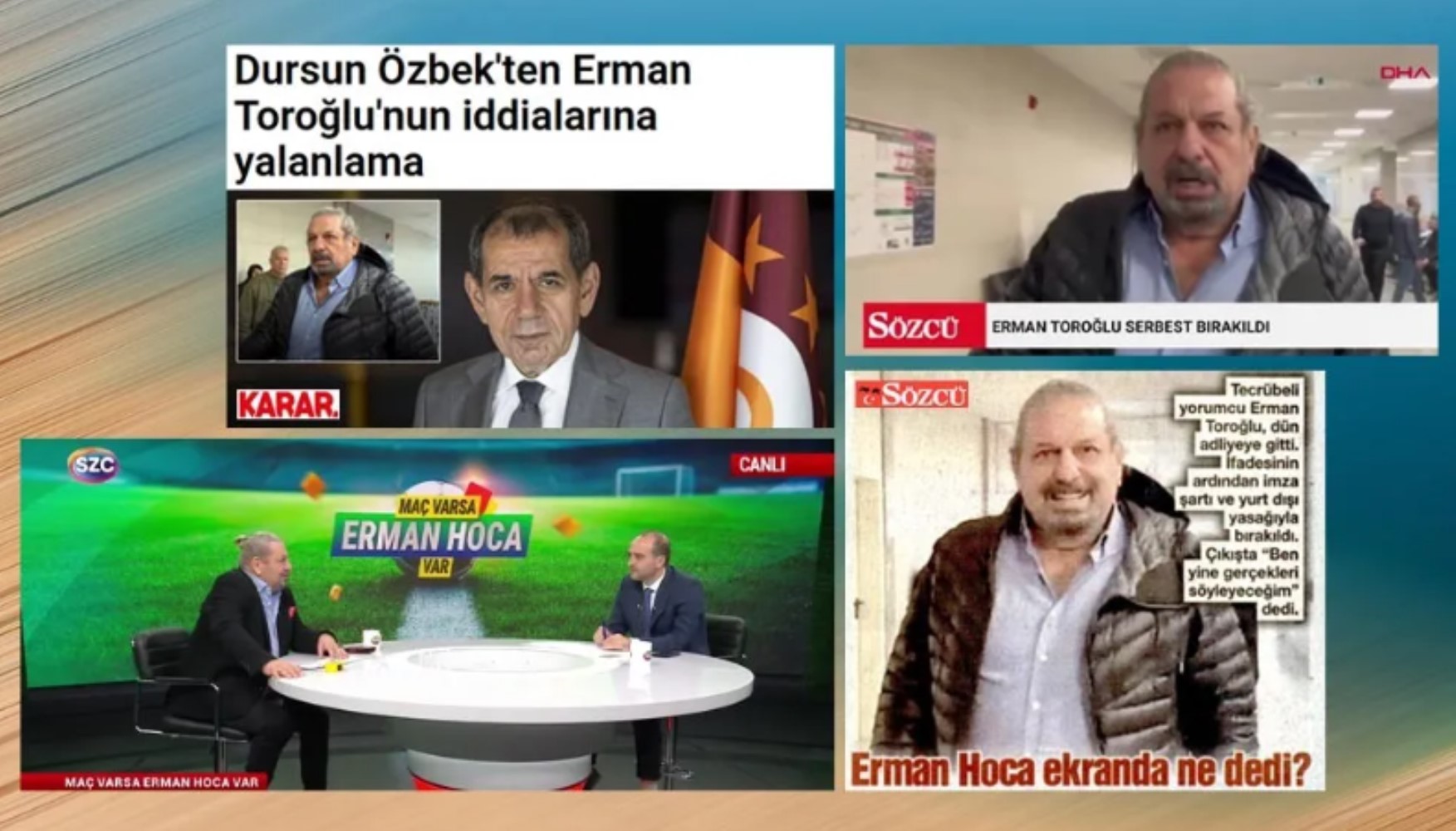
Turkey also witnessed a football commentator being detained due to his remarks on a program! Fortunately, Erman Toroğlu was not arrested; he was released with a signature requirement and a travel ban.
A statement could have been made, or the right of reply and correction could have been exercised. While these methods of correction were available, making Toroğlu the subject of an accusation of “publicly disseminating misleading information” is concerning in terms of showing the stage that media and freedom of expression have reached.
Sözcü, which wrote that the released Toroğlu said, “I will continue to tell the truth,” provided the following information under the headline “What did Erman Hoca say on screen?”:
“GS President Dursun Özbek says to the TFF President, ‘We are obliged to be champions this year.’ It is said that he uttered a sentence like ‘Support us.’ They say, ‘Erman Toroğlu is lying.’ I hope it is not true.”
These words of Toroğlu show that he was relaying a “rumor” on the program, not verified information. In fact, he is not even sure of its accuracy himself, as he adds “I hope it is not true” after saying “it is said.” Indeed, Dursun Özbek denied Toroğlu’s words.
Even if it is a sports program, a commentator cannot voice a rumor on screen that he is aware might not be true. Like news reporters, sports commentators are also obligated to convey accurate information. Ultimately, what they are doing is not a chat among friends at a sports club’s local...
Moreover, Toroğlu may not have had problems until now because he spoke on pro-government channels, but he is now on Sözcü TV. He no longer has the armor to protect him...
Implicit denial from Yeni Şafak
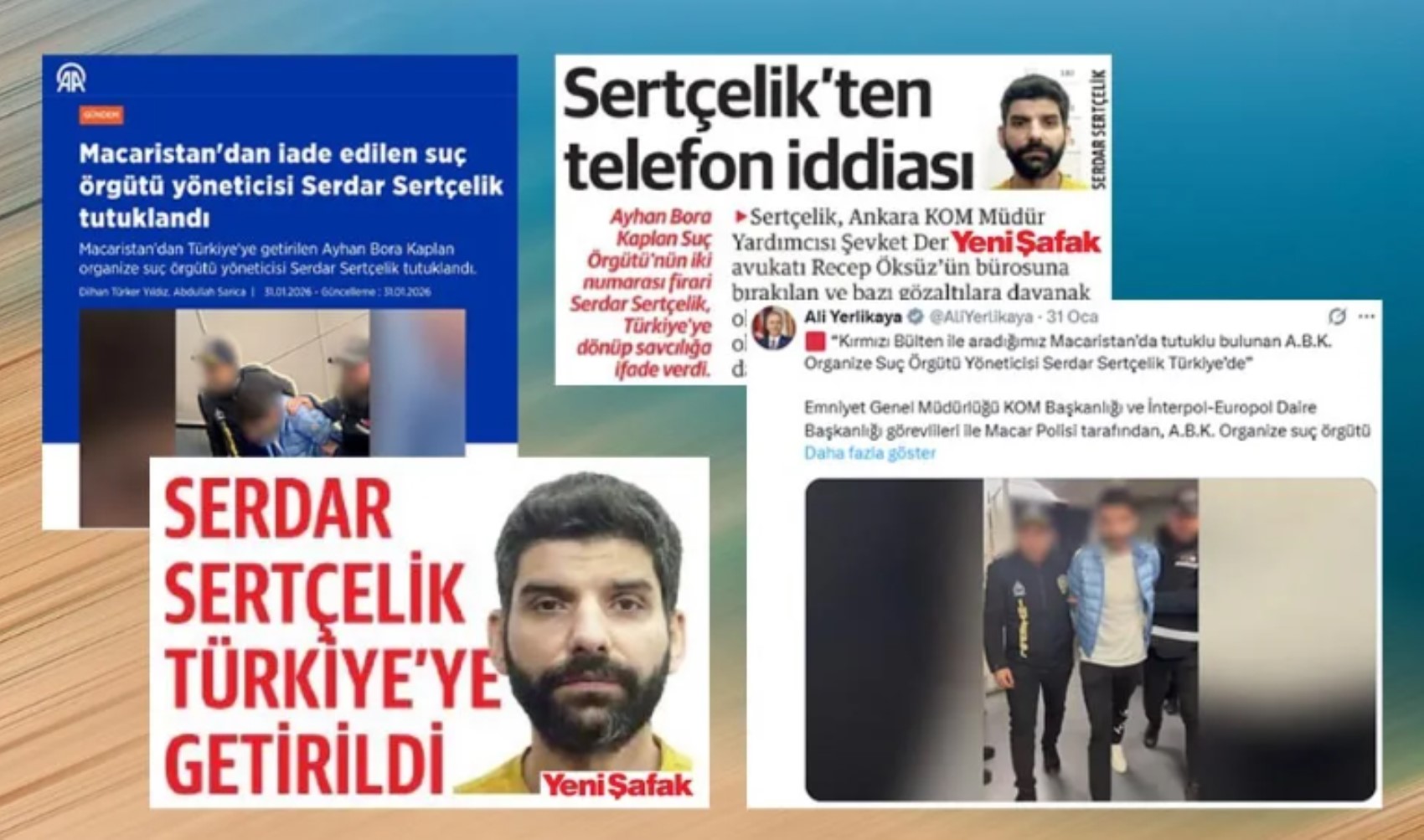
In one of his recent statements, Ali Yerlikaya had announced the good news that Serdar Sertçelik, who is both a defendant and a secret witness in the “Ayhan Bora Kaplan criminal organization” case, had been captured and brought to the country:
“Serdar Sertçelik, the manager of the A.B.K. criminal organization, was brought to our country from Hungary by the General Directorate of Security KOM Department and Interpol-Europol officers and the Hungarian Police.”
However, Tolga Şardan emphasized in T24 that, contrary to what Ali Yerlikaya announced, there is different information showing that Serdar Sertçelik returned on his own. On February 11, the very day Yerlikaya handed over his ministry, a denial also came from İsmail Saymaz. In his article on halktv.com.tr titled “Was that phone left at the door for a setup?”, he stated that Serdar Sertçelik said he “returned of his own volition” from Hungary.
Anadolu Agency, which published Yerlikaya’s statement, did not pay attention to this new information that came to light. However, Yeni Şafak, in its news titled “Phone claim from Sertçelik” published on February 12, wrote, “Serdar Sertçelik returned to Turkey and gave a statement to the prosecutor’s office.”
By conveying this information, Yeni Şafak was not only denying Yerlikaya, who is now just a “former minister,” but also denying itself. Because in the news titled “Serdar Sertçelik brought to Turkey” published in Yeni Şafak on February 1, Sertçelik’s return was written as “obtained information.”
It is also remarkable that Yeni Şafak, which denied Yerlikaya one day after he left his seat, ignored its own news from 11 days ago. A newspaper that feels the need to correct someone else’s mistake should not try to cover up its own mistake.
Template decisions in access blocks
Magistrate courts act very quickly when making access block decisions, but when it comes to objections, it takes months for a decision to be made.
The Istanbul Chief Public Prosecutor’s Office had requested an access block on content regarding Deputy Minister of Culture and Tourism Batuhan Mumcu and his wife on December 18, 2025. The justification was also strange; “Protection of national security and public order!” The Prosecutor’s Office did not even feel the need to explain the connection of the news about the deputy minister and his wife to public order and national security.
Of course, the Istanbul 4th Magistrate Court did not ask about the connection of the subject to “national security and public order,” nor did it even dwell on it. It fulfilled the Prosecutor’s Office’s request on the very same day. Somehow, the judge examined exactly 177 links, from Ekşi Sözlük to a post by CHP’s Oğuz Kaan Salıcı, within a few hours and decided to block access to all of them.
When the decision is this fast, it is inevitable that there are legal oddities in the content of the decision. Among the 177 blocked links, the “BabaOcağı” news site was also included. In other words, instead of blocking a single piece of news, they completely shut down the babaocagi.com site. Thus, a penalty disproportionate to the intended legal benefit was given...
Did the judiciary, which took the access block decision in one day, handle the objections with the same speed? Not a chance. It took a month for the objections to be heard and decided. Blocking in one day, objections in a month!
The Istanbul 5th Magistrate Court heard the objections of the Freedom of Expression Association, Google, Murat Cindoruk, and Bahadır Özgür to the access blocks, along with BabaOcağı’s objection to the closure of the site, together; and decided on January 21; about a month later. And it rejected the objections with a one-line template justification such as “the decision and the grounds it is based on are in accordance with procedure and law.”
There was no explanation in the decision notified to the parties regarding either the relevance of the blocked content to “national security and public order” or the complete closure of BabaOcağı for a single piece of news.
Unfortunately, objections to blocks are always rejected with such template decisions; the media is not even allowed to seek its own rights and justice.
Respect for the memory of the deceased woman
There are such news stories that you get stuck, wondering “Where should I grab this from?” Sabah’s news of “Suspicious death on a rented boat” is exactly like that...
This headline on the front page is contradicted by the news, which does not mention “suspicion.” On the contrary, the sentence in the news, “While no signs of battery were found on the young woman’s body, it is evaluated that she died of a heart attack,” points to the death of the woman named Bahar Taş due to natural causes.
The spot sentence on the front page, “The prosecutor’s office, which launched an investigation, detained two men named T.Y. and S.E. who were with Taş,” is also problematic. The phrase “two men who were with Taş” creates a perception as if the deceased woman had a relationship with these two men; it stains the woman’s memory. However, they had rented the boat as a “group of friends.” The news does not mention how many friends they stayed on the boat with.
Using a photo of a deceased woman reflecting a moment when she looked happy and pleasant in the death news is also not very appropriate for the situation. Of course, the same photo was used by almost all outlets, from ANKA and Now TV to NTV, in addition to Sabah.
This is the usual method that our media cannot give up in news where women are victims or murdered... It is essential to learn to write without putting the woman in the showcase of the news...
In a single sentence:
The pro-government media, including Sabah, AA, CNN Türk, TV100, and TRT, did not report that a state of emergency was declared on campus, students were not allowed in, and classes were suspended in the news that “President Erdoğan was welcomed by students with carnations at Boğaziçi University.”
In Yeni Şafak’s news titled “Refugee camps under water,” it was not about those who took refuge in another country, but about camps where people who fled to another region within their own country live.
Anadolu Group, which also includes Migros, gave a full-page obituary for its founder Kamil Yazıcı to 17 newspapers; all of them were newspapers that glossed over or ignored the Migros strike.
Minister of Agriculture and Forestry İbrahim Yumaklı chatted with a group of journalists in Gaziantep; however, the Türkiye newspaper reporter wrote it as an exclusive story, saying “Yumaklı, who spoke to our newspaper.”
Cem Küçük, in the broadcast on TGRT, called CHP MP Mahmut Tanal a “Parliament bandit,” labeling him and insulting him in a way that should never happen in journalism.
THY, which bought new planes, gave full-page advertisements to 16 pro-government newspapers saying “Our 500th star is in the skies”; they also published praise news such as “500 signatures to the sky.”
The advertisement titled “The Konya difference in social municipalism” by AKP’s Konya Metropolitan Mayor İbrahim Altay was published in both Milliyet and Yeni Şafak on the same day under the guise of news.
Hürriyet, Oksijen, and TRT Haber wrote “maruz” (exposed to) instead of “mazur” (excused) in the sentence “CHP’s fascist treatments cannot be excused” by MHP Chairman Bahçeli.
Akşam wrote “...introduced with a launch” in the news “500 times mashallah,” but “launch” also means introduction.
FOR YOUR CRITICISMS, COMPLAINTS, AND SUGGESTIONS: [email protected]
Most Read

Striking picture for Özgür Özel's 'New Party'

The PKK opening and Özgür Özel’s path!..

How did the newspapers view Özgür Özel's farewell to the CHP?

He killed his wife by slitting her throat: Their children witnessed the moments

What did the CHP do?

Özel’s new party move in the world press

The New CHP, against CEHAPE

Fire at TUSAŞ engine factory in Eskişehir under control

From self-efficacy to despair

Kılıçdaroğlu's first message on Özgür Özel's new party announcement