



Did journalists receive a mid-year raise?
Don't let the passionate objections of the journalist community regarding the decisions made in July about pensions and the minimum wage fool you. They are in a difficult situation themselves, but they cannot even speak about their own economic conditions...
Journalists are divided into pro-government media and opposition media, but when it comes to the wages of employees, such a distinction disappears. In a large part of the media, journalists were left with wages close to the minimum wage in July.
I asked around to see which media organizations increased the salaries of their employees for the second half of the year; there was no mid-year raise in July at Cumhuriyet, DHA, Ekonomim, Habertürk, Hürriyet, Milliyet, Posta, Sözcü TV, Karar, Sabah, and KRT. It was said that a mid-year raise would be given at Habertürk TV, but it is said that it is still being worked on.
There was a 25 percent increase at BirGün, 12-24 percent at ANKA, and 20 percent at NTV. There was also a 20 percent mid-year raise at Haber Global, but wages had only been increased by 30 percent at the beginning of last year. At Now TV, which increased wages by around 50 percent at the beginning of the year, a 15 percent raise was given in July. The highest increase was at Tele1 with 32-33 percent.
Halk TV owner Cafer Mahiroğlu's post on May 12, stating, "In order for Halk TV employees not to be crushed further under difficult living conditions, a new adjustment will be made to salaries in June as far as resources allow," led to expectations of a high increase. But then, flat raises ranging between 1,000 and 2,500 liras were made to the employees' wages. These adjustments did not cover everyone either.
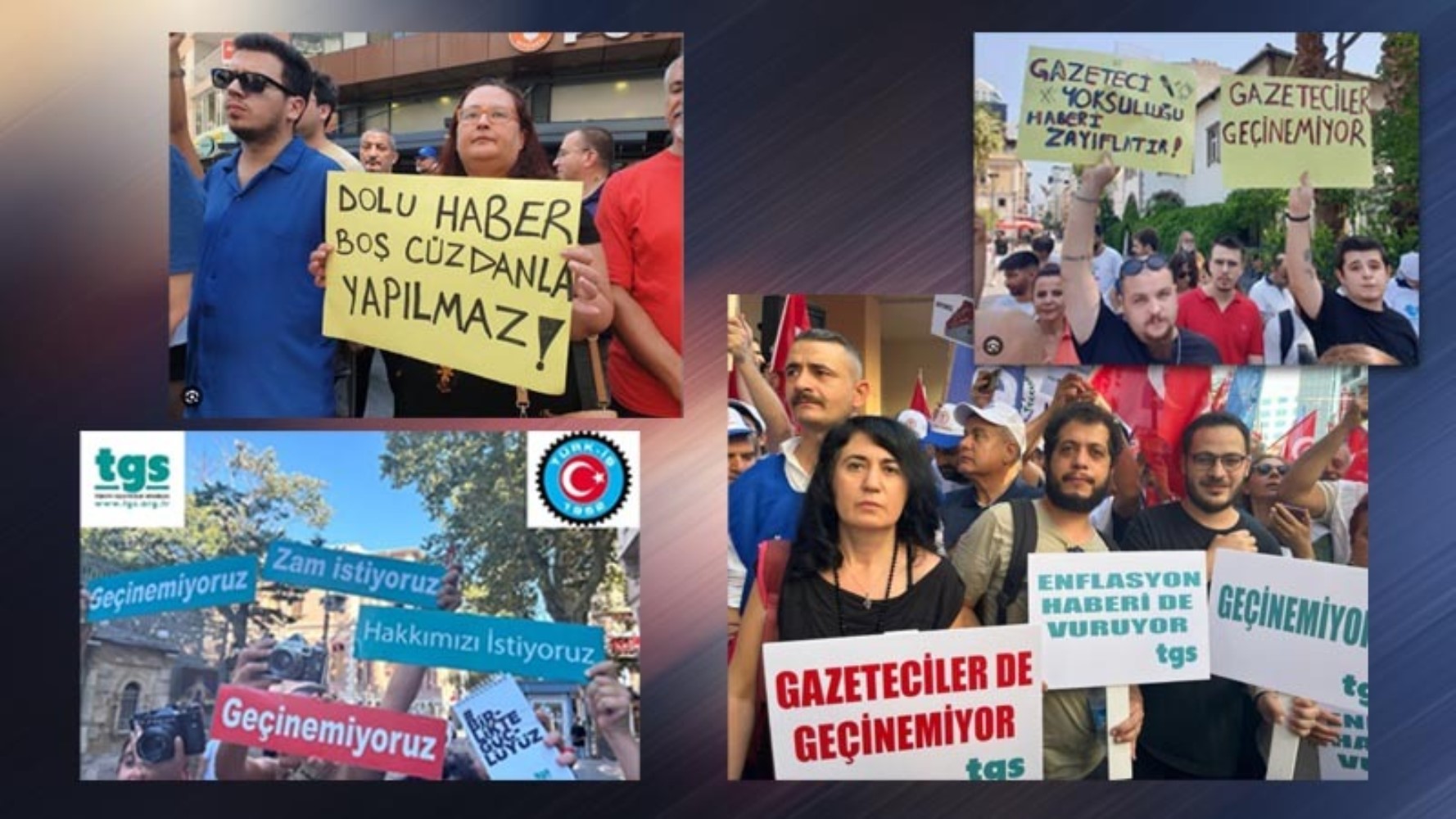
Sözcü newspaper announced the reason for increasing its sales price to 15 liras on August 8 as, "However, labor, printing, energy, and transportation costs have increased so much that a 3-lira raise was inevitable to survive." But in reality, there had been no increase in the wages of Sözcü employees in July; there had been an increase of around 60 percent at the beginning of the year.
With the situation as it is, it was hurtful for our journalist colleagues that Sözcü included journalists' wages among the reasons for its readers. Moreover, Sözcü is a newspaper that publishes news almost every day about how retirees, civil servants, and minimum wage earners cannot make ends meet and how the cost of living is rising. Those who write those news stories are also journalists whose wages have not increased.
Of course, we cannot ignore the impact of the economic crisis on media organizations or the loss of advertising revenue in print media. Economic policies that reduce the salaries of all employees to minimum levels cannot be overlooked either. However, independent of these, it is obvious that there has been a decline in the income level of journalists in recent years.
The lack of union organization is one of the biggest factors. They defend the rights of others, but when it comes to themselves, they cannot find the words to explain their problems.
The language of the media in dog massacres
While the law regarding stray dogs was being discussed in Parliament, the pro-government media was full of news about dog attacks. News about people who were crushed under vehicles while running away from dogs and children torn apart by dogs followed one another.
Those news stories made the ruling party's job easier: it helped quite a bit in creating public opinion so they could pass the law comfortably. Thanks to these publications, led especially by Sabah, Türkiye, and Yeni Akit, stray dogs were demonized and turned into objects of fear.
Now, news of dog murders is coming from all over the country; dogs are being poisoned, and puppies are being killed. Newspapers, news sites, and television stations that reported on dog attacks before the law passed are now ignoring the dog massacres; they are disregarding them.
Sabah's coverage of 13 dogs being drowned in an irrigation pool in Denizli on its front page, along with news of dog attacks, was a rare positive example. But the same newspaper published a bizarre, unsubstantiated claim attributed to a person injured by stray dogs, saying, "The 'kibble lobby' offered me a 5 million lira bribe to criticize the government."
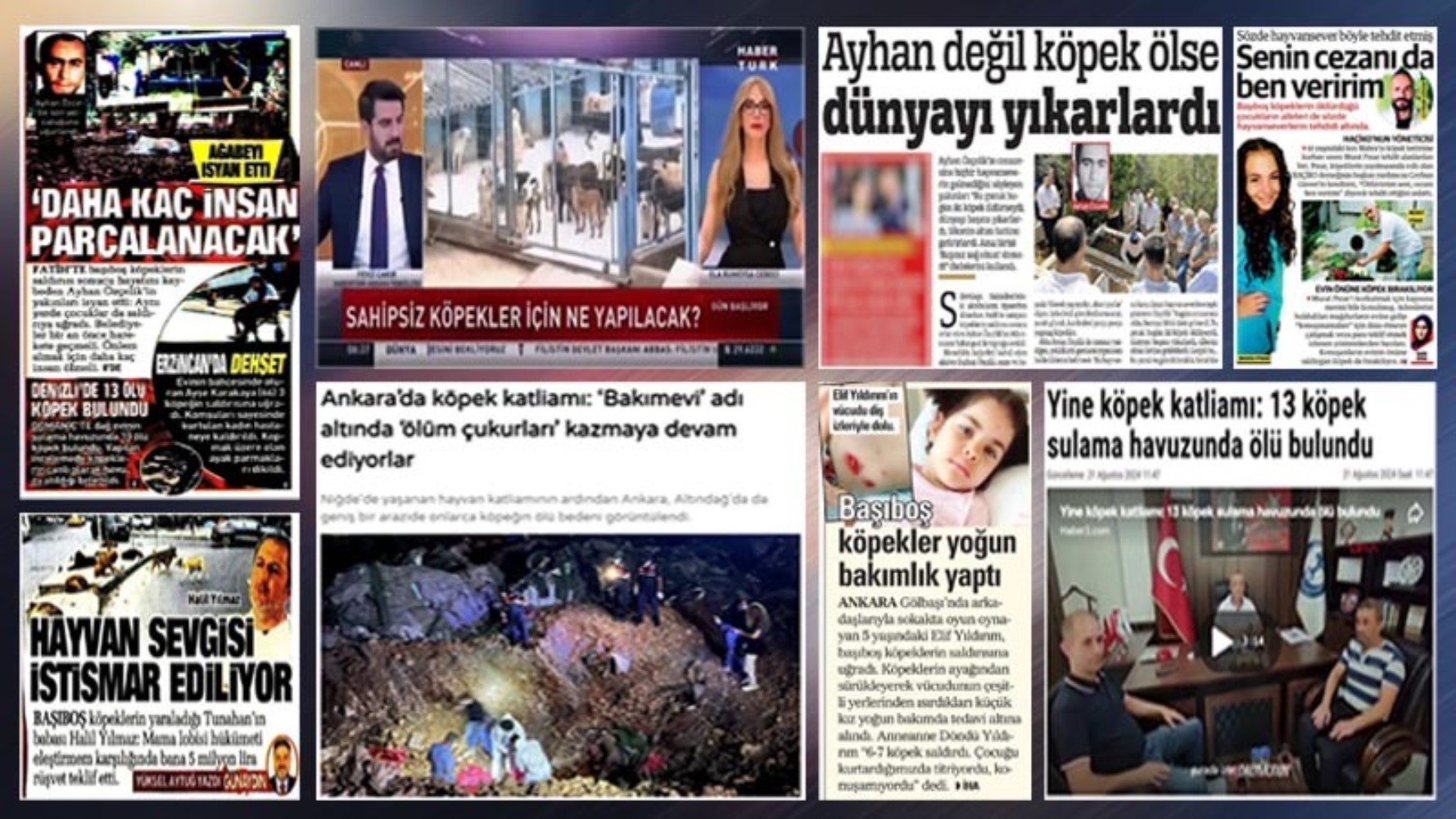
“Stray dogs sent people to intensive care” and “This is how a so-called animal lover threatened” are stories that Akşam and Yeni Şafak continue to run, while they continue to ignore the dog murders. Fevzi Çakır on Habertürk TV also fueled the opposition to these animals by comparing the act of bringing food to stray dogs to the fact that the poor cannot afford to eat meat.
In such an environment, Hürriyet has come out and called on "all politicians, both from the government and the opposition, to speak up" to prevent these massacres! But the addressee of the call is wrong. It was the AKP executives who created this environment of massacre and portrayed stray dogs as the country's primary problem. And, of course, the pro-government media that demonized stray dogs.
The government and its media are the ones who really need to speak up and change their language to stop the dog massacres. But of course, the opposition media should also value news about dog attacks just as they do dog murders; they should be able to approach people who are attacked and experiencing problems with empathy.
What did they eat until they were full?
Sharing restaurant receipts for those going to Greece has become a trend, and the media reports on these without questioning or examining them at all. The restaurant receipt shared by İbrahim Tatlıses's son, İdo Tatlıses, on his social media account also became news on CNNTürk, Gazete Duvar, Sözcü, TGRT, Türkiye, Takvim, Yeni Çağ, and dozens of other sites:
“The 71.50 Euro (2,647.50 TL) bill paid by İdo Tatlıses in Greece surprised everyone! 'We ate until we were stuffed.'"
The news was based solely on what İdo Tatlıses wrote; not even a word was added to it. They didn't even look at what the food on the receipt was, for which the total amount was 71.50 Euros (2,647.50 TL). I looked at the menu:
“Pasta with carbonara sauce 10 Euros, Pasta with Bolognese sauce 9 Euros, Moussaka 10 Euros, Potatoes 4 Euros, Mushrooms 7 Euros, Manouri cheese with honey and sesame (2) 13 Euros, Greek salad 7.50 Euros, Water 2 Euros, Cola (3) 9 Euros.”
When you translate the names on the receipt into Turkish, it is understood that there is no such menu as claimed. There are two pastas and one moussaka as main courses; the rest are salads and appetizers. What they drank were cola and water.
It is an exaggeration to report such a menu as "Five people ate until they were stuffed" without even looking at its content. Greece might be cheaper than Turkey, but reporting this without making generalizations and by examining the shared receipts ensures we remain faithful to the truth.
There is no cabinet anymore
Old habits still continue; on days when President Erdoğan is to meet with ministers, news stories like "The Cabinet is meeting" or "Council of Ministers meeting" are written and said.
Yeni Şafak columnist İhsan Aktaş recently titled his article, "Why are government actions not discussed on the anniversary of the AK Party's founding?" He was talking at length about "government actions." Akşam, Sabah, and Yeni Şafak also ran stories last week saying "Cabinet in Ahlat."
Even though government circles call the presidential system unique to Turkey the "Presidential Government System," there is no government, no cabinet, and no Council of Ministers in the Constitution. There is only the President and the ministers appointed by the President in this system.
Therefore, it is more accurate to say "the President and his ministers" instead of terms like government, cabinet, or council of ministers. This is the constitutional definition. In news about Erdoğan meeting with his ministers, using expressions like "Erdoğan met with the ministers" is more appropriate for the situation.
The pro-government media's mention of "government" and "cabinet" is a conscious choice, just like addressing Erdoğan, who holds the title of President constitutionally, as "President" (Başkan). But it is wrong...
Not news, but a post
The pro-government media is following the events that stirred up the streets in England and the attacks on foreigners with great interest. Most of all, they highlight that the spark was ignited on social media and the use of social media. However, there is a distortion in their news that is also reflected in their headlines:
“A woman detained on allegations of starting the fake news that brought the far-right to the streets in England” (AA), “Detention for fake news sharing in England” (Sabah), “Woman spreading fake news in custody” (Türkiye), “Fake news arrest in England” (Yeni Şafak).
There is an emphasis on "fake news" in the headlines, but the woman detained, named Bernadette Spofforth, is not a journalist, and what she shared was not news. The woman shared a Muslim name as the attacker, wherever she made it up from, and following this, attacks on mosques and foreigners began.
But the pro-government media, by reporting it as "news" instead of a "post," ends up associating journalists with this mistake in an irrelevant way.
Journalists should choose their words carefully and use a meticulous language when writing news. Misused words create different meanings, as in the news about England. Especially the words in the headlines are even more important. Because some people just glance at the headlines and move on.
In a single sentence:
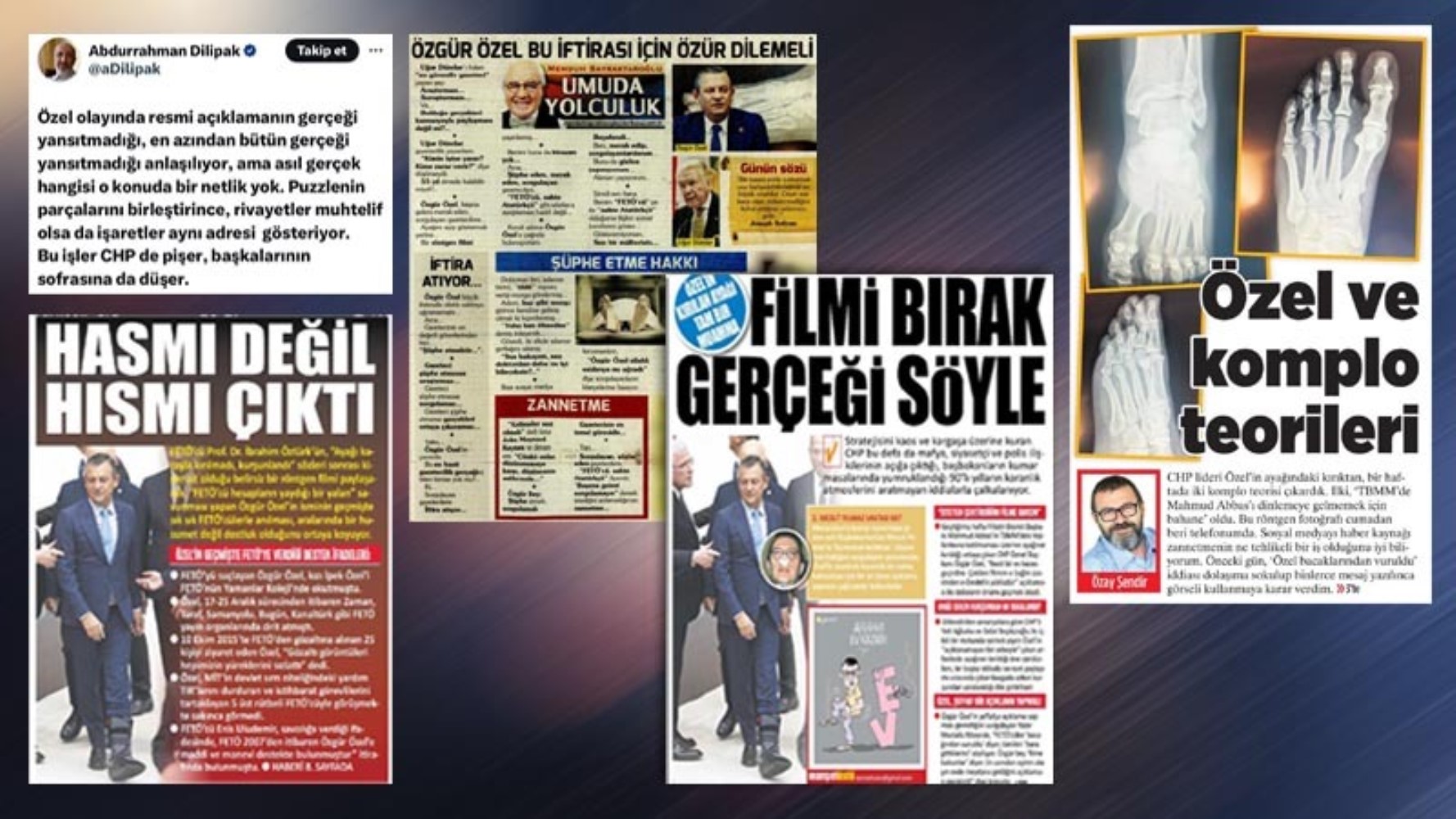
Even though CHP Chairman Özgür Özel explained even the X-ray film of the fracture in his foot, Yeni Akit continued its conspiracy theory without concrete basis with news stories like "Forget the film, explain the truth" and "It turned out to be a relative, not an enemy," Memduh Bayraktaroğlu from Korkusuz with his article "The right to doubt," and Abdurrahman Dilipak with his social media posts.
Türkiye newspaper described Fenerbahçe President Ali Koç's visit to the CHP and MHP by writing "He visited opposition parties," thereby characterizing the MHP as an "opposition party."
The MHP's publication, Türkgün, did not just say, "Bahçeli targeted TİP's Ahmet Şık with these words"; it also carried Bahçeli's insults toward Şık, such as "bastard," to its front page.
In a full-page advertisement titled "The address for second-hand" published in Sabah newspaper with the side note "This is an advertisement," reporter Metin Can's byline was included, which is contrary to journalistic principles.
The opposition media did not publish the news that the CHP-run Antalya Metropolitan Municipality was fined 464 thousand TL for polluting the sea by discharging wastewater.
Hürriyet, a newspaper of the same group, introduced a new series starting on Kanal D as "A mermaid in love with the sun," while Milliyet introduced it as "A mermaid in love with water and the sun."
In the İHA news story, "Allegation that a famous aesthetician wanted to take over the hospital with a fake signature," the name of the doctor involved in the incident was coded, even though it was stated that he was "famous."
Karar used the ANKA news story, "The fugitive contractor of the Palmiye Site, which caused the death of 150 people in the earthquake, went to a notary while being sought," without a source.
The news "The giant ocean hidden in the depths of the world," used on the Cumhuriyet site on August 22, was stale news that had been published on the Aljazeera Türk site on June 14, 2014, with almost the same headline.
Most Read

Striking picture for Özgür Özel's 'New Party'

The PKK opening and Özgür Özel’s path!..

How did the newspapers view Özgür Özel's farewell to the CHP?

He killed his wife by slitting her throat: Their children witnessed the moments

What did the CHP do?

Özel’s new party move in the world press

Fire at TUSAŞ engine factory in Eskişehir under control

The New CHP, against CEHAPE

From self-efficacy to despair

Kılıçdaroğlu's first message on Özgür Özel's new party announcement