



FOOTBALL INTERVIEW UNDER HOLDING SUPERVISION
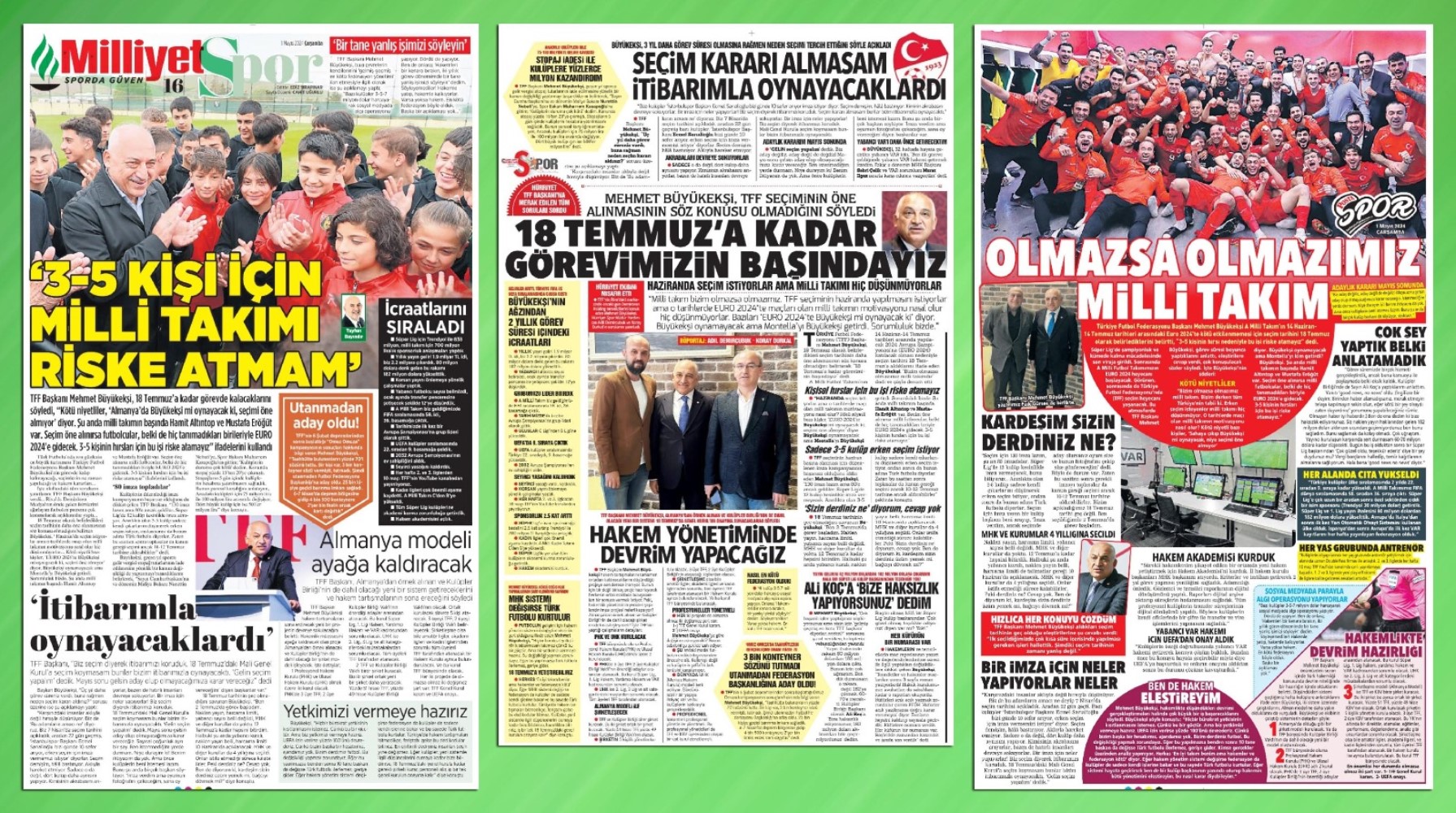
Hürriyet, Milliyet, and Posta newspapers dedicated a full page last Wednesday to an interview with Turkish Football Federation President Mehmet Büyükekşi.
Although different headlines were used, all three were the same interview. In Posta, there was no information on how or where this interview was conducted. Milliyet, however, provided the information that “the boss of football, who hosted leading names from Demirören Media in Riva, made statements that will be talked about a lot.”
This information was completed by the sentence in Hürriyet: “Büyükekşi, who hosted Demirören Holding representatives at his headquarters in Riva, answered questions from Hürriyet Sports Deputy Manager Adil Demirçubuk and Koray Durkal.”
It turns out that “Demirören Holding representatives” took the football writers of Hürriyet, Milliyet, and Posta with them to Riva; and these writers conducted the interview under their supervision! In this case, Hürriyet, which presented the collective interview as “answered Hürriyet’s questions,” was deceiving its readers. Milliyet and Posta were also providing incomplete and incorrect information to their readers.
It is contrary to journalistic ethics for writers to conduct an interview under the supervision of “representatives”—whose names are kept secret—of Demirören Holding, which owns their newspapers.
If there were no conflict of interest between them and the Federation, why would holding representatives be there during a journalistic activity?
Indeed, the fact that the interviews were entirely based on Büyükekşi’s effort to clear himself against criticisms sufficiently explains the reason for the Holding’s supervision.
Boss interest is wonderful, football interview is just an excuse…
THE SOUVENIR PHOTO IN FRONT OF THE AKP
CHP Chairman Özgür Özel’s visit to President Erdoğan at the party headquarters had a visible benefit in terms of journalism.
The opposition media, which had been subjected to accreditation bans for years, was able to enter in front of the AKP Headquarters. Reporters from opposition TV channels broadcast live side-by-side with their colleagues working in pro-government media. Before leaving, they even took a souvenir photo together.
The constant in the Özel-Erdoğan meeting was the lack of information provided by the media, and therefore by society. Neither party was transparent enough about what happened during the meeting; they did not provide detailed information to the public.
While AKP Spokesperson Ömer Çelik settled for a short statement hours after the meeting, the CHP also informed a group of journalists late at night. Additionally, Gökhan Günaydın spoke on a TV channel; Namık Tan also gave a one-sentence assessment to a journalist. Özgür Özel, on the other hand, preferred to make a few-sentence statement to one journalist instead of a collective statement.
When Erdoğan and Özel answered a few questions from journalists the next day, so much “backstage information” had been spread about the meeting by that time that their answers to questions about the content of the meeting could not go beyond feeding the atmosphere created by the “backstage” rumors. Unfortunately, the “empty chair” gossip and the “atmosphere” created by the meeting took up more space in the media than its content.

FINANCING, NOT A LOAN
The news of “6.3 billion dollars of external financing for Turkey from the Islamic Development Bank” was based on the statement of Treasury and Finance Minister Mehmet Şimşek. The news reported by Anadolu Agency was used in the same way in many places, including Hürriyet, NTV, and CNN Türk.
I read it carefully; the words “loan” and “interest” did not appear even once. But since the IDB did not give it as a “grant,” the 6.3 billion dollars must have been a loan. In other words, they had given “debt”; it must certainly have an interest rate, even if it is low.
Not only was this information not provided, but under the news, the 35 billion dollars that the World Bank will transfer to Turkey was also called a “resource.” However, Minister Şimşek had defined this “resource” allocated by the World Bank as “financing” in his speech, but after criticisms and discussions, the Ministry had to announce that it was a “loan.”
An economic news story cannot consist only of conveying what is said with words like “said” or “announced.” A journalist matures the news by adding new information and analysis to what is said, and by translating definitions into a language that society can understand; that is how they present it.
But the “financing” news reported by AA and used by the pro-government media does not provide the information that a loan was taken; it covers up the truth. Calling the billions of dollars to be provided by the Islamic Development Bank and the World Bank “financing” and “resource” instead of clearly writing that they are “loans,” i.e., “debt,” turns journalism into a public relations activity.
IF THE LANGUAGE OF THE GOVERNMENT AND POLICE IS USED
When the AKP opened Taksim to celebrations in 2010, the pro-government media was showering it with praise with headlines like “Like a forest, fraternally” (Sabah), “The taboo is broken” (Star/Yeni Şafak), and “Unity in Taksim” (Yeni Şafak).
The same newspapers used headlines such as “Taksim insistence cast a shadow over the celebrations” (Sabah), “May 1 provocateurs” (Türkiye), and “Taksim is not a rally area” (Yeni Şafak) before this year’s May 1. Undoubtedly, the reason for this change in their language is not due to journalistic concerns, but rather the change in the attitude of the AKP government over the last 14 years. It is natural for them to take such contradictory stances when they adopt the language of the government instead of an objective journalistic language.
However, the language of the opposition media was also problematic.
A reporter on Halk TV repeated a police chief’s instruction in Beşiktaş that humiliated journalists, “Sweep the journalists away,” on live broadcast; they described the event as “we are being swept, they are sweeping, we are being swept.”
There were other reporters who used the “language of the police.” On KRT TV, the reporter talked at length about the “measures” taken by the police in Istanbul! However, what the police did was not a measure, but to block those who wanted to celebrate May 1 in Taksim and to set up barricades. A reporter and the presenter in front of them should know the difference between a measure and an obstruction.
On Sözcü TV, the reporter was also trying to prove the legitimacy of the police intervention by saying, “…it is obvious that it is forbidden” and “…the police had to intervene.”
The NOW TV reporter was talking about “detention procedures.”
A journalist moves away from objectivity to the extent that they use the language of the police, the government, or other politicians. A journalist should keep their distance from the language used by the parties they are covering, just as they should keep their distance from the parties themselves.
DIDN’T YOUR HEARTS ACHE, MARMARA COMMUNICATIONS STUDENTS?
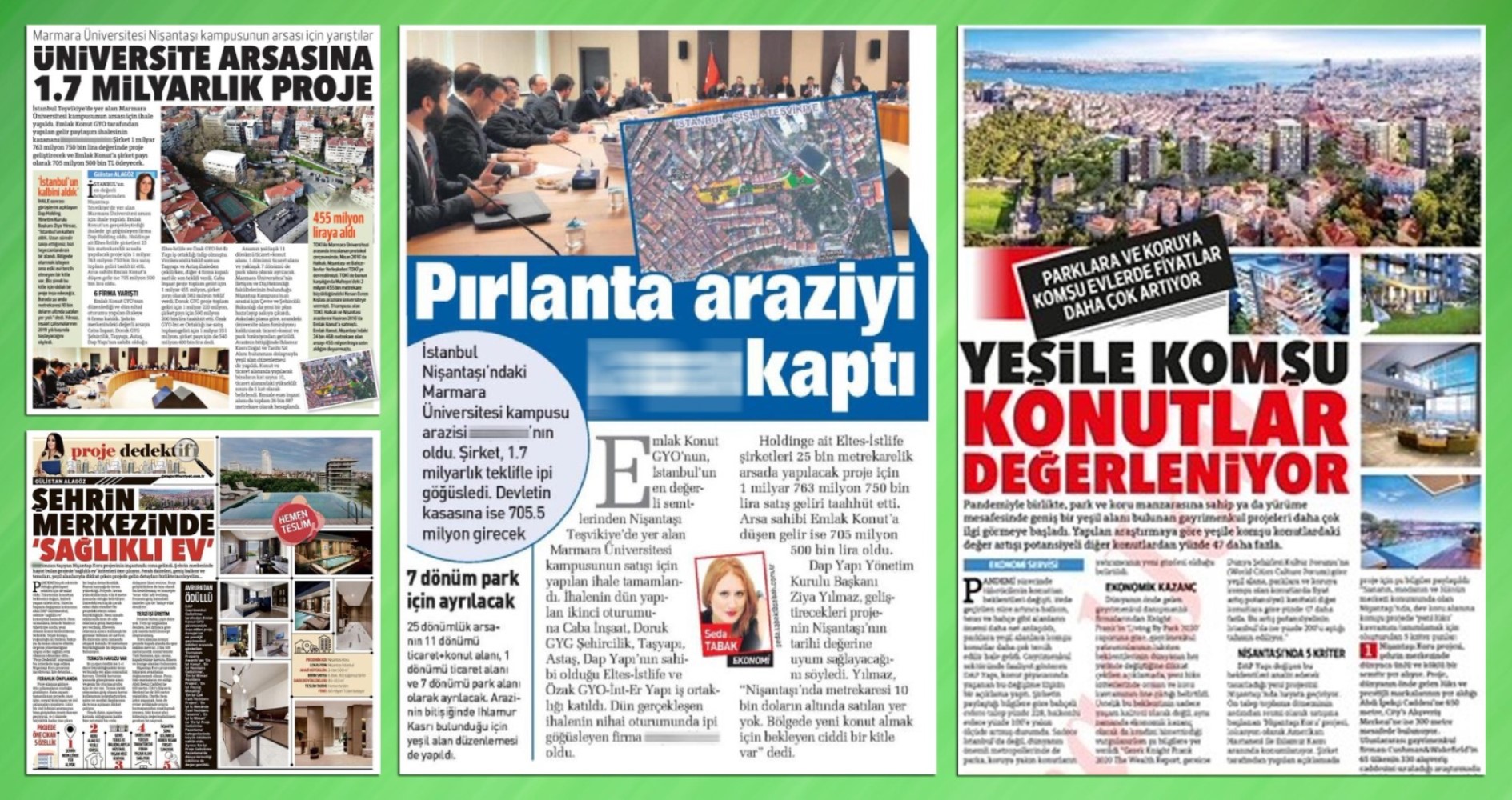
When the green land of Marmara University Faculty of Communication was sold in 2018 to be turned into concrete, the media ignored the protests rising from the neighborhood.
Instead of protecting the trees, hedgehogs, and birds, they supported the concreteization. Newspapers like Hürriyet, Posta, Milliyet, and Sabah advertised the construction project by publishing the bulletin sent by the company as news, saying “Residences adjacent to green space are gaining value.”
Three years passed, and the project reached its end. This time, a promotion titled “Healthy homes in the city center” was published in Hürriyet, and the project was advertised again with the “Ready for delivery” bubble. Neither is any deficiency regarding the project mentioned in the text, nor is it reminded that it is the land of Marmara University Faculty of Communication.
I wonder, don’t the students of Marmara University Faculty of Communication feel any heartache at all? Why are the students of Prof. Dr. Ünsal Oskay so silent?
BE CAREFUL WHEN “TRANSLATING” BAHÇELİ
MHP Chairman Devlet Bahçeli said at his party’s group meeting, “If I want to say something, I say it directly to the addressee,” but in reality, journalists often have to struggle to understand the addressee of Bahçeli’s implicit words and behaviors.
The addressee of Bahçeli’s words in his April 23 message, “the corrupt mentality that serves to devalue the Turkish nation with the expression of local people,” was not clear.
In the opposition media, it was mostly written that Bahçeli meant Treasury and Finance Minister Mehmet Şimşek with these words. In some news sites, based on “MHP sources,” it was assessed that Bahçeli meant Ekrem İmamoğlu and Mansur Yavaş.
Bahçeli, on the other hand, said eight days later that with that sentence, he meant “DEM supporters and some CHP mayors who took the term local people as a reference.” However, in those days, Şimşek’s words, “We need to convince the local people that inflation will fall,” were on the agenda. İmamoğlu and Yavaş, on the other hand, had mentioned “local people” exactly three years ago and in a different context.
In fact, when there are words and behaviors of Bahçeli that require “translation,” the most correct thing is to ask him again. Journalists caught this opportunity on April 29, after President Erdoğan’s visit. However, they preferred to take a souvenir photo with Bahçeli instead of asking.
Of course, if it could not be asked to Bahçeli, it could be discussed with MHP executives. But in such a situation, there can be no necessity for writing “anonymous source” news in terms of journalistic principles. The words of party executives gain news value when accompanied by their names. A politician who wants to make the journalist a partner in their own mistake gives a statement by hiding their name.
In one sentence:
- The opposition media did not question the responsibility of the IMM in the case of 5-year-old Edanur Gezer, who fell into a water-filled pit left open in a park in Küçükçekmece and died.
- Yeni Akit has now started a campaign against the serving of alcoholic beverages in restaurants at military guesthouses belonging to the Turkish Armed Forces.
- Akşam’s “Ugly harassment of a little girl” news, based on the account of the newspaper’s writer Taceddin Kutay, was one-sided, and the woman accused of harassing Kutay’s daughter was exposed with a photograph.
- In Hürriyet’s “2nd act in the divorce case of the NASA professor couple” news, there was no point in hiding their surnames while all the data that would reveal their identities were provided.
- In Türkiye’s “Both lower quality and more expensive” news, the names of two multinational companies that produce coffee and sauces and sell lower-quality products at higher prices in our country than in Europe were missing.
- It was wrong for Yeni Yaşam to report the news of a police officer killing two police officers at the police station where he worked in Adıyaman as “Police clashed with police: 2 police died”; there was no clash.
- As if there could be a “legal” violation, the headline “Boeing’s former employee: The company committed countless legal violations” was used for the news on Cumhuriyet’s website.
- The photos of Cem Garipoğlu’s dismembered corpse, which A Haber broadcast with the subtitle “Autopsy photos on A Haber for the first time,” were a traumatic situation for the viewers.
- Cigarettes and smoke were not blurred in the movie “The Magnificent Seven” shown on ATV.
- Halktv did not provide a source when quoting Hürriyet’s “4 new guests to Turkish cuisine” news.
- Cumhuriyet, Halktv, and Odatv did not state that the news “Selman Öğüt’s name was removed from Esenyurt University’s website” was taken from Serbestiyet.
- Sözcü, like many news sites, published it with sexist language using the headline “…became a woman” instead of using the headline “The son of the famous couple changed gender.”
FOR YOUR CRITICISMS, COMPLAINTS, AND SUGGESTIONS: [email protected]
Most Read

Striking picture for Özgür Özel's 'New Party'

Özgür Özel gives a dated response regarding the number of resignations

Forest fire in Antalya brought under control

The PKK opening and Özgür Özel’s path!..

How did the newspapers view Özgür Özel's farewell to the CHP?

He killed his wife by slitting her throat: Their children witnessed the moments

What did the CHP do?

Özel’s new party move in the world press

The New CHP, against CEHAPE

Fire at TUSAŞ engine factory in Eskişehir under control