



Türkiye newspaper columnist Cem Küçük had found the indictment regarding the CHP Istanbul Provincial Congress to be "very weak" when it was first released:
"3 pages are suspects, 2 pages are minutes, the last 3 pages are commentary. I have very serious criticisms of this indictment. It contains only one tape and two informants. There is no concrete evidence."
Cem Küçük, who said these things on TGRT Haber, changed his mind after the court decided to suspend the CHP Istanbul provincial administration:
"The court has signed off on an important decision in the 9-page indictment. It was already clear that phones, tablets, and money were given to delegates in Istanbul and Ankara. The court clarified this situation and removed the CHP Istanbul provincial administration from office. I think this decision is the beginning of the end for the CHP."
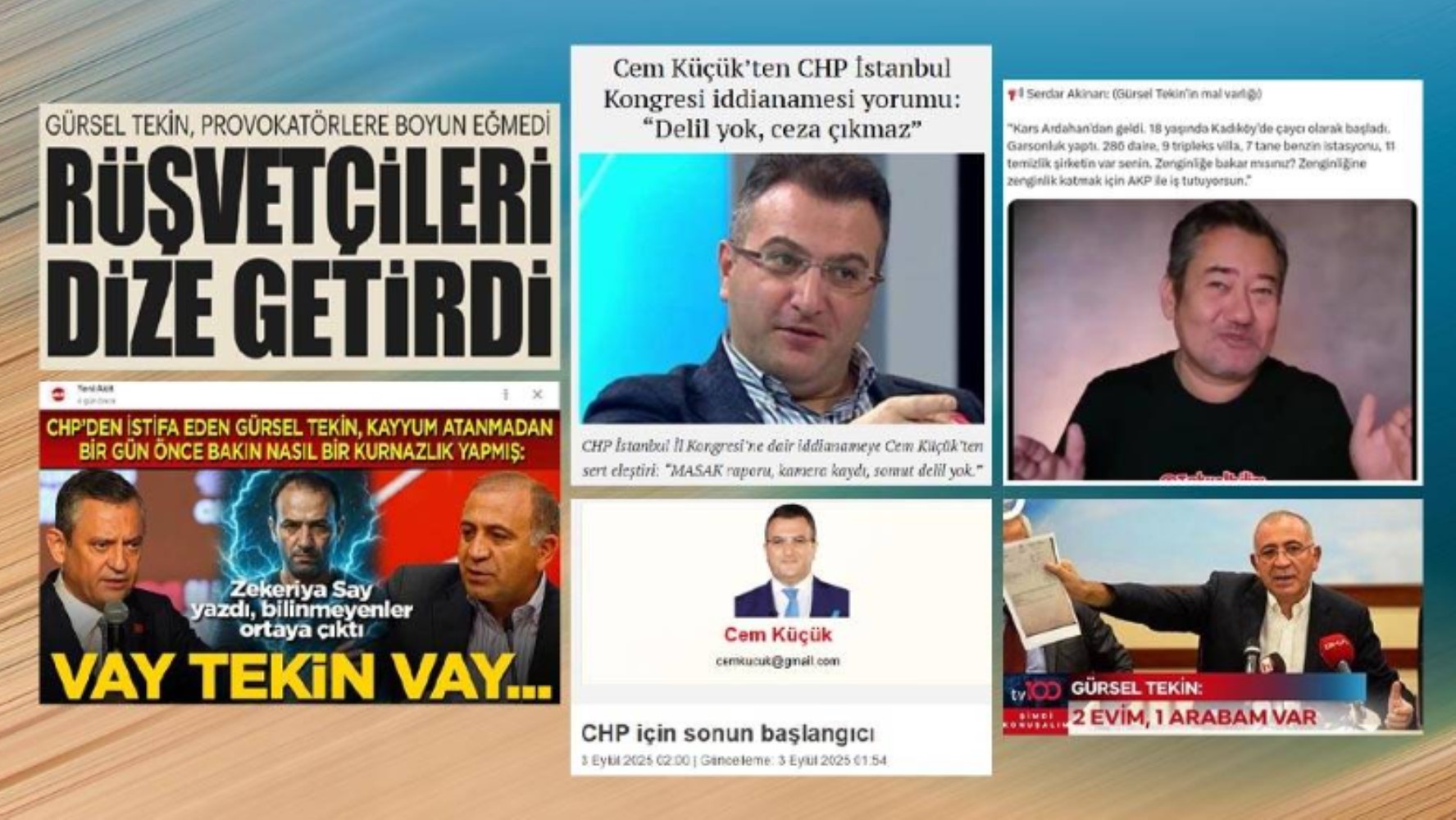
Küçük's turnaround happened in just three days, but one must give credit where it is due; during the days he was criticizing the indictment, the pro-government media was paving the way for this court decision. Indeed, the justification of the court, which announced the sentence before the trial, was "the investigations initiated by the Istanbul Chief Public Prosecutor's Office and the audio recordings reflected in the press."
Undoubtedly, Cem Küçük was not the only one who changed his stance rapidly. After the court decision, the pro-government media began to show interest in and heap praise upon Gürsel Tekin, whom they had previously constantly vilified. Pro-government TV channels lined up to host Gürsel Tekin on live broadcasts.
The most striking change occurred at Yeni Akit. Yeni Akit, which wrote "Godless Gürsel" a few years ago, ran a headline saying "Gürsel Tekin did not bow to provocateurs" after he entered the CHP building accompanied by thousands of police officers. Yet, as recently as September 4, News Manager Zekeriya Say had said everything imaginable about Gürsel Tekin in the newspaper, and his article had been published on the internet under the title "Oh Tekin, oh."
Although incomparable to the pro-government media, the view of Gürsel Tekin also changed in the opposition media. The past of Gürsel Tekin, who had been held in high regard for years, began to be scrutinized, and his assets began to be discussed. Serdar Akinan even mentioned a wild list of assets on his YouTube account, but Gürsel Tekin denied it; he announced a more modest list.
Of course, as journalists, we will stand for democracy and universal law, but what is wrong is to write and speak as supporters and spokespersons for political parties. Violating the rule of partisanship and maintaining distance harms journalistic standards, and objectivity disappears.
Most importantly, the news is crippled; we cannot convey the truth in its plain form; a shadow falls upon it.
Turnarounds in football media
Just like the sudden turnarounds of journalists covering politics, very sharp turns can sometimes be taken in the football media as well. A coach who wins a match is suddenly praised to the skies and declared the most amazing football person; when they lose the next match, they are practically dragged through the mud.
This is exactly what happened to A National Football Team coach Vincenzo Montella.
He was showered with praise after the away victory against Georgia on September 4.
Hürriyet columnist Uğur Meleke said in his article after this match, "...proof of what a correct coach Montella is. Montella has practically created a club team with the crescent-star jersey, and we left Tbilisi successfully yesterday with the 'FC National Team' harmony."
The same Uğur Meleke, in his article titled "Barcelona 2011 reloaded!" written after the defeat to Spain, blamed Montella, saying, "Our coach Montella should have started the second half with 3-4 changes after a terrible first half. Making only 1 change until the 6-0 mark is a mental lapse." There were only three days between the two articles.
It was not just Uğur Meleke; after the Georgia match, the football media was covered with headlines of happiness such as "A world of happiness" (Akşam), "Shine, my crescent and star" (Milliyet), and "You are wonderful, kids" (Sabah). Montella was being exalted so much that TFF President İbrahim Hacıosmanoğlu was making statements like, "God willing, we will make Montella a Turkish citizen."
However, after the Spain match, the football pages were filled with headlines like "Historic defeat" and "The bull hit our kids," as if an unexpected development had occurred. Montella, who was being talked about for citizenship, suddenly turned into a coach whose dismissal was being discussed...
Of course, there were football writers who made consistent evaluations after both matches. But in our football media, just like in the stands, approaches with high emotional doses prevail instead of objectivity...
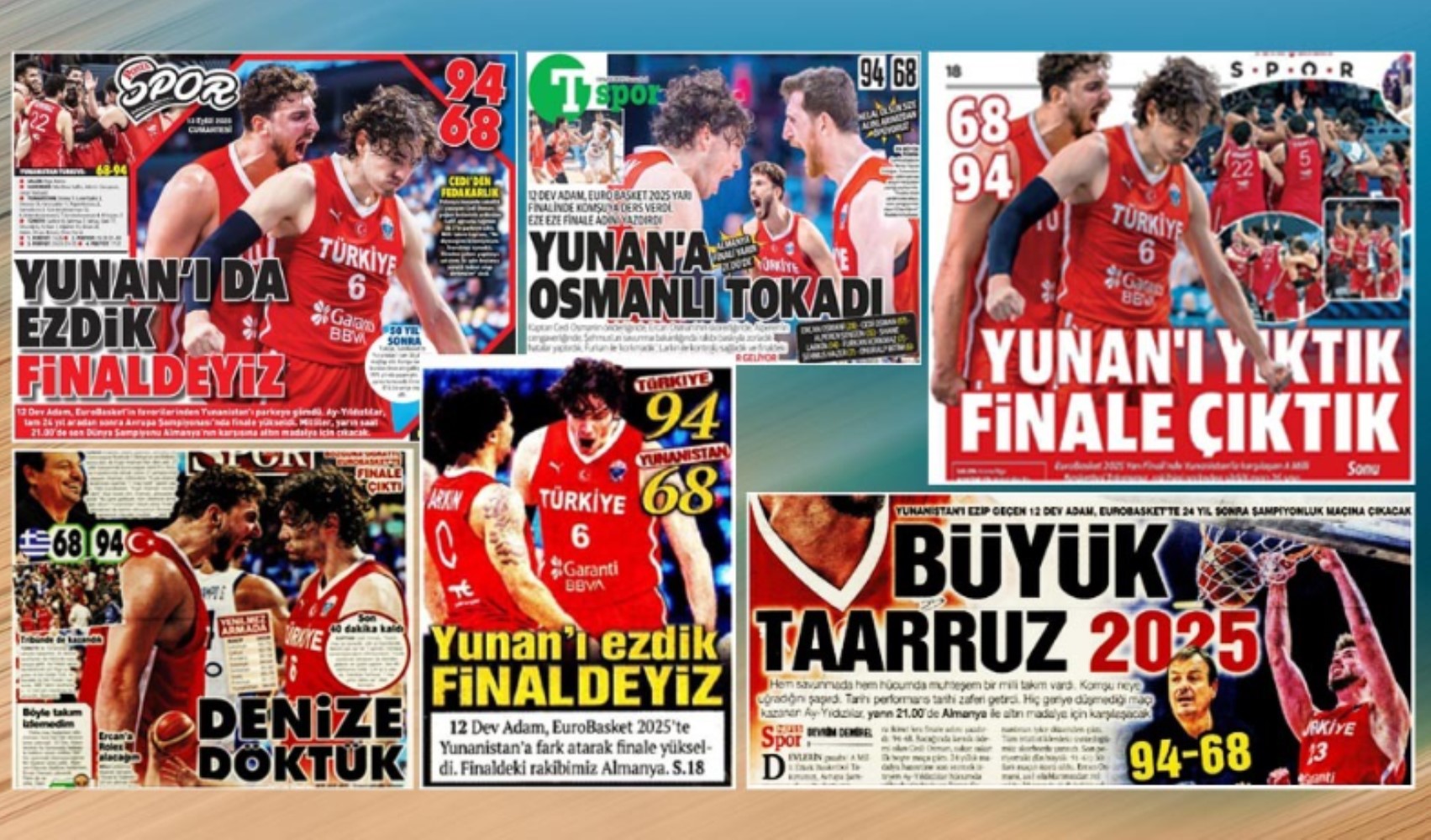
Unfortunately, journalistic boundaries were also significantly crossed after the national basketball team defeated the Greek team. Headlines like "We crushed the Greek, we are in the final" (Posta), "Great offensive 2025" (Nefes), "We poured them into the sea" (Sözcü), "Ottoman slap to the Greek" (Türkiye), and "We destroyed the Greek, we reached the final" (Yeni Şafak) reflected not joy but hostility, and furthermore, hate speech.
They covered up the ISIS connection
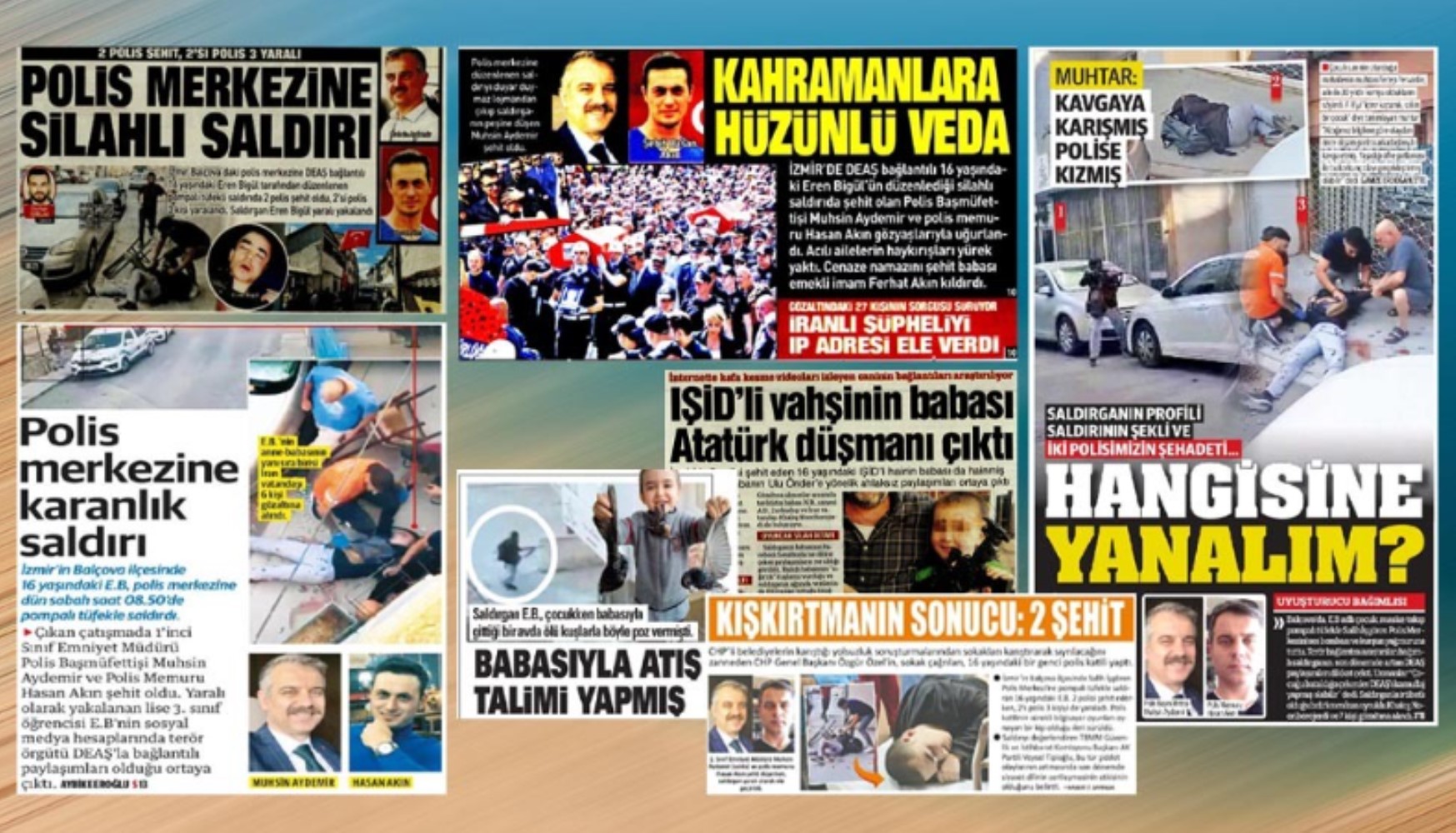
The connection of the police station attack in Izmir to ISIS (or DAESH) was clear immediately after the incident. The concrete clues were plain to see.
16-year-old E.B. had shared the words of the killed ISIS leader Al-Baghdadi, "Turkey is now a target of operations," from his account named "1Muvahhid99" before the attack, and had written, "I will perform istishhad (dying heroically) soon and I will be a martyr, God willing." Moreover, he had an ISIS logo on his mobile phone, and he was shouting "Allahu Akbar" while lying on the ground. His family had told journalist Seyhan Avşar, "Recently, our child was visiting different websites. He was watching beheading videos. In recent days, he was always telling all of us, 'You are infidels.'"
Anadolu Agency, Demirören News Agency, and some pro-government media outlets did not include this information in their news. One of them, Akşam, did not mention ISIS at all in its September 9 news titled "16-year-old attacker martyred 2 police officers." Türkiye newspaper said in its headline "Which one should we grieve for?" that "Experts say those who dragged the child into the swamp might have used DAESH as camouflage."
Hürriyet, on the other hand, only sufficed with saying "The claim of the terrorist organization DAESH is being investigated" in the last line of a box on the first day. In its September 10 news titled "Who directed the 16-year-old killer?", it asked "Was he a lone wolf" and stated in between the lines that "the DAESH connection is being investigated."
There was no trace of ISIS in the news of dozens of news sites. Yeni Akit did not stop at hiding ISIS; it blamed Özgür Özel with an irrational approach by writing, "Özgür Özel's street calls made a 16-year-old youth a police killer."
When Anadolu Agency wrote four days after the attack, based on the examination of E.B.'s computer, that he was "influenced by the ISIS ideology," these media outlets were also forced to include the ISIS connection between the lines.
However, one must give them credit; unlike the others, Sabah, Milliyet, and Yeni Şafak from the pro-government media did not hide the attacker's ISIS connection and influence from the first day, but rather highlighted it.
So, why didn't AA, DHA, and other media outlets write about the ISIS connection or influence of the attack from the first day? Even the operations launched by the police were in this direction. This is an editorial choice that needs to be explained and discussed...
Local journalism is sounding the alarm
Prof. Dr. Süleyman İrvan updated his local newspaper research, which he conducted with his students at Üsküdar University, and published it on his own blog. He put his finding in the title of the article: "Local newspapers are disappearing by merging."
In fact, in his article, he concretely explains that this development is not spontaneous, but the result of both the imposition of conditions and the pressure policy carried out by the Press Advertising Agency through penalties. He takes each city one by one, listing by name how the newspapers merged (or were forced to merge), and which newspaper remained standing as a result. The point reached is terrible; the number of local newspapers, which was 467 in 45 cities in 2012, has fallen to 118!
If the goal of the Press Advertising Agency were higher quality, better journalism, it would not force local newspapers to merge. Because a decrease in the number of newspapers does not improve the level of journalism; it harms it. İrvan also emphasizes that forcing newspapers to merge does not produce positive results:
"Neither newspaper circulations increased nor did higher quality newspapers emerge. On the contrary, many journalists became unemployed. The decrease in newspaper diversity also leads to the malfunctioning of local democracy and the restriction of the public's right to receive information."
Local journalism is actually the main artery that feeds mainstream journalism. The disappearance of local newspapers, in addition to the elimination of critical journalism against local authorities, blocks the way for the training of local journalists and the retention of existing journalists in the profession.
Mainstream media also suffers great damage from this desertification in the local area...
The junk of websites
Şanar (Suzan) Yurdatapan drew my attention to the boxes located in the lower sections of news sites, saying, "'Accessing news' is a separate problem in the country we live in."
Yurdatapan was giving the "Artı Gerçek" site as an example with the words, "There are only 5 news items on its homepage at the top. These are updated, but the essence remains the same. Then? Horoscopes, who they are, some districts, miracle foods, those who became rich suddenly."
Yurdatapan was very right; even the fact that there were 36 horoscope news items when there are 12 horoscopes was enough to explain the situation on its own. In fact, the presence of interesting but, in my opinion, junk-quality texts that have nothing to do with news at the bottom is not a practice unique to Artı Gerçek. I quickly scanned a few news sites. The heading "May interest you" exists under many news sites. There is not only news in these sections; advertising and news are intertwined.
For example, in the "May interest you" section of Gerçek Gündem, boxes for "Earn 100 thousand liras a day with artificial intelligence" were mixed with news about "Petek Dinçöz's latest state." For example, on Odatv, I came across the headline "What is the secret meaning of women keeping their legs in a crossed position?" Under the Hürriyet site, there are boxes that have nothing to do with news and journalism, from "Dream interpretations" to "Beautiful words."
These sections at the bottom of news sites are usually rented out to programmatic advertising agencies; it is not the site management that places this junk content, but them. However, trying to generate income and find readers with such a method also eliminates the seriousness of the news on the site and damages its credibility. It might bring three or five clicks, but I am sure the number of readers it drives away is much higher.
Citation etiquette
Sözcü announced that Gazi Secondary School was in a neglected, dilapidated state in its headline "Reputation did not visit the school next to the palace" published on September 11.
Halktv.com.tr cited this news from Sözcü with the headline "Gazi Secondary School, five minutes away from the Palace, is in ruins"; it also showed the source. But one day later, Halk TV published this news as "Misery five minutes away from ostentation" without citing the source. Moreover, the news ended with "Now all eyes are on whether renovations will be made for this school."
However, Sözcü had followed the issue and published the news "Gazi Secondary School has entered renovation" that day. Halk TV had missed both Sözcü's second news and the fact that ministry officials had intervened in the problem! It is essential to cite the source and research well when citing news. ...
FOR YOUR CRITICISMS, COMPLAINTS, AND SUGGESTIONS: [email protected]
Most Read

Striking picture for Özgür Özel's 'New Party'

The PKK opening and Özgür Özel’s path!..

How did the newspapers view Özgür Özel's farewell to the CHP?

He killed his wife by slitting her throat: Their children witnessed the moments

What did the CHP do?

Özel’s new party move in the world press

Fire at TUSAŞ engine factory in Eskişehir under control

The New CHP, against CEHAPE

From self-efficacy to despair

Kılıçdaroğlu's first message on Özgür Özel's new party announcement