



CHP Gaziantep MP Hasan Öztürkmen, who continues the salvos of the Kemal Kılıçdaroğlu administration against the opposition media, has escalated the claims even further:
“In 2024, 2025, and the first 4 months of this year, 755 million liras have been paid to certain TV channels, newspapers, and troll accounts. According to the information provided by our Deputy Chairman (Bülent Kuşoğlu), who serves as the treasurer, 755 million TL has been paid to some TV channels, newspapers, and troll accounts that criticize Kılıçdaroğlu every day, distort the facts, and have become propaganda channels rather than news channels.”
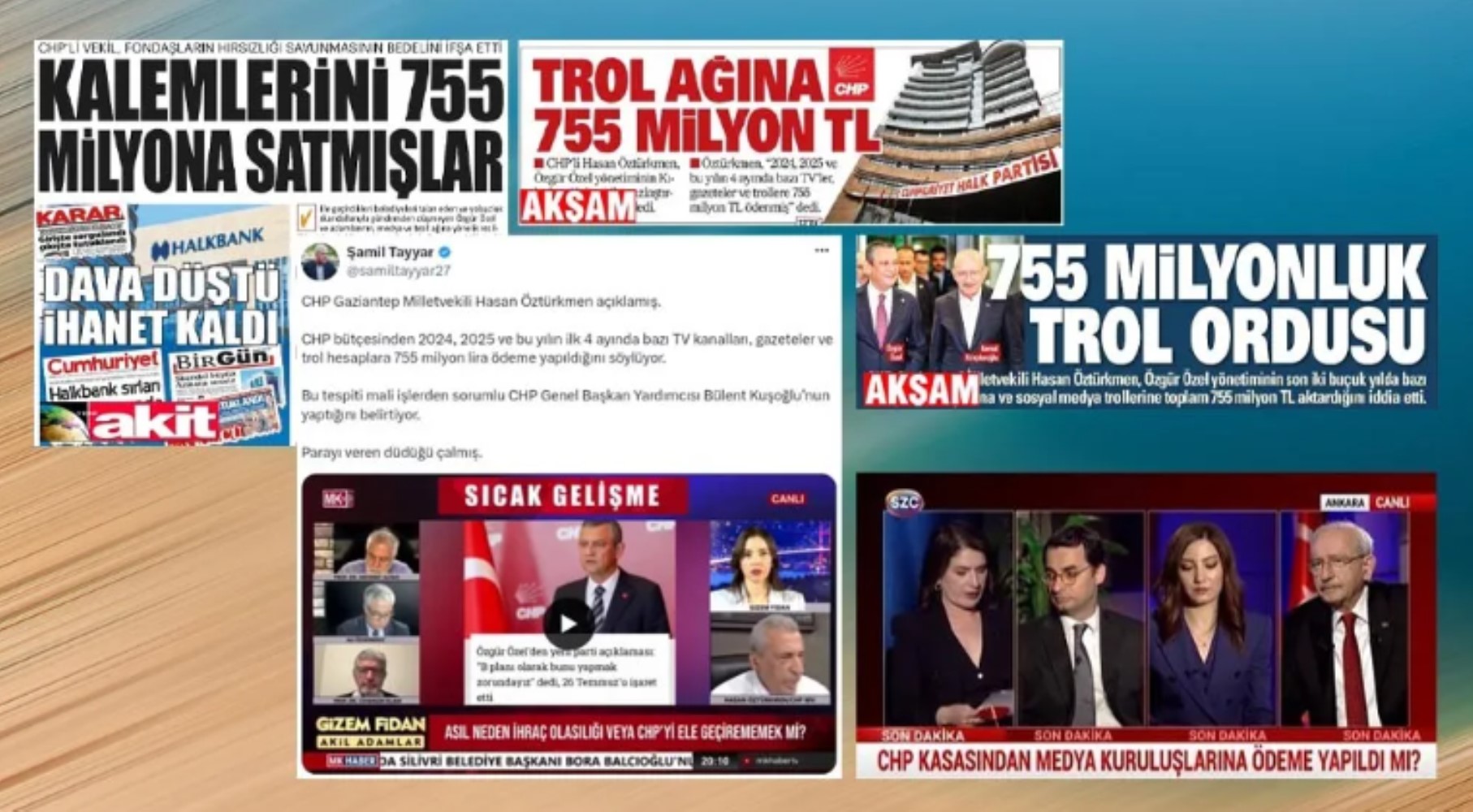
While Şamil Tayyar shared these words of Hasan Öztürkmen on MK TV by saying, “He who pays the piper calls the tune,” the pro-government media also reported it with headlines such as “755 million TL to the troll network” (Akşam), “They sold their pens for 755 million” (Yeni Akit), and “He showered the funded press with money” (Sabah).
Of course, without questioning, without checking the accuracy…
However, Hasan Öztürkmen’s words were not based on any document; he saw it as his right to smear and cast suspicion on the opposition media without even explaining to whom and why the money was paid.
So what happened? Sözcü TV, one of the channels that Hasan Öztürkmen described as a “propaganda channel” without naming it, hosted Kemal Kılıçdaroğlu on a live broadcast. And the program lasted for two hours. They did not host a guest program as is customary to see on TV in recent years; instead of questions like “Sir, how do you evaluate this?” which render the journalist passive, they asked questions that questioned and at times challenged Kılıçdaroğlu.
There may have been missing questions, but Barış Terkoğlu, Senem Toluay Ilgaz, and Aslı Kurtuluş Mutlu truly did a successful job in this environment where the polarization within the CHP also negatively affects the view of journalism. It turned out that some journalists who criticized them mistakenly believe that asking questions is a show of courtesy and that a journalist cannot ask every question that comes to mind. These journalists either do not know or have forgotten interviews like those of Oriana Fallaci, where the journalist argues head-on with the interviewee. It was tragicomic for some politicians to try to teach journalism to journalists.
In the program, they rightly asked about Hasan Öztürkmen’s accusations as well. While answering this question, Kılıçdaroğlu said that “the CHP had also made protocols with some TV channels in the past, and these were legitimate payments,” but that “large sums of money were paid to social media” during the Özgür Özel era. With these words, Kılıçdaroğlu was referring to the protocols the CHP made with channels like Halk TV, which had been discussed before, regarding “advertising, campaign videos, and the live broadcasting of group and press meetings.” I had also criticized those protocols at the time.
Upon being reminded that Hasan Öztürkmen also claimed that money was paid to newspapers and journalists, Kılıçdaroğlu referred to Hüseyin Doğan, an advisor to CHP Spokesperson Müslim Doğan, and said, “Someone working under our MYK member voiced this. We removed him from the party. There is no such thing.” He then added, “I don’t know about the journalists. You are saying it, I don’t know. If a payment is made, if there is a payment, it must be made on a legitimate basis.”
Now it is Hasan Öztürkmen’s turn again. If he has information that Chairman Kılıçdaroğlu does not know, he must explain it with documents and names; otherwise, he should come out and apologize. Of course, not only Öztürkmen, but everyone, especially Bülent Kuşoğlu, should speak by documenting what they know or should not produce slander.
In memory of Persepolis and Satrapi
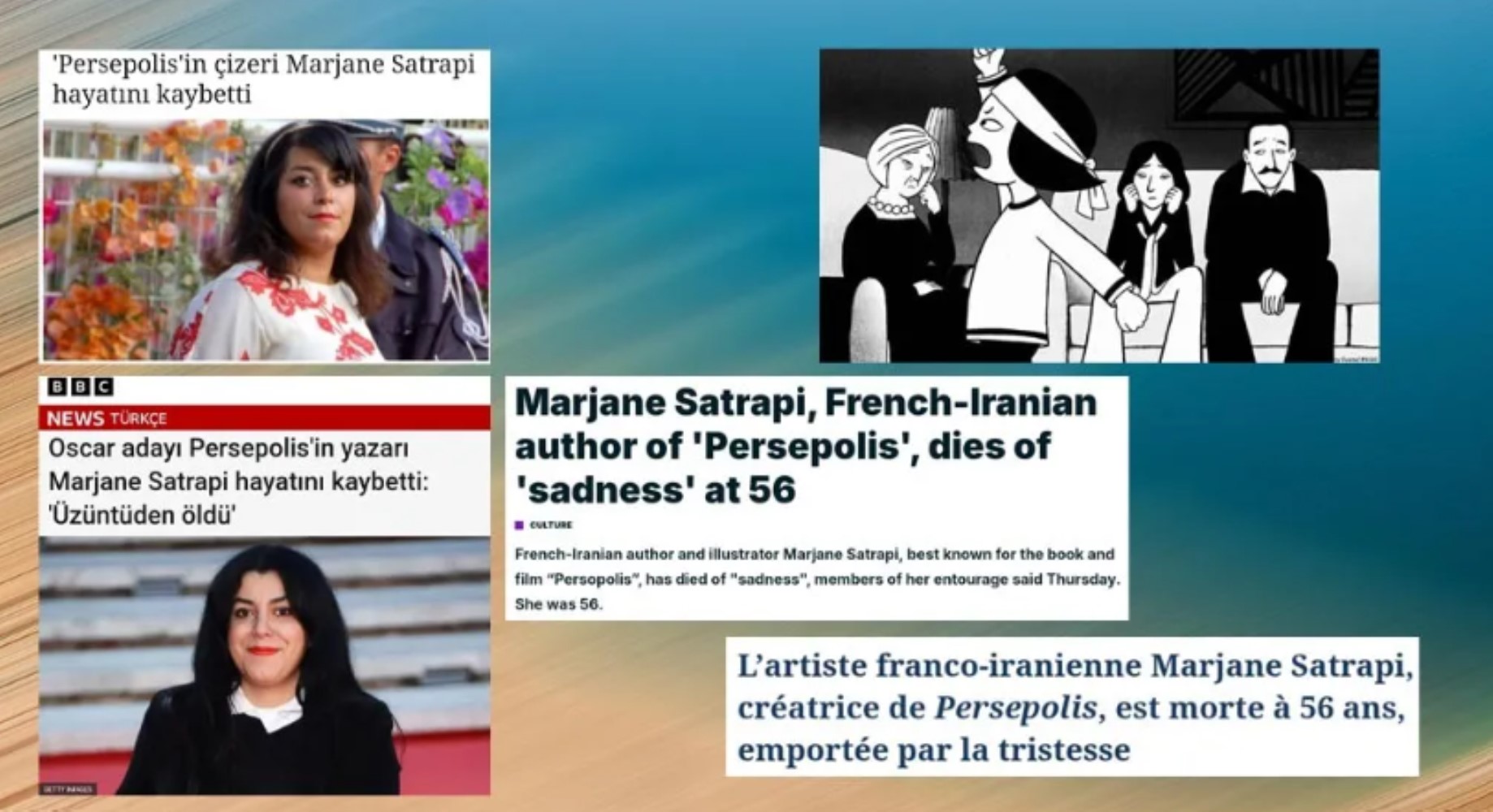
The news regarding the death of Marjane Satrapi, known for the animated film “Persepolis,” which tells the life of a girl growing up in the oppressive and totalitarian “mullah” regime in Iran, was mysterious.
As in France, the news in Turkey also stated, based on information provided by “family members,” that Satrapi “died of grief.” There was no information in the news about how grief had caused such a major medical problem as to lead to her death. It was only emphasized that she was deeply affected by the death of her husband and “love of her life” Mattias Ripa a year ago.
The statement from the Élysée Palace also said, “She captivated a global audience with Persepolis. A leading figure of French culture and an artist dedicated to freedom; her works carried a universal message and earned her great international fame,” but did not go into detail about Satrapi’s death.
I was curious and searched. The headline of the news published by Le Figaro on its “culture page” under the byline of Olivier Delcroix said, “Persepolis creator, French-Iranian artist Marjane Satrapi, died of grief at 56,” but inside, I found that the word “suicide” was used twice without being explicitly stated, and its synonyms “ended her life” and “terminated her life” were used. No other information about the suicide was provided.
If Le Figaro knows, it is inconceivable that the entire French media does not have information about Satrapi’s suicide. It is clear that they wanted to show respect for Satrapi’s memory and not upset her loved ones. Le Figaro, nevertheless, felt the need to inform its readers, even if between the lines.
I also hesitated to write this article. Then, thinking that if a famous person like Satrapi were to commit suicide, it would be published with all its details in our country, I decided to write it.
I hope this care shown by the French media regarding Satrapi’s death will be an example to our media, which, despite all the warnings, writes about suicide cases without hesitation, even down to the method.
Detention for a cloth bag with Kurdish writing!
The mistreatment that journalists Tuğçe Tatari and Rengin Azizoğlu encountered at the entrance of the Parliament on the day of the tension in the CHP Group did not attract attention; it did not even become news.
I learned about what happened from Tuğçe Tatari’s article in T24 titled “Is it necessary to accept mistreatment to enter the Parliament?” While entering the Parliament with Rengin Azizoğlu, the police confiscated Azizoğlu’s cloth bag, which had the logo of the Dicle Fırat Journalists Association and the Kurdish words “Çapemenîya Azad Civaka Azad” (Free Press, Free Society) written on it.
When they objected, they were taken to a search cabin and subjected to a “thorough search” with their legs apart and arms up, and their blouses opened. Tatari recounts that search by saying, “one step further was a strip search.”
Following Tatari’s article, the Dicle Fırat Journalists Association, whose cloth bag was confiscated, also made a statement. The DFG described the police’s behavior as a “humiliating and unlawful practice” and requested that the TBMM Presidency launch an investigation into those responsible.
The treatment they deem appropriate for journalists is very grave. It is even more grave that alarm bells ring in the eyes of a police officer who sees a cloth bag with Kurdish writing… The existence of such police officers in this age, and their duty at the gates of the TBMM, is a great danger in terms of democracy and media freedom.
Beykoz Media School brotherhood at work
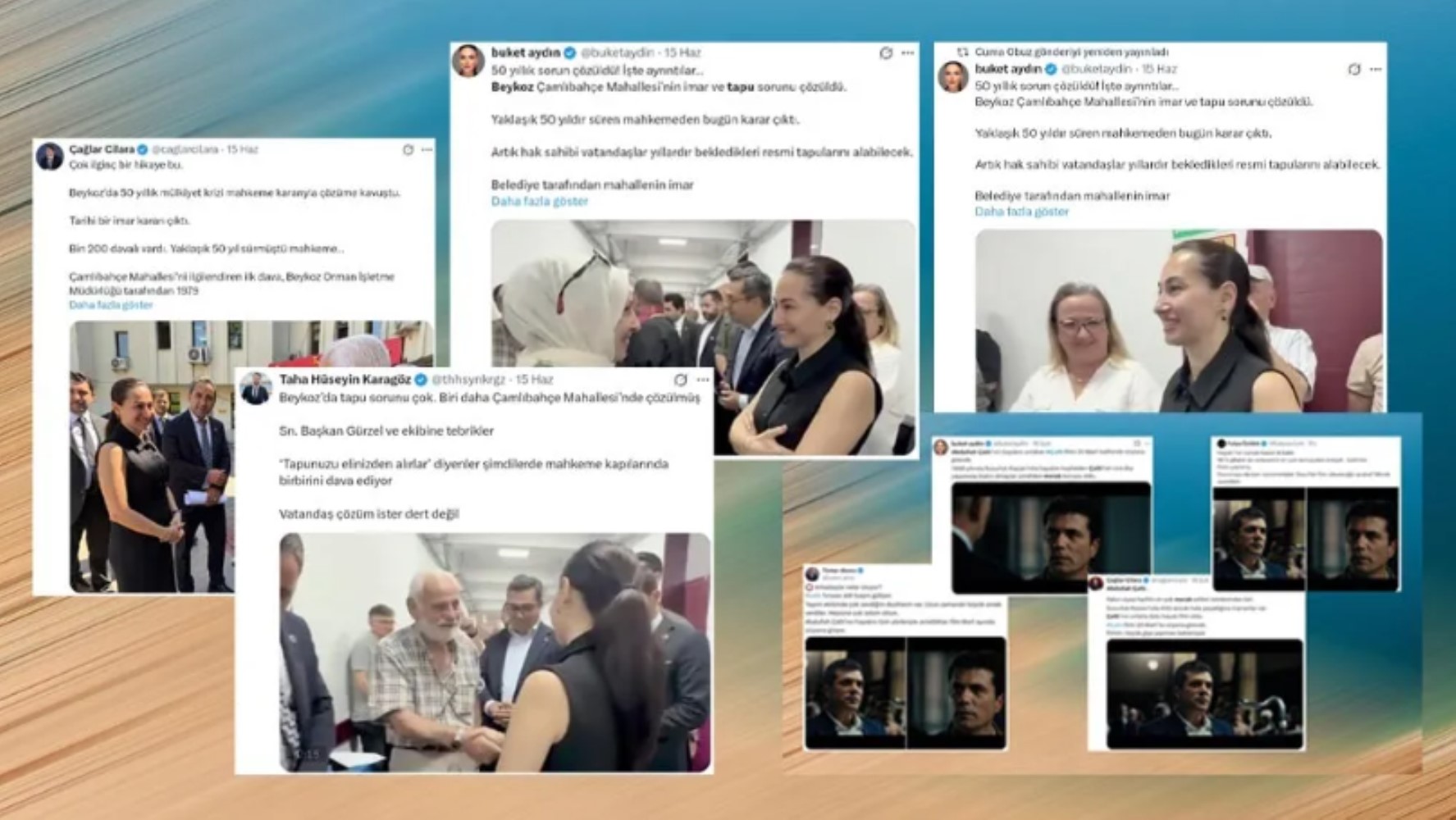
Journalist Dinçer Gökçe caught it, and he shared it. Buket Aydın, Çağlar Cilara, Cuma Obuz, and Taha Hüseyin Karagöz advertised the activities of Özlem Vural Gürzel, the Mayor of Beykoz who switched to the AKP, with joint posts. With almost the same words, the same sentences.
The same names had previously drawn attention with joint posts. First, Buket Aydın, Türker Akıncı, Çağlar Cilara, and Başak Şengül made joint posts supporting the AKP Adapazarı Mayor Mutlu Işıksu, who was accused of an “extramarital affair.” The visuals and words in the posts, which were made one after another as if they were unaware of each other, were the same.
Buket Aydın, Çağlar Cilara, Fulya Öztürk, and Türker Akıncı also promoted the film of Abdullah Çatlı, one of the darkest names in recent history, with joint visuals and expressions.
The common denominator of these names is that they are instructors at the “Beykoz Media School” founded by Özlem Vural Gürzel, the Deputy Mayor of Beykoz who switched from the CHP to the AKP. I wonder how much fee these names receive from the AKP-run Beykoz Municipality in return for “instructing”? If they would disclose it, we could learn the dimensions of the interest relationship underlying these organized PR efforts.
The denied news
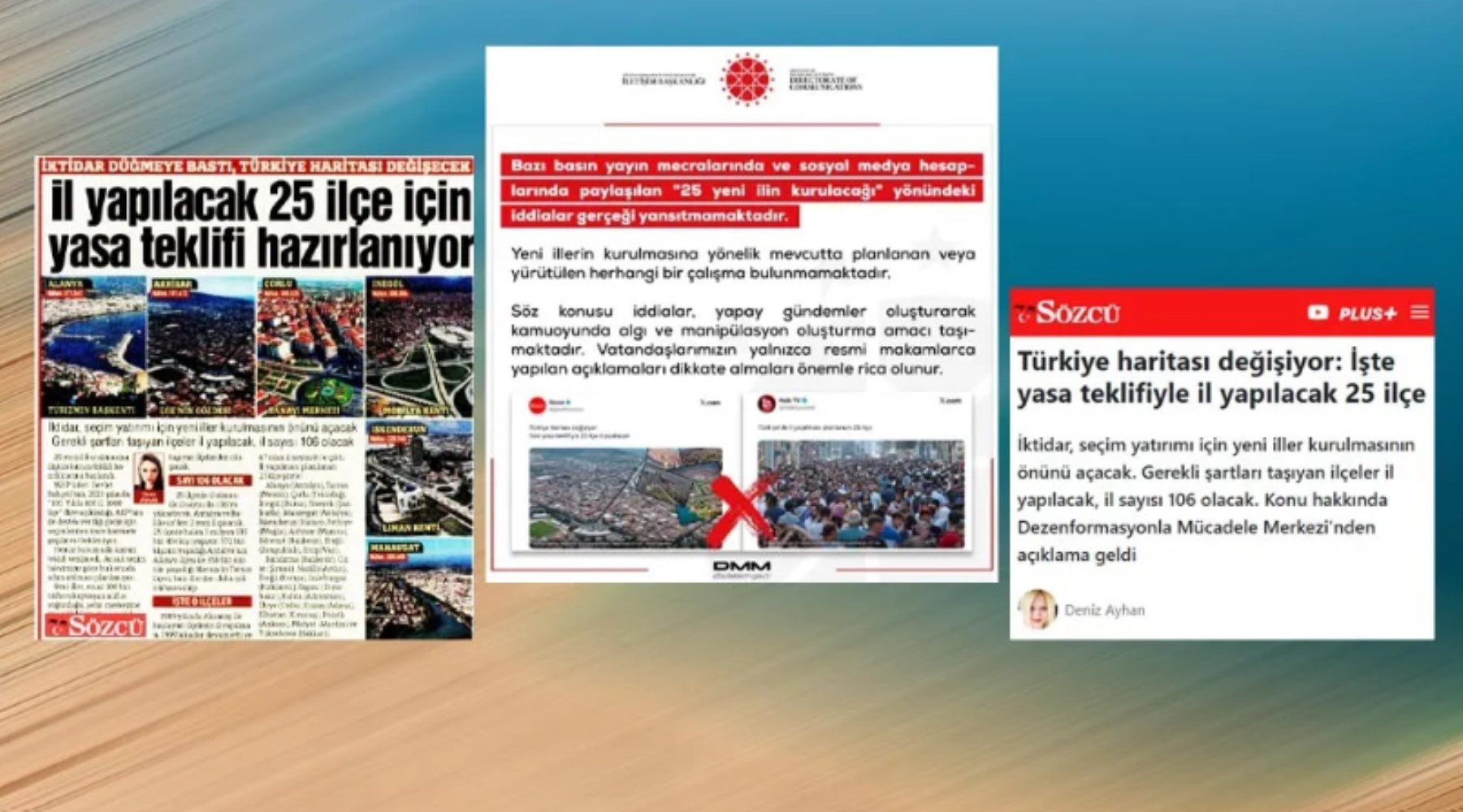
The news in the Sözcü newspaper that “A legislative proposal is being prepared for 25 districts to be made provinces” was published on its website as well as in print.
No source was given in the news; it was only stated that “…preparations for a legislative proposal have begun.” The news, which also included the names of the districts that would become provinces, spread rapidly on news sites. However, the Center for Combating Disinformation (DMM) made a statement saying, “The claims that 25 new provinces will be established do not reflect the truth.”
After the DMM’s denial, what needs to be done is clear. Either you defend the news with documents and information, or you apologize and retract it. However, Sözcü only added the sentence “A statement has come from the DMM regarding the subject” to the spot under the headline “Turkey’s map is changing: Here are the 25 districts to be made provinces with the legislative proposal,” and that was it. It didn’t even do that in the printed newspaper; it didn’t correct it at all.
This is clearly a game of deceiving the reader. By adding to the spot and the bottom of the news just by saying “A statement has come” without stating that the statement denies the news, the misinformation is not corrected; contrary to the content of the denial, it is used to attract the reader’s attention.
This attitude is not right. If you cannot present new data regarding the denied news, you are obliged to correct it openly. Respect for the reader and loyalty to the truth require this.
Football media missed it
On the day Aziz Yıldırım was re-elected as Fenerbahçe President after an eight-year hiatus, news about Aykut Kocaman began in the football media:
“Here is Yıldırım’s roadmap” (Fanatik), “Kocaman is expected” (Fotomaç), “99 percent Aykut Kocaman” (Sabah), “Kocaman preparation” (Akşam), “Yıldırım will first reach an agreement with Aykut Kocaman” (Hürriyet), “Yıldırım’s plan is ready” (Milliyet), “The roadmap has become clear” (Yeni Şafak), “Kocaman duty” (Nefes)”
Football writers were very sure that Aykut Kocaman would be the new head coach. So much so that even in the “It is being announced” (Sabah) news on June 18, it was written that “The only candidate is Kocaman.”
However, Aziz Yıldırım outmaneuvered all the football writers and announced that İsmail Kartal was the new head coach. It was left to the football media to write news like “Big surprise” (Fanatik), “Three scenarios in Kocaman chaos” (Sözcü), and “Aziz Yıldırım’s Kocaman surprise” (Hürriyet).
It seems that football writers do not have full control over what happens behind the scenes. In such a situation, they should not have written about Aykut Kocaman as if it were certain information. But I observe that most football writers are constantly swinging from one extreme to the other. The difference between the broadcasts they made while the National Team was going to the World Cup and the broadcasts when they were eliminated is proof of this…
In a single sentence:
While Türkgün newspaper Editor-in-Chief Mehmet Müftüoğlu was saying on Habertürk, “Mansur Yavaş will not act with the Özgür Özel team. He will remain in the CHP,” the words of İsmail Dükel, “Mansur Yavaş will act with Özel,” were appearing at the bottom of the TV100 screen.
On the day Yeni Şafak came out with the headline “The worst scenario after the 2001 crisis: The industrialist’s profit was not enough for interest,” Hürriyet published the news “Signal of recovery in industry.”
CHP MP Adnan Beker’s response of “I will send them to the fish restaurant” to Özgür Özel, who said “Let the real journalists eat” while sitting at the table prepared at the Ulus Market in Ankara, was a distorted view that saw it as an insult to journalism.
The pro-government media ignored the hunger strike of the miners and the police intervention in the protest of private school teachers and the Women’s Platform in Ankara.
Foreign Minister Hakan Fidan took Mustafa Kartoğlu from Akşam, Sevil Nuriyeva from Türkiye, and Yahya Bostan from Yeni Şafak with him on his Moscow trip.
Internethaber advertised a hospital in its headline “Sun warning from Medipol expert.”
FOR YOUR CRITICISM, COMPLAINTS, AND SUGGESTIONS: [email protected]
Most Read

Striking picture for Özgür Özel's 'New Party'

The PKK opening and Özgür Özel’s path!..

How did the newspapers view Özgür Özel's farewell to the CHP?

He killed his wife by slitting her throat: Their children witnessed the moments

What did the CHP do?

Özel’s new party move in the world press

Fire at TUSAŞ engine factory in Eskişehir under control

The New CHP, against CEHAPE

From self-efficacy to despair

Kılıçdaroğlu's first message on Özgür Özel's new party announcement