



How many steps, how many phases, how many stages are there for the PKK to dissolve itself and lay down its arms? Those trying to follow it closely must surely be confused.
With the announcement of the PKK's congress decision, headlines like "Here is the roadmap for the new stage" appeared, as seen in Sabah. Later, the Türkiye newspaper announced on its front page that the 2nd stage had been reached, declaring the number of stages to be 4 by saying, "It will be liquidated in four stages."

If the number of stages had stopped there, it would be fine, but it didn't. In Akşam newspaper, Melik Yiğitel reduced the number of stages to 3 by writing, "A 3-stage plan is in operation!" Although President Erdoğan only said, "We are in a new phase" without giving a number at the parliamentary group meeting, one day later Habertürk, Hürriyet, Sabah, Yeni Şafak, and NTV collectively stepped in and increased the number of stages to 5.
Moreover, while Erdoğan used the word "phase" (safha), Habertürk, Hürriyet, and Yeni Şafak preferred the word "stage" (evre), and Sabah preferred the word "step" (aşama). NTV used both words. Although presented as exclusive news, the content of the reports in all five different outlets was the same. Furthermore, while Hande Fırat in Hürriyet, Okan Müderrisoğlu in Sabah, and Yahya Bostan in Yeni Şafak cited no sources at all, Fevzi Çakır in Habertürk relied on "security sources," and Mustafa Berber in NTV relied on "intelligence sources."
It seems that the MIT or another unit related to security gathered these journalists and explained the situation. And they wrote it as if it were their own information and assessment! This is poor journalism. Writing expressions that gain value from the institution that says them as if they were one's own is both being used and misleading the reader.
When journalism turns into conveying the whispers of certain bureaucrats and politicians like this, it causes a commotion. There is a lot of talk about steps, stages, phases, whatever they may be, but what is actually happening and how the process will proceed becomes incomprehensible.
When the executors of the process, such as President Erdoğan and MHP Chairman Bahçeli, as well as the relevant bureaucrats, do not act transparently, the whispers of vague centers like "intelligence sources" replace concrete information. The confusion grows even further with the backstage gossip and false statements presented as information by the "talking heads" on screens.
Moreover, on one hand, the pro-government media, which does not ask questioning or probing questions even when sitting across from Erdoğan on his private plane—starting their remarks by saying, "This is actually a revolution that requires a Nobel Peace Prize"—publishes headlines like "The day the PKK ended," "The decision to dissolve has arrived, the terror-free era has begun," "And the PKK dissolved itself," "The 50-year terror era has closed," and "Erdoğan's peace." Reports follow one another that weapons will be surrendered, organization leaders will go to other countries, and that terror and the Kurdish issue are over.
On the other hand, the opposition media uses headlines like "The government revealed its intention early," "Lausanne cannot be discussed," "They met in 1921," "We are emptying Qandil, don't interfere in Syria," "Erdoğan's annotation on the dissolution text," and "Don't burn hearts, don't forgive this traitor." Reports that focus on the Treaty of Lausanne, the amnesty of PKK members, and constitutional amendments, without giving enough importance to the end of terror, are pulled to the front pages.
Setting aside the confusion, this attitude of the media does not serve peace journalism.
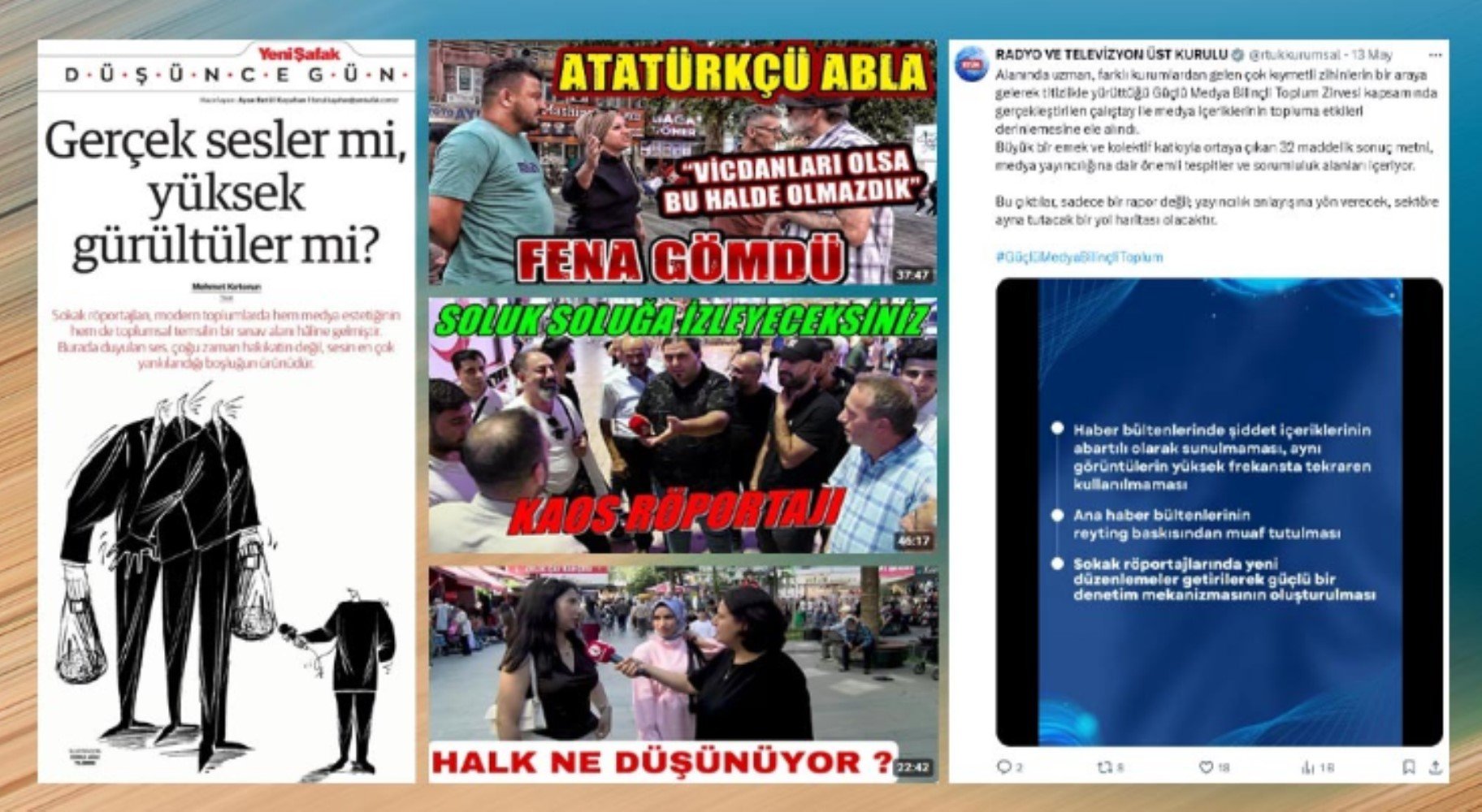
A call to street interviewers
The new enemy of the government front is "street interviews." Following President Erdoğan, the "Strong Media, Conscious Society Summit" organized by RTÜK also saw a demand for "the creation of a strong oversight mechanism by introducing new regulations for street interviews."
In an article published in Yeni Şafak under the byline of Mehmet Kırtorun, it was argued that "structures like RTÜK, the Press Council, and Press Professional Principles should undergo a comprehensive regulation that also covers digital publishers conducting street interviews." The article also speaks of "building a new media morality," stating, "This morality includes not only adhering to journalistic principles but also respecting the dignity, expression, and context of the individual."
It seems the author of these lines neither knows the difference between ethics and morality nor is aware of media ethics. We are talking about universal journalistic principles, not a moral understanding that changes according to time, place, or person. Journalistic professional ethics already include "respect for the dignity, expression, and context of individuals." One does not need to go far to see the professional principles of journalism regarding humans; one can look at the Turkey Declaration of Rights and Responsibilities of Journalism.
Furthermore, the "TGC Professional Principles Board," of which I am a member, added a section about "street interviewers" while updating the declaration:
"'Citizen journalists,' 'digital content creators,' 'street interviewers,' and 'fragmented news reporters' who are not professional journalists but use digital channels and social media for the purpose of content production, information gathering, and dissemination must also observe the public interest; they must base their work on accuracy and objectivity, and take care not to cause information pollution."
As can be seen, we journalists are not calling for putting "street interviewers" under the control of RTÜK and suppressing their freedoms like Erdoğan, RTÜK, or some government spokespeople; we are calling on them to act in accordance with universal media ethics and trying to guide them.
And not just them, but also "citizen journalists," "digital content creators," and "fragmented news reporters" who are not professional journalists...

Who are those making those comments?
The headline "Where was the CHP deputy seen: No one is listening to Özgür Özel" gave the impression that the CHP deputy was in a strange, or even inappropriate, place.
However, Okan Konuralp, the subject of Odatv's news, is a deputy with a journalistic background and was a speaker at the "Digital Monopolies, Dangers, and Quests" conference organized by journalistic professional organizations. What could be more natural than his presence there?
Odatv's objection was that Konuralp was a speaker in the same session as Demirören Media Editorial Coordinator Deniz Ayas and was sitting next to him. The news stated:
"The fact that a representative from a media organization included in Özel's boycott calls came together on the same platform with the CHP deputy led to comments that 'No one is listening to Özgür Özel.'"
This is a surprising comment. If the CHP is boycotting Demirören TV channels, must a party deputy not sit next to anyone from that group? Moreover, the news says "led to comments," but who made those comments? There is no one.
In journalism, one does not write "comments" on behalf of anonymous people. There is no justification for hiding the name of a source in such a story anyway. It is clear that the one making the comment is Odatv itself. It is extremely wrong to publish the news by twisting and bending it like this instead of criticizing it openly.
I wish Odatv had reported on what was discussed at that conference instead of making such comments under the guise of news. At the workshop and conference I also attended, the problems created by digital monopolies and artificial intelligence in terms of digital journalism were discussed and debated for two days. In the end, we prepared a final declaration in the form of a roadmap.
It is a pity; after the algorithms of digital platforms, perhaps an artificial intelligence danger that will crush us all is rapidly coming upon us; our journalist friends are in a completely different mood...
Screens are also open to those with stained records
Milliyet columnist Ali Eyüboğlu, in his article titled "Those with stained records should not be on screen," argued that television executives should not put former football players Ümit Karan and Nihat Kahveci on screen in accordance with "broadcasting principles and responsibilities to society."
This is because the Court of Cassation upheld the 1-year and 8-month prison sentence given to Ümit Karan last week for the crime of "simple sexual assault remaining at the level of molestation." Nihat Kahveci's ex-wife also applied to the court and had him banned from approaching their two children for more than 500 meters for two months on the grounds that he "harmed their pedagogical development by insulting them."
Eyüboğlu is right to argue that Karan and Kahveci should not be brought onto television and YouTube football programs as "commentators." Because the commentators on those programs are also presented to society as role models. However, it is objectionable for people who have committed sexual assault or insulted their children to take place on screens as exemplary personalities. It is especially harmful to young people.
Unfortunately, neither the executives of TV channels nor the football and tabloid media in our country take football stars and famous actors who commit crimes, do evil, or even use violence, like Karan and Kahveci, off the field; they do not, in a sense, excommunicate them; they continue to bring them onto programs and make news about them, adding to their fame.
To give an example, the football media almost ignored the fact that the famous Brazilian football player Robinho was sentenced to 9 years in prison for raping a woman in Italy. The tabloid media also quickly forgot that actor Ahmet Kural was convicted of the crimes of "insult, threat, and intentional injury" against his girlfriend, artist Sıla Gençoğlu.
There are many who talk about morality, but in practice, there is no one who observes ethical codes or the public interest.

In a single sentence:
• In Çorum, the municipal police displayed the 50 thousand 145 liras found on a beggar by lining them up one by one on a large table, and İHA served this exhibition photo to the media exactly as it was.
• Yeni Akit reported that CHP İzmir Deputy Sevda E. Kılıç had died; when Kılıç made a statement saying, "I am alive," instead of apologizing, they tried to blame the error on unknown people by writing, "They are up to something again: The deputy whom CHP members said 'died' has 'come back to life!'"
• Journalist Furkan Karabay was arrested on charges of "insulting the President" and "targeting persons who have served in the fight against terrorism," citing his videos and social media posts; an access ban was imposed on his X account.
• Cumhuriyet misspelled the word "muhatap" (interlocutor) in the headline "CHP leader Özgür Özel: The interlocutors are Erdoğan and Devlet Bahçeli," but the spelling inside the news was correct.
• It was wrong for the Türkiye newspaper to characterize the question asked to Muslera, "Will you leave your gloves to Uğurcan?" as an "unpleasant question"; a journalist asks every question that comes to mind.
• Akşam, in its news "The Central Bank returned to buying after 2 months," left out the information that the Central Bank started selling foreign currency after the İmamoğlu operation on March 19, 2 months ago.
• Akşam did not give the name of the company in its news "Death pool in unlicensed bungalow."
• The company undertaking the landscaping of the construction project of the Azerbaijanis took writers from Cumhuriyet, Dünya, Ekonomim, and Hürriyet to Montenegro as guests, and they promoted the company and the project with their articles.
• The Türkiye newspaper hid the information that "the number of ships using the Istanbul Strait decreased compared to the same period last year" in the last line of the news "823 'bombs' passed through the Strait in 3 months."
• İHA reporters who wanted to report on the crane accident that occurred before CHP Chairman Özgür Özel's İzmir rally were attacked by a group.
FOR YOUR CRITICISM, COMPLAINTS, AND SUGGESTIONS: [email protected]
Most Read

Striking picture for Özgür Özel's 'New Party'

The PKK opening and Özgür Özel’s path!..

How did the newspapers view Özgür Özel's farewell to the CHP?

He killed his wife by slitting her throat: Their children witnessed the moments

What did the CHP do?

Özel’s new party move in the world press

The New CHP, against CEHAPE

Fire at TUSAŞ engine factory in Eskişehir under control

From self-efficacy to despair

Kılıçdaroğlu's first message on Özgür Özel's new party announcement