



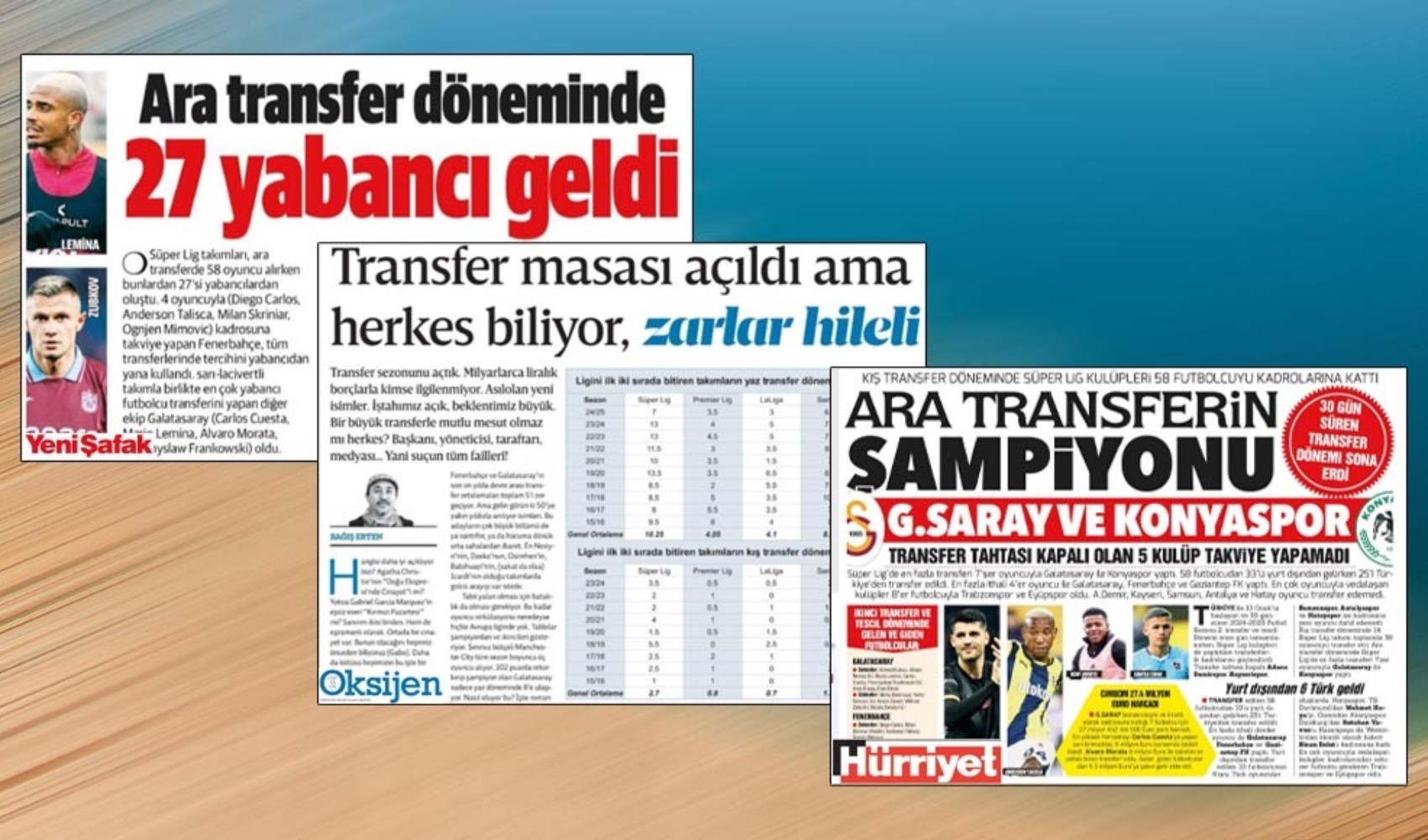
Sports writer Bağış Erten, in his article titled “The transfer table is open, but everyone knows the dice are loaded,” described the transfer frenzy of the football industry. He spoke of “names thrown out knowing they would never come to fruition, and mind-boggling sums of money,” and shared the findings of a study:
“Between December 24 and January 13, Fanatik, Fotomaç, Sabah, Milliyet, and Hürriyet newspapers linked 48 players to Fenerbahçe and 46 to Galatasaray. Who isn't on the list? Interestingly, in the vast ocean of transfers, they are all ‘fishing’ for the same names. Yet, the total winter transfer averages for Fenerbahçe and Galatasaray over the last 10 years barely exceed 5.”
Given that the transfer window continued for another 29 days after the study Erten mentioned in his article in Gazete Oksijen, the number of footballers added to the transfer lists of Fenerbahçe and Galatasaray in these newspapers must be much higher than what was stated in that study.
However, when transfers ended on February 11, we saw that Fenerbahçe had signed only 4 players, and Galatasaray only 7! Just think, five newspapers scatter the names of dozens of players for these two teams, but very few of them actually happen. It is not just these newspapers; almost the entire football media engages in this kind of journalism during transfer periods; unlikely names are thrown out and scattered about.
The news regarding Beşiktaş's choice of a new head coach is another proof of how accurate the football media is regarding transfers. I scanned the news in these same five newspapers again. They wrote about a large number of names as candidates for Beşiktaş's new head coach, ranging from Roger Schmidt to Nico Kovac, Paulo Fonseca, Roberto Mancini, Rudi Garcia, Felix Magath, Slaven Bilic, Markus Gidsol, Massimiliano Allegri, Martin Siegbert, and Igor Tudor! But they could not predict the Norwegian coach Ole Gunnar Solskjaer at all. Until the day Beşiktaş informed the Public Disclosure Platform (KAP), they didn't even have a clue about this name.
In fact, “made-up” news continues in every transfer period and coaching change. For years, the names of dozens of footballers are written and spoken about every time, but perhaps 10 or 15 percent of those names are actually transferred.
So why is this? Could football journalists be misled by football team managers? That is possible. But a journalist shouldn't be fooled every transfer period... And it is obvious that some of those mentioned will never come.
Perhaps the real reason stems from football writers' concerns about ratings, circulation, and readership, or from them becoming part of the football industry! After all, we are talking about an industry where millions of dollars circulate. The profit is huge, and there are many who profit from transfer news...
THE CIRCULATION RACE BETWEEN SÖZCÜ AND NEFES
I have been watching with curiosity the changes in the circulation of these three newspapers since those who left Sözcü and Korkusuz founded Nefes. When Nefes started broadcasting on December 19, Sözcü's circulation was over 100 thousand, and Korkusuz's was over 54 thousand. Let me also note that while the selling price of Nefes and Korkusuz was 10 liras, Sözcü's price was 15 liras.
Odatv reported Nefes's circulation on its second day as 73 thousand. According to the Media Monitoring Center, in the week of December 16-22, Sözcü's circulation was 101 thousand, Korkusuz's was 54 thousand, and Nefes's was 44 thousand. In the week of December 30-January 5, Sözcü's circulation fell to 85 thousand for the first time, and Korkusuz's to 50 thousand.
Then Nefes's circulation began to rise slowly and exceeded 50 thousand in the week of January 27-February 2. In the same week, Sözcü's circulation was 79 thousand, and Korkusuz's was 47 thousand. These three newspapers are drawing a strange curve in their circulation. Sözcü seems to have stopped its decline, which at one point went down to 76 thousand.
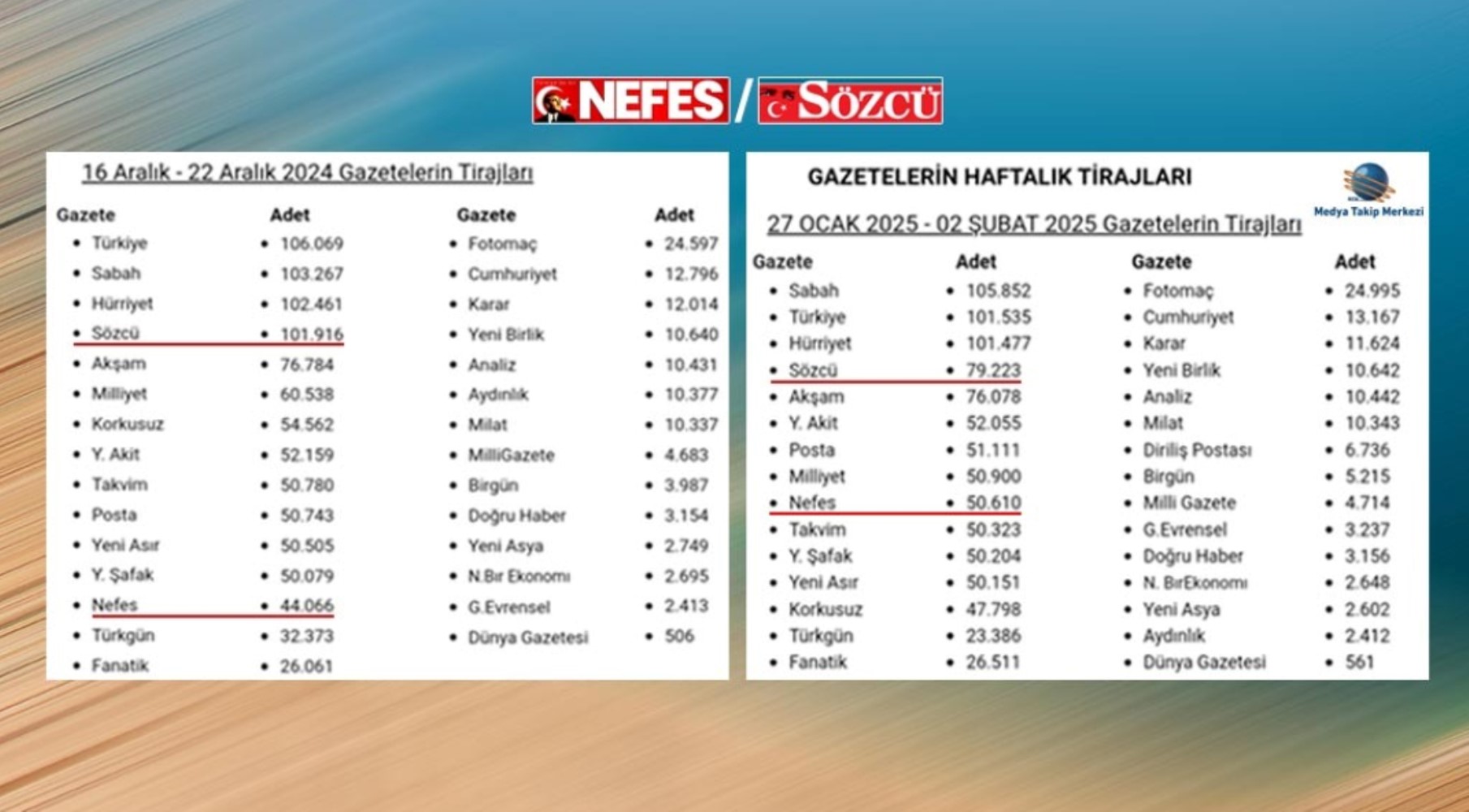
Nefes may have also gained readers from newspapers other than Sözcü and Korkusuz. In the last two-month period, the circulations of newspapers such as Türkiye, Sabah, Hürriyet, and Akşam remained about the same, but what is interesting is that Milliyet fell from 60 thousands to 50 thousands, and Aydınlık from 10 thousands to 2 thousands. It seems there is a readership that is unhappy with the newspaper they read and is caught in the middle. Let's see what kind of path these readers' journey between newspapers will follow in the coming days...
Of course, I should also remind you that circulation is the number of newspapers printed, not sold. Unfortunately, there is no information on how many of those printed are sold...
ERDOĞAN'S WORDS SHOULD HAVE BEEN CORRECTED
While responding to CHP Chairman Özel's words, “If he reads Bertolt Brecht's poem 'A Worker Reads History' from the teleprompter at the group meeting, I will say 'he is not ignorant',” President Erdoğan repeated his old mistake once again:
“I was sentenced to 1 year in prison for reading this poem, which belongs to Ziya Gökalp. History from secondary school to university tells whether I read the poem or not. But I don't know how much ability Mr. Özel has to read poetry himself.”
It is not true that the lines “Minarets are our bayonets, domes are our helmets, mosques are our barracks,” which caused Erdoğan to be sent to prison in 1999, were taken from Ziya Gökalp's poem “Soldier's Prayer.” There are no such lines in that poem.
The real source of these words is the poem “Divine Army” by the Ankara-based poet M. Cevat Örnek. Örnek included this poem in his books “7 Dağın çiçeği” (1966) and “Gülden dikenden” (1974).
Erdoğan had also made the mistake of attributing it to Ziya Gökalp in his speech in Parliament in 2011. At that time, it was written in Malumatfuruş that the poem did not belong to Ziya Gökalp but to M. Cevat Örnek, and the mistake was corrected. Writers like Murat Bardakçı also wrote that the poem belonged to Cevat Örnek. Despite this, Erdoğan repeating the same mistake over and over is now a conscious choice.
But in the media, Erdoğan's mistake was reported without even a correction note. In fact, Akşam repeated the mistake again days later with a news story titled “Özgür Özel read the poem wrong.” Readers and viewers were misled in plain sight.
Journalists' responsibility regarding mistakes is not to Erdoğan, but to the reader and viewer. In journalism, it is mandatory to correct a mistake, not to report it exactly as is.
THE MISTAKE IN THE “ÖCALAN'S LETTER” NEWS
The news “Cemil Bayık: We have received Öcalan's letter” was first reported in the evening by Sterk TV, one of the media outlets close to the PKK. When the Mesopotamia Agency repeated it with the same headline, the news spread rapidly. Dozens of news sites announced this development.
However, in Artı Gerçek's news titled “Response from KCK to the letter claim: 'We have had some information',” Bayık's words were reported differently. I asked a friend who knows Kurdish to watch the interview on Sterk TV, which is the actual source of this news, with PKK leader Cemil Bayık. He watched it and wrote to me:
“Cemil Bayık does not say in the program, ‘Öcalan sent us a letter.’ He says, ‘A letter came to the fore in the Turkish media. Upon this, we had some information. We evaluated this as well.’”
In this case, all the news from Sterk TV and those based on it were wrong. It seems that on the evening the news was heard, they copied it exactly without researching, out of a habit of cutting and pasting. But they could have corrected the mistake later; they didn't. Even Sterk TV and the Mesopotamia Agency did not correct it.
It didn't stop there; two days later, Yeni Yaşam repeated the mistake on its front page with the news “Bayık: We have received the letter.” On the same day, DEM Party Co-Chair Tülay Hatimoğulları also responded to a question about “Öcalan's letter” at a press conference, saying, “We followed the statements made by Mr. Öcalan's organization in the press. They shared with the public the information that a message had reached them.” In fact, she also referred to the false news.
Öcalan's letter may have been delivered to Qandil, I don't know that. What I do know is that the Bayık news is wrong, and therefore Hatimoğulları's words are far from providing information. Now what needs to be done is for journalism to step in, investigate the letter, and shed light on the dark points.
Of course, while writing new information, it is essential to correct false news and provide an explanation to the readers. This is the requirement of “independent journalism” that feels it owes the truth to its readers.
THE SPIKE STABBED INTO THE EYE IN THE ATV SERIES
A new example of RTÜK protecting pro-government channels is ATV's series titled “Can Borcu.” A reader named M. Akın Güre, who sent an email, complained about the “child abuse,” “violence,” and “incitement to crime” scenes in this series:
“There is a network in the series that incites young people to commit crimes by promising cash prizes via phone messages. In the 6th episode, a child who scratches the bodywork of a car is rewarded with 2000 liras on the condition of proving it with a video. In the series, this event is shown to the audience step by step. The second event is even more terrifying. The network asks the same girl to leave broken glass in a children's playground. The child leaves the broken glass pieces at the exit of the slide in the playground.
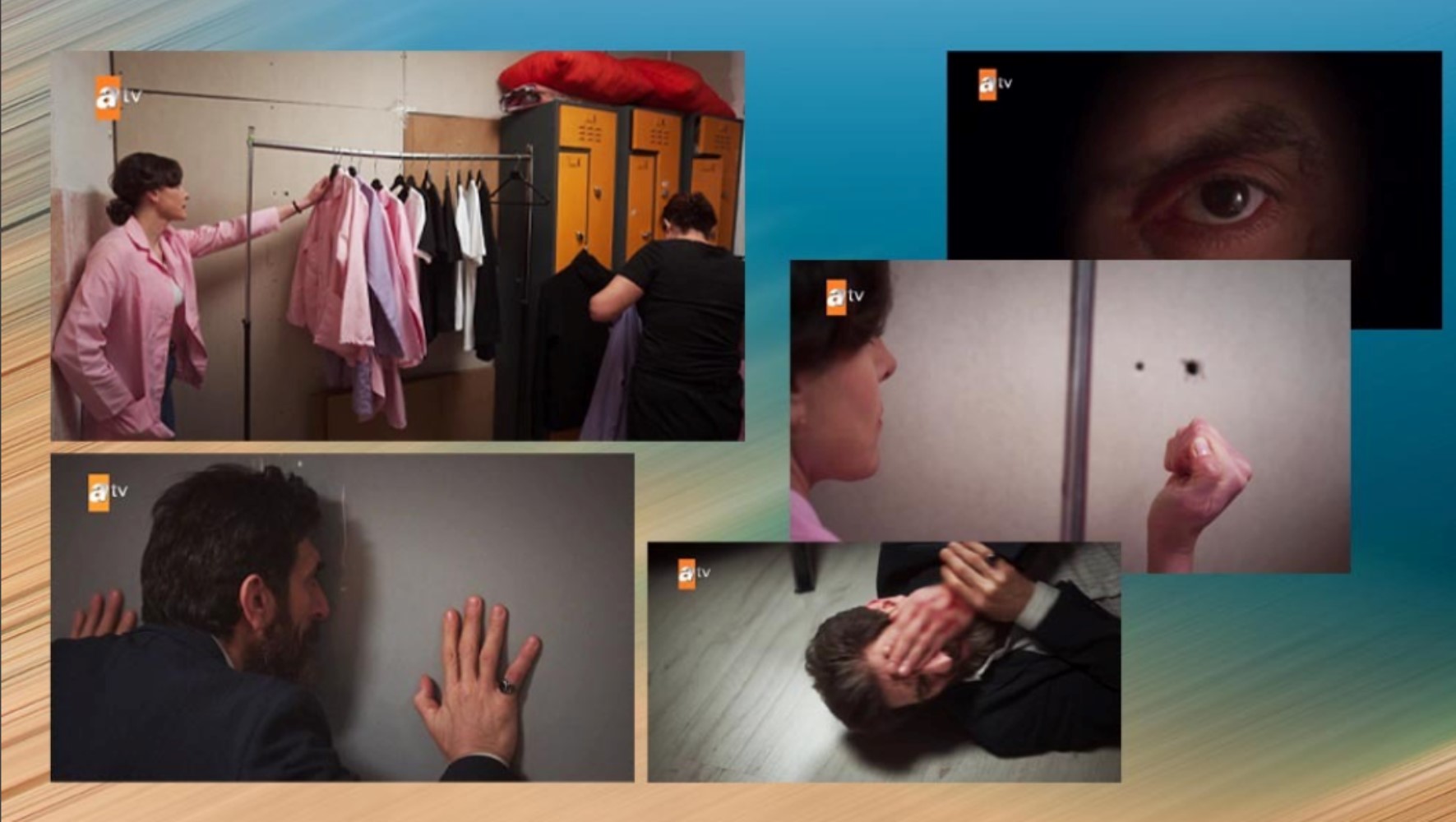
In the 7th episode, Hande stabs a spike through a hole into the eye of the boss who is ‘peeping’ at the women working in the workplace through a hole in her room. Punishment and being against harassment of women are placed side by side; it misses the solution of seeking rights through law and justice. I complained to RTÜK's hotline.”
I looked at those episodes of the series. M. Akın Güre's findings are correct. The scenes where children are made to commit crimes against other children in exchange for money are chilling, and so is the stabbing of a man's eye with a spike.
Of course, bad characters and evils are also dealt with in series; but it is not necessary to show violence in all its brutality. It is possible to tell stories by creating images without showing violence in all its nakedness. After all, visual art products like films and series leave effective traces in the viewer's mind to the extent that they can create images.
Clearly, as in many new series, there is no trace of artistic creativity in ATV's “Can Borcu.” Commercial concerns are taking its place. Let's see if RTÜK will see the evils in this series?
In a single sentence:
The Press Council decided to condemn Yeni Şafak on the grounds that it slandered Necla Zarakol and her daughter Ayşe Zarakol by linking them to the Gezi protests and Osman Kavala through manager Ayşe Barım with the news “Everything was beautiful for them” and “Ayşe Barım's tyranny in the media.”
Sabah, in its news “The fake banker got the punishment,” wrote the person convicted of defrauding presenter Cansu Canan Özgen as Mustafa A., hiding his surname.
In Akşam's “Death in the virtual world” and Türkiye's “Fake alcohol poisoning” news, “fake rakı” or “fake liquor” should have been written instead of “fake alcohol”; because the alcohol is real, what is produced is fake.
DHA, Hürriyet, Cumhuriyet, and Haber7 did not write the name of the market that transported meat in inappropriate conditions in the news “Big penalty for meat scandal”; they also blurred the name Yunus Market in the photo.
In the news “A ‘survey’ was also conducted on the lieutenants who were not dismissed: Who was with you” by BirGün, Cumhuriyet, Nefes, and Veryansın TV, it should have been called an “investigation” instead of a “survey.”
Yeni Şafak published a promotional text of a company providing “digital food aid” as news and with the headline “100% exemption from SGK premium with P…” without putting a “This is an advertisement” warning.
Milliyet headlined the news about the driver who was arrested for causing serious injury by driving his car onto a motorcycle courier who broke his mirror as “The debate over who is right.”
Halk TV owner Cafer Mahiroğlu hosted a dinner for “Alevi federation presidents, faith leaders, and local federation presidents on the first day of the Khidr Fast.”
FOR YOUR CRITICISM, COMPLAINTS, AND SUGGESTIONS: [email protected]
Most Read

Striking picture for Özgür Özel's 'New Party'

Özgür Özel gives a dated response regarding the number of resignations

Forest fire in Antalya brought under control

The PKK opening and Özgür Özel’s path!..

How did the newspapers view Özgür Özel's farewell to the CHP?

He killed his wife by slitting her throat: Their children witnessed the moments

What did the CHP do?

Özel’s new party move in the world press

The New CHP, against CEHAPE

Fire at TUSAŞ engine factory in Eskişehir under control