



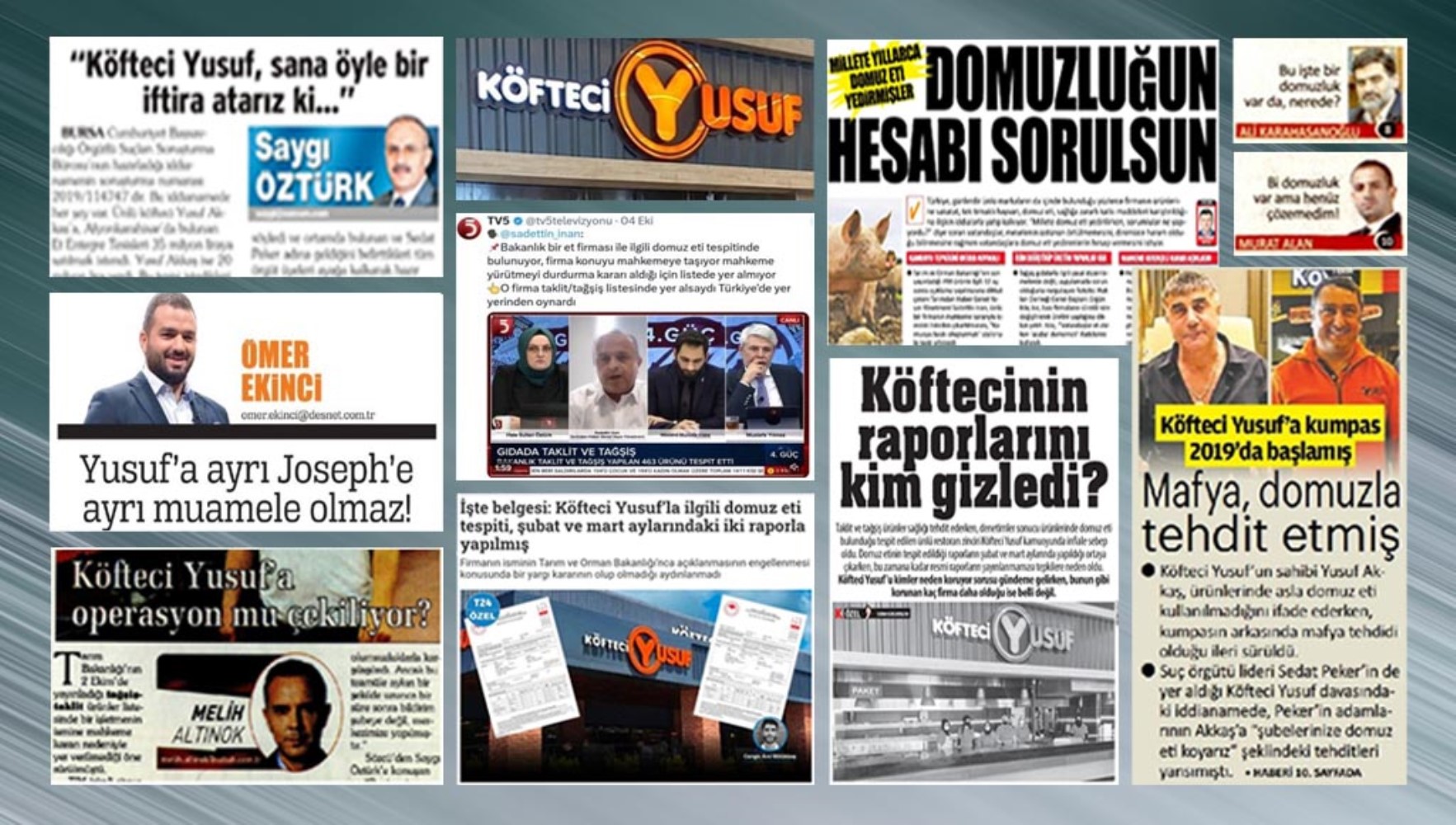
When the Ministry of Agriculture and Forestry announced the companies involved in food fraud on October 3, most of the media coverage was incomplete. With the exception of Milliyet, newspapers did not publish the names of the companies, thereby protecting the "companies that engaged in imitation and adulteration in their products." Contrary to the newspapers, most news websites prioritized protecting the consumer by publishing the names of the widely known brands.
The real journalistic work came from Sadettin İnan, a writer for the website Tarımdan Haber. İnan criticized the ministry for announcing the list of imitation and adulterated products after holding it back for 32 months. In a broadcast on TV5, he also stated, "Pork was detected in the products of a famous meatball chain, but the company obtained a stay of execution from the court, preventing its name from being included on the list."
He did not give the name of the meatball restaurant, but suspicions gathered around Köfteci Yusuf. Two days later, when it became a trending topic on social media, news websites began to name the company. The fact that the company's lawyer, Ali Uslu, responded to Gazete Pencere's inquiry by saying he had "no information, could not make a statement, and could not respond to the allegations" was, albeit indirectly, the first confirmation.
Nevertheless, newspapers and television channels continued to hide the name of Köfteci Yusuf in their reports. However, T24's discovery and publication on October 9 of reports kept at two branches in February and March clarified that the "famous meatball chain" in question was indeed Köfteci Yusuf. Once the reports surfaced, Köfteci Yusuf, which had remained silent for five days, was forced to make a statement; it defended itself by calling it a "conspiracy."
When the matter reached this point, the Ministry of Agriculture and Forestry could no longer hold back; it added Köfteci Yusuf to the list of imitation and adulterated products. Karar questioned on its front page why it had not been included on the list until that day. However, the court decision, which was rumored to have been newly obtained, could not be brought to light.
Even more interesting was that newspapers like Sabah, Sözcü, Türkiye, and Yeni Akit, which had not pursued the story until that day, suddenly began to defend Köfteci Yusuf. The sharpest maneuver was made by Yeni Akit, which published a front-page headline on October 10 reading "Let the pork account be settled," but then published a story on October 11 titled "Mafia threatened with pork," with two of its columnists defending Köfteci Yusuf.
It is a good thing that journalists and social media exist! If expert journalist Sadettin İnan had not brought this incident to the agenda, if social media had not risen up, if news websites had not pursued it, and if T24 had not found those reports, we would never have known that pork was found in Köfteci Yusuf's meatballs; it would have been covered up and forgotten.
One criticism: Sadettin İnan should have given the name of Köfteci Yusuf from the very beginning. A journalist looks out for public health and does not shy away from writing and saying the names of companies that commit fraud. This does not lead to a search for "who is that meatball seller"; it does not cast suspicion on all meatball sellers.
THE PLUNDERED ARCHIVE OF A HUMOR LEGEND
Humor writer Erdinç Utku has been expressing his outrage on social media for some time. He also sent me what he wrote there. "I cannot find it fitting for Sözcü to publish cartoons that were published in Gırgır by erasing the signatures on them," he said.
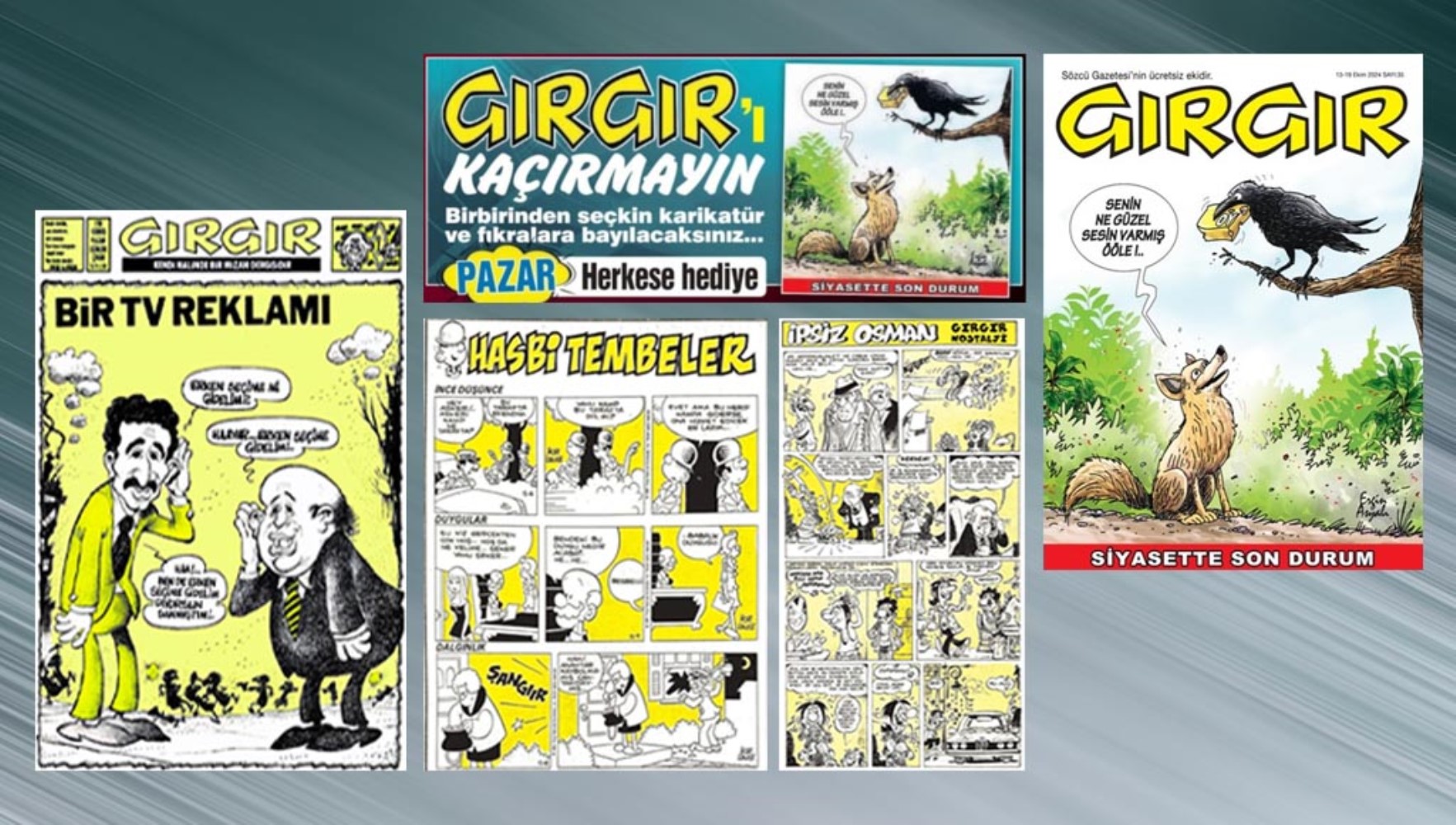
The fact that the humor legend Gırgır magazine, which began publication in 1971, has become a supplement is a sad situation in itself. Oğuz Aral's Gırgır was a cartoon school with a weekly circulation exceeding 500 thousand, and it was also a school of political cartooning. It had carried the cartoon tradition coming from Akbaba to its peak. The end of the Gırgır legend was the disagreement Haldun Simavi had with Oğuz Aral in 1989. Simavi seized the magazine's archive without even giving Oğuz Aral and the departing cartoonists a chance to empty their drawers; he transferred the magazine to Ertuğrul Akbay. Although Gırgır was published intermittently until 2017 from that date on, it could never be that old humor magazine again.
Gırgır is now published as a supplement to the newspaper Sözcü, owned by Ertuğrul Akbay's son Burak Akbay, but it is a shadow of its former self. Erdinç Utku's complaint is also extremely justified. Instead of a humor magazine equipped with the current drawings of cartoonists, they are content with repeating the cartoons in the old Gırgır. For some reason, they also choose the non-political ones...
Sözcü's editorial board must have an explanation. However, there can be no moral explanation for publishing old cartoons with the signatures removed. The fact that the copyrights of Gırgır belong to Sözcü does not justify the erasure of the artists' signatures.
To give an example, "İpsiz Osman" is a cartoon series created by Orhan Alev and Ergün Gündüz. Sözcü reprints it exactly as it is every week, writing "Gırgır nostalgia" on the side, but the name and signature of its writer and illustrator are missing.
Not only in the "İpsiz Osman" strip, but in the vast majority of the cartoons in the eight-page Gırgır supplement, there is no signature. I think only the cover of the supplement is current, and it has the drawing and signature of Sözcü's cartoonist Ergin Asyalı. Other than that, only the Mort Walker signature stands out in the "Hasbi Tembeler" strip; probably because he is a foreign cartoonist...
In fact, some cartoon strips do not even have the name of the character or the story on them. It is not even clear when the cartoons were published before. None of them have been given their original dates. In this state, it gives the appearance of a sloppy and haphazardly prepared supplement.
Publishing Gırgır in this form is an insult to that humor legend. Removing the cartoonists' signatures is also an ethically problematic behavior. They are severing the artist from their own creation, and the creation from its context.
Being the owner of the copyrights may have given Sözcü the publishing rights to the magazine, but this does not give them the right to make changes to artistic products and sever the artist from their work.
FEELING SORRY FOR ISRAELI CIVILIANS?
"It is not correct to say that Israel deserved this; after all, it is civilians who are harmed. Even if military points are targeted, I am concerned that many civilians could be harmed by the impact of the missiles."
Following these words by NTV Foreign News Director Ahmet Yeşiltepe, the lynch mobs waiting in the wings immediately went into action. Oh, how could he be concerned about civilians being harmed in Israel!
Fatih Portakal's words on the Sözcü TV broadcast, "Tel Aviv is unfortunately under missile attack. There are explosions in the city," were also targeted by the same lynch mobs.
Since when has it become a crime for a journalist to oppose civilians being harmed? I, too, am saddened by the victimization of Israeli civilians in missile attacks. I am also very saddened by the displacement and killing of Palestinian and Lebanese civilians; I am even devastated.
In the face of the rogue state of Israel's aggression, its terrorizing of the region, and its genocide, Iran and Hezbollah's response with missiles is certainly understandable. But our understanding should not prevent us from being saddened by civilians being harmed.
Civilians are the side that does not fight in wars. Journalists do not fight either; they report the evils of war; they always defend humanity and peace. Our anger and our rebellion should not make us forget our humanity.
"BROUGHT TO THE AGENDA THAT HE MIGHT BE IMPLYING"
The news headline was exactly as follows:
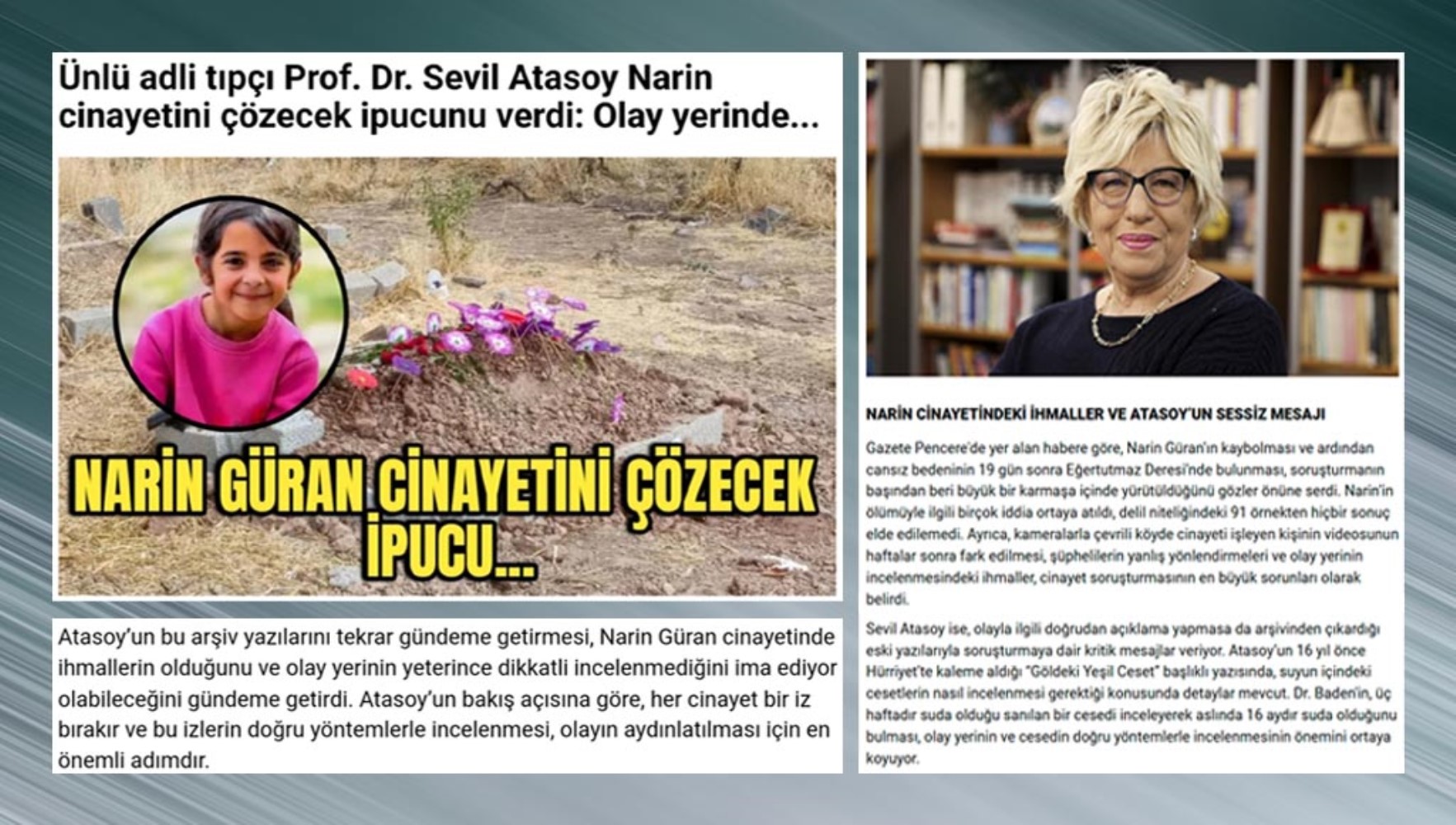
"Famous forensic expert Prof. Dr. Sevil Atasoy gave the clue that will solve the Narin murder: At the crime scene..."
This headline on Karar's website arouses curiosity, and you open the news. After reading 23 lines of piled-up old information, you reach the information that Atasoy "gave critical messages about the investigation with her old writings she took out of her archive." The message is conveyed with a sentence like this:
"Atasoy bringing these archive writings back to the agenda brought to the agenda that she might be implying that there were negligences in the Narin Güran murder and that the crime scene was not examined carefully."
Amazing! Atasoy didn't even imply it; she brought to the agenda that she might be implying it by sharing her old writings, and a long news story was constructed based on that!
So, where is the "clue that will solve the murder" emphasized in the headline? It is not there; the reader has been deceived. This is a journalistic game that is unfortunately common on news websites, done by implying that there might be a clue.
THE JOURNALIST WHO SPEAKS INSTEAD OF THE PRESIDENT
Hilal Köylü is one of the rare journalists who has been able to find the opportunity to ask President Erdoğan a question in Parliament. Köylü asked, "You said you are open to cooperation with the DEM Party, but they say there is no concrete step. Can there be a concrete step, should we wait?" But instead of answering, Erdoğan turned to A Haber reporter Rüya Akkuş and said, "Rüya, what do you say?"
Why should another journalist answer a question asked by a journalist instead of the President? But Rüya Akkuş, perhaps not thinking so, immediately took on the role of Erdoğan. She said, "Let's continue the moderate atmosphere in politics without waiting for a concrete step." Although Köylü insisted, "Will the moderate atmosphere continue?" Erdoğan walked away, saying, "Rüya gave the answer."
The purpose of asking a question there as a journalist was to learn Erdoğan's attitude. But by speaking in his place, Rüya Akkuş prevented Erdoğan's attitude regarding DEM from being learned. And by putting herself in the politician's place, she violated the rule of distance.
DO NOT DEGRADE THE READER
Prof. Dr. Baskın Oran, who has high linguistic sensitivity, is saddened these days when reading or watching the news; I can even say he suffers. He summarized some of the spelling and pronunciation errors he encountered for me:
"Writing 'million' with letters is fine, but in a country where people are in need of thousands while you are going out to dinner with your spouse, writing even 1,500 as 'one thousand 500' is simply degrading the reader. Everyone in this country who has studied up to the third grade of primary school reads 1,500 as one thousand five hundred. They have that much reading ability.
* 'Yediemin' (trustee) means a safe hand, someone who holds something securely, a custodian. What does it have to do with the number seven (yedi) that it is written and said as 'Yediemin'?
* 'Analiz etmek' (to analyze) or 'analize etmek'? To avoid this question, 'tahlil etmek' should be used.
* 'Fekkikabir' means breaking a grave, opening a grave. What does it have to do with conquest (fetih)?"
* 'One should not use the word 'oldukça' (quite/rather) instead of 'çok' (very). Because it means quite, not very. It is used in the wrong place instead of 'as much as possible'.
* "What on earth does 'taciz edildi' (was harassed) mean? Does it mean was bothered, does it mean was raped, what does it mean? Can there be such a hermaphroditic (bisexual) term?"
In one sentence:
Akşam, Sabah, Türkiye, Y. Akit, and Y. Şafak used Anadolu Agency's story "Mosques in Europe meet the needs of society from education to culture" without citing the source.
Akşam, by putting the headline "Platonic love" on a murder story, produced a justification for a woman being killed by a man with whom she had no relationship other than working at the same workplace.
Sabancı group company Çimsa took writers from Hürriyet, Posta, Milliyet, Sabah, and Yeni Şafak to Spain and hosted them there to promote its new investment in Bunol.
Ekol TV quoted BirGün's story "They partitioned the park and installed a door: A warning to the occupiers" without citing the source and published it as "according to allegations."
Yeni Şafak promoted the AKP-run Ordu Metropolitan Municipality on two full pages.
It was inappropriate to use the word "allegation" in the story that Tele1 and T24 quoted from Sözcü about "Labor Minister Işıkhan's friend's son-in-law, who is a cook, being appointed as an attaché to Germany."
It was wrong for Milliyet to use the word "tane" (piece/unit) in the headline "How many Meral Oğuz are there in the DT" on the front page—even though it was not in the text—as "tane" is not used for people in Turkish.
The BTK unlawfully blocked access to the LGBTI+ news portal KaosGLorg from the family and child profiles of the "Safe Net" application.
Sözcü did not state that it quoted Müyesser Yıldız's article on the 12 Punto website in its story "The duty stations of nearly 40 commanders were changed."
RTÜK canceled the terrestrial broadcasting license of Açık Radyo, which has been broadcasting for 30 years and is a symbol of environmental awareness, pluralism, and diversity in Turkey.
FOR YOUR CRITICISMS, COMPLAINTS, AND SUGGESTIONS: [email protected]
Most Read

Striking picture for Özgür Özel's 'New Party'

The PKK opening and Özgür Özel’s path!..

How did the newspapers view Özgür Özel's farewell to the CHP?

He killed his wife by slitting her throat: Their children witnessed the moments

What did the CHP do?

Özel’s new party move in the world press

The New CHP, against CEHAPE

Fire at TUSAŞ engine factory in Eskişehir under control

From self-efficacy to despair

Kılıçdaroğlu's first message on Özgür Özel's new party announcement