



Perhaps one must believe in the magical power of the media. The “Grey Wolf sign” used by the Idealists (Ülkücüler) was suddenly transformed into a symbol for everyone living in this country, and that is how it began to be portrayed.
The reason for this sudden transformation is that national football player Merih Demiral made the “Grey Wolf sign” during the Austria match, and UEFA opened an investigation and imposed a penalty on the grounds that he had engaged in a “non-sporting gesture.”
Akşam ran headlines like “The Grey Wolf is ‘Turkish’, shut your voices”, while Hürriyet wrote “(İlber Ortaylı): The Grey Wolf is the symbol of the Turkish nation.” Meanwhile, pro-government writers and TV channels such as Ali Saydam, Hasan Öztürk, Nedim Şener, Salih Tuna, Serkan Fıçıcı, Erhan Afyoncu, Hikmet Genç, and Hilal Kaplan entered a race to justify Merih Demiral.
It didn't stop there; even Uğur Dündar supported him by saying, “It is a historical and cultural symbol also used by Gazi Mustafa Kemal Atatürk, it cannot be equated with racism. Therefore, we are all Merih Demiral.” Barış Doster also took his place among those sanctifying the “Grey Wolf sign” on his program on TV100, referencing Nâzım Hikmet’s comparison of Atatürk to a “Blond wolf” and stating, “Left-liberals are surely not more leftist than Nâzım. I say ‘How happy is the one who says I am a Turk’ and I kiss Merih Demiral on the forehead.” Many journalists, from Yılmaz Özdil to Fatih Çekirge, Tunca Bengin, Gürkan Hacır, and Ece Üner, also supported these views.
However, there is a confusion in these narratives. The “Grey Wolf” mentioned as a symbol of Turkishness during the founding years of the Republic, for which epics were written, does not carry the same meaning as today’s “Grey Wolf sign.” What is at issue is not the “Grey Wolf” of the past, but the “Grey Wolf sign” of today and its meaning. The issue is also not that it is used in some Turkic Republics.
Tuğrul Türkeş had explained that his father, Alparslan Türkeş, saw the “Grey Wolf sign” in 1991 at a rally for Abulfaz Elchibey in Baku and that they started using it in Turkey after that. The reason for this statement by Tuğrul Türkeş was the words of then-Prime Minister Tayyip Erdoğan, who had said, “They are exploiting (martyr) funeral ceremonies with their own unique signs.” Although Erdoğan himself made this sign in 2018, he did not like it in 2007 and viewed it as a symbol of the MHP members.
Indeed, until a few days ago, this sign was not referred to anywhere as our country's common symbol; we were not all making the “Grey Wolf sign” as citizens morning and night. Because this sign is a political symbol that represents and is identified with the MHP and the Idealists. Naturally, it is also accepted as the symbol of the Idealists in European countries.
Because it is a political symbol, it was not right for the “Grey Wolf sign” to be used on the football field. A player on the national team, which represents all citizens of Turkey, had no right to display the political symbol of a portion of this country's people on the field.
To criticize UEFA’s investigation and the heavy penalty it imposed, one does not necessarily have to portray the “Grey Wolf sign” as a “National symbol.” You can criticize it, you can say it is a double standard and political; you may even have a point. But journalism should not have been a voluntary partner in the maneuver to turn the symbol of MHP members into the symbol of Turks or even Turkey.
Moreover, we are talking about the Turkish National Team, the team whose success we take pride in. Our shared joy should not have been overshadowed by a debate and political crisis triggered by a gesture. After the UEFA penalty, the media should not have used the language of hostility and hatred, and the football match should not have been turned into the Ottoman Empire's campaigns of conquest.
Furthermore, one of the journalistic mistakes during the crisis process was that some of our colleagues shared information and visuals without verifying their accuracy. Whether it was those claiming Atatürk wrote the “Grey Wolf” book, or those using montaged images to make Atatürk perform the “Grey Wolf sign,” they were all there…
Men eating rice and the comedy of baldness
“Canan Karatay warned men who eat rice,” “Canan Karatay revealed the food that causes baldness in men.” These and similar headlines are published on Akşam, Cumhuriyet, Halktv, Odatv, Milliyet, Sputnik Türkiye, T24, Türkiye, Yeni Akit, and dozens of other sites.
These reports caught my attention through a post by a reader named Özgür Öğret. They were all identical; it was clear they had been plagiarized from somewhere, but there was no source. Upon researching, I encountered a comical situation. The exact same news, word for word, had been used in Aydınlık and some other sites last February. It had also been published in September 2023 on the sites of ABC, Türkiye, Cumhuriyet, CNN Türk, and Posta.
However, I could not find where it was first published. It is certain that news sites love this story. Otherwise, some sites would not have used such a story for the second time with a year's interval.
As for the content, it has no substance; it cannot even be called news. These texts do not answer questions such as where and when Karatay said this, or whether there is a scientific basis for her words. Since there is no information anyway, it is adorned with photos of rice and bald heads so that the reader stays on the page for a long time. Some say rice pilaf, in most it is not even clear what kind of rice it is…
The claim that rice causes hair loss in men is nonsense. Scientists do not attribute hair loss in men to a single factor; they characterize poor and inadequate nutrition as only one of the factors. They state that the primary factor is genetic structure; they note that baldness in men is mostly inherited from the family; and they mention that besides genetics, there are factors such as hormonal imbalances, vitamin and mineral deficiencies, stress, depression, cosmetics, medications, and treatments.
As you can see, these texts published as attributed to Prof. Dr. Canan Karatay have no serious side. Of course, if you only eat rice and have a poor diet, your hair will fall out, and other diseases will occur.
The conscience of the journalist
There is a complete mess in the US-sourced news regarding writer Eylem Tok and her son Timur C., who was involved in a fatal traffic accident. Not only are journalistic principles not being observed, but contradictory news is being published. There is also no need felt to correct news that turns out to be false.
The news “Turkish courier caught writer Eylem Tok and her son in the US” was published on June 18 in many places, including Aydınlık, Haber7, Halk TV, Hürriyet, Milliyet, Kanal D, and Haber Global. However, it was a report full of gaps; first of all, there was no detail regarding the name and identity of the “Turkish courier.” Indeed, Hacı Orhan, the lawyer for the family of Murat Aci, who died in the accident, denied this information on Odatv, but no one corrected their news.
The second error in the news about the capture of Tok and her son was about where they were caught. While some reports stated they were caught in a house, others provided information that they were caught at a school where they had gone for a meeting to register Timur C. The confusion on this matter continued until the news “This is how Eylem Tok and her son were caught” published in Akşam on June 27. Yavuz Atalay’s report, which was published in more detail on the front page the next day, also included footage of the moment Eylem Tok and her son were caught. The same footage was also published in Hürriyet. But even though it was confirmed that they were caught at the school, those who said “Caught at home” still did not correct it.
Also, until that day, Timur C.’s photo was being used with his face visible in many media outlets, including Akşam. However, in the photos and footage of the moment of capture coming from the US, Timur C.’s face was blurred.
Thus, the rule applied in the US ended up affecting our media as well. Whereas, not publishing the photos and identities of those under 18 is both a legal requirement and a necessity of journalistic principles in our country…
Furthermore, even though Eylem Tok and her son may be condemned in the public conscience, journalists should not act on judgments and should not put themselves in the place of judges and prosecutors.
Corporate cooperation of three journalists
Oğuz Alper Öktem, the founder of the mobile taxi application TAG, is a name who frequently uses digital media and viral advertisements in his struggle against taxi drivers. Last week, he also shot a video against traffic police having TAG drivers' vehicles towed by private companies' tow trucks instead of the Police Organization Strengthening Foundation.
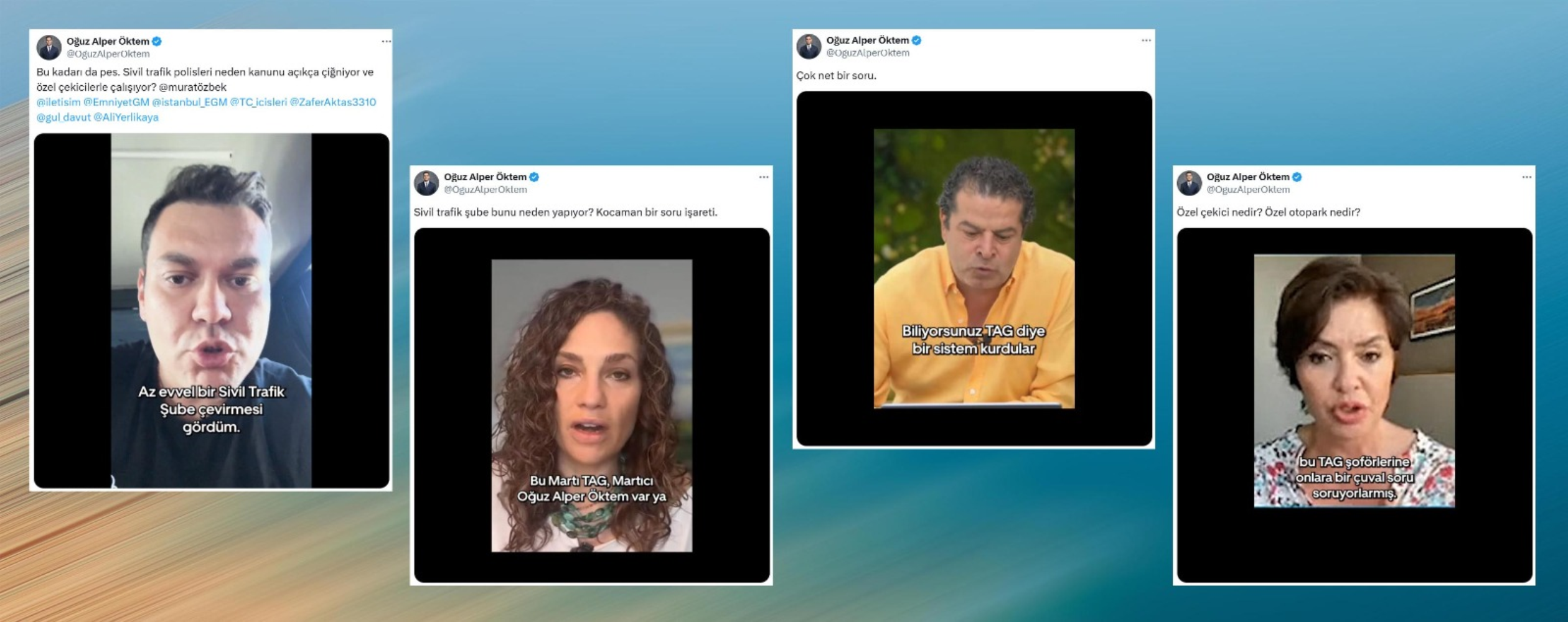
For some reason, after Öktem shared the video criticizing the private tow truck practice, journalists Özlem Gürses, Nevşin Mengü, and Cüneyt Özdemir also stepped in. They also shot videos criticizing the use of private tow trucks and supporting Öktem. All three videos were more or less similar in content; in all three, Öktem’s video was also shown, and praises were heaped upon him.
Interestingly, Öktem first shared the journalists' videos from his own account. It is clear that Öktem organized these videos; the journalists did not just happen to notice the private tow truck problem out of the blue!
There are no labels such as “sponsored,” “collaboration,” or “advertisement” in these posts, but they act as spokespeople for a commercial company; they provide promotional support. This is behavior contrary to journalistic professional principles.
If reporting were done, such a one-sided promotional video based only on Öktem’s words would not be shot; at the very least, the Traffic Law and the Highway Traffic Regulation would have been consulted.
Reader opinions
I had criticized the fire in the region between Diyarbakır and Mardin being called a “stubble fire” despite expert reports and witness statements. The pro-government media was not mentioning DEDAŞ’s responsibility and the sparks falling from the electric pole. But I must emphasize that, in order not to allow for misunderstanding, NTV, unlike them, reported all reports and statements and did not act one-sidedly.
Let me convey two reader opinions. Musician Şanar Yurdatapan said, “A terrible shame is going on at the Halk TV channel. Every 10 minutes, without any warning, it cuts the broadcast abruptly to enter commercials, and when it ends, it continues from where it left off just as abruptly.”
Yüksel Kenaroğlu also criticized that the fact that the incident took place in Germany was not mentioned in the headline “Collected from all markets: Harmful substance found in famous tea brand” by Halktvcom, ABC, Yeniçağ, and Yeni Akit, calling it an “example of ugly journalism.”
In one sentence:
• On the anniversary of the Madımak massacre, Yeni Akit continued to defend the convicted murderers with the sub-headline “Sivas oppressed have been rotting in dungeons for 31 years.”
• Türkgün used the drawing of Timur Soykan, one of the journalists it targeted as “Halk TV’s amateur detective,” regarding the Sinan Ateş case without permission and without citing the source.
• Ülkü Ocakları Deputy Chairman Burak Kılıç threatened Barış Terkoğlu, Alican Uludağ, Erk Acarer, İsmail Saymaz, and Timur Soykan, who are meticulously following the Sinan Ateş case.
• Following Hürriyet, Milliyet, and Ekonomi, Gazete Oksijen also interviewed the Vice President of Bvlgari and promoted the new hotel in Cennet Bay, but did not mention its damage to the environment.
• Çiğdem Günal, a “(Sports) News program presenter” from Tivibu, advertised a car brand for three days while going to Germany for Euro 2024 by sharing with the “collaboration” label.
• In the joint program of Habertürk and Bloomberg HT, Fevzi Çakır did not object to Treasury and Finance Minister Şimşek’s words “Minimum wage is not low in Turkey” and did not ask a question.
• Sabah began its news commemorating the July 15 coup attempt starting from July 1.
• In the news “Compensation for harassment in the hospital after 11 years,” Hürriyet hid the name of the private hospital that was sentenced to pay compensation.
FOR YOUR CRITICISMS, COMPLAINTS, AND SUGGESTIONS: [email protected]
Most Read

Striking picture for Özgür Özel's 'New Party'

The PKK opening and Özgür Özel’s path!..

How did the newspapers view Özgür Özel's farewell to the CHP?

He killed his wife by slitting her throat: Their children witnessed the moments

What did the CHP do?

Özel’s new party move in the world press

The New CHP, against CEHAPE

Fire at TUSAŞ engine factory in Eskişehir under control

From self-efficacy to despair

Kılıçdaroğlu's first message on Özgür Özel's new party announcement