



Sabah columnist Mahmut Övür, in his article titled “Two corruption cases and two approaches,” addressed the 400 million lira corruption operation at the Yunus Emre Institute.
He emphasized that the investigation was initiated by the General Directorate of Foundations and that the prosecutor's office took action following a criminal complaint on December 23, 2024, stating, “This corruption operation was the first flare for the codes of the new era.” Övür argued that this operation proved the inaccuracy of the “perception operation carried out by the CHP management and its journalists claiming that ‘the government only goes after CHP-run municipalities.’”
I wish Mahmut Övür had examined the journalism displayed during the investigation at the Yunus Emre Institute before accusing the opposition media of double standards by saying, “Those who go after corruption and those who hide it.” I wrote about this at the time. When İsmail Arı announced the tax inspectors' investigation in his report titled “Public foundation robbed with fake invoices,” published in BirGün on December 12, 2024, the pro-government media was silent.
İsmail Arı did not stop there; he reported on the corruption at the Institute one after another. He continued his series of reports on December 27 with “Fake invoice scandal grows: Minister's spouse and MHP figure's son resign” and on January 4 with “The scale of the robbery is millions of liras.” Other opposition media outlets also reported on this corruption for days.
The pro-government media, which ignored these reports, published small news items with an embarrassed demeanor once the Institute's executives were detained. In Mahmut Övür's newspaper, Sabah, the detentions were also just a tiny news item on the ninth page. If it had been about the CHP or other opposition parties, who knows how much they would have blown it out of proportion!
They also completely ignored the fact that one of the deputy presidents who resigned from the Institute was the spouse of the Minister of Family and Social Services, Mahinur Göktaş, and the other was the son of MHP Deputy Chairman Semih Yalçın. They already forgot about the investigation entirely afterward.
They even buried the news that the former president, Prof. Dr. Şeref Ateş, who learned he would be tried with a request for 7 years in prison after the indictment was prepared, had returned from abroad to surrender. In fact, Mahmut Övür's newspaper, Sabah, just tucked it in tiny next to his article on the subject a day later. It would have been shameful if they hadn't done at least that much…
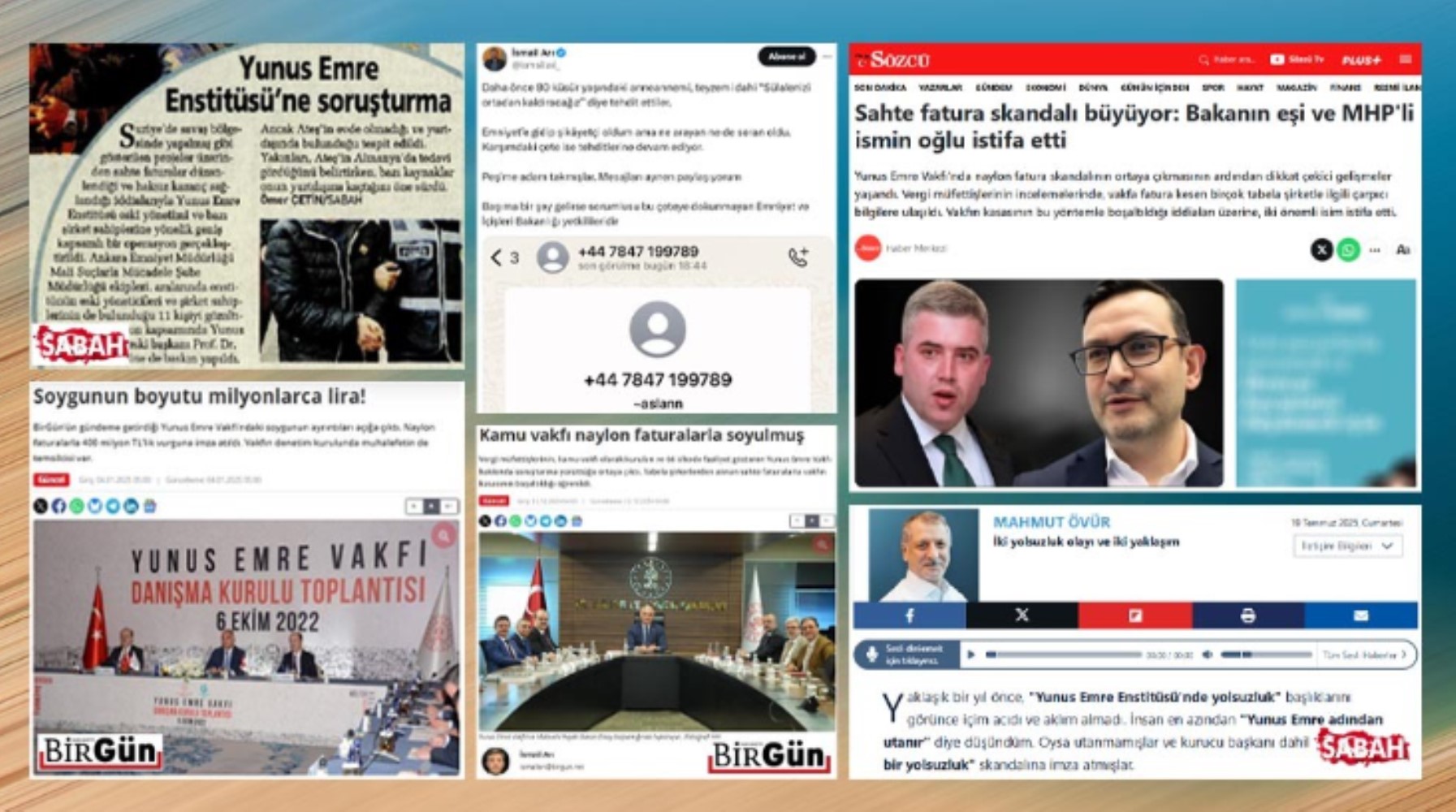
When you are in the ranks of the pro-government media like Mahmut Övür, journalism is more comfortable, and you can fire at will. That is certainly not the case for young journalist İsmail Arı, who does not let go of corruption stories like the one at the Yunus Emre Institute. A few days ago, he announced on social media that he had been threatened after his report on “Bribery in the judiciary.” He said, “I went to the police and filed a complaint, but no one called or asked. If something happens to me, the responsibility lies with the Police and the Ministry of Interior officials who do not touch this gang.”
When this incident became news, the police took a protection order for İsmail Arı, but the prosecutor's office has not taken any action regarding those who threatened him to this day. Of course, he continues to do critical journalism without paying attention to all this, tirelessly…
In the opposition media, however, journalism is a dangerous profession. There is the possibility of being kept in prison for 75 days like Furkan Karabay or 37 days like Fatih Altaylı without even an indictment being written for flimsy reasons like “insulting the President,” or being threatened like İsmail Arı…
Yeni Şafak’s “news” without subjects
In Yeni Şafak, in the report titled “Industrialists expect a strong interest rate cut” published before the Central Bank's interest rate decision, it was unclear who these industrialists were. The sentences ended with expressions such as “Industrialists… want,” “is expected,” and “it is stated that it is essential.”
There was also no subject in Yeni Şafak’s report titled “CHP is changing course for the commission”; the sentences ended with expressions such as “strengthened their evaluations” and “is giving signs.” At the end of the report, it was stated that “Intra-party opposition spokespersons reported,” trying to give the impression that information was obtained from someone while writing the report, but the names of the people they called “spokespersons” were unclear.
The common feature of both texts is that their subjects are not written, and their basic elements are missing. As such, even though they were published as if they were news, both gave the impression of a commentary reflecting the expectations of the newspaper management. Of course, a newspaper can publish opinions/evaluations/commentaries/editorials, etc., regarding economic and political developments. But they must clearly state that it is a commentary or whatever it is. Presenting the views and evaluations of the newspaper management as if they were news is an insult to journalism…
Journalism on the Dubai-Istanbul-Bodrum line
Hürriyet, Milliyet, and Ekonomim columnists engaged in covert advertising for a luxury hotel built by an Italian company in Bodrum last year; as if that were not enough, similar articles were repeated this year in Oksijen and Ekonomim.
I also criticized the articles from last year in my piece titled “The journalist's duty and corporate interests.” This is because the articles promoted the project of the company referred to as an “icon of luxury,” while ignoring the years-long struggle of the local people against the construction project in Cennet Koyu and the court decisions. Corporate interests were prioritized over the interests of the public.
Last year's promotional articles were based on meetings held in Dubai and Istanbul with Silvio Ursini, an executive of the partner Bvlgari. Journalists were hosted in Bodrum again this year.
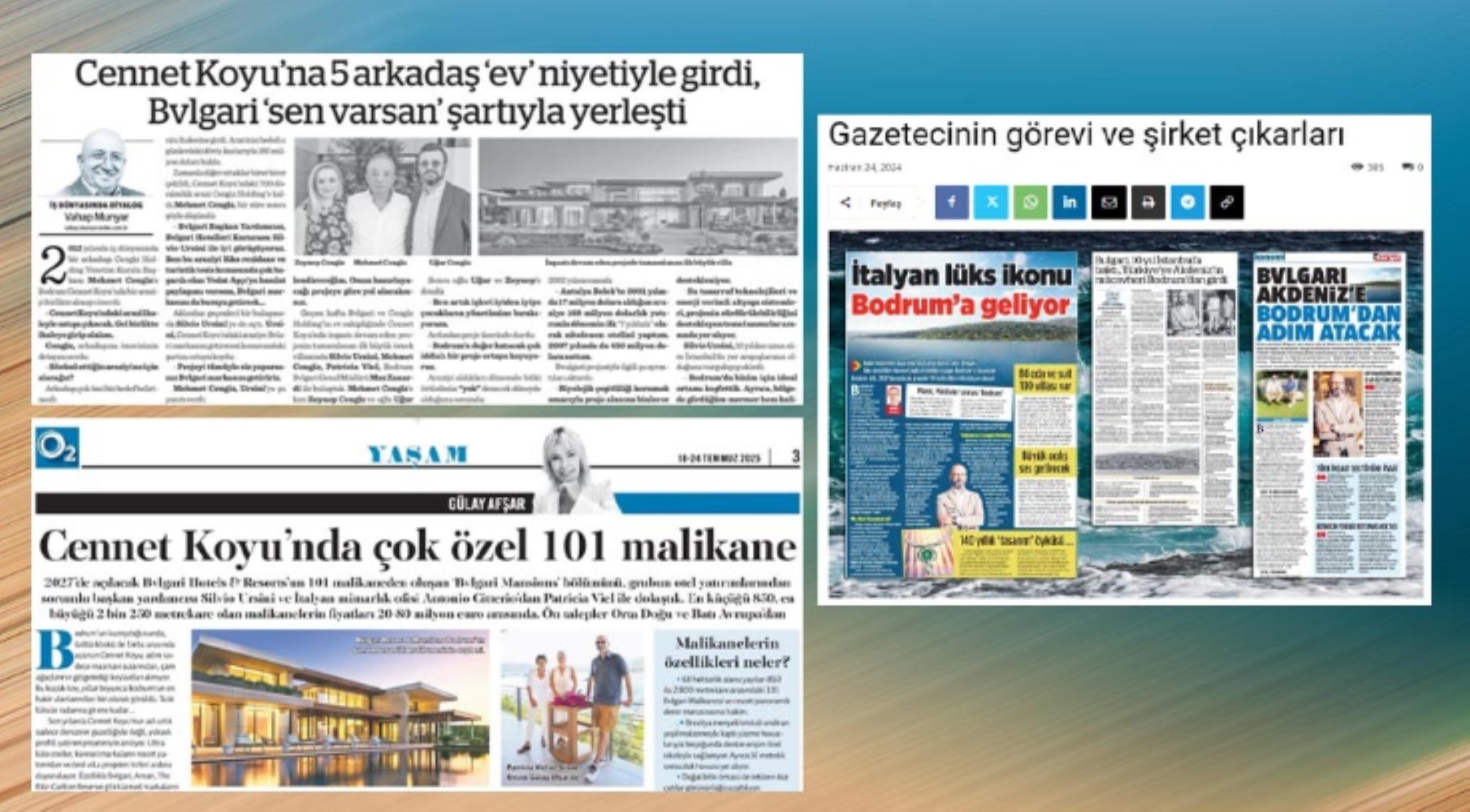
Vahap Munyar, who wrote a year ago, “Bulgari watched Istanbul for 10 years, entered Turkey from Bodrum, the jewel of the Mediterranean,” this time titled his article, “5 friends entered Cennet Koyu with the intention of ‘home,’ Bvlgari settled in on the condition of ‘If you are there.’” This time, his article is heavily focused on an interview with the other partner, Mehmet Cengiz. In Oksijen, Gülay Afşar wrote her article, “101 very special mansions in Cennet Koyu,” by talking to Silvio Ursini and architect Patricia Viel.
The common feature of both articles is that they again do not mention the property disputes regarding “Cennet Koyu” or the public's efforts to protect the bay at all. In fact, Gülay Afşar first defines Cennet Koyu as “one of the most pristine areas of Bodrum,” and then praises the burying of the bay in concrete by saying, “It is now being marketed as a new lifestyle.”
Again, corporate interests have been prioritized over the protection of nature and the efforts of the public. By setting aside the questioning and critical nature that is the foundation of journalism, journalism has been reduced to a tool for commercial interests.
Cumhuriyet’s contradictory BYD reports
Cumhuriyet published a report on its economy page on July 23 titled, “Chinese BYD shifts production to Turkey.” It was stated that the company had postponed its investment in Hungary, would bring forward production at the facility it would establish in Manisa, and that the factory would become operational in 2026.
A day later, on July 24, again in Cumhuriyet and again on the economy page, a report titled “BYD investment has turned into a riddle” was published. In this signed exclusive report, it was stated that no steps had been taken so far to establish the factory and that no team had been formed yet.
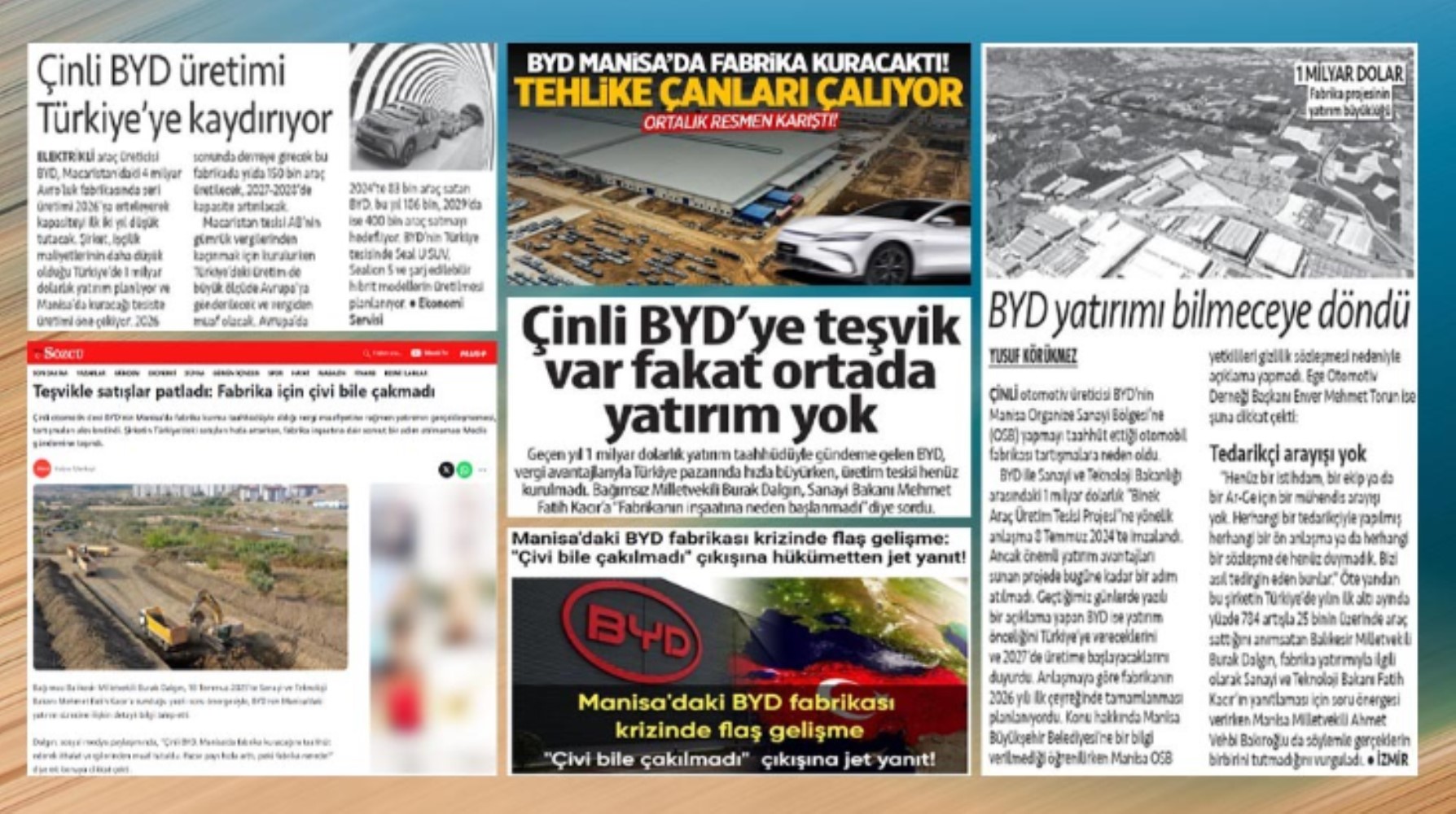
Now one must ask; which of these contradictory reports is true? Of course, the fact that there is no development toward the establishment of the factory. We actually know that from reports published in other media outlets days ago. Since the first days of this month, reports such as “Has BYD’s Manisa factory become a lie?” and “Sales exploded with incentives: Not even a nail was driven for the factory” have been published on various news sites, and Independent MP Burak Dalgın brought the issue to the Parliament's agenda with a parliamentary question.
While this information and these discussions are out there, it is wrong to report that production in Hungary will be shifted to Turkey without mentioning any of them. If there is such a development, it is even more wrong to say “It has turned into a riddle” the next day.
Both BYD reports should have included all previous developments on that subject, and the follow-up reports should not have contradicted each other. I suppose the Cumhuriyet reader is confused…
In a single sentence:
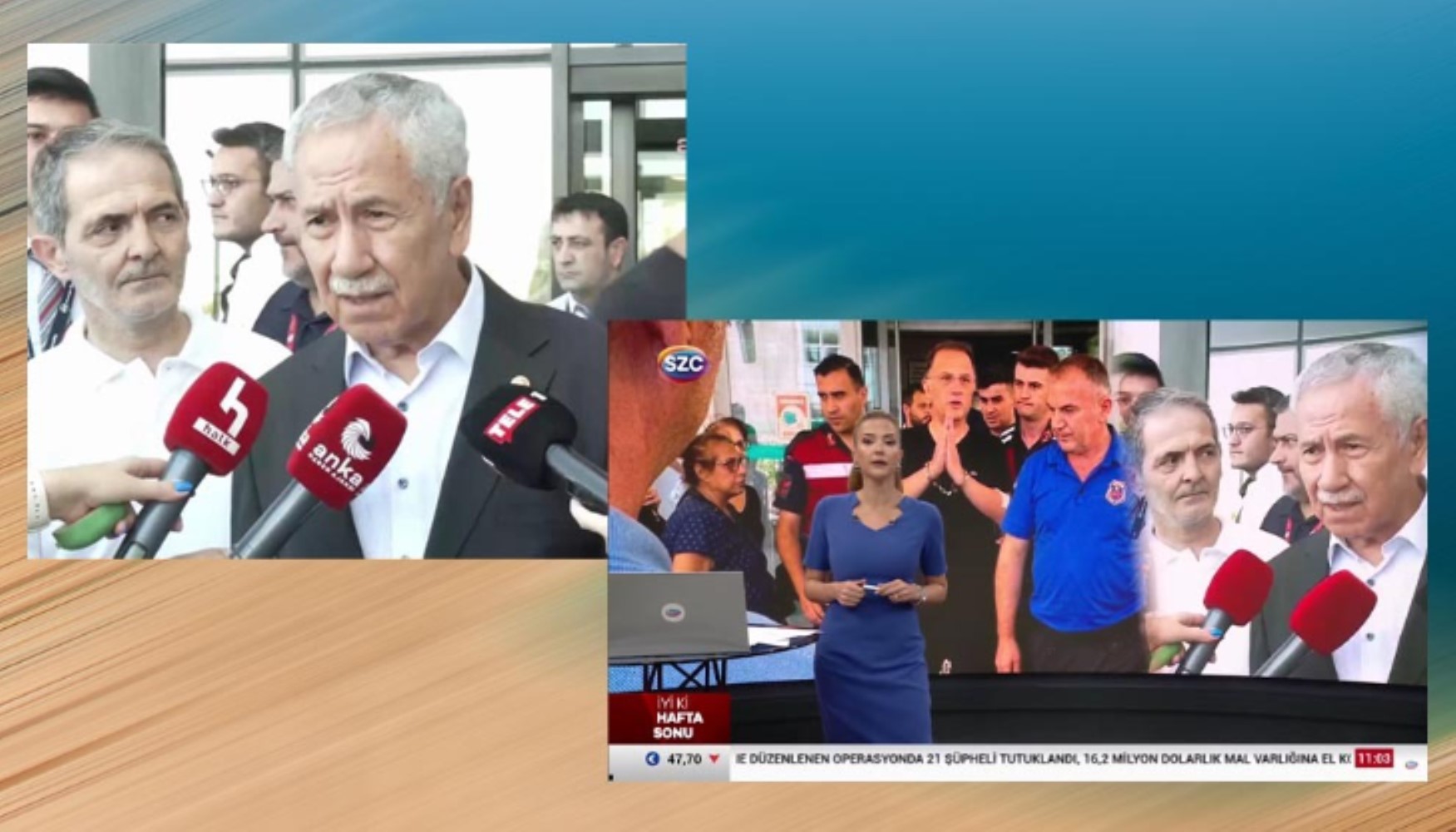
In the program of Simge Fıstıkoğlu on Sözcü TV, the Anka, Halk TV, and Tele1 writings on the microphones in front of Bülent Arınç, who visited Murat Çalık in the hospital, were erased, distorting the reality in the photo; it was shown as if the news organizations there did not exist.
- In the program on TV100, asking the sister of the murdered Ayşe Tokyaz questions such as “How did they meet?” and “What kind of person was Cemil Koç?” was wrong as it sensationalized the murder and would further victimize the victim.
- The pro-government media published the IDEF 2025 fair on their front pages but ignored the fact that companies supplying weapons to Israel were also participating in the fair and the protest attempts against these companies.
- CNN Türk claimed that an assassination attempt was made on SDF General Commander Mazlum Abdi, but did not correct its report after the denial.
- Reports by Bianet, Cumhuriyet, and 12Punto regarding KRT TV owner Fırat Bozfırat not paying employees' wages were blocked from access on the grounds of “national security and public order.”
- Journalists Gençağa Karafazlı and Şenol Öksüz, who wrote the news that Rize Provincial Director of National Education H. İbrahim Akmeşe had a private toilet and lounge built, were detained.
- Kemal Belgin wrote in the Türkiye newspaper that Hakan Çalhanoğlu was flirting with Fenerbahçe, but it had been finalized a day before that article that the footballer was staying at Inter.
- In Hürriyet, Yalçın Bayer showered the tour company whose press conference he attended with praise using sentences such as “...it succeeds not only in surviving for years, but also in growing, transforming, and becoming a leader” and “It actually instills a habit, not just sales.”
- Sözcü TV broadcast the footage of the Osmaneli forest fire in its “Gündem Masası” program accompanied by Cem Adrian's song, “A forest is burning somewhere in my heart / The songs you left behind are silent without an owner.”
- The text titled “The new address for gastronomy enthusiasts” in Yeni Şafak was a covert advertisement in the guise of news for a hotel in Mersin.
- Sözcü reported, “200 PKK terrorists released in 72 hours”; despite the Ministry of Justice announcing that only 15 releases took place in Diyarbakır in accordance with the Constitutional Court decision, it did not correct its report; it continued the “200 releases” reports.
- Hürriyet, from the Demirören Media Group, engaged in covert advertising by publishing a total of six reports this month about the Demirören Media and Technology Vocational and Technical Anatolian High School.
FOR YOUR CRITICISM, COMPLAINTS, AND SUGGESTIONS: [email protected]
Most Read

Striking picture for Özgür Özel's 'New Party'

The PKK opening and Özgür Özel’s path!..

How did the newspapers view Özgür Özel's farewell to the CHP?

He killed his wife by slitting her throat: Their children witnessed the moments

What did the CHP do?

Özel’s new party move in the world press

Fire at TUSAŞ engine factory in Eskişehir under control

The New CHP, against CEHAPE

From self-efficacy to despair

Kılıçdaroğlu's first message on Özgür Özel's new party announcement