



The President's chief advisors are in a race with each other on social media. They are constantly making posts and statements regarding political developments or comments coming from the opposition.
Mehmet Uçum, the name who posts the most among the chief advisors, is also the Deputy Chairman of the Presidential Legal Policies Board. It would be expected for the posts of such a high-profile figure to receive attention in the pro-government media.
However, on the contrary, the opposition media showed great interest in Uçum's Sunday article titled "Steps taken and expected new steps in the process of transition to a Turkey without terrorism," regarding the visit of members of parliament to İmralı to meet with Abdullah Öcalan on November 2. In fact, Cumhuriyet featured it for a second time the next day in its news story "CHP does not believe in the tension."
From the pro-government media, only the newspapers Bengütürk, CNN Türk, Hürriyet, Türkgün, and Türkiye reported on Uçum's article. Pro-government newspapers such as Akşam, Milliyet, Posta, Sabah, Türkiye, and Yeni Şafak preferred to report on Foreign Minister Hakan Fidan's words on the same subject.
Uçum's article on "judicial independence" on November 9 generally received less echo; it could only be reported in Anadolu Agency, BirGün, Habertürk, T24, and Turktime.
Uçum's article, which he penned for Anadolu Agency on November 16, suggesting that the amnesty issued after the Sheikh Said rebellion in 1928 be taken as an example for a "Turkey without terrorism," also failed to become news in the pro-government media. This article by Uçum was published on sites such as Bianet, Cumhuriyet, Evrensel, Gazete Pencere, Halk TV, Sol Haber, Kısa Dalga, Sözcü, Serbestiyet, Rudaw, and Ulusal Kanal. It was also included in the printed editions of the newspapers Aydınlık, BirGün, Cumhuriyet, Nefes, Korkusuz, and Sözcü. In fact, Sözcü published it on its front page with the headline "'Sheikh Said' visa came from the Palace."
In fact, this indifference of the pro-government media is not unique to Uçum. The post by Presidential Chief Advisor Ayhan Oğan, in which he said, "Saying 'do not go to İmralı' means wanting the transition process to a Turkey without terrorism to fail," was only published in Cumhuriyet, Gazete Pencere, Independent Turkish, Halktv, Odatv, Rudaw, Evrensel, Sözcü, and Yeni Yaşam.
Oktay Saral, one of the presidential chief advisors who previously insulted journalist Fatih Altaylı and former minister Namık Kemal Zeybek, most recently targeted comedian Hasan Can Kaya. Saral's post containing insults was published on the news sites BirGün, Cumhuriyet, Evrensel, Gazete Pencere, Gazete Oksijen, Halktv, 12 Punto, Haberler, Kısa Dalga, Korkusuz, Süper Haber, Sözcü, T24, TGRT Haber, Oda TV, and Yeniçağ. Again, it was primarily the opposition media that showed interest in Saral's post.
As can be seen, the pro-government media does not constantly keep the presidential chief advisors in the spotlight; it does not convey every one of their views and posts to the public. The opposition media, on the other hand, attaches more importance to the presidential chief advisors and considers it a duty to convey almost everything they say to the public.
This means that these individuals are not perceived as influential figures in the pro-government media, nor in the presidency and AKP politics; their influence in the political realm is limited to the opposition media attaching importance to their every post and reporting on them without fail.
WERE THE KOKOREÇ, KUMPIR, AND MUSSEL SELLERS GUILTY?
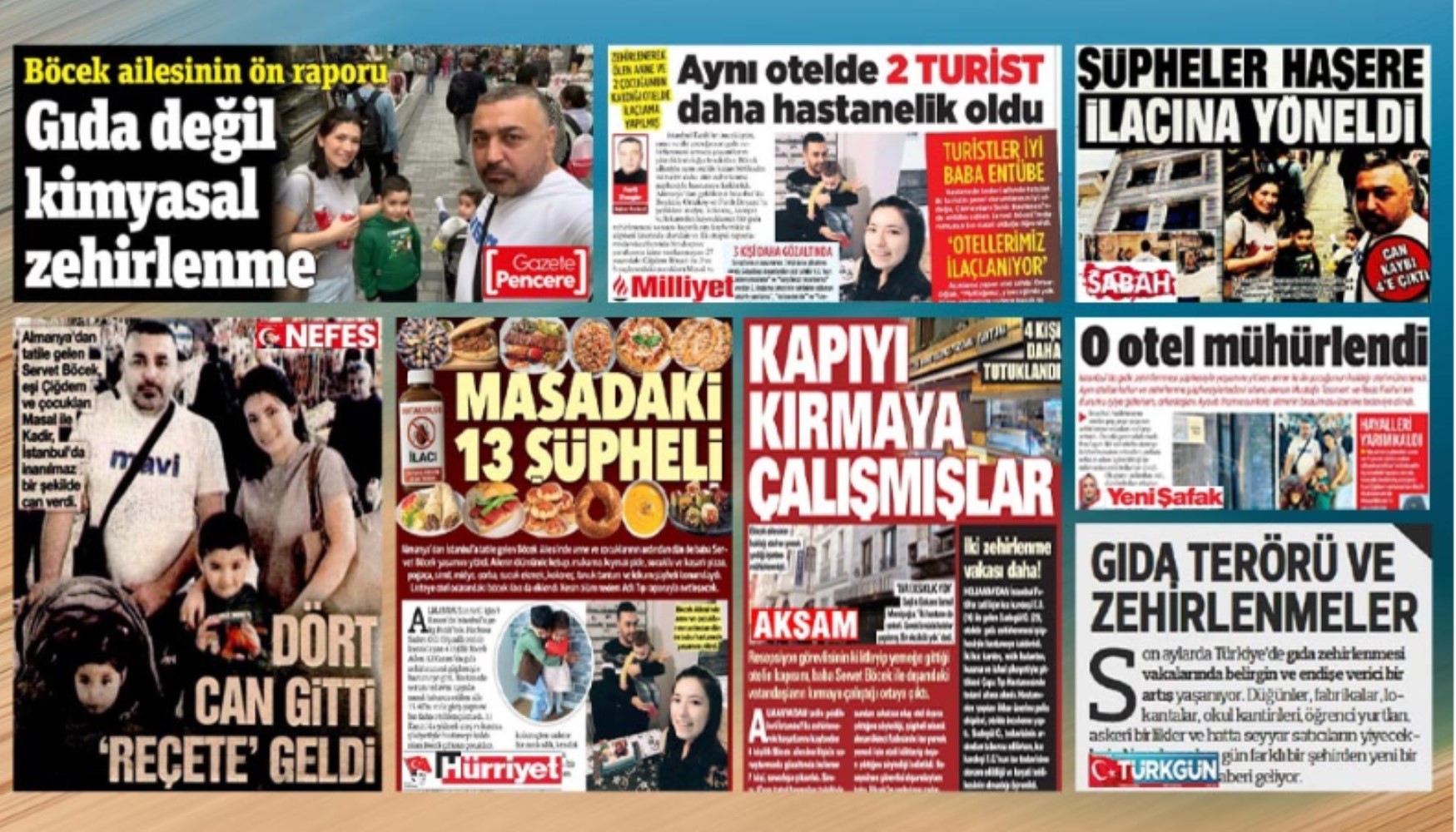
The media's rush to find a culprit also manifested itself after a family of four from Germany died from poisoning. A culprit was found in a flash; the kokoreç seller, the mussel seller, the kumpir seller...
Once the culprit was found, television channels, news sites, and newspapers began targeting the food and beverage venues in Ortaköy, Istanbul, where the family had eaten mussels, kokoreç, Turkish delight, and kumpir, without delay starting from November 14. The police followed the media and immediately detained those vendors. The media also supported these detentions by explaining that the mussel seller, kokoreç seller, and kumpir seller had "criminal records."
However, forensic medicine experts like Prof. Dr. Halis Dokgöz were saying that food poisoning would be mass-scale. That day, no one else who ate kokoreç, mussels, Turkish delight, or kumpir from the same place was poisoned.
The media did not care about this either. Within two days, the media had thoroughly latched onto "food poisoning"; doctors, dietitians, and experts continued to explain on all screens and sites how this family could have been poisoned by kokoreç or mussels. The media neither questioned the family being sent back to the hotel from the two hospitals they visited, nor the inadequate medical intervention, nor did it go to the Harbour Suites Old City Hotel to investigate what happened there.
All of Turkey was on the verge of becoming experts on food poisoning and food hygiene when it was announced on November 16 that two more tourists staying at the same hotel had been poisoned.
However, it took days for the media to put aside the food poisoning option and turn to the fumigation at the hotel. The media, which wrote that "the hotel was sealed" on November 17, focused entirely on the hotel on November 18 with headlines such as "Aluminum phosphide leaked from the bathroom" (Akşam), "'Aluminum phosphide' possibility in poisoning suspicion in Fatih" (Gazete Pencere), "New suspect aluminum phosphide" (Nefes), and "Suspicions turned to pesticide" (Sabah).
Indeed, in the evening hours, the preliminary report of the Forensic Medicine Institute emerged. The preliminary report stated that the family might have been "affected by chemical substance poisoning" at the hotel and that "the possibility of food poisoning was low."
But in the meantime, it was too late for the kokoreç seller, mussel seller, Turkish delight seller, and cafe operator; they had already been arrested. The reason was "suspicion"! It would not be wrong to say that the news in the media triggered this suspicion. They had fallen victim to the "media court" that made decisions in a flash.
Another mistake of the media was that, despite it becoming clear that the deaths were caused by the fumigation at the hotel, the name of the hotel was not given in the days after November 17. The media, which published criminal records when it came to the kokoreç seller, kumpir seller, and mussel seller, avoided writing or saying the name of the hotel. In fact, on November 20, most of the news reports about the poisoned family having difficulty leaving the hotel because the door was locked, and the arrest of the hotel and fumigation company employees, did not contain the name of the hotel.
Not writing where the news took place in such negative developments, especially to protect commercial businesses, is a disease that has recently settled well into the media. Just think, in the news "Hidden camera scandal at a college in Adana" in Cumhuriyet on November 18, the name of the private college was not mentioned! Can there be news with a hidden subject and an uncertain addressee? Our media invented it, and now it happens.
THE VERDICT OF THE PRESS COUNCIL
Kastamonu University Faculty of Communication Dean Prof. Dr. Muharrem Çetin complained to the Press Council about the 12 Punto news site's report "Copy-paste academy: Dean's theses turned out to be stolen" and demanded that the text of the rebuttal be published exactly as is.
The High Board of the Press Council, taking into account that Çetin's rebuttal was published as a link, decided that there was no ethical violation and that the "complaint was groundless." There is no problem up to this point.
However, the sentence in the decision, "The application made by the complainant to the person serving under the title of media ombudsman has no validity for the Press Council," was noteworthy. I found it strange that they defined me as "the person serving under the title of media ombudsman" instead of writing my name.
One of the media organizations I cooperate with as a "Media Ombudsman" is 12 Punto.com.tr. Prof. Dr. Çetin first applied to me regarding this news, which is based on a report submitted to the rectorate and alleges that "Çetin did not cite sources and committed plagiarism in his master's and doctoral theses." After examining it, I suggested some changes to the news, and they were corrected. I also suggested that Çetin's response text be published, and it was published as a separate news item—not by providing a link as incorrectly stated in the Press Council decision.
Under these circumstances, emphasizing that the application made to me without naming me "has no validity" is a condescending attitude lacking a sense of professional solidarity, as well as ignoring my efforts that ensured the resolution of the problem.
Of course, my decisions and ethical warnings regarding the purification of journalism from errors may not be binding for the Press Council. However, they should have had validity; because our common denominator is a valuable goal such as increasing the quality of journalism...
WHY DOES HALK TV PARTICIPATE IN THE POLICE'S PUBLIC SHAMING?
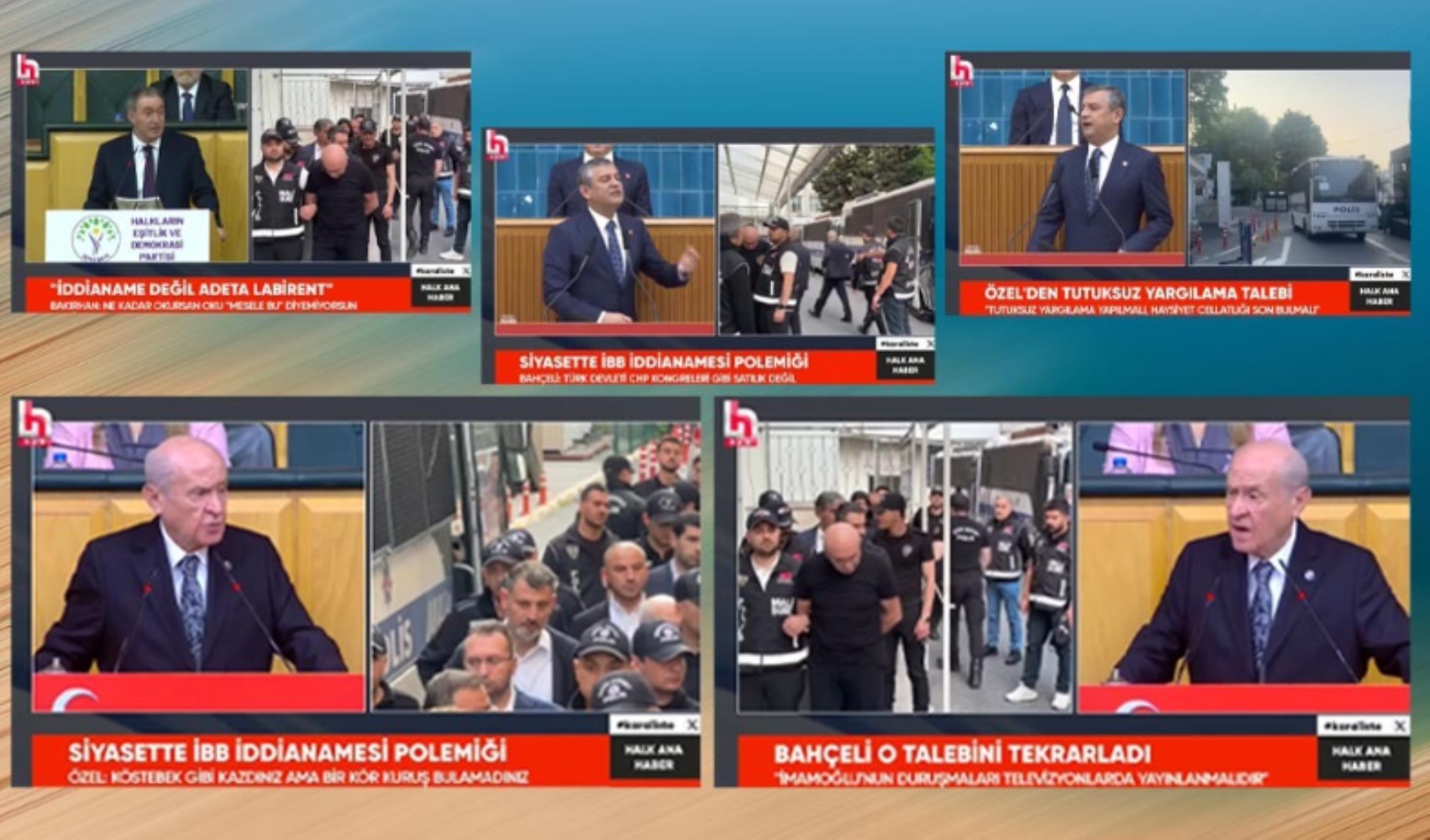
MHP Chairman Devlet Bahçeli's repetition of his call for the hearings where Ekrem İmamoğlu will be tried to be broadcast live on TRT also found an echo in Halk TV news.
On the evening of November 18, while those words of Bahçeli were being broadcast in the news bulletin presented by Ece Üner, "Bahçeli repeated that demand" was written at the bottom of the screen. At the same time, the screen was split in two; first, images of the entrance gate of the TRT campus in Oran were shown, and then images of the detained CHP members being walked by police holding their arms were played.
I do not know what kind of necessity there is in terms of journalism to see the TRT gate while Bahçeli is speaking; I also do not think that those watching Bahçeli are curious about that gate.
But what is truly grave was the bringing to the screen of images where the police "publicly shame" people who have been detained but have no conviction against them, as if they were criminals. Scenes were being broadcast where the police were holding people by their arms and walking them in front of the camera.
Moreover, these images were not broadcast only while reporting Bahçeli's words about live broadcasting from TRT. They were also played over and over again during the İmamoğlu indictment section of the bulletin, and during the speeches of Bahçeli, Özgür Özel, and Tuncer Bakırhan.
In terms of journalism, broadcasting these images in this way can have no benefit other than creating movement on the screen. Repeatedly playing these images has two consequences; it stuns the viewer and violates people's right to innocence by supporting the police's public shaming!
Of course, Halk TV is not the only one making this mistake; these images are also being repeated in opposition media outlets as well as the pro-government media. I wrote about this issue based on what I saw on Halk TV because it caught my attention there.
While criticisms that the police have no right to "publicly shame" people in this way and label them as criminals have been voiced many times on Halk TV and other opposition screens, bringing these images to the screen regardless of relevance is a big mistake...
In one sentence:
Sözcü conducted a full-page interview about Sedat Peker and mafia-like structures and presented him as an "opinion leader" without writing about his past record regarding being a "criminal organization leader."
In the "Automobile" page of Cumhuriyet, in the article "Winter tire time," the tires of a tire brand were promoted under the guise of informing readers.
Akşam, Türkiye, and Yeni Şafak also joined the campaign for the reopening of the gold mine that was closed after the accident that led to the death of nine people in İliç, Erzincan.
The photograph included in the Türkiye newspaper's news story "Here is the İmralı program," which some news sites also used, is not of İmralı island, but of Yassıada, and even an old version of it.
Akşam published a full-page promotion of the AKP-run Haliliye (Şanlıurfa) Municipality under the guise of news without putting a "This is an advertisement" warning.
Yeni Şafak gave a new example of "boss journalism" in its news story "Conakry Port in Guinea is growing with Albayrak."
Upon a request regarding a news story about Ekrem İmamoğlu's diploma, access to the entire Medyaradar site was blocked for 6 days; then the site was reopened by saying it was "by mistake."
FOR YOUR CRITICISMS, COMPLAINTS, AND SUGGESTIONS: [email protected]
Most Read

Striking picture for Özgür Özel's 'New Party'

The PKK opening and Özgür Özel’s path!..

How did the newspapers view Özgür Özel's farewell to the CHP?

He killed his wife by slitting her throat: Their children witnessed the moments

What did the CHP do?

Özel’s new party move in the world press

The New CHP, against CEHAPE

Fire at TUSAŞ engine factory in Eskişehir under control

From self-efficacy to despair

Kılıçdaroğlu's first message on Özgür Özel's new party announcement