



I think being praised in the media has become a daily requirement for the MİT (National Intelligence Organization). Almost every day, the pro-government media is filled with hymns of praise for operations announced through unofficial "briefings" from the MİT. Interior Minister Ali Yerlikaya also takes care not to fall behind the MİT, personally announcing the police's operations, both large and small, and even certain traffic accidents, in his capacity as minister.
The MİT and the Police made headlines together on January 3; "Operation against MOSSAD cell" (Akşam), "Manhunt for MOSSAD mole" (Milliyet), "Assassination response to MOSSAD" (Yeni Şafak), "MOSSAD agents captured" (Hürriyet), "MİT captures 34 Israeli spies" (Sabah), "Israeli spies packaged" (Türkiye).
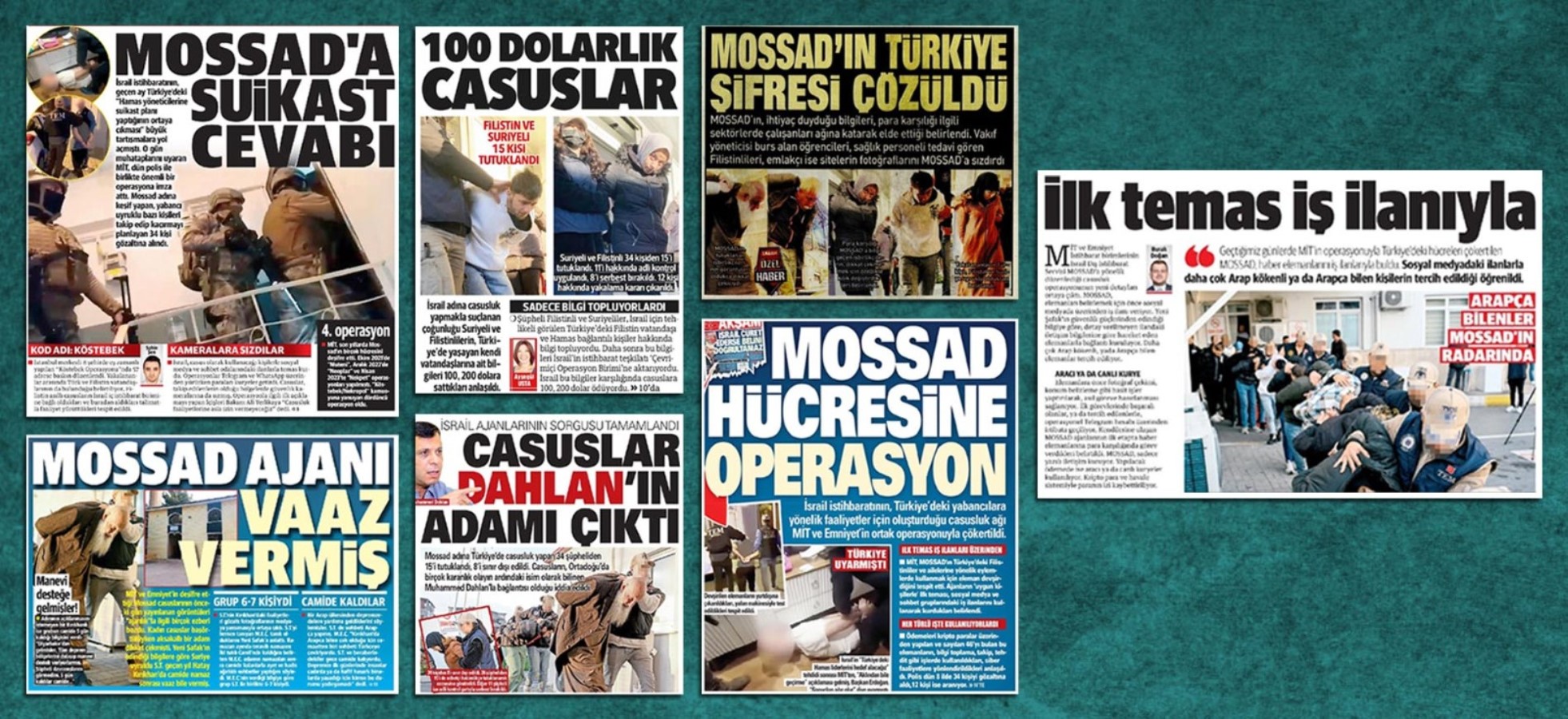
The news of the operation continued for days. However, as the statements and photographs of the "Israeli spies" began to emerge, it was understood that those captured were quite different from the usual "Agent" archetypes. There were veiled women and long-bearded men among them.
First, Yeni Şafak's report that "MOSSAD agent gave a sermon," and then Hürriyet's report on "100-dollar spies" ruined the flair of the grand operation. Those announced with great fanfare as "agents" and "spies" were actually asylum seekers who provided information to Israeli intelligence for 100-200 dollars.
Indeed, of the 34 people detained, only 15 were arrested. Days later, Yeni Şafak completely deflated the operation's atmosphere with its report, "First contact through job postings." In this report on January 14, those captured were described as "informants."
However, an agent and an informant are very different. An agent is intelligence organization personnel, while an "informant" is merely a person from whom information is obtained; therefore, all the "agent" or "spy" news written until that day went to waste. The pro-government media did not even feel the need to clearly correct the error.
This is what happens when operation news, provided even by hiding the source, is not passed through an editorial filter and is published in an inflated manner without being checked. This is not journalism, but serving as a soldier for disinformation.
NEWS OF MARTYRS AND BLINDNESS IN THE MEDIA
Following the news of the deaths of young soldiers, the statements coming from the top of the state never change; every time, the honor of martyrdom is spoken of at length, it is said that their blood will not remain on the ground; then the ceremonies are concluded by saying, "We buried them in our hearts." Within a few days, all these words are forgotten, until the next news of martyrs arrives...
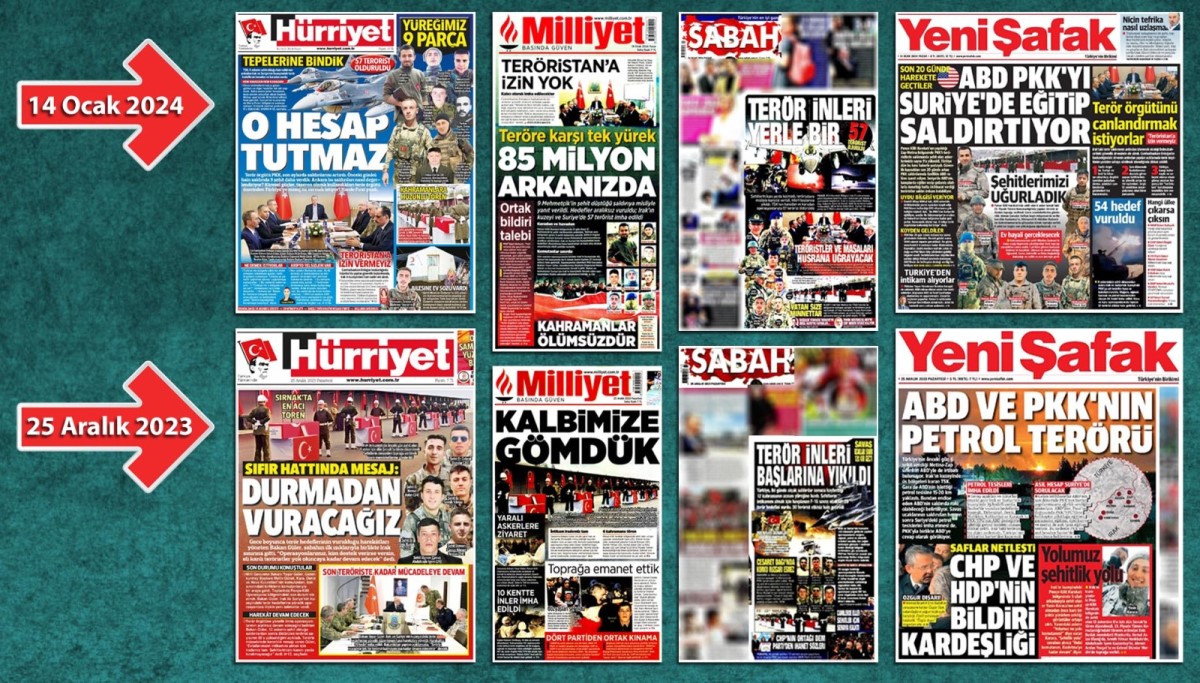
The mainstream media is the same; the approach is always the same. So much so that the headlines regarding the martyrdom of 12 soldiers on December 25 and the headlines in the news about the martyrdom of nine soldiers on January 14 are almost identical. These headlines from two different dates, which I selected from four newspapers, show the stereotypical approach in the mainstream media very well:
Sabah: Terror dens destroyed over their heads (December 25) Terror dens razed to the ground (January 14)
Hürriyet: We will strike without stopping (December 25) We descended upon them (January 14)
Milliyet: We buried them in our hearts (December 25) One heart against terror (January 14)
Yeni Şafak: US and PKK's oil terror (December 25) US trains and attacks with PKK in Syria (January 14)
I am sure that if I go back a little further and compare older headlines, a different result will not emerge. Our mainstream media has trivialized this burning issue of the country.
In the media, there is no approach different from that of the political power and the statements and remarks of the security units. There is no focus on how the PKK could attack the same hills twice in 20 days and kill 21 soldiers. News expressing military errors, such as Cumhuriyet's headline "Strategic error makes us a target," is not encountered in the mainstream media.
Far from criticizing, some pro-government writers who have lost their ability to criticize, such as Hürriyet columnist Fuat Bol, accused those who questioned the military weakness in these attacks and those who displayed a critical approach by saying, "The real terrorists are inside," and branded them as "terrorists."
Following the death of nine soldiers, "Heroism literature" was also brought back to the counter. The Türkiye newspaper reported the soldiers' deaths with the headline "They could not lower the Turkish flag." TV programmer Hakan Ural joined the chorus on Haber Global, saying, "We uprooted and threw these out of our lands, brother. Whether they cry, scream, or shout, they were uprooted and thrown out." Yet, he himself was someone who had been sentenced to prison for obtaining a "fake medical exemption report" to avoid military service.
In such an environment, it was proper journalism for Fulya Öztürk from CNN Türk to go to the border region and try to convey the conditions of the soldiers. But Fulya Öztürk preferred to talk about herself and her experiences there rather than the conditions. She responded to the accusations of "exposing the military" that came to her words "A team went out to the field" on the broadcast not with professional codes but by personalizing it. She said, "I think of my soldier more than I think of myself. Let it come to me, not to them." She also wrote on social media, "...up until now, I have heard nothing but satisfaction from the soldiers and commanders." She limited her function to "pleasing the commanders," and she was proud of this.
One of the remarkable articles questioning the military and political errors in the deaths of the soldiers was İsmail Saymaz's "Why did we give 22 martyrs in three months," and the other was Haldun Solmaztürk's article in Gazete Pencere titled "They don't know! They don't learn! They can't manage!" Saymaz lists the PKK's attacks in the "Operation Claw-Lock" region and asks questions. Solmaztürk also criticizes the security management and the political stance followed by giving examples, saying, "None of this is normal, it is not fate, nor is it inevitable."
The mainstream media, which still does not want to understand that the problem has long since exceeded the dimension of terror and cannot be solved solely by military methods, is at least as responsible as the politicians who make bombastic speeches for young people dying in groups of three or five. The laments of the politicians who say "Their blood did not remain on the ground" are fake, as are the headlines of the media that say "We buried them in our hearts." Their eyes are blind, their consciences are deaf...
RTÜK'S CARELESS DOCUMENTARIES
RTÜK (Radio and Television Supreme Council) is as sloppy and careless in the documentaries it has broadcast as it is in its commonplace behavior of imposing censorship and bans on television stations.
"Turkey's natural beauties," which RTÜK had broadcast on FOX TV in place of the series "Kızıl Goncalar," for which it had issued a broadcast suspension penalty, was a documentary shot in a hurry with little effort in a short time. Thanks to drone technology, just fly it in the air and write something over the footage!
The other documentary broadcast in place of "Kızıl Goncalar," "Media literacy," was also not based on long-term research. Except for Prof. Dr. Nurdan Taşkıran, whose views were sought, the names journalist Cengiz Semercioğlu, editor Bünyamin Yılmaz, director and screenwriter Mesut Uçakan were people who did not have studies on "media literacy."
Already, Cengiz Semercioğlu was explaining that he had been a journalist for 35 years and that "digitalization has led to a dizzying change in the media"; Bünyamin Yılmaz was talking about "the media changing its shell" and that "everyone is now a media organization." In the final section, it was emphasized that "media literacy" is about being able to think critically and ask the right questions; the documentary concluded with the sentence, "The media literacy course added to the curriculum by the Ministry of National Education in cooperation with RTÜK needs to become widespread."
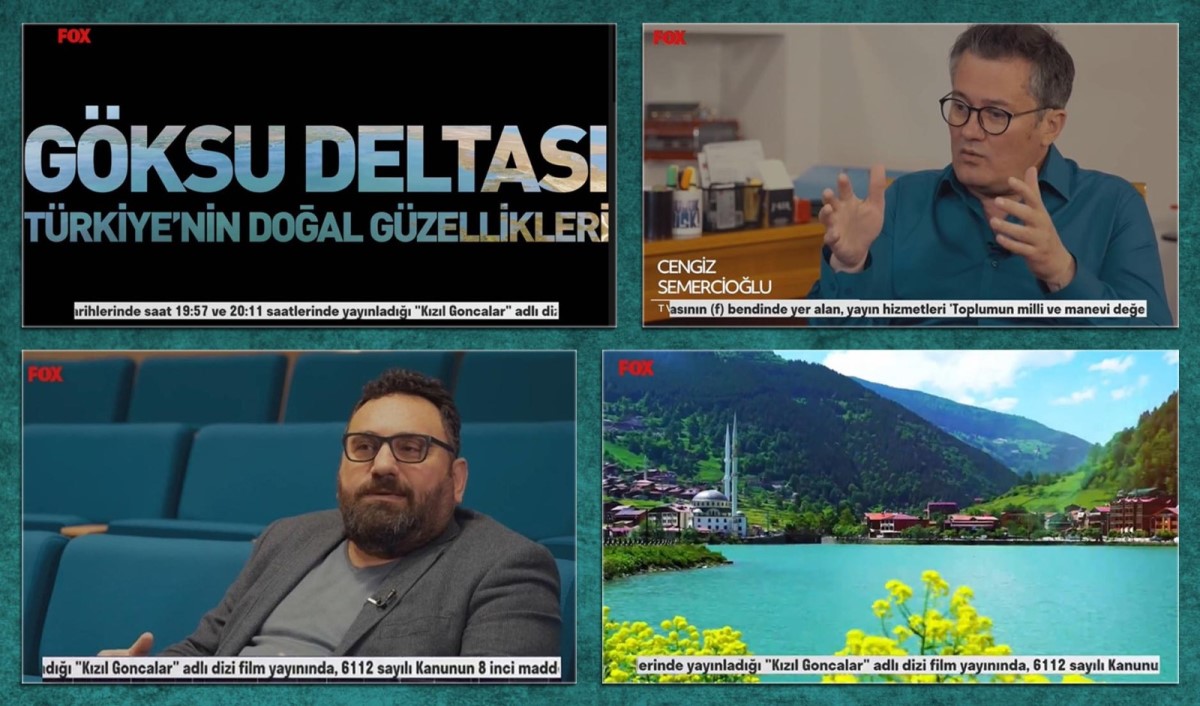
The documentary was also technically inadequate. The scrolling subtitle covered the "expert" titles. Moreover, the credits containing the name of the company and the team that prepared it did not appear on the screen at the end of the documentary. Therefore, we do not even know the identity of the people RTÜK paid. If we knew the company, we would have been able to learn who is being paid with such ordinary, careless work...
In a single sentence:
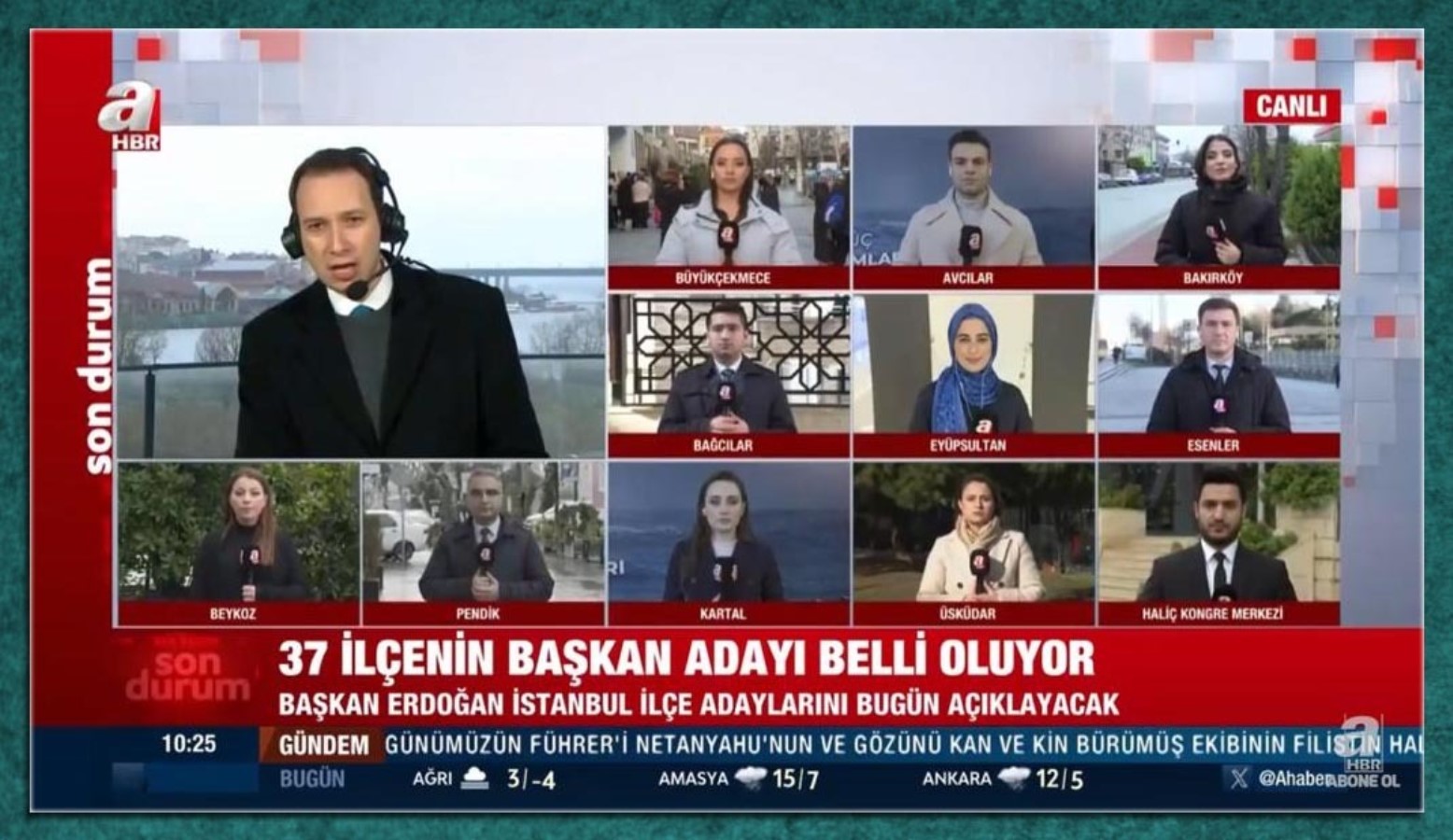
- Before announcing the AKP's Istanbul district candidates, A Haber sent 11 reporters and cameramen to 11 different districts and made live connections in a special broadcast.
- It was a deficiency that it was not stated that the "83 percent occupancy in intensive care" headline in Akşam and Hürriyet was the rate in Istanbul; it gave the impression that it was the rate across Turkey.
- 24 TV Presidential reporter Yağmur Yıldız, who is worried on behalf of the AKP, accused those who congratulated the candidates on social media before President Erdoğan announced them of "disrespecting the effort spent for the candidate introduction meeting," "overshadowing the excitement," and "stealing the spotlight."
- Hande Fırat from Hürriyet also contributed to the promotion of AKP's İzmir candidate Hamza Dağ by sharing his candidacy video, along with her "Best wishes" message on social media.
- In the news about three workers burning to death in a container, which was reported by AA, DHA, and İHA and used by Akşam, Cumhuriyet, Gazete Pencere, Karar, Milliyet, Sözcü, and Sabah, the information that the name of the factory in Sultanbeyli was "Tube Çelik Yapı" was left out.
- Korkusuz reported Faik Erdemli's article from Cumhuriyet titled "Coat for the price of an Audi A3" with the headline "Which brave heart bought the 1.3 million coat," and Takvim with the headline "Money coat," but did not cite the source.
- The throwing of water bottles and a smoke bomb onto the field during the Denizlispor-Amedspor match, and the match being stopped from time to time due to tension in the stands, could not become news in the mainstream media.
- In its report "Terrorist's cousin is propaganda chief in CHP," the Türkiye newspaper showed a person who was given a new duty in the CHP as being related to crime solely because of their kinship.
- Akşam published the promotional page of Gaziantep Metropolitan Municipality titled "Gaziantep takes care of the family" without putting a "This is an advertisement" warning.
- Following the operation against the Büyükçekmece Municipality in Istanbul, A Haber Reporter Ahmet Nazif Vural, who was broadcasting in front of the municipality, was attacked and kicked on the ground.
- Yeni Akit columnist Ali İhsan Karahasanoğlu, who justified the Somali President's son getting away with a light sentence for causing the death of Y. Emre Göçer, described the headlines "Is the price of a death 27,000 TL?" as "spoiling the relations between Somalia and Turkey."
- Contrary to what was written in most news, President Erdoğan did not call İyi Party Chairman Meral Akşener, but had answered Akşener's phone call.
- Yeni Akit distorted the debate arising from the chanting of "Long live Sharia" slogans in the courthouse corridors in its report "Secular bigots were disturbed by the Takbir."
- Rahmi Turan used his column in the Sözcü newspaper as a platform for his complaint regarding a personal problem he experienced with a cargo company.
- Akşam's headline "Semih's email turned out to be fake" was wrong; that email Semih Kaya submitted to the court was not Semih Kaya's email, but Seçil Erzan's; she had arranged it.
- Although the budget deficit reached a record level of 842.5 billion TL in December, Yeni Şafak converted the November data into dollars and wrote, "Current account deficit decreased by 10.7 billion dollars in 6 months."
FOR YOUR CRITICISM, COMPLAINTS, AND SUGGESTIONS: [email protected]
Most Read

Striking picture for Özgür Özel's 'New Party'

The PKK opening and Özgür Özel’s path!..

How did the newspapers view Özgür Özel's farewell to the CHP?

He killed his wife by slitting her throat: Their children witnessed the moments

What did the CHP do?

Özel’s new party move in the world press

The New CHP, against CEHAPE

Fire at TUSAŞ engine factory in Eskişehir under control

From self-efficacy to despair

Kılıçdaroğlu's first message on Özgür Özel's new party announcement