



NTV’s report on the fire in the rural area between Diyarbakır and Mardin, which led to the deaths of 15 people, news was self-contradictory, with sentences clashing with one another.
The introduction of the report stated, “...an expert report regarding the fire has been prepared. The report stated that the fire originated from an electricity pole,” but the report continued as follows:
“Investigations continue regarding the stubble fires that turned into a disaster in Diyarbakır and Mardin. The cause of the fire has been determined. A three-person expert committee consisting of electrical, mapping, and agricultural engineers prepared the report on the fire.
The report stated that it was determined that a conductive wire had been wrapped around the fuse of the insured disconnector pole instead of a fuse. It was stated that the fire started as a result of the conductive wire snapping and igniting the grass on the ground. However, the Chief Public Prosecutor's Office found the report insufficient and requested a more detailed interim report.”
If you trust this report and are relaying it to the audience, what is the point of still calling it a “stubble fire”? You cannot both provide the information that “the fire originated from electricity poles” and label it a “stubble fire.”
Furthermore, when NTV’s report was published, four days had passed since the fire on June 20. After the initial report, witness statements, the fire department report, and even footage of sparks falling from the electricity pole had emerged. DEDAŞ was also defending itself with satellite imagery.
In such a situation, what a journalist should have done was to investigate carefully and reveal DEDAŞ’s responsibility or the delay in intervention, if any. If a definitive conclusion could not be reached, at the very least, they should have included the statements and accusations of both sides.
In fact, opposition media had been publishing data suggesting it might not be a “stubble fire” since the second day. Despite this, most of the mainstream media, primarily Anadolu Agency , continued to define it as a “stubble fire”—like NTV—even days later.
The reason was that they had relied from the very first moment on the statements from Interior Minister Ali Yerlikaya, the Diyarbakır Governor’s Office, and DEDAŞ that the fire was “caused by stubble burning.” A few days later, President Erdoğan also declared the verdict from the highest level by calling it a “stubble fire.” Reporting solely based on official statements is the death of journalistic reflex. 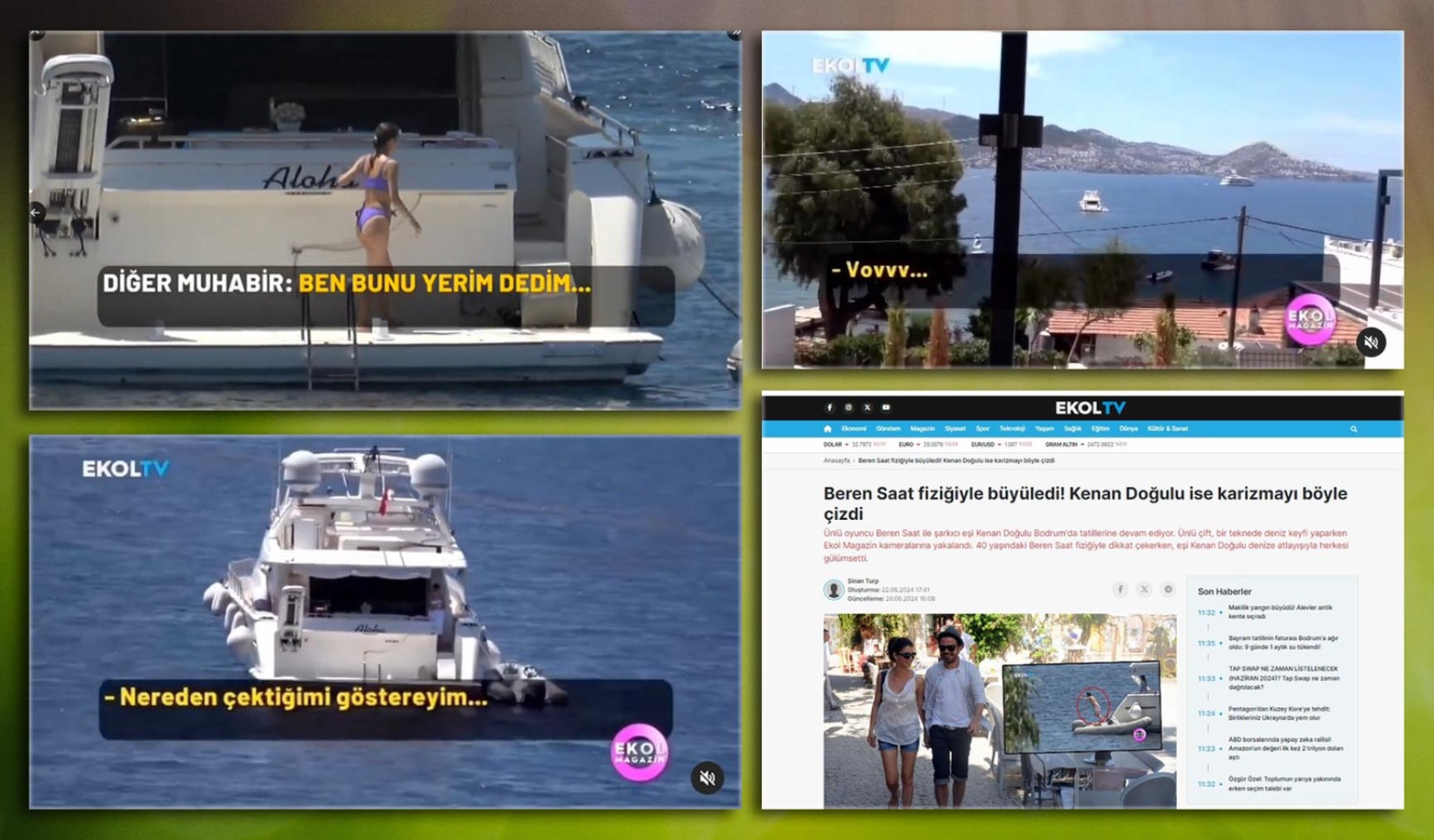
IS IT HARD TO APOLOGIZE?
It was shameful for journalism that a reporter who secretly filmed actress Beren Saat from a distance while she was entering the sea said, “I could eat this Beren,” and that this was broadcast on television.
Unfortunately, Ekol TV did not apologize in their statement, which said, “The sentences used by a reporter from another channel who filmed the same footage went unnoticed, and an investigation has been launched.” They did not even delete the news titled “Beren Saat dazzled with her physique, while Kenan Doğulu lost his charisma.”
Ekol TV reporter Uğur Kotan defended himself by saying, “I am watching with astonishment the relevant institution and its reporter, who have been playing dead despite me being subjected to so many unfair insults for two days.”
It is understandable that Kotan did not name that reporter, but that tabloid reporter should have apologized, and the TV channel they work for should not have defended them and should have taken a stance against this inappropriate behavior.
The only problem in this case is not just the reporter saying those inappropriate words. Tabloid reporters might see it as normal, but filming Beren Saat, who was entering the sea from a boat far from the shore, assuming no one could see her, is a violation of privacy.
Even if she is a famous artist, we cannot defend the use of telephoto lenses to film Beren Saat while she is entering the sea in a place she thought was away from prying eyes, rather than in a public space like a beach, under the guise of freedom of the press.
A sad aspect of this incident is that those images, which involve the objectification of the female body and, as Hadise said, “harassment of a woman,” are still live on dozens of news sites...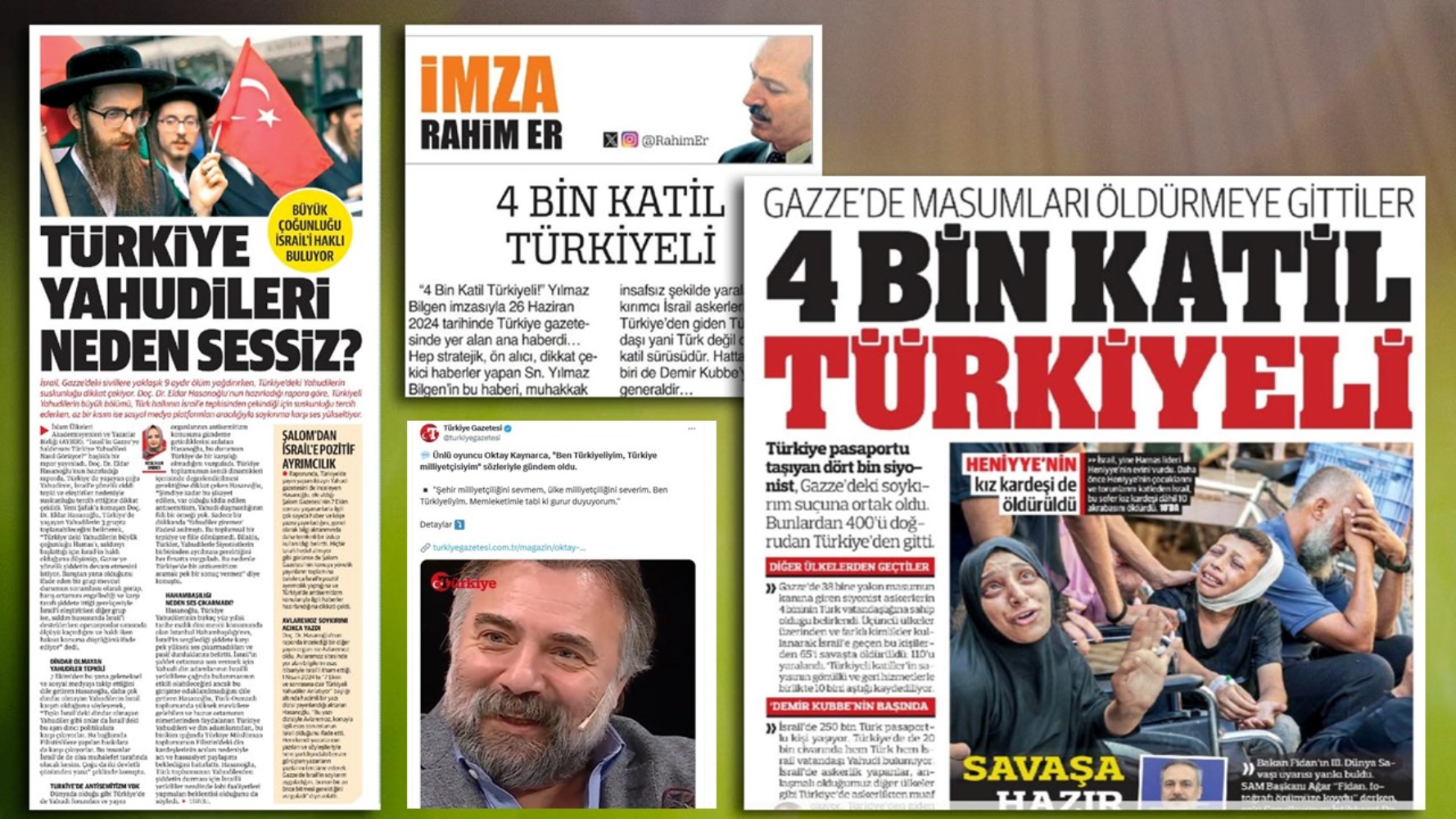
WASN'T THE TERM “TÜRKIYELI” SUPPOSED TO BE AVOIDED?
The newspaper Türkiye published a headline on June 26: “4 thousand Türkiyeli killers.” Directly below it, it stated, “Four thousand Zionists holding Turkish passports have become partners in the genocide crime in Gaza. 400 of them went directly from Turkey.”
A day before Türkiye, a news titled “Why are Turkey’s Jews silent: The vast majority find Israel justified” was published in Yeni Şafak. Both reports hold Jews in Turkey responsible for the massacres in Gaza, accusing and targeting them.
Of course, as journalists, we must take a stance against the inhumane war, oppression, and murders committed by Israel against the Palestinian people. There is no doubt about that. But while objecting to the bloody war waged by the State of Israel, we must not target Jews who are citizens of the Republic of Turkey, and we must not sacrifice them to hate speech. Journalism would be responsible for any attack directed at those people.
It was noteworthy that the word “Türkiyeli” was not placed in quotation marks in the headline of the report in Türkiye newspaper, which referred to the “ Unionof Türkiyeli in Israel.” Although the report also mentions “Turkish citizen” and in one place “Türkiyeli” was put in quotation marks, the sentence “It was learned that the general at the head of the ‘Iron Dome’ system is also a Türkiyeli” was also used.
Moreover, the newspaper’s columnist Rahim Er used the same headline the next day without quotation marks and in his article he used the phrase “Türkiyeli killers” exactly nine times. In fact, years ago, in an article he wrote, while evaluating the concept of citizenship in the Constitution, he had asked, “How do non-Muslim minorities become Turkish when they become citizens?”
Türkiye newspaper did not support famous actor Oktay Kaynarca when reactions arose against his words, “I am a Türkiyeli.” But apparently, when it comes to Jews, things change; they do not object to Jews being called “Türkiyeli”! In other words, everyone living in Turkey is a “Turkish citizen,” but some can be “Türkiyeli”!
THE ENVY-INDUCING ASPECT OF THE ELECTION IN IRAN
The most striking aspect of the election campaign in Iran was, without a doubt, that the six presidential candidates appeared on state television for live broadcasts four times.
Perhaps because the pro-government media did not want to evoke the fact that President Erdoğan in Turkey has not been able to face even critical journalists for years, let alone appear in live debates with his opponents during elections, they avoided reporting on these programs in Iran where candidates participated. Anadolu Agency, Aydınlık, Hürriyet, NTV, Takvim —aside from these, I did not see any news about the candidates' debates on TV. Even they only briefly reported on one of the four programs.
As a matter of fact, the opposition media in Turkey did not give the necessary importance to the elections in Iran; not all of the debate programs were reported. Yet, reformist candidate Masoud Pezeshkian was advocating that “women cannot be forced to wear headscarves” and was not refraining from openly stating that he is a Turk.
Despite this, those programs could not reach the top of the agenda for the opposition media in Turkey; they could not become the main topic of TV programs. Not a single channel from the opposition media could broadcast even a portion of the candidates' debate program in Iran in its entirety.
Would it have been bad to remind voters that it is essential for candidates to appear in joint TV programs for a fair and democratic election? I truly envied the Iranian example. Of course, without forgetting that this practice is the achievement of so much resistance, so much struggle, and so many deaths...
In a single sentence:
Most Read

Striking picture for Özgür Özel's 'New Party'

Özgür Özel gives a dated response regarding the number of resignations

Forest fire in Antalya brought under control

The PKK opening and Özgür Özel’s path!..

How did the newspapers view Özgür Özel's farewell to the CHP?

What did the CHP do?

Özel’s new party move in the world press

The New CHP, against CEHAPE

From self-efficacy to despair

The return of craftsmanship in the age of artificial intelligence