



The first step in the PKK organizing a ceremony to lay down arms, even if symbolic, was Abdullah Ocalan making a new call to his organization via a video message. The broadcast of Ocalan's image for the first time in 26 years and its content carried "news value."
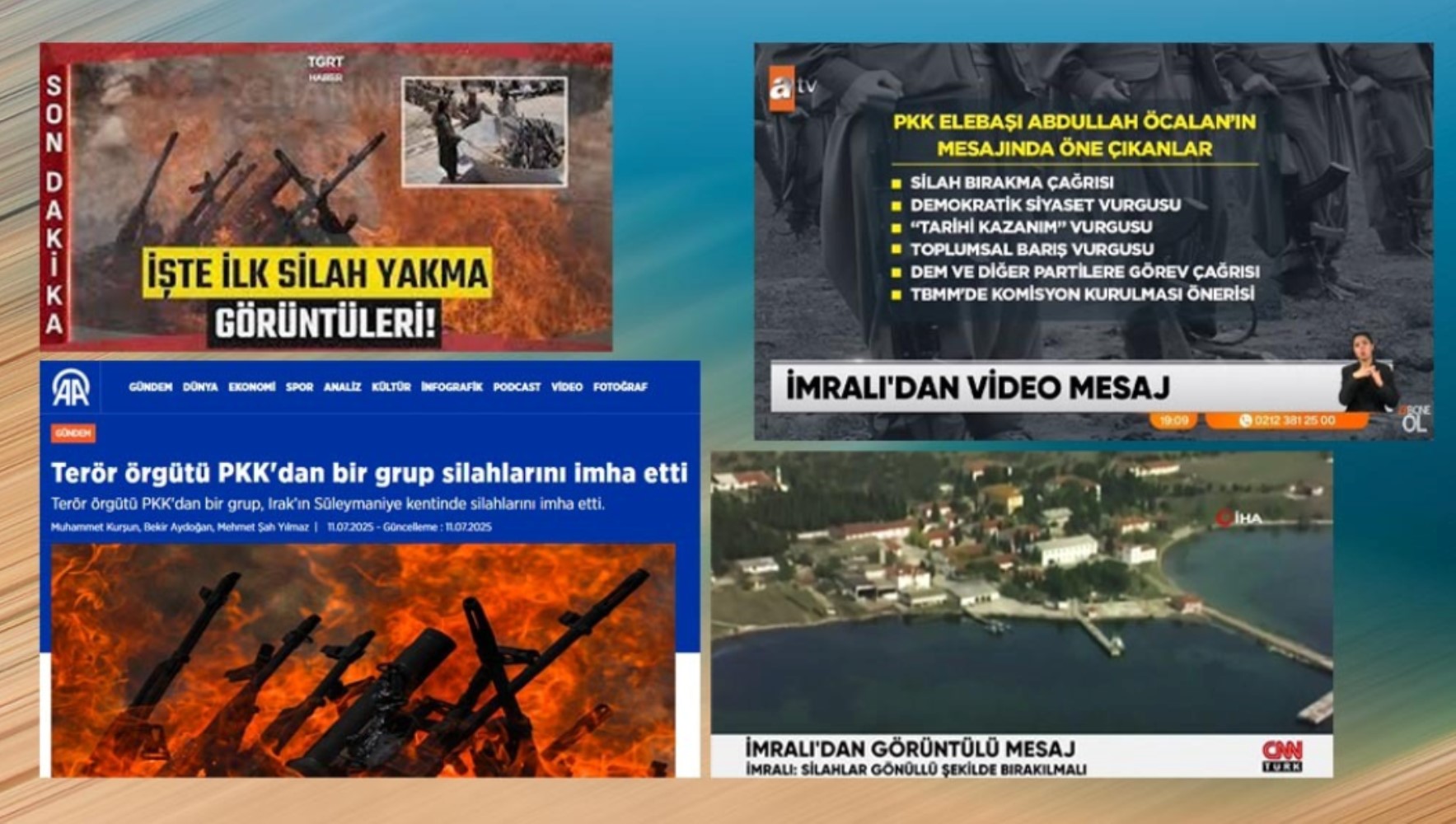
However, most of the mainstream media, especially the pro-government media, brushed off Ocalan's message as a few-sentence news item; they did not fully report its content. Television channels such as ATV, Habertürk, Star, Show, CNN Türk, and NOW, while reporting the news, kept playing archive footage of weapons, Imrali island, and DEM Party members in the background instead of showing Ocalan's image.
Similar reporting was evident in the news coverage of the symbolic "burning of weapons" ceremony by 30 PKK members in Sulaymaniyah. The Anadolu Agency served the footage it shot without placing its logo on it; it announced this development, which pro-government circles also described as "historic," with a four-sentence news item—yes, just four sentences! There was not a single sentence in the news from the text read by Bese Hozat, a member of the PKK's leadership, who made a statement at the ceremony.
The mainstream media also did not go into the details of Bese Hozat's statement, just as they did with Ocalan's message. Yet, in the text she read, it was summarized as: "on the basis of enacting democratic integration laws," "as a step of goodwill and determination, we are destroying our weapons with our free will in your presence." Moreover, Hozat concluded her speech by going off-script, saying, "Undoubtedly, very serious legal reforms are needed for this historic initiative to succeed."
These words gave an idea about what the PKK is waiting for to continue the "first step." It was the right of the people of this country to know these things. And it was the duty of journalists to report them.
To end the more than 40-year-long conflict-ridden, bloody process entirely, there is a need for "peace journalism." And "peace journalism" cannot be conducted by only reporting the state's statements and plans. It is necessary to convey the PKK's approach and statements regarding the process to the public, as well as to reflect the issue in all its dimensions, focusing on the future rather than the past.
In this context, the change in language and the approach toward the DEM Party in the pro-government media is an important development. Journalism can only contribute to the process functioning more healthily in this way.
TWO GROUPS OF JOURNALISTS OBSERVED
Two groups of journalists went to the region to observe the PKK's symbolic "weapon burning" ceremony. The departure of one group of journalists was organized by the DEM Party, and the departure of the second, smaller group was organized by the "state's security units."
For years, I have been writing that it is unethical for journalists to participate in "invited trips." But I also emphasize an exception every time. A journalist can go on an invited trip in cases where it is not possible to observe it otherwise. However, it is a condition that they or their institution cover the expenses and that it is stated in the broadcast that the trip was by invitation. This is an event that it is not possible for journalists to observe with their own means.
Seeing the criticisms on social media, I spoke with some friends from both groups. The journalists taken by the "state's security units" said that their institutions covered their flight tickets to Erbil and the hotel fees there. Some of these journalists learned upon boarding the plane that their tickets had been upgraded to "Business Class"; they flew in the economy section on the return.
The approximately 30 journalists taken by the DEM Party also bought their own flight tickets to Diyarbakir, but the party organized the bus travel, and the Kurdistan Regional Government (KRG) in Iraq covered the accommodation in Erbil. The travel of both groups from Erbil to the ceremony area in front of the Casene cave and their return were organized in the same way. Security in Erbil and on the road was provided by KRG teams.
The journalists taken by the "state's security units" reached the ceremony area earlier and found places in the protocol; they were also asked to keep their phones in their bags. They were not even searched. The journalists taken by the DEM Party, on the other hand, had been warned in advance not to bring their mobile phones with them; nevertheless, the male journalists were searched at the entrance.
Everything in the ceremony area was under control. MIT and PUK officials worked in cooperation; the footage shot was also released for broadcast after being checked. In such a controlled area, what is important in terms of journalism is that the reporting is not under surveillance and that no shadow is cast on editorial independence.
The readers and viewers will decide to what extent our colleagues there fulfilled the requirements of journalism.
THE SUICIDE OF THE ERDOGAN GOVERNMENT
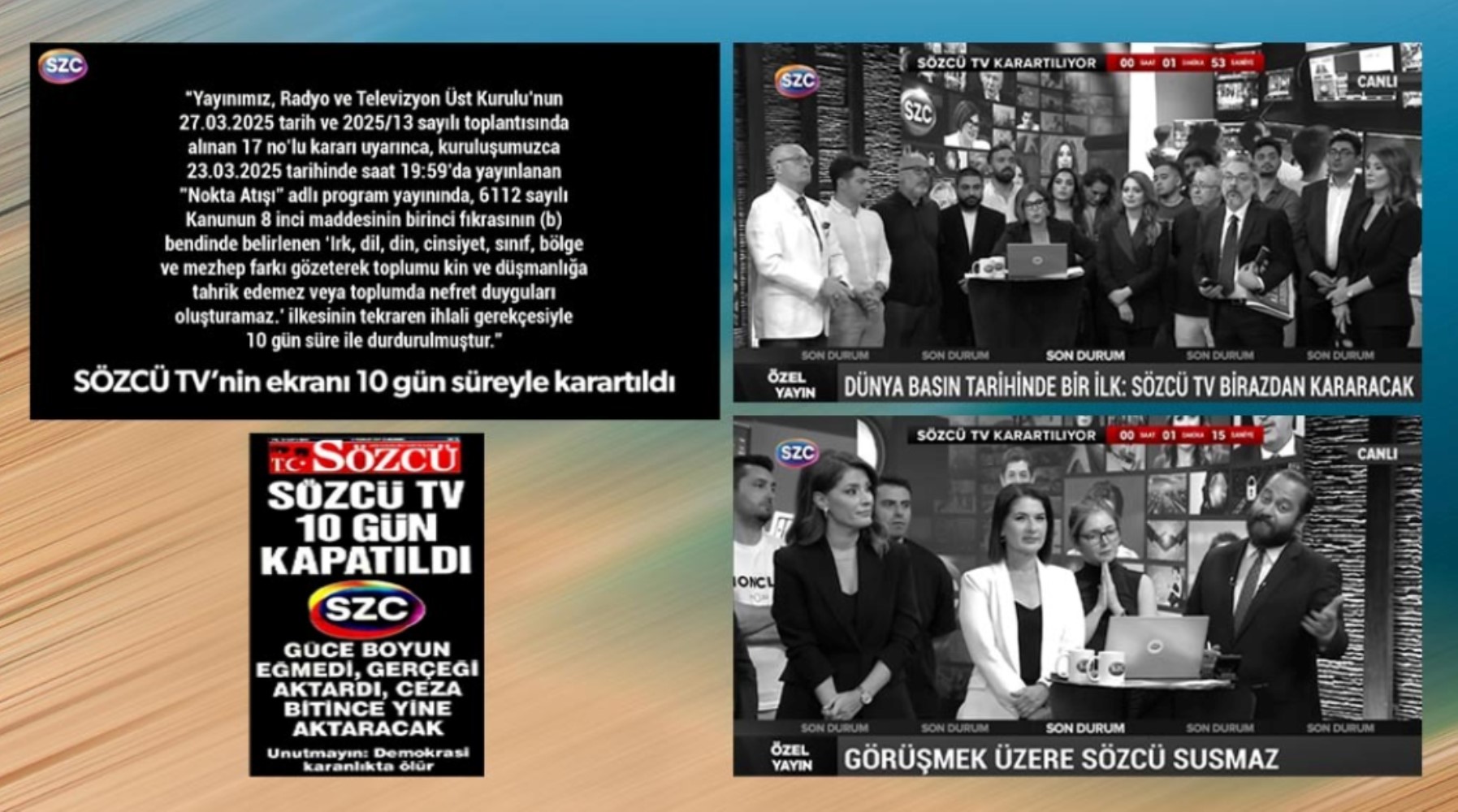
While RTUK was imposing a 10-day broadcast suspension penalty on Sözcü TV, it had a hard time coming up with a justification. The justification stated in the RTUK decision on the blacked-out screen has nothing to do with Sözcü TV's broadcast.
Specifically, RTUK supposedly penalized Sözcü TV on the grounds of violating the principle in the law that "it cannot incite the public to hatred and hostility by discriminating based on race, language, religion, gender, class, region, and sect, or create feelings of hatred in society."
According to RTUK, Sözcü TV committed this "crime" by broadcasting the following words of guest Berk Esen in the "Nokta Atışı" program on March 23, criticizing the police's attitude at the CHP rally in Saraçhane:
"...even though we can no longer watch the images of police violence on these channels due to RTUK pressure, we see it on the street, we see it on social media. Under very heavy police violence, not only in Saraçhane but in many regions of Turkey, citizens of the Republic of Turkey, my young friends who are the age of my students, are under heavy violence and are resisting."
Realizing that these words would not constitute a sufficient and meaningful justification for a 10-day penalty, they also cited as an example in the decision the words of guest Ugur Poyraz in the "Öncesi Sonrası Gece" program broadcast on Sözcü TV on March 21: "Security forces are acting against the law and intervening with pepper spray, batons, and shields."
There is also a logical error in establishing a link between criticizing the police and "inciting the public to hatred and hostility." While words about police violence on Sözcü TV are called a "violation," on the other hand, "negative news patterns presented accompanied by intervention images," that is, broadcasting images of police violence, are described as "widespread and traditionalized media practice." If it is a "traditionalized media practice," then defending that practice cannot be a violation!
The real reason they had such a hard time finding a justification is hidden between the lines of the decision. In the decision, the broadcasting of CHP Chairman Özgür Özel's words regarding President Tayyip Erdogan and Chief Prosecutor Akın Gürlek at the Saraçhane rally on March 24, and the slogans of those in the field against Erdogan, are evaluated as "expressions that amount to insults, are divisive, accusatory, cast suspicion, and do not contain respect." Following this, expressions such as "delicate balances of journalism" and "responsible broadcasting" are listed one after another.
Clearly, RTUK's real target is the broadcasting of Özel's rally and what was said there. The show regarding the police is a pretext. Well, Özel's speech is a live broadcast from the rally. Cutting off the opposition leader's speech during a live broadcast and censoring his words would not be ethical; it would be preventing the public's right to know.
The prosecutor's office is also pressuring Halk TV by opening an investigation into its owner Cafer Mahiroglu, RTUK is imposing a 10-day broadcast suspension, and Sabah is writing "The rent stall was set up at Halk TV." What can Halk TV do? It has to make an effort to cut the slogans shouted at Özgür Özel's rallies. Tele 1 as well, of course. Anyway, no one else broadcasts the rallies.
They may not be aware, but a government deprived of criticism sinks into darkness, and the public that cannot get news from independent channels does as well. Shutting down critical television stations would be the government's suicide.
"DEAR CHAIRMAN" IS NOT APPROPRIATE
CHP Chairman Özgür Özel participated in a broadcast on Halk TV during the week; he answered questions from Kürşad Oğuz, İsmail Saymaz, and Sinem Fıstıkoğlu. In the program, which lasted about two hours, almost everything on the agenda was asked to Özel.
Two points caught my attention in the program. The first is the length of the program. Although such long interviews are now being conducted on many channels, in the past, an interview with a chairman would not exceed one hour. I think that is the correct way. I don't think anyone today, unless they have a special interest, will sit in front of the screen and watch for two hours.
The second was Sinem Fıstıkoğlu starting her question about the "invitation to the street" words with "Dear Chairman." This is an incorrect form of address. Özgür Özel is not Sinem Fıstıkoğlu's "Chairman." Kürşad Oğuz said "Dear Chairman" a few times; that is correct.
A journalist should pay attention to the contact/distance rule during an interview with a politician. Addressing someone as "My Chairman" does not leave distance in between; it makes it look overly intimate.
OZTURKMEN'S SENSITIVITY TO SOURCES
I had drawn attention to the source problem in the parliamentary questions of opposition party deputies and criticized the failure to cite sources for news.
I received a response to my article last week from CHP Gaziantep Deputy Hasan Öztürkmen. Öztürkmen stated that, contrary to what I wrote, he asked about the Ministry of Labor and Social Security renting a 13-story building for 86 thousand liras per year by citing Veryansın TV as a source. Öztürkmen said, "I work with consultants who have a background in journalism, and we show sensitivity on this issue."
It seems I made a mistake by writing based on news in newspapers. I apologize to Öztürkmen and hope that his sensitivity to citing sources will be an example to all deputies.
In a single sentence:
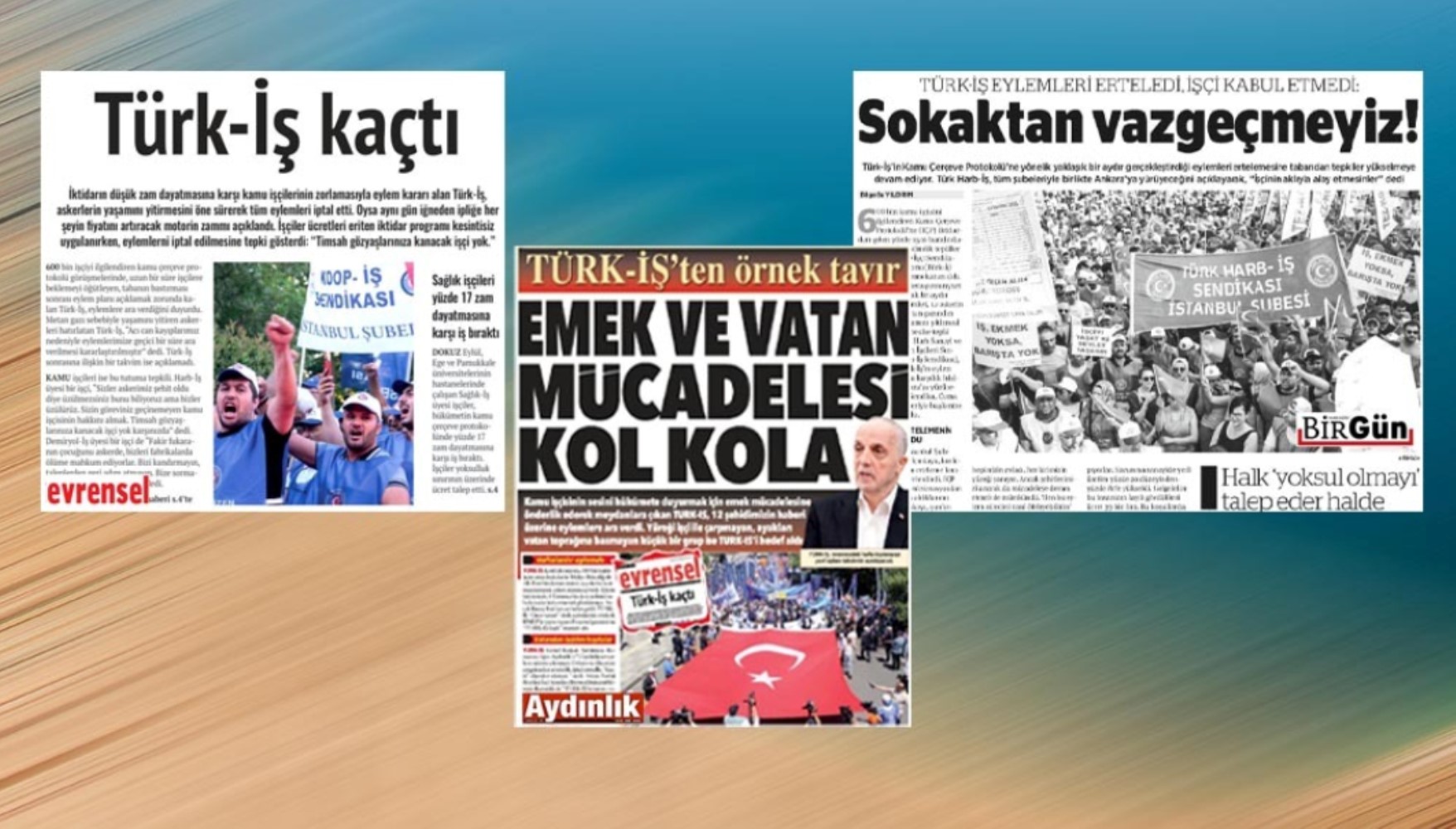
• Aydınlık responded to Evrensel's headline, "Türk-İş fled: Türk-İş, which decided to take action under the pressure of public workers, canceled all actions by citing the loss of soldiers' lives as an excuse," with the headline, "Exemplary stance from Türk-İş: Labor and homeland struggle hand in hand"; BirGün also reported in a similar line to Evrensel with the news, "Türk-İş postponed, the worker said continue."
• Yeni Şafak reported, "FETÖ fugitive Zekeriya Öz appeared years later at the funeral of Muhammed Yakut," but when it was understood that the person was not Öz, it corrected it as if others had written it incorrectly, saying, "While it was claimed that the name in the footage was Zekeriya Öz..."
• President Erdogan's lawyer, Ahmet Özel, responded to Sözcü columnist Saygı Öztürk's article dated June 12, 2015, ten years ago, with an advertisement published in the Sabah newspaper.
• Korkusuz's news about a man in Antalya stabbing his sister, which started with "I removed my sister's... I am happy" and detailed the murder, was violence pornography.
• Hürriyet and Korkusuz protected the accused private hospital by not writing the name of the hospital that Ayşenur Yazıcı said she would sue in the news, "I remained disabled due to mistakes."
• Cumhuriyet's news, "Went to the emergency room for a sore throat: Heart stopped after the injection!" was also a one-sided "allegation" news item written without any research.
FOR YOUR CRITICISMS, COMPLAINTS, AND SUGGESTIONS: [email protected]
Most Read

Striking picture for Özgür Özel's 'New Party'

Özgür Özel gives a dated response regarding the number of resignations

Forest fire in Antalya brought under control

The PKK opening and Özgür Özel’s path!..

How did the newspapers view Özgür Özel's farewell to the CHP?

He killed his wife by slitting her throat: Their children witnessed the moments

What did the CHP do?

Özel’s new party move in the world press

The New CHP, against CEHAPE

Fire at TUSAŞ engine factory in Eskişehir under control