



Yeni Şafak’s headline was surprising. This time, it was taking its opposition to interest rates into the legal arena: “An authority that threatens property rights.”
Yeni Şafak was bringing to light an illegality that even the opposition media had failed to notice in the “new omnibus bill” submitted by the AKP government to the Turkish Grand National Assembly. It drew attention to the drawbacks of granting “prosecutors the authority to seize individuals' assets without a judge's decision,” stating, “The measure to be taken before a verdict is finalized, through the authority granted to prosecutors to ‘seize first, we’ll look later,’ results in the de facto punishment of the individual.”
Yeni Şafak may not want to see it, but the current practice is already like this. The only difference in the new regulation is that a judge's decision is no longer required. Currently, a prosecutor requests it, a single judge at the Criminal Judgeship of Peace makes the decision; assets and companies are seized and immediately transferred to the TMSF (Savings Deposit Insurance Fund). People are punished in advance without a trial or court ruling.
It is possible to give dozens, perhaps hundreds of examples, but there is no need to look far. The detention of journalist Merdan Yanardağ two days ago and the subsequent seizure of Tele 1 is a striking example of “de facto punishment before a verdict is finalized,” that is, trial-less punishment.
When the Istanbul Chief Public Prosecutor's Office announced that “the Istanbul Criminal Judgeship of Peace had decided to appoint a trustee to Tele1 on behalf of the TMSF,” let alone a conviction being handed down against Merdan Yanardağ, his statement had not even been taken at the police station yet!
The Chief Public Prosecutor's Office claimed that “Merdan Yanardağ had ‘obtained benefits’ from a person named Hüseyin Gün, who is accused of espionage, and was the ‘media arm of the election process,’” and a few hours later, his sentence was announced! Neither a trial nor a court decision! Neither was deemed necessary; with the Chief Public Prosecutor's Office's verdict of “It is understood,” Merdan Yanardağ was made a “spy,” and the penalty was imposed on Tele1.
The appointed trustee, as if mocking the situation, seized the channel, interrupted the news, and immediately started broadcasting a “penguin documentary.” They deleted some videos on YouTube and closed the account. This attitude alone reveals that the goal is not a legal process, but the silencing of an opposition channel.
Unfortunately, opposition media, especially television stations, are now completely devoid of legal protection and are under the constant threat of being transferred to a trustee. But neither critical journalism can be silenced nor can society be prevented from learning the truth through these trial-less punishments.
The TRNC has already become “82” for Turkey

G-82 is the restriction code given to “those engaged in activities against national security,” while N-82 is for “foreigners whose entry into the country is subject to a ‘prior permission’ condition.”
These codes are not well known or discussed in Turkey, but they are the name of a major problem for Turkish Cypriots. Since 2021, intellectuals, journalists, and some opposition figures coming from Cyprus have been turned back from the airport with these codes; they are not allowed into Turkey.
The practice of banning entry to Turkey, which has no legal justification or basis, has become the subject of a documentary. The documentary, titled “Code 82,” is described as a “work aimed at etching the critical period experienced by Turkish Cypriots into social memory.”
“Code 82” was also screened at the Cyprus Turkish Journalists Union one week before the election. Speaking before the screening, Journalists Union President Efdal Keser said he was saddened that the initiatives they had taken regarding those banned from entering Turkey had remained inconclusive.
As is known, on one hand, analyses are constantly being made about the reasons for the loss of Ersin Tatar, who is supported by the AKP government in the elections; on the other hand, MHP Chairman Bahçeli's words regarding the declaration of the TRNC as the 82nd province of Turkey are on the agenda.
Unfortunately, Bahçeli's wish has a counterpart in the Republic of Turkey, as the “82” code is given to the bans applied to Turkish Cypriots! This ban code is also one of the reasons that lead to the reaction of people on the island towards Turkey…
The flippancy of smearing a woman whose five children died
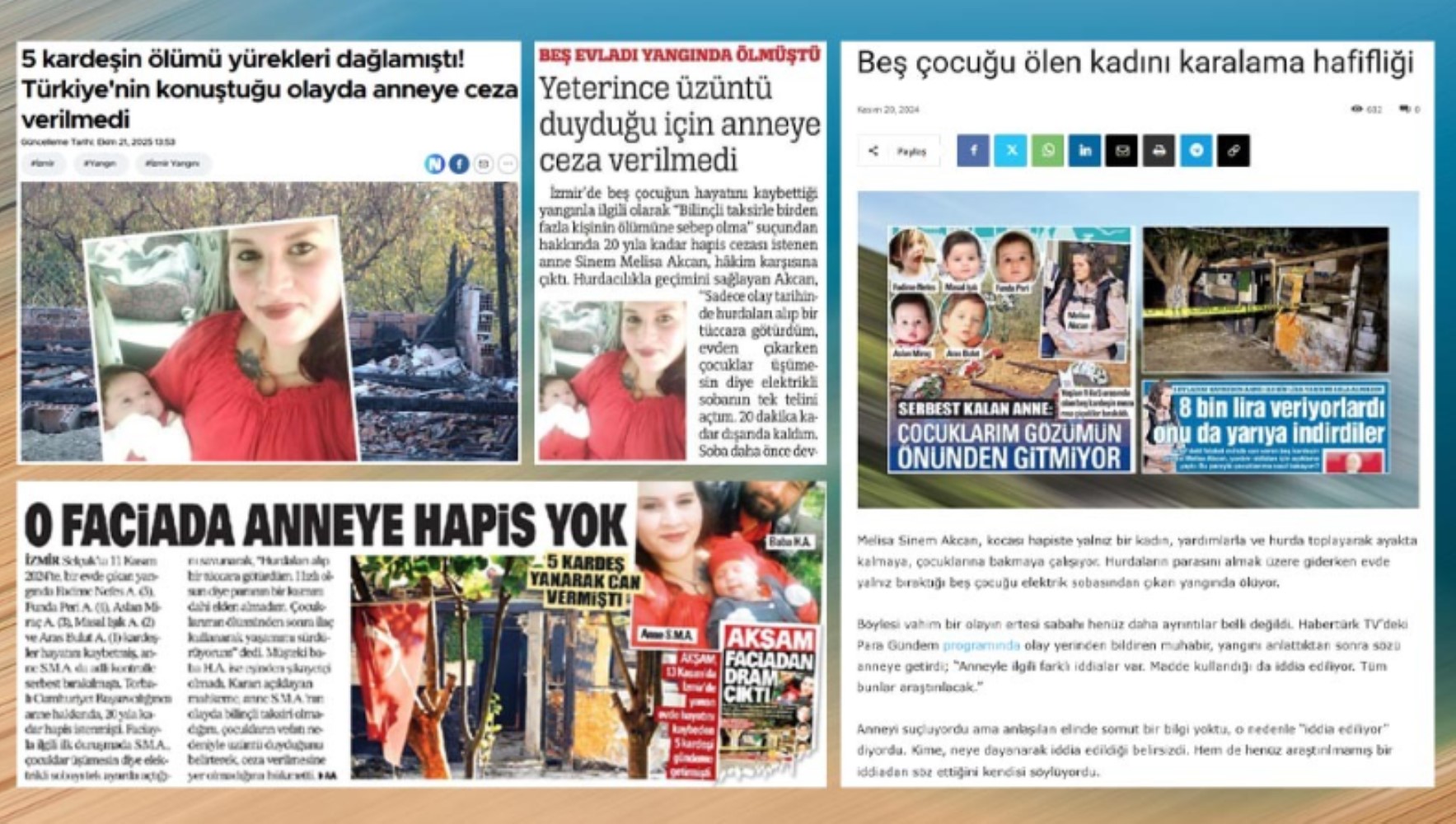
When I saw the news headlines “No punishment for the mother because she felt enough sorrow” and “No prison for the mother in that tragedy,” I remembered the broadcasts from last year. News and comments had been published that mercilessly smeared Melisa Sinem Akcan, the mother whose five children died in a fire, and were devoid of empathy.
Regarding the fire in the Selçuk district of İzmir, the reporter speaking from the scene on Habertürk TV's “Para Gündem” program had said, “There are different allegations regarding the mother. It is also alleged that she used substances.” After this program, similar accusations were made about the mother on some news sites, in columns, and on TV.
In my article titled “The flippancy of smearing a woman whose five children died,” published on November 18, 2024, I emphasized the wrongness of “reporting news without relying on concrete information and documents” in such an event, and warned that “circulating the ‘allegation’ that she used drugs when one should be even more careful is a behavior that would wound consciences.”
Fortunately, the court empathized with the mother and made its decision by taking into account “the sorrow she felt over the death of her children.” The acquittal decision given by the judges also cleared mother Akcan of those news reports and comments that portrayed her as a “bad and irresponsible woman” in addition to the death of her children. I hope the journalists responsible for those broadcasts will learn a lesson from this event and internalize the importance of empathizing with victimized people and the sense of justice.
DHA really loved the “cheated husband” story
I couldn't stop myself from reading it when I saw it in dozens of newspapers and news sites. Judging by the headlines: Hürriyet, “A family fell apart twice”; Korkusuz, “DNA test shock for the cheated husband”; Nefes, “Neighbor said ‘get a DNA test,’ the father of her 2 children turned out to be her cousin”; Posta, “The father of her children turned out to be her cousin”; Takvim, “Blood tie betrayal,” it was a new event.
However, in these news reports sourced from DHA, it was stated that the man named Hüseyin A., who learned that two of his three children were not his own in a DNA test he had done upon his neighbor's warning, had ended his marriage the previous year. So the event was not new.
Indeed, when I searched the internet, I saw that the same news had been published twice before. DHA had reported the news on March 14, 2024, with the headline “Neighbors said ‘get a DNA test’... His world collapsed with the truth he learned after the divorce.” DHA put the news into service again on June 19, 2024, with the headline “He learned that 2 of his 3 children were not his own! He made a request.” It didn't stop there; DHA repeated this news for the third time on October 19 of this year with the headline “He had a DNA test with his neighbor's tip-off, the father of 2 of his children turned out to be her cousin.”
Except for the fact that the first two news reports were from Konya and this year's was from Antalya, the only novelty in the latest news was that the two children whose fathers turned out to be different were in a difficult situation and what the man said.
Unfortunately, when reporters and editors encounter an event they think will attract attention, they report it as if it happened for the first time with every new development. Especially if it has been reflected in the judiciary, it is written as if it were new with the same headlines before the lawsuit is filed, after the lawsuit is filed, and when the verdict is issued. This bad journalism is done sometimes out of ignorance and sometimes with malicious intent.
The strike news where the union is not written
In the headline of Sözcü newspaper on October 22, “Misery for the worker, reign for the AKP member,” the strike that has been going on for 3.5 months at the Gübretaş factory in Kocaeli was mentioned. It was stated that the former AKP deputy and party officials, who are in the position of employers, did not accept the workers' wage increase demands but gave themselves a 60 percent raise in their own allowances.
Considering that news about trade union life and strikes has become barren in the media, it was a valuable piece of news. However, Atilla Özsever, a journalist specializing in working life, criticized the news:
“The name of the union of the workers continuing this strike is not in the news, that is, it is not specified. This is a very serious mistake for a news report. Also, the number of workers on strike and the average wage they receive are not written. The 40 thousand lira monthly ‘attendance fee’ received by AKP officials has not been compared with worker wages.
Let me provide that information; the striking union is the Petrol-İş Union, affiliated with Türk-İş. 240 workers are continuing the strike. The average worker wage is 34 thousand lira. The employer's wage increase offer is not 38 percent; it was 30 percent before the strike and rose to 33 percent on the 79th day of the strike. The union's increase demand is 95 percent.”
Özsever's criticism is very justified. The name of the union, the wages of the workers, and the changes in their increase demands should have been in the news. When these elements are missing, Sözcü's news does not fully reflect to the reader what is happening at Gübretaş. It is a piece of news that has not been worked on enough, not matured...
“It is alleged” but by whom?
In Yeni Şafak's news titled “FETÖ shadow in the Court of Cassation: File manipulation and ‘single number’ game by Department Head Yaman,” there was no subject.
The news was written with sentences ending in “it is stated,” “it was claimed.” But who claimed it, who stated it, was not written. Even a sentence without a subject ended with “the answer to the question is wondered.”
Similarly, in its news titled “Allegation that CHP will not make a defense,” there was no subject. There was not a single word in the news about who or whom it was that alleged that the defendants would not make a defense in the lawsuits against CHP municipalities. The sentences ended with the words “it is alleged,” “it is stated,” “it was claimed.”
Even a person with the slightest knowledge of journalism and a few years of experience would actually be ashamed to publish such news. Because these texts are not news, they are trash. News has a subject; who is alleging it, what is the source of the news, it is all written.
In a single sentence:
İbrahim Aydın, Uğur Koç, and Yaşar Gökdemir from BirGün were convicted for reporting on the Sabah reporter's visit to Chief Public Prosecutor Akın Gürlek; Asuman Aranca from T24 was also convicted for reporting on the expert report in the nationalist Sinan Ateş murder case.
After writer Ergün Poyraz, journalist Emin Aydın was also arrested upon the complaint of Aydın Metropolitan Mayor Özlem Çerçioğlu, who switched from CHP to AKP.
Journalists who are Ankara Representatives of the media attending Interior Minister Ali Yerlikaya's meeting did not ask why he did not make a statement regarding the murder of journalist Hakan Tosun.
In Hürriyet, the headline “Cat alimony” was given to the news, but it should have been called “maintenance expenses,” not alimony; “maintenance expense” was also written in the parties' divorce agreement. (İzzet Doğan)
Sabah wrote “Mason Sanver and Tekdağ were arrested,” as if being a “mason” were a crime.
Yeni Akit engaged in anti-democratic and discriminatory journalism that did not recognize the voter's will with the headline “Greek lovers rejoiced in the TRNC” regarding the election results.
Sözcü's news “25 percent of the indictment was written with artificial intelligence” was based on a “plagiarism analysis” of the indictment regarding the municipalities that was done by ChatGPT but not verified, and whose reliability was not checked by an editor. (M. Şafak Sarı)
Akşam's publishing of the names of two defendants who were acquitted in the Minguzzi case and were under the age of 18, with their names coded but their faces visible in their photos, was contrary to laws and ethical principles.
FOR YOUR CRITICISMS, COMPLAINTS, AND SUGGESTIONS: [email protected]
Most Read

Striking picture for Özgür Özel's 'New Party'

Özgür Özel gives a dated response regarding the number of resignations

Forest fire in Antalya brought under control

The PKK opening and Özgür Özel’s path!..

How did the newspapers view Özgür Özel's farewell to the CHP?

He killed his wife by slitting her throat: Their children witnessed the moments

What did the CHP do?

Özel’s new party move in the world press

The New CHP, against CEHAPE

Fire at TUSAŞ engine factory in Eskişehir under control