



These days, one of the most frequently cited grounds in lawsuits filed against journalists is "spreading propaganda for a terrorist organization," while the other is "targeting individuals involved in the fight against terrorism."
Opposition media, wishing to avoid being the subject of such accusations, have stopped using the names of judges and prosecutors in their reports on trials; even the name of the expert witness whose testimony led to the trial of Istanbul Metropolitan Municipality Mayor Ekrem İmamoğlu cannot be written and is instead coded.
However, it is free for pro-government media to use names; the crime of "targeting" does not apply to them. They can name any judge or prosecutor they wish in their reports. The latest example is the process surrounding the cancellation of the release decision for Ayşe Barım—who was detained on charges of creating a monopoly in the TV series industry and for organizing the Gezi protests—following an objection by the Chief Public Prosecutor's Office.
In the reports by Türkiye, titled "Ayşe Barım couldn't even step out of prison! Jet objection to release in Gezi Park investigation, re-arrested," and Sabah, titled "Ayşe Barım's release was short-lived! High Criminal Court issued a re-arrest warrant," the names of the Peace Criminal and High Criminal Court judges who ensured Ayşe Barım remained in custody were absent, but the name of the judge who granted the release, Fatih Kapan, was explicitly written. In fact, the release decision was labeled a "scandalous decision," and Judge Fatih Kapan was declared "guilty."
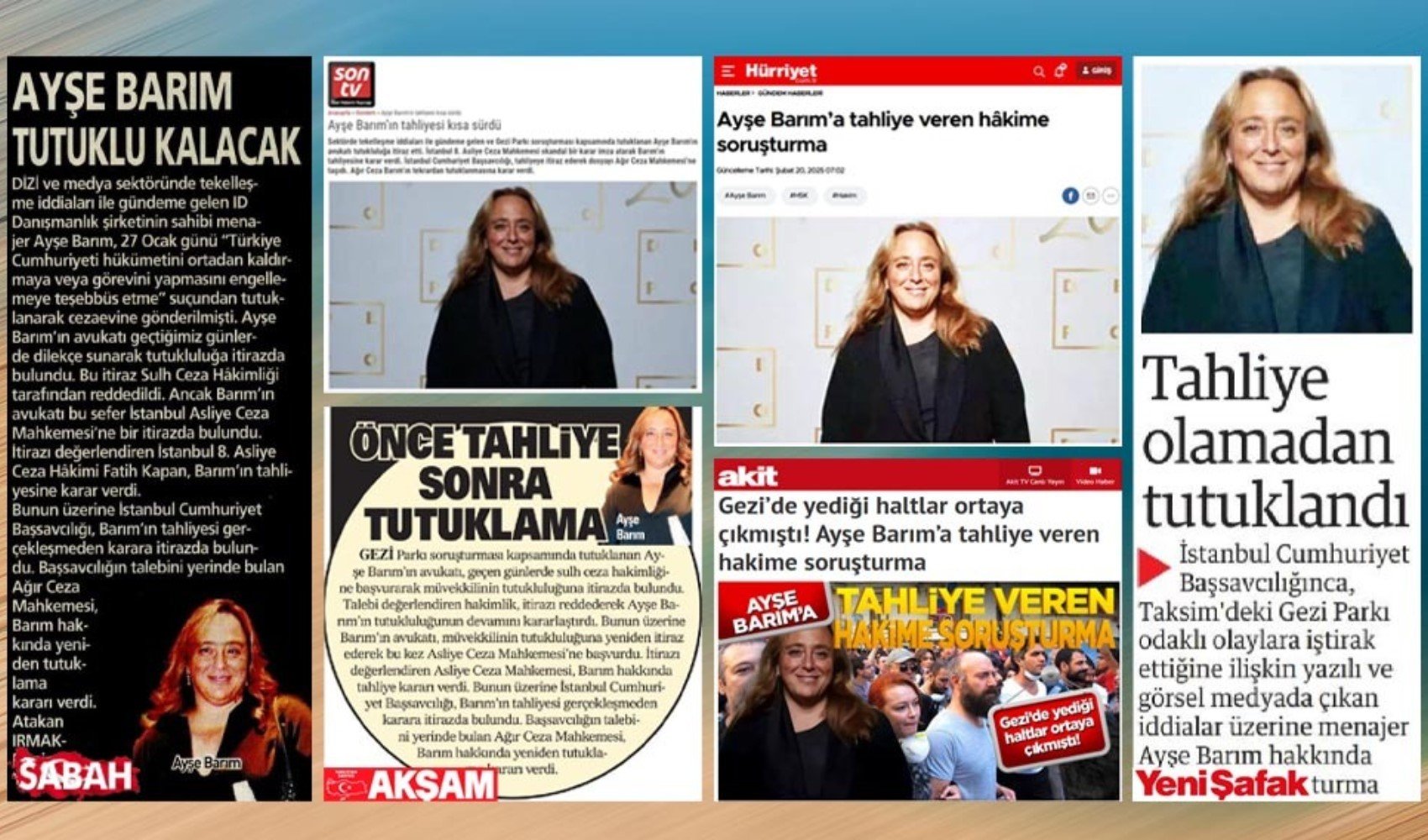
In a process involving three judges, hiding the names of two while revealing the name of one can hardly be explained by good intentions. Especially if the HSK (Council of Judges and Prosecutors) opens an investigation into Judge Fatih Kapan following these reports, does this not constitute targeting through news reports and an attempt to influence the judiciary?
A journalist does not attempt to influence judicial processes; this is our professional principle. But in the case of Ayşe Barım, journalism, let alone influencing the judiciary, vilified the judge and portrayed him as guilty. Moreover, it is not just the Ayşe Barım case; there are so many such incidents...
Akşam, Habertürk, Haber7, Star, Sabah, Takvim, Türkiye, and Yeni Şafak declared the open meeting in Büyükada as a "continuation of July 15" and a "spies' meeting." All defendants were acquitted; the Supreme Court of Appeals closed the file, but not only did they not apologize, they did not even report on the acquittal.
Most recently, reports were also made to influence the trial of Esenyurt Mayor Ahmet Özer, as well as Suat Toktaş from Halk TV and four other journalists. This is what journalism looks like under the wings of the ruling power; targeting is free, and so is influencing the judiciary...
Invited trips and the reputation of journalism
In my article titled "Mr. Murat, that's not how an interview is done," I emphasized that businessman Murat Ülker's private interviews should not be seen as journalistic products and criticized the approach of journalists to these interviews.
Murat Ülker responded by saying, "Criticism is valuable, but my goal is, of course, not journalism," in a way agreeing with my criticism. There was no sound from the journalists who were my primary addressees; they did not explain why they praised those interviews and articles as if they were journalistic activities.
Ultimately, Murat Ülker is a businessman who attaches importance to media relations and reputation management. He doesn't just conduct interviews and write books; he organizes "Starry Conversations" at Yıldız Holding's headquarters in Çamlıca, which journalists also attend. In recent years, he has been taking journalists to London in groups, hosting them, showing them around his factory, and introducing his investments there. Journalists who go as invitees write about what they see upon their return.
Ülker's London invitations did not attract attention until İsmail Saymaz shared a photo on Instagram last week with the caption, "We are in England as guests of Ülker." In the photo Saymaz shared, journalists Murat Muratoğlu and Erdal Sağlam, digital publisher Adem Metan, and Murat Ülker's advisor and communicator Mustafa Kaya were visible. Then the criticisms began; although they did not write articles about the trip, the photo was heavily debated on social media.
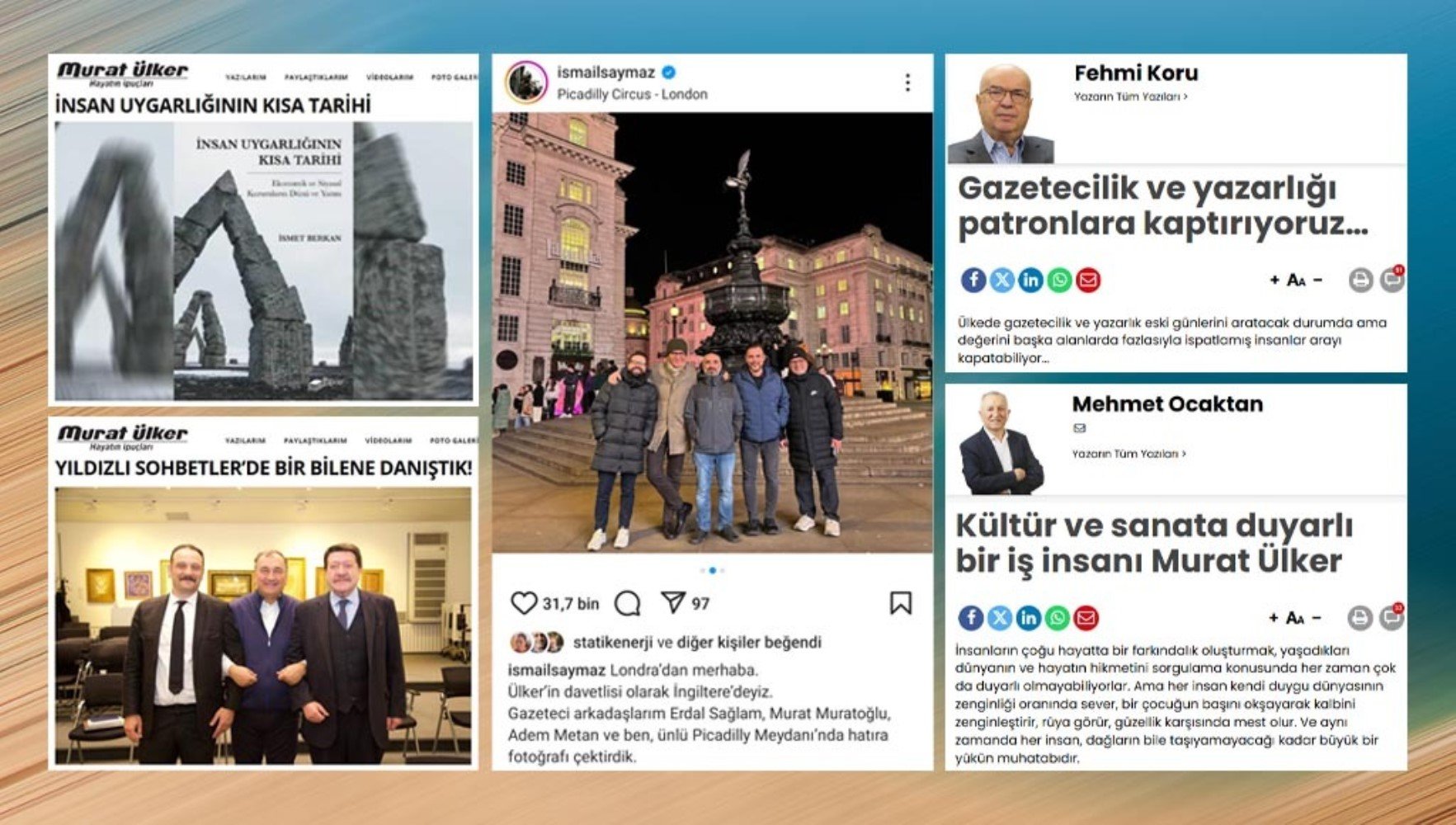
Ülker's London invitation is problematic regardless of who the inviting or participating journalists are. Let's look at it this way: why would a businessman take journalists all the way to London and show them around? He wouldn't make this invitation if he didn't have an interest, would he? The Ülker group's interest is to promote its company and announce its activities to the public. Besides, this is likely cheaper than advertising in newspapers, on television, and on news websites; and news/articles are more effective for promotion than advertising. One should actually check if Ülker advertises in the opposition media as well.
Invited trips create a conflict of interest. A financial relationship develops with the news source; this damages the reputation of journalism. Of course, journalists do not protect the company just because they are taken on a trip, but since they are forced to report what is shown to them, they end up publishing in the company's favor. Indeed, not much journalistic product that goes beyond press releases comes out of these trips.
If there is a subject with "news value" at the destination, the media organization covers the expenses. It is against the nature of journalism for the source of the news to cover the cost of the news.
Indeed, as in the Turkish Declaration of Rights and Responsibilities of Journalism, in many countries around the world, media organizations and journalistic organizations—except in exceptional circumstances—consider participating in invited trips among the sins of journalism.
In a study I conducted previously, I compiled the principles of many organizations, from the BBC to the Washington Post, New York Times, Le Monde, AP, and AFP, regarding "invited trips." Let me just say this: world journalism does not show the tolerance for invited trips that we do here...
Journalism is on the run in patron-owned media
When Demirören Holding board member Tayfun Demirören was arrested at the airport, information that had not been reflected in the media until that day spilled out.
The company Tayfun Demirören founded in Germany had gone bankrupt, and his real estate project was seized when he could not repay the 240 million Euro loan he received from there. Subsequently, his checks worth 66 million bounced, and a prison sentence was issued in Turkey about two months ago.
The debts of Tayfun Demirören, brother of Yıldırım Demirören, were very small compared to Demirören Holding's multi-billion dollar debt, but his creditors were private companies, not Ziraat Bank!
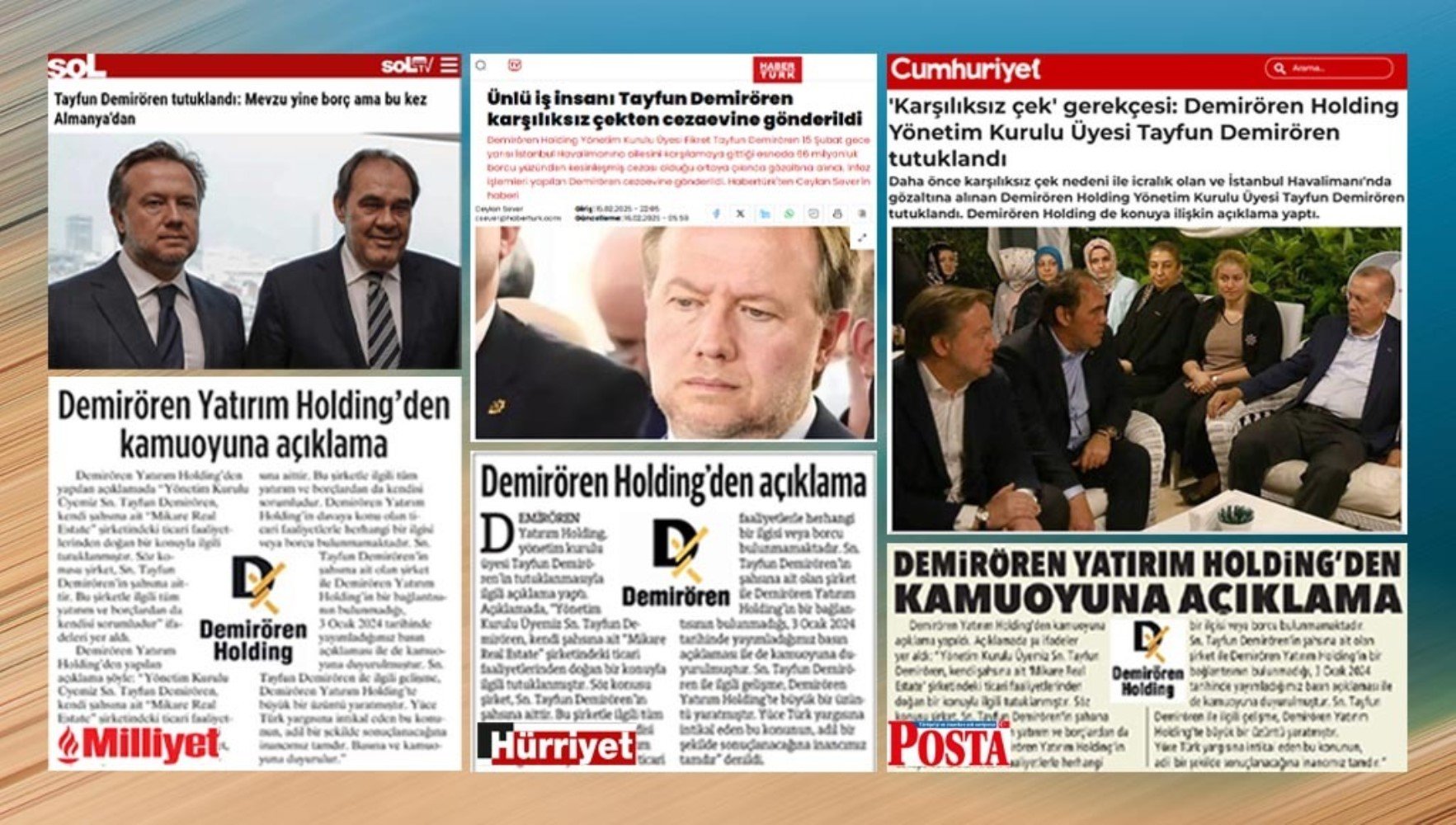
The arrest warrant was first heard on opposition news sites that evening. Upon this, Demirören Holding issued a statement stating that "Tayfun Demirören was arrested in connection with a matter arising from his activities in his personal company 'Mikare Real Estate'" and that they were "saddened."
The arrest of a businessman in the management of a holding company is news. Moreover, there is a matter of bounced checks involved. But the Demirören Group's newspapers and television channels could not report this event properly. Hürriyet, Milliyet, Posta, and CNN Türk published the Demirören Holding statement briefly, and that was it. They could not even report on the release of Tayfun Demirören, who spent one day in prison, after the family paid the debt; they were buried in silence.
When it is patron-owned media, journalism runs away like this, and there is no sign of editorial independence. The patron's interests come before the public interest and the society's right to know.
Respect for the reader and the viewer is zero, while loyalty to the patron is ten out of ten. If the patron is tied to certain places, allegiance to those places naturally becomes inevitable...
Differences in Kurdish translation
In my article "The mistake in 'Öcalan's letter' reports," I criticized the reports stating "Cemil Bayık: Öcalan's letter has reached us." Dicle Müftüoğlu, one of the editors of the Mezopotamya Agency, sent a statement objecting to this article; in summary, it is as follows:
"Before the news was published, the headline was confirmed with Stêrk TV, which broadcast the program. There may be different translations due to Cemil Bayık's Kurdish. However, the Turkish text sent by the journalist who conducted the interview, Ersin Çaksu, was also published in the Fırat News Agency. This text also included the expression 'the letter has reached.' Our news has also been verified by its source."
A reader named Sefin Ari, who stated that those reports were correct, also argued that "I should apologize." When other reactions came from the Kurdish media, I re-examined that section, which I wrote based on Artı Gerçek's report and a translation by a journalist friend of mine. First, let me convey the Kurdish of the words of Cemil Bayık, one of the PKK leaders, on Sterk TV:
"Me ragihandinê Tirkiyeyê dişopand û me hinek encam derdixistin. Di dawiyê de mektûbek jî bipêş ket. Li ser vê jî hinek malûmatên me çêbûn."
Journalist Özgür Paksoy, who objected to the translation in my article on social media, translated these sentences into Turkish as, "We were following the Turkish media and drawing some conclusions. Finally, a letter also came to the fore. Upon this, we received some information." Ferid Demirel's translation was also in the form of, "We were following in the Turkish press, we were drawing some conclusions. And of course, a letter was also in question. Through this (referring to the letter), we had some information."
As can be seen, there is no direct statement in these translations by Cemil Bayık saying "Öcalan's letter has reached us"; this conclusion is reached through interpretation. Of course, it can be written by stating that it is an interpretation, but a word that was not said cannot be written as if it were said (especially in quotation marks). That was all I was saying. Otherwise, I had also emphasized that Öcalan's letter might have reached them. Indeed, it was announced as such later; Duran Kalkan also confirmed it.
Mine was a criticism of journalism and news writing technique. I did not make an assessment about the "Imralı process," the contacts being carried out, or especially the "Kurdish media." I have no intention of targeting anyone. It is beneficial for everyone to be open to criticism, including me, of course...
In a single sentence:
In Sabah, Yüksel Aytuğ attributed the poem "Divine Army," which contains the lines "Minarets are our bayonets, domes are our helmets" by poet M. Cevat Örnek, to Ziya Gökalp; President Erdoğan repeated the same mistake once again last week.
Yeni Akit continued its series of insults against journalists and dissidents by calling Istanbul Metropolitan Municipality Mayor Ekrem İmamoğlu a "gang leader" and calling Barış Pehlivan, Kürşad Oğuz, Seda Selek, Serhan Asker, and Suat Toktaş, who are facing lawsuits, "hired pens."
Sabah's report "A dagger to history in the heart of Hagia Sophia" regarding a hotel turning its historical cistern into a SPA center was used in the media without citing the source.
Nefes reported the words of Mehmet Memiş, who is known as "Medium Memiş" and later turned into a "hodja," as "Hodja Memiş lashed out at the so-called hodjas on social media."
Akşam and Sözcü used Türkiye's report "Scrap price flew for nothing/ No work for SCT incentive" without citing the source.
Emlak Konut, which gave full-page advertisements to pro-government TV channels, news sites, and 17 newspapers for the new housing campaign, kept the opposition media out of the campaign.
Karar joined the race to attract the attention of retirees in the media with the headline "Excitement for '22 thousand lira' in holiday bonus," raising the bonus amount to a level that will never happen.
In Sözcü's report "Paying rent in Istanbul is more expensive than flying every day," the 20-day ticket cost for an Istanbul-Kayseri flight was calculated incorrectly.
Akşam, Hürriyet, and Sözcü wrote that famous director Christopher Nolan would shoot his new film in Ordu, but the Türkiye newspaper researched the subject and reached the information that it was not true.
FOR YOUR CRITICISMS, COMPLAINTS, AND SUGGESTIONS: [email protected]
Most Read

Striking picture for Özgür Özel's 'New Party'

The PKK opening and Özgür Özel’s path!..

How did the newspapers view Özgür Özel's farewell to the CHP?

He killed his wife by slitting her throat: Their children witnessed the moments

What did the CHP do?

Özel’s new party move in the world press

The New CHP, against CEHAPE

Fire at TUSAŞ engine factory in Eskişehir under control

From self-efficacy to despair

Kılıçdaroğlu's first message on Özgür Özel's new party announcement