



THE ALLURE OF FOCUSING ON A KILLER'S LIFE STORY
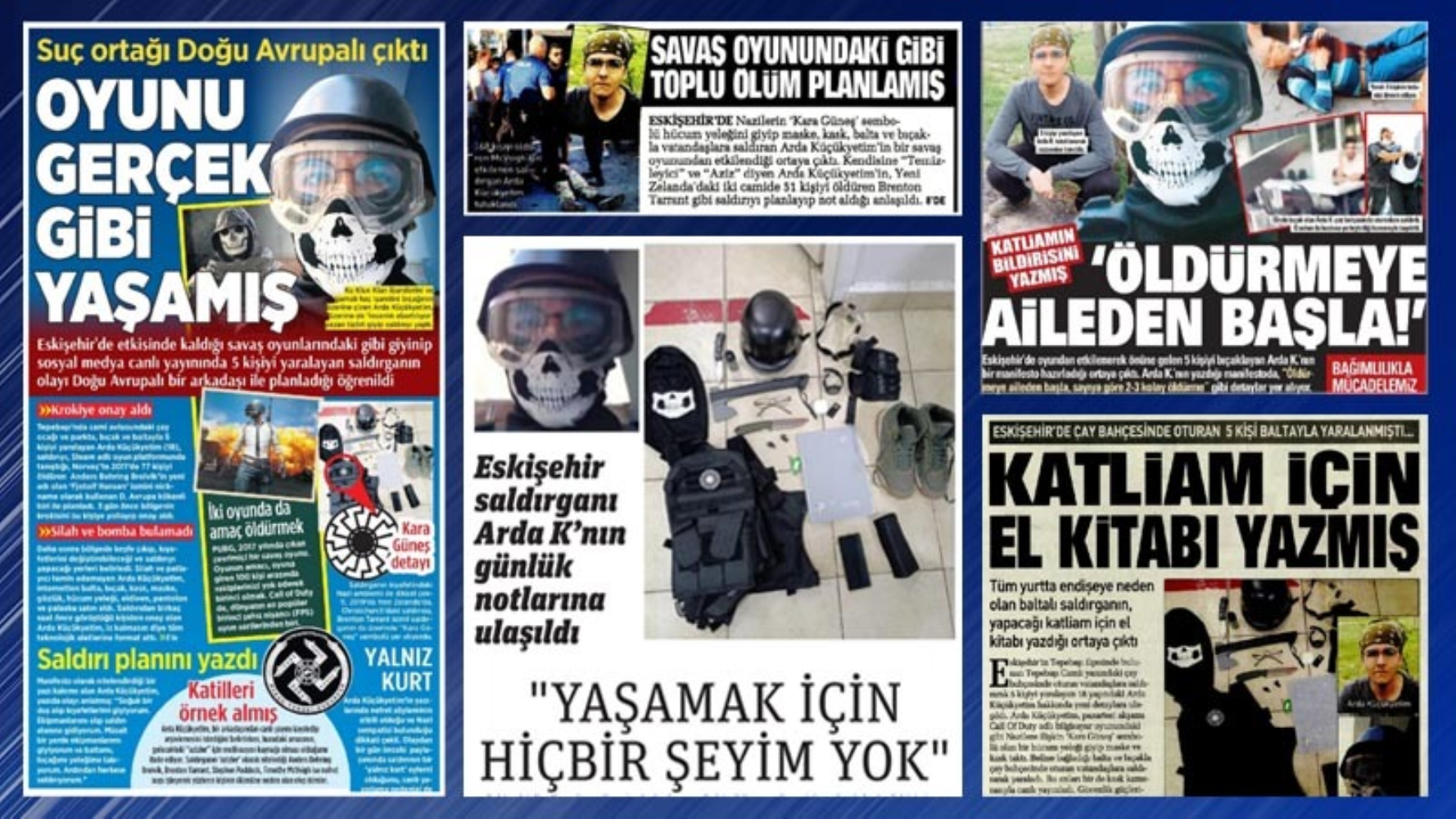
Who did the young man in Eskişehir, who was influenced by a computer game and randomly stabbed people he encountered on the street, choose as his role models? Racist and soulless killers like Anders Breivik, who killed 77 people in Norway, and Brenton Tarrant, who killed 51 people in New Zealand.
18-year-old Arda Küçükyetim also wore a helmet and tactical vest, set up a camera rig, and went out with the intention of killing as many people as possible. While reporting on these events, our media rightly reflected the horror of the attack on one hand and tried to be cautionary on the other. Sharing expert opinions and drawing attention to the harms of these games was valuable.
However, while trying to be cautionary, it was problematic to include details of the ultimatum text prepared by Arda Küçükyetim, the name of the computer game he was influenced by, and to focus on his life story. Akşam, Hürriyet, Sabah, Takvim, Türkiye, as well as news websites and television channels, provided the names of those games and published excerpts from the text on his blog.
Milliyet went even further, creating detailed boxes about the content of those two games and giving Arda Küçükyetim the title of "Turkish Breivik." Milliyet did not stop there; it published the thoughts this attacker wrote in his diary in great detail.
In fact, the attack itself shows us what journalists should not do. Clearly, this person learned the information about the robotized killers on the other side of the world from the media and the internet; he copied it from there. As Prof. Dr. Burhanettin Kaya stated in Milliyet, "young people can repeat the behavior of others, whether real or virtual, by copying them."
Then, our duty as journalists is to publish such news and attacks in a way that prevents young people from taking them as examples or copying them, and to act with care. Of course, one cannot say we should provide no information at all about these murders and killers. However, we can keep the news more limited, we can avoid using expressions that heroize the young attacker's behavior, and we can avoid reporting every moment of the attack and the bloody developments in a way that increases the effect of horror. We can avoid publishing the details of the texts where he describes his attack preparations and the motivations he wrote on his blog.
Following Brenton Tarrant's attack on mosques, the then-Prime Minister of New Zealand, Jacinda Ardern, had requested that the terrorist's name not be mentioned, and that his life story and manifesto not be shared, so that he would not be heroized and his ideas would not spread. And she was right…
Furthermore, if that computer game is so dangerous and influential enough to lead to dire consequences for young people, why should we announce its name to those who do not know it? It would have been best not to write the names of these games at all. Protecting young people is as much our obligation as reporting the brutality of the attack.
THERE IS NO SUCH THING AS A PRO-VIOLENCE JOURNALIST
When former Minister Adil Karaismailoğlu attacked DEM Party Mersin MP Ali Bozan with kicks and punches in Parliament, did he receive a warning or a penalty for this behavior? Of course not. He even received praise from government circles, and the media joined the race to cover up his misconduct.
Just because the person beaten was from the DEM Party, the opposition media, like the government ranks, used headlines such as "Fist and kick fight in Parliament" or "Fists spoke again in Parliament," failing to take a stance against violence.
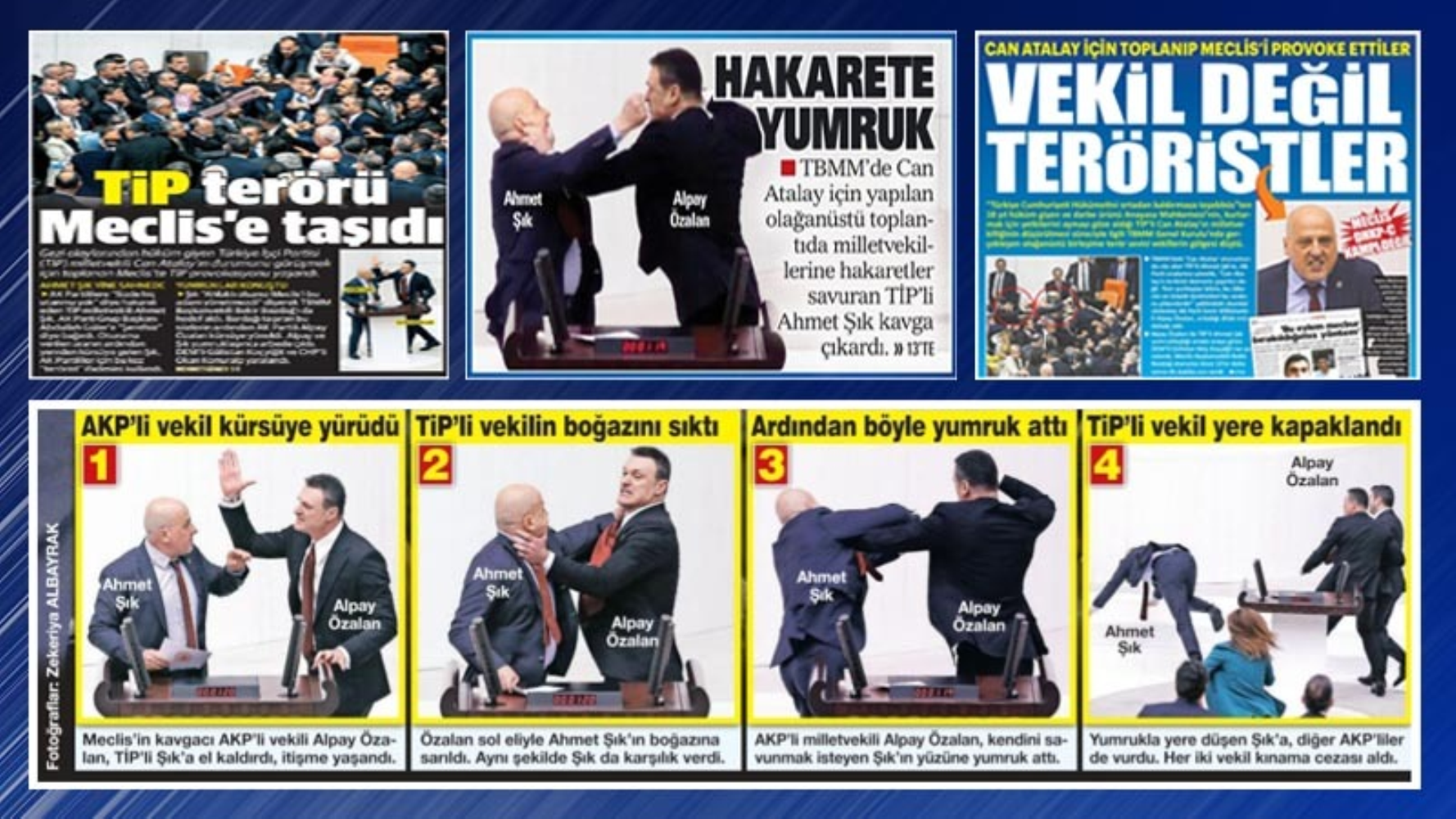
The pro-government media, which did not condemn the violence then, has now gone even further and defended AKP member Alpay Özalan, who attacked Ahmet Şık. They supported the violence against the MP who was speaking at the podium in the middle of Parliament:
"A punch to insults" (Akşam), "Fist to fist in the Supreme Parliament" (Hürriyet), "Big fight in the TBMM" (Milliyet), "Provocation from TİP in Parliament" (Sabah), "Blood flowed in Parliament" (Türkiye), "Not MPs but terrorists" (Yeni Akit), "TİP carried terror to Parliament" (Yeni Şafak)
The commentary on pro-government television channels was in this direction as well; instead of saying that no matter how harsh or insulting Ahmet Şık's words were, they would not justify violence, they openly backed the attack by Alpay Özalan and the AKP members.
When this is the case, one can no longer speak of the safety of opposition MPs in Parliament. Backed by the government's power, law, and journalists, AKP members can attack any MP whose speech they do not like as they please; and the media will applaud. One who does not say "Violence is wrong, whoever it comes from and whatever the reason" cannot be called a journalist.
JOURNALISM GAP IN "STREET INTERVIEWS"
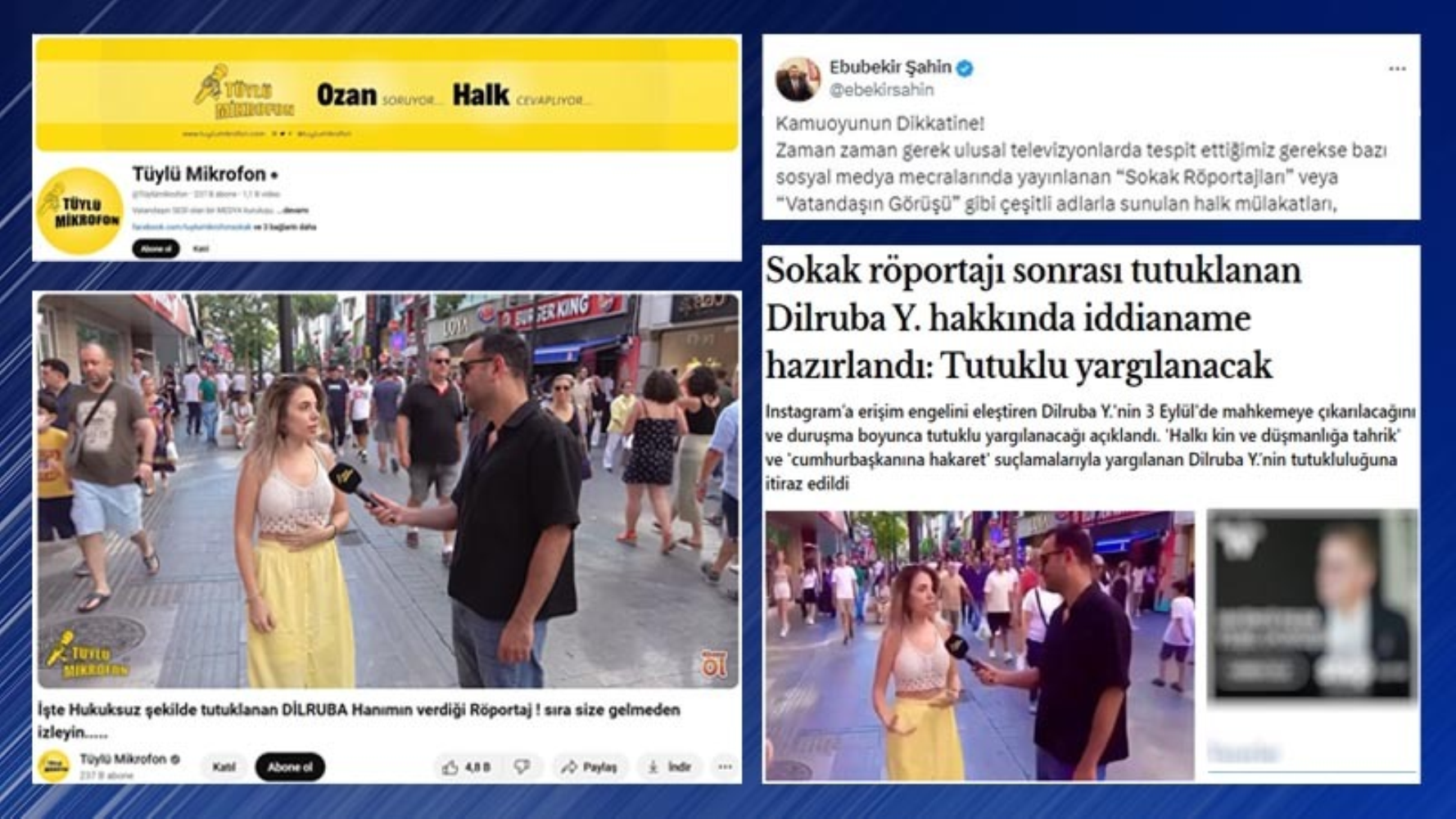
It was evident from the post by RTÜK President Ebubekir Şahin that the AKP government is uncomfortable with "Street Interviews." The unlawful arrest of Dilruba Y., who criticized the Instagram ban, is also a result of this discomfort…
They likely want to instill fear in people by punishing them preemptively just for speaking out and criticizing the government's restrictive stance. Because RTÜK has no authority over "Street Interviews"; the law is clear. These interviews, called "Street Interviews," conducted by randomly holding microphones to people on the streets, are not radio or television broadcasts…
Furthermore, it is not possible to evaluate all "Street Interviews" according to journalistic principles and rules. Indeed, the interview that served as the basis for the arrest of Dilruba Y. was published on a YouTube account called "Tüylü Mikrofon." Ozan Çakmakçı, who conducted the interview, calls himself a "reporter," but he is not a journalist; he is a YouTuber, or in the fashionable term, a "content creator."
If he were a journalist, he would have put the interview with Dilruba Y. through an editorial filter and applied journalistic rules. He did not do so because his only goal was to get more views and more engagement.
There is no insult, discrimination, or hate speech in Dilruba Y.'s words, but there are some low-level, rude words and derogatory expressions like "brain-washed idiots." Those are disturbing. If it were on television, those parts would definitely have been removed. Thus, she would have been prevented from having problems herself, and a justification for the government's unlawful arrest would not have been created.
"Street Interviewers" need to draw moral boundaries for themselves and set rules. They might not escape being a target of the government, but their broadcasts would sit on a more respectable plane. The fundamental issue is the journalism gap in these interviews that provide a space for freedom of expression for people.
PEKER AÇIKALIN AND CONSCIENCE IN REPORTING
The latest victim of the absurdity of publishing everything heard, or even every rumor or bizarre claim as an "allegation" under the name of reporting, was the artist Peker Açıkalın.
On August 9, a social media account called MagazinBurada posted: "Master actor Peker Açıkalın had a brain hemorrhage! It has been learned that a confidentiality order has been placed on the hospital file of Açıkalın, who is alleged to have lost his ability to speak and will undergo a series of surgeries."
This "news," whose source was not even clear, instantly spread through the media from Aydınlık to CNNTürk. As always, news sites raced to get clicks over Açıkalın's health this time as well. The saddest part was that a site called Haber33 used the headline "Did Peker Açıkalın die?" They did not care how sad Açıkalın's loved ones and relatives would be.
However, after a while, the artist's wife, Çilem Açıkalın, refuted these claims with a post: "Yes, he was operated on 4 months ago, but his health is quite good. It is not as written. Please do not believe these baseless news reports. My husband is quite well and healthy." This time, news reports stating "It was alleged that Peker Açıkalın had a brain hemorrhage" and "...the claim was refuted" were published.
Just as it is wrong for a magazine site to report without asking or verifying with Peker Açıkalın's wife and relatives, it is equally wrong for news sites to copy what they wrote without checking. The cost of publishing as an allegation and then correcting it is the loss of credibility and reputation for journalists. Not to mention the unnecessary sadness of the artist's relatives and loved ones…
LOOK AT THE REQUEST
On the day Palestinian President Mahmoud Abbas arrived, a "Live Broadcast Announcement" was sent to journalists from the Parliament Speaker's Press Unit. The frequencies of the links where Abbas's speech would be broadcast in Turkish, English, Arabic, and French were provided. And a "request" was made:
"We request that the entirety of the addresses of our Honorable Speaker (of Parliament) and Mr. Abbas be broadcast LIVE."
In fact, even without the Parliament Speaker's "request," it was clear that news channels would broadcast Abbas's speech live. What they really wanted, with a tone like giving an order, was for Parliament Speaker Numan Kurtulmuş's speech to be broadcast live as well. Clearly, they saw themselves in a position to make such a request of journalists.
Indeed, this "request" of theirs was largely fulfilled. During Kurtulmuş's speech, more than 20 news channels were broadcasting live. Naturally, there was more interest in Abbas's speech; all news channels except Sözcü TV broadcast it live from beginning to end.
In a single sentence:
- Akşam and Yeni Şafak ignored the news that Şakirpaşa Airport would close after the opening of Çukurova Airport and published the news "Şakirpaşa moved to Çukurova in 4 hours"; according to them, Adana airport did not close, it moved.
- In the Türkiye newspaper, it was written that Mehmet Doğan "would be buried in the Taceddin Dergâh, where Akif's grave is also located," but M. Akif Ersoy's grave is in Istanbul, and the Taceddin Dergâh is the place where M. Akif Ersoy wrote the National Anthem.
- 45 companies, including Amazon, Ülke TV, Blu TV, Dsmart, Disney+, TLC, Exxen, Cosmogo, Gain, Netflix, Szctv, Mubi, NTV, Turkuvaz, TV8, Puhu TV, and Spotify, applied to RTÜK and received an "Internet broadcasting license," but Youtube Music, Apple TV, and AppleMusic continue to broadcast without having applied for a license yet.
- Sabah had used the headline "6 million roots of drugs seized," but security forces had not found "drugs," but "plants used to make drugs" such as hemp and skunk.
- TRT Haber prepared a 3.5-minute special promotional video for the anniversary of the AKP's founding and broadcast it on its news program.
- Journalist Hande Fırat shared a photo while getting skin care at a beauty center and promoted this center with the tag "#notanadcollaboration."
- Sözcü, in its news "Giant health investment in Turkey," promoted Medicana's new hospital and made exaggerated praise such as "started a new era in health with a new generation service approach."
- In the news by Gazete Pencere, Gazete Oksijen, and Yeni Şafak, "They damaged a rock-carved structure for an advertisement in Cappadocia," the information that the company fined was Kığılı was missing.
- CNN TÜRK, which watched the US Department of Defense spokesperson's press conference, broadcast the news with the announcement "Pentagon explained to CNNTÜRK" as if it had conducted an exclusive interview.
- In the media, the name of the hotel was not written in the news about a customer moving their bed to the restaurant to protest the failure to solve a problem with the air conditioner, but it was stated on the site called Turizmhabermerkezi that this protest took place at Fun SunFamily Life Belek.
FOR YOUR CRITICISM, COMPLAINTS, AND SUGGESTIONS: [email protected]
Most Read

Striking picture for Özgür Özel's 'New Party'

The PKK opening and Özgür Özel’s path!..

How did the newspapers view Özgür Özel's farewell to the CHP?

He killed his wife by slitting her throat: Their children witnessed the moments

What did the CHP do?

Özel’s new party move in the world press

Fire at TUSAŞ engine factory in Eskişehir under control

The New CHP, against CEHAPE

From self-efficacy to despair

Kılıçdaroğlu's first message on Özgür Özel's new party announcement