



Yılmaz Bilgen, a reporter for Türkiye newspaper, is a true "chaos hunter"! Wherever he goes, he immediately discovers a "chaos lobby" or a "chaos gang" there; he keeps churning out stories headlined "Chaos plan activated," "Chaos lobby won't stop," "Chaos gang swings into action." He discovers a "chaos lobby" in Hatay, where he went to cover the earthquake — and in Syria too. It's always the chaos lobby, the chaos gang, the chaos plan…
When I most recently saw a story headlined "Chaos plan activated on multiple fronts," again bylined Yılmaz Bilgen, on the front page of Türkiye newspaper on 23 February, I launched an archive search. I found that he has written a full ten "chaos" stories since 2022. Below each headline I have summarised the content in Bilgen's own words:
Chaos plan activated: New scheme built around refugees (5 May 2022) More than 60 million dollars was set aside for provocations and incitement centred on Syrian refugees.
Provocation teams in the field: Chaos lobby won't stop (12 February 2023) Dirty hands that see the earthquake as an opportunity for chaos have taken the stage. Sabotage teams are preparing to spark a civil war and an uprising.
Insidious enemy in pursuit of opportunity (20 February 2023) The chaos gang, seizing on the earthquakes as an opportunity, has moved to ignite the flames of sedition along ethnic lines.
Their goal was not to help but to create chaos! (7 February 2024) The foreign-backed chaos gang had been working to ignite the flames of sedition along ethnic lines.
They are financing terror sympathisers for chaos! (19 February 2024) The Paris-led chaos lobby, seeking to destabilise Turkey ahead of elections, has swung into action.
Crypto agents in public institutions and the judiciary lying in wait (21 February 2024) FETÖ, together with other terrorist organisations, has moved to create chaos. The target is a coup by 2026 at the latest.
Foreign services in pursuit of chaos (15 May 2024) Terror operations in Iraq and Syria and the initiative taken in Gaza are cited among the most important reasons for the chaos that is sought to be manufactured in Turkey.
Dark gangs unite for chaos (23 May 2024) Information was obtained that several mafia-like structures have been brought together to produce chaos, and that the Boyun gang will also be used in the plot.
Chaos alliance inciting society! (1 September 2024) The CHP, the DEM Party — an extension of Kandil — and the Zafer Party are working in cooperation, playing on raw nerves to inflame society.
Chaos plan activated on multiple fronts (23 February 2025) Recent developments have updated the calculations targeting Turkey. This time, they will try different tactics from those used in Gezi and 15 July.
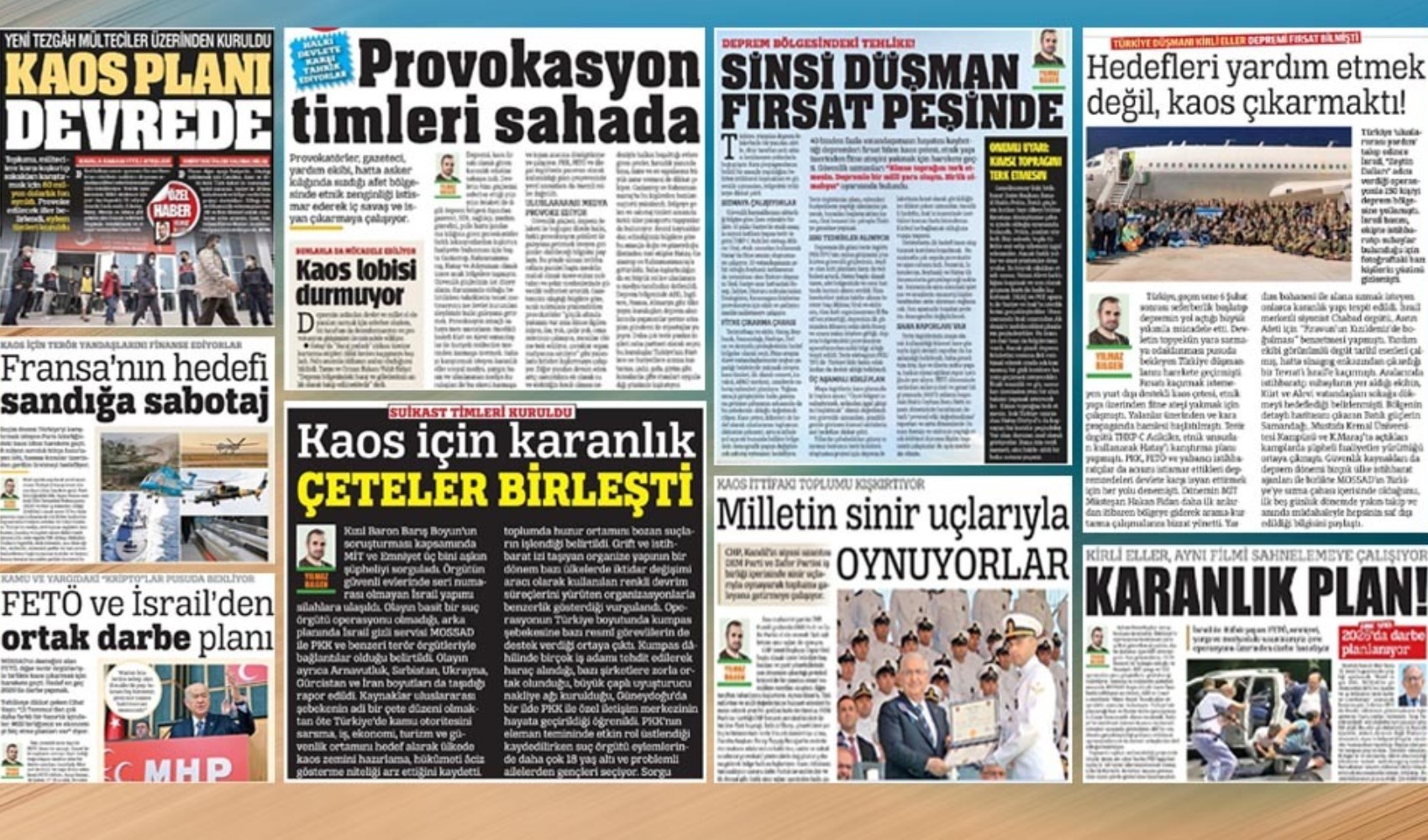
The striking aspect of Bilgen's "chaos" stories is that they are mostly not grounded in any concrete source, and are written with vague expressions such as "it was stated," "it was learned," and "information was obtained." For example, he based his most recent piece, "Chaos plan activated on multiple fronts," on Prof. Dr. Adem Palabıyık and Cihat Yaycı, whom he emphasised are "experts in their fields." Yet Palabıyık is a sociologist and Yaycı is a retired admiral. It is also unclear what data they relied on when they spoke.
In the opening of the story he wrote: "Forces that had gone into standby mode following Gezi and the failed 15 July coup attempt have swung back into action." What happened after they swung into action — that part is missing. In a box headlined "State on alert," he reported "more than 100 NGOs awaiting orders for chaos" and that "specially trained operatives have begun to be placed," but the source was again nothing more than "it is stated."
I will not belabour the point: these are stories that contain no data to suggest they are true and go no further than the author's own interpretation. Yılmaz Bilgen is someone who told the Haksöz website "I am supporting the Syrian uprising through the press and media" and "I stood in the ranks of fighters who negotiate nothing and make no commitments," and who practises journalism accordingly. Let us grant that Yılmaz Bilgen is steeped in a world of chaos and coup conspiracies — but where is Türkiye newspaper's editorial filter? It does not appear to be working in these stories.
NOT A RAPE STORY BUT A PORNOGRAPHIC NARRATIVE
Although the piece says "what a 13-year-old child went through will chill your blood," the sentence that immediately follows in the headline — "They queued up at the window to rape her" — evoked a pornographic story rather than shocking the reader.
The story written by Seyhan Avşar on the Gerçek Gündem website, concerning the rape of a 13-year-old girl in the Ilgın district of Konya, was filled with details that matched the pornographic connotations of the headline. "Information" such as the 16–17-year-old defendants entering the house through a window and having sex with A.A. one after another, and ejaculating into a towel or cloth so she would not become pregnant, was recounted at length. It was reported that she was threatened with being told on to her father and was frightened into compliance — yet at the same time, sentences such as "I consented to half of the sexual encounters I had with Zeki, but not the other half" were quoted, effectively providing a justification for the sexual abuse.
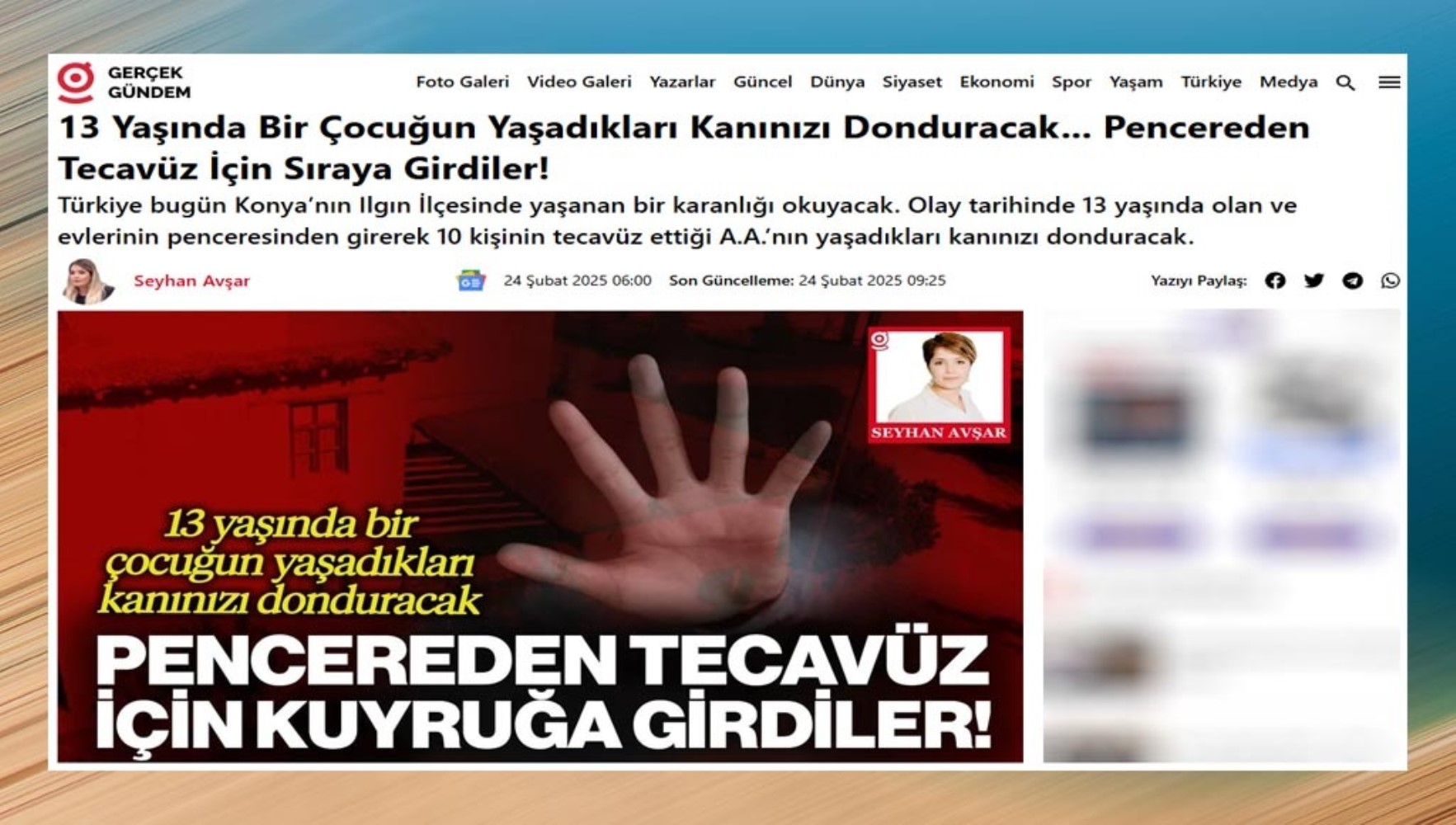
At the end of the story it was noted that one of the defendants was acquitted, while the other nine defendants were sentenced to prison on charges of "aggravated sexual abuse," "violation of the inviolability of the home," and "simple sexual abuse," though the verdict was overturned on appeal.
In a rape story of this kind, there was no need to provide so much detail about the sexual abuse. The horror of the abuse could easily have been conveyed without supplying that pornographic information. But it is clear that an attempt was made — and succeeded — to produce a text that would attract more attention than an ordinary rape case. However, what emerged was a narrative that also blames the victim girl, is harmful to her, and could potentially serve as a model for individuals inclined to commit such crimes.
The Media and Diversity Guide of the Turkish Journalists' Association states: "Care must be taken with the language used in reporting sexual crimes such as harassment and rape. Care must be taken to ensure that the visual material and narrative style used in such stories do not create pornographic or encouraging connotations." This story is, unfortunately, a textbook example of a violation of these principles.
I should note that, as in the Gerçek Gündem story, I also used the term "rape" alongside "sexual abuse." This is because rape is one of the most severe forms of sexual abuse. Saying only "sexual abuse" without using the word "rape" would not be sufficient to convey the event accurately.
THE JOURNALIST SEARCHING FOR THE SNOWWOMAN
The story "They kidnapped snowwoman Safiye" was broadcast for two minutes on Show TV's main evening news bulletin. It must have been very well received, because it was also aired on Habertürk the following morning.
Reporter Murat Dada first speaks with Sibel hanım, who named the snowwoman she built in her garden Safiye; he then sets out — as an "investigative journalist" — to search for Safiye, whom he describes as "the neighbourhood's most beautiful snowwoman." While talking to neighbours and a greengrocer in the neighbourhood, he tries to maintain a serious expression but cannot help laughing at intervals.
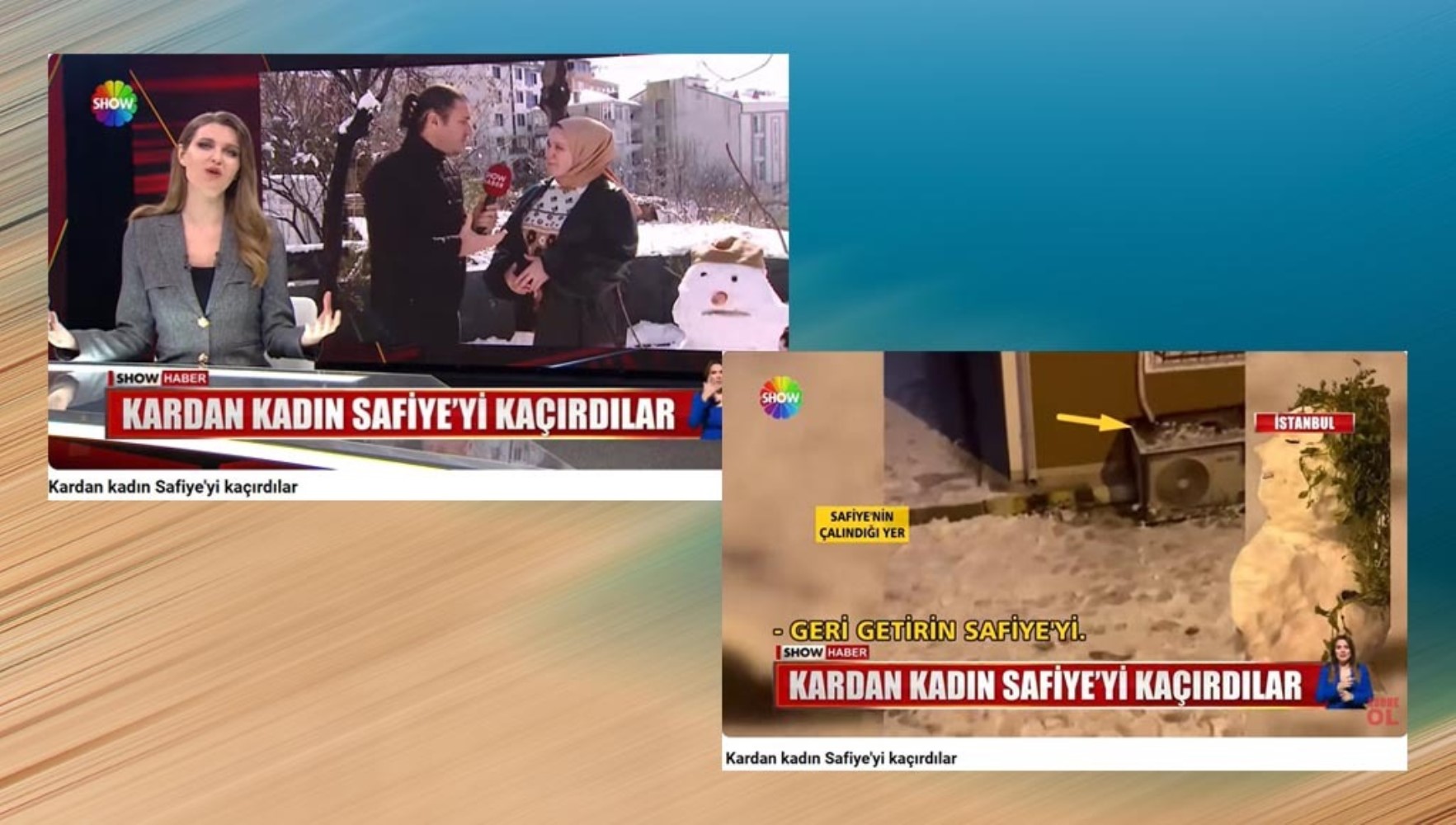
It must be admitted: these were entertaining images that would make people smile. But it was not news — and certainly not news worthy of being broadcast in a main evening bulletin.
One would think Turkey were a European country with so few events worth watching and following that Show TV can send a reporter and cameraman "to solve the mystery of the missing snowwoman," and they can spend energy and time searching for a snowwoman!
The Safiye the snowwoman story is a striking example of how far television channels outside the news channels have come in their journalism. Sadly, a large portion of those television channels' main evening bulletins is filled with such trivial stories.
Some broadcast entertainment footage as news because they are trying to ingratiate themselves with those in power; others because they fear incurring the wrath of those in power — they have even abandoned the ratings race.
PALESTINIAN HOSTAGES OR DETAINEES?
When the release of Palestinians following the ceasefire was announced on the public news channel France Info TV with the subtitle "Palestinian hostages released," Jewish-origin Deputy Caroline Yadan applied to Arcom, France's equivalent of the RTÜK. The channel's management issued a statement saying "it was not done deliberately and was a human error," and suspended the staff member who wrote the subtitle.
In the French media, the term "Palestinian detainees" is used. It is argued that the term "Palestinian hostages" implies an equivalence with Israeli hostages. Le Monde, after explaining the definitions in response to a question on the matter, gave the answer: "There are detainees in Israel, there are hostages in Gaza — that is the reality."
In Turkey, until recently, headlines used "hostage exchange" or "prisoner exchange," while stories used the terms "Palestinian convicts" or "Palestinian detainees." But some outlets, such as NTV and Yeni Akit, also occasionally used "Palestinian prisoners of war."
When Foreign Minister Hakan Fidan announced that 15 of the Palestinians released by Israel had been brought to Turkey, his use of the word "esirler" (prisoners of war/captives) changed the media's language. Anadolu Ajansı, Sözcü, CNN Türk, Artı Gerçek, Posta, Medyatava, Sabah, and Takvim published that story under the headline "Palestinian prisoners of war/captives"; after that, the term "esir" spread widely in the media.
Technically speaking, "Palestinian convicts" or "Palestinian detainees" is more accurate. Yes, the parties are an organisation and a state. Calling the people abducted by the organisation "hostages" is fine. But the state on the other side is also a state that tramples on law and human rights. It cannot be said that Palestinians were detained and convicted through fair trials. Saying "detainee" or "convict" could also mean legitimising Israel's unlawful practices.
In such a situation, every media organisation can make an editorial choice in line with its editorial line. However, media organisations should discuss and decide on definitions in advance. And then, when a politician like Hakan Fidan uses a different term, they should not immediately convert his language into "news language."
In brief:
Akşam wrote "Read in four languages," but Öcalan's call was read only in Turkish and Kurdish; it was translated into Arabic and English in DEM Party's live broadcast on social media.
Sözcü TV's Serap Belovacıklı's refusal to broadcast the Kurdish reading of Öcalan's call — saying "we will put it on screen when they do it in Turkish as the official language" and "we are not airing it because nobody understands it" — was a discriminatory stance.
The story "Journalist Sever passed away," which Milliyet squeezed into seven lines, did not even include the information that Ahmet Sever had worked at Milliyet for years as its Brussels correspondent.
Among the 12 TV channels whose daily broadcast schedules are published on the television page of Nefes newspaper — founded by those who left Sözcü — Sözcü TV is not included.
In Sabah's story "Prosecutor who was attacked by hooligans speaks out," the information about where prosecutor Necip İşçimen spoke — whether at a hearing, at the prosecutor's office, or elsewhere — was missing.
Yeni Şafak, following the example of Turkuvaz Group's summits, organised a transport summit "under the auspices" of the Ministry of Transport and an agriculture summit "under the auspices" of the Ministry of Agriculture.
Milliyet deceived its readers by publishing the promotional text of the AKP-run Ordu Metropolitan Municipality as a news page without the warning "This is an advertisement."
Cumhuriyet, Dünya, Türkiye, and Mynet used Elips Haber's story "Dündar announced: Cigarette price hike expected" without citing the source.
The mainstream media used the story "17 of the Madımak convicts released," published on the Büyük Sivas website under the byline Menekşe İrem Çolak, without citing the source.
The recall of six Ülker products in the United States on the grounds that "allergen contents were not stated in the ingredients," and Ülker's statement on the matter, did not appear in the mainstream media apart from a few news websites.
Akşam and Yeni Şafak deceived their readers by publishing an online shopping company's text headlined "Ramadan shopping from the market in your pocket" as news without a advertising disclaimer.
FOR YOUR CRITICISM, COMPLAINTS AND SUGGESTIONS: [email protected]
Most Read

Striking picture for Özgür Özel's 'New Party'

Özgür Özel gives a dated response regarding the number of resignations

Forest fire in Antalya brought under control

The PKK opening and Özgür Özel’s path!..

How did the newspapers view Özgür Özel's farewell to the CHP?
Houthis strike Saudi-owned tanker

What did the CHP do?

Özel’s new party move in the world press

The New CHP, against CEHAPE

From self-efficacy to despair