



Do not be fooled by the fact that newspapers, news websites, and television channels are now filled with reports on the “Gülistan Doku murder.” Initially, the Gülistan Doku file was intended to be closed as an ordinary “suicide case.”
From January 5, 2020, the day Gülistan Doku disappeared, what prevented the file from being closed was the struggle of women's organizations and the family's refusal to stop searching for their daughter. Opposition media, local journalists, and especially female journalists supported their efforts from the very beginning.
The interest of the pro-government media, however, was limited to searches in the dam reservoir and subsequent statements. As years passed, they lost interest almost entirely and largely forgot about this file.
Gülistan Doku’s family, who believed from the first day that their daughter was a victim of murder rather than suicide, never took a step back. They opened a “Gülistan Doku’s family” account on social media, launched a campaign with the hashtag #GülistanDokuyaNeOldu (What happened to Gülistan Doku), and continued searching for their daughter through criminal complaints and protests. The persistence of the family and women's organizations led the police and the prosecutor's office to form special teams from time to time, and even resulted in the brief detention in Alanya in 2022 of Zeinal Abarakov, the boyfriend who was the last person to see Gülistan Doku before she disappeared. Yet, the investigation never seemed to progress.
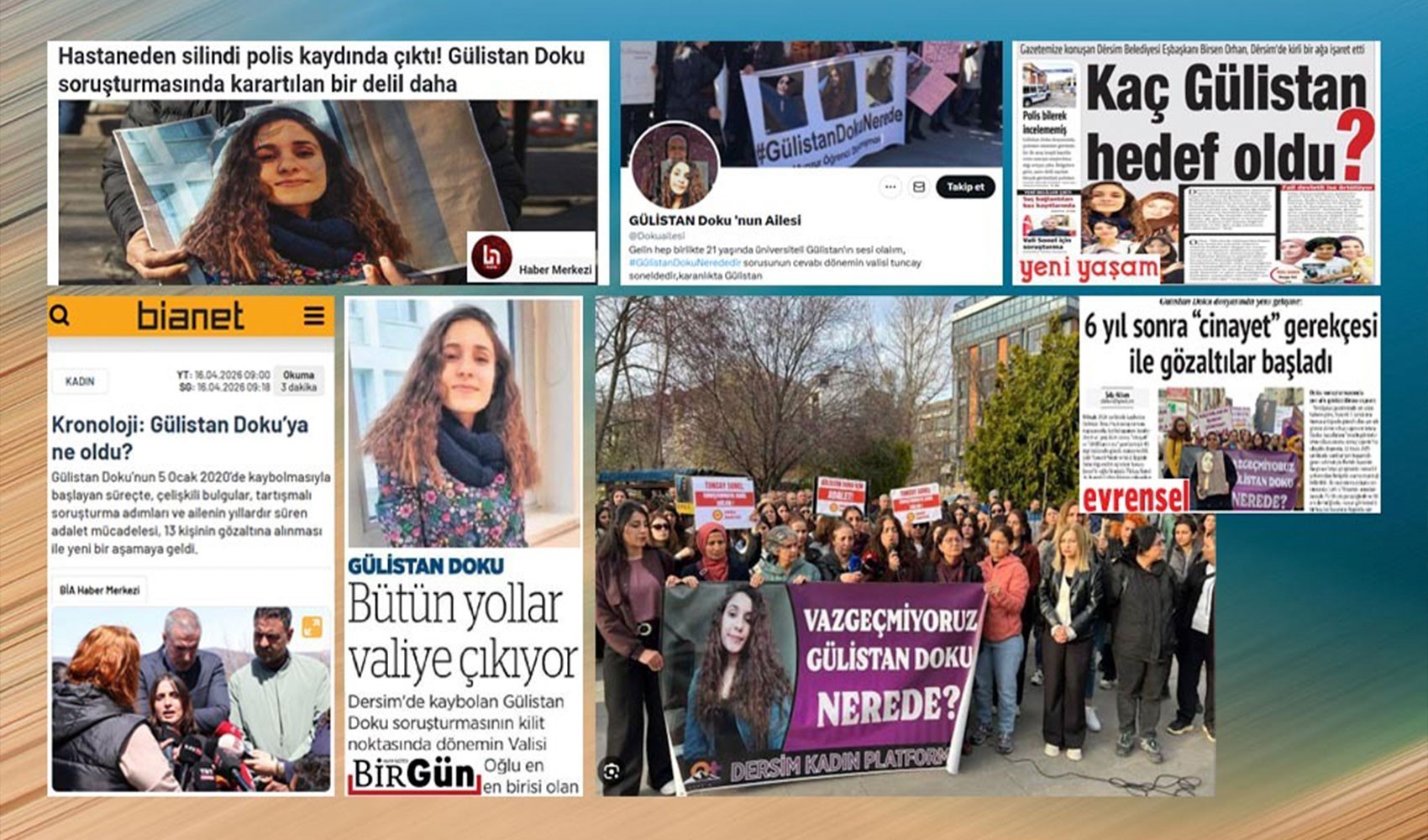
After 2022, women's organizations and her entire family, led by Gülistan Doku’s mother Bedriye Doku and sister Aygül Doku Filiz, kept the “murder” allegations on the agenda through protests, criminal complaints, and statements. I am not listing names for fear of forgetting someone, but in general, the opposition media and Kurdish media meticulously continued their coverage of Gülistan Doku; they published reports aimed at shedding light on the unanswered questions.
Among local journalists, Serhat Ozan Yıldırım and Ferit Demir, in particular, carefully followed the protests and all initiatives taken for Gülistan Doku for years. Both contributed significantly to the flow of news to the mainstream media. Tuncay Sonel, the Tunceli Governor at the time, whom the family accused of “covering up the murder,” filed a lawsuit against Ferit Demir due to one of his reports. When Ferit Demir received the summons for the hearing at the Ankara 7th Civil Court of First Instance, he asked questions such as, “Why did you say ‘Gülistan Doku jumped from the Sarısaltuk viaduct and committed suicide’ when you had no evidence?”
The investigation file, which had remained closed for a long time, was reopened with the appointment of Chief Public Prosecutor Ebru Cansu to Tunceli in 2024. The Chief Prosecutor reached new evidence that strengthened suspicions that Gülistan Doku had been murdered. Ten people, including Mustafa Türkay Sonel, the son of the former governor, were arrested on suspicion of “intentional killing” and “tampering with evidence.”
One should not find it strange that Halk TV hosted Tuncay Sonel’s lawyer. What matters is how the conversation was conducted and what was asked. The lawyer was not merely hosted; he was grilled with the right questions. There is nothing wrong with granting the defense a right to speak.
Now, the entire media’s attention is on this investigation. Let me remind you that, as with every investigation, we must set our emotions aside and observe and report with the composure of a journalist. A journalist speaks and writes based on data and evidence, not with prejudices or preconceived notions.
THE PHOTOGRAPHS OF THAT CHILD
The call for “the media to act with a sense of responsibility” in the Directorate of Communications’ statement regarding the school attacks in Şanlıurfa and Kahramanmaraş was valuable:
“Detailed descriptions of violent acts, highlighting the identities of victims and perpetrators, and keeping events on the agenda by dramatizing them may create an incentive for similar acts and deepen the climate of fear and panic in society. Therefore, moderation, sensitivity, and ethical principles must be the basis of broadcasts.”
These were justified warnings that we have also been emphasizing for years. However, even the pro-government media did not comply with this call; across the media, there were broadcasts that disregarded ethical principles, magnified the impact of the violence, and would increase trauma in society.
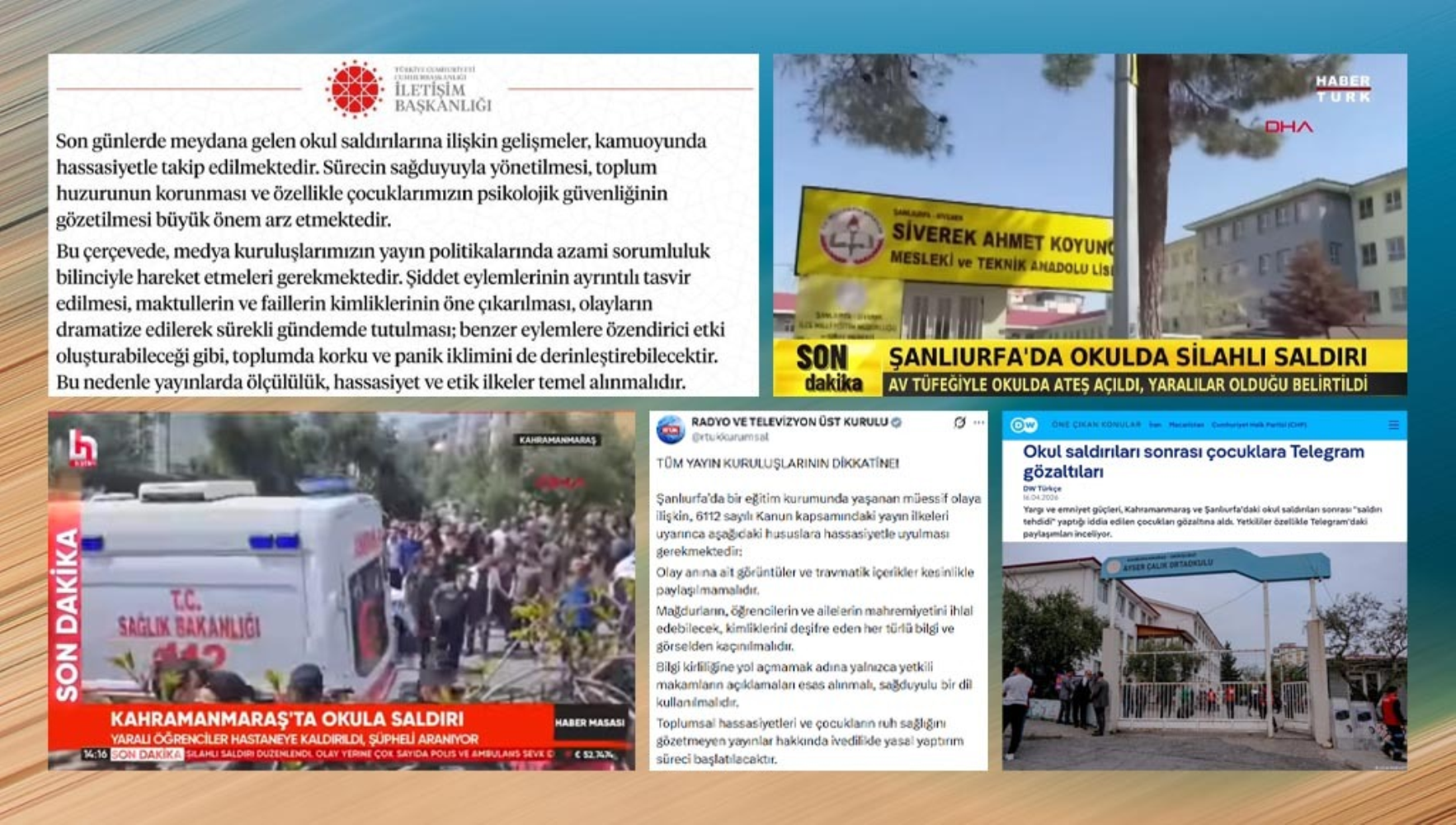
Photographs and footage of the 14-year-old attacker shooting at a firing range, celebrating his birthday, and dancing at school were used. Yet, the danger of such visuals is evident even from the fact that the attacking child put a photo of Elliot Rodger, who murdered 6 people in the US, on his WhatsApp profile.
Our priority should have been to take care to ensure that school attacks do not become an incentive and do not create an effect of fear and panic in society. Unfortunately, this could not be done; the media acted as an intermediary for the spread of fear and anxiety. The root causes of the school attacks were not focused on; the responsibility of public authority and the deterioration in the education system were ignored.
These attacks were treated as individual and family problems; the failure to prevent the attack was reduced to a security issue. When viewed through a police lens, children were placed at the center of “crime” and portrayed as a security threat. The subsequent detention of children was also supported in the news as if it were a method to prevent danger.
Since we know the coverage of similar events, this journalism was not very surprising. Because for the media to present these attacks with their root causes and in accordance with ethical principles, they must be organizations that are free from concerns about viewership/readership and prioritize the public interest. Unfortunately, the mainstream media is far from this line. Economic and commercial concerns and the interests of the political power are more of a priority for them.
Even before these attacks, the news and especially TV series were full of violence. In TV news and on news websites, footage of peer bullying in schools and fights between children was repeatedly broadcast in a way that set an example. Even TRT’s series were full of bloody scenes. Pro-government channels were covered in violent, mafia-themed series.
Following the school attacks, RTÜK, which issued a statement saying, “do not share footage of the incident, do not talk to victims and eyewitnesses,” was ignoring the violence on pro-government television channels. If RTÜK had done its job as a “regulatory body” until today, there would have been no need to panic and rush to take violent TV series off the air or change their scripts after these school attacks.
There should never have been violence in those series to begin with.
NEWLY INVENTED: THE CRIME OF BEING FAMOUS
I can no longer count which wave of the “drug operation against celebrities” we are on; I have lost track. Last week, “celebrities” were detained again, and the label “celebrity” was once again in the news headlines:
“Eight more celebrities end up in jail,” “Eight more celebrities arrested,” “New development in the drug investigation into celebrities.”
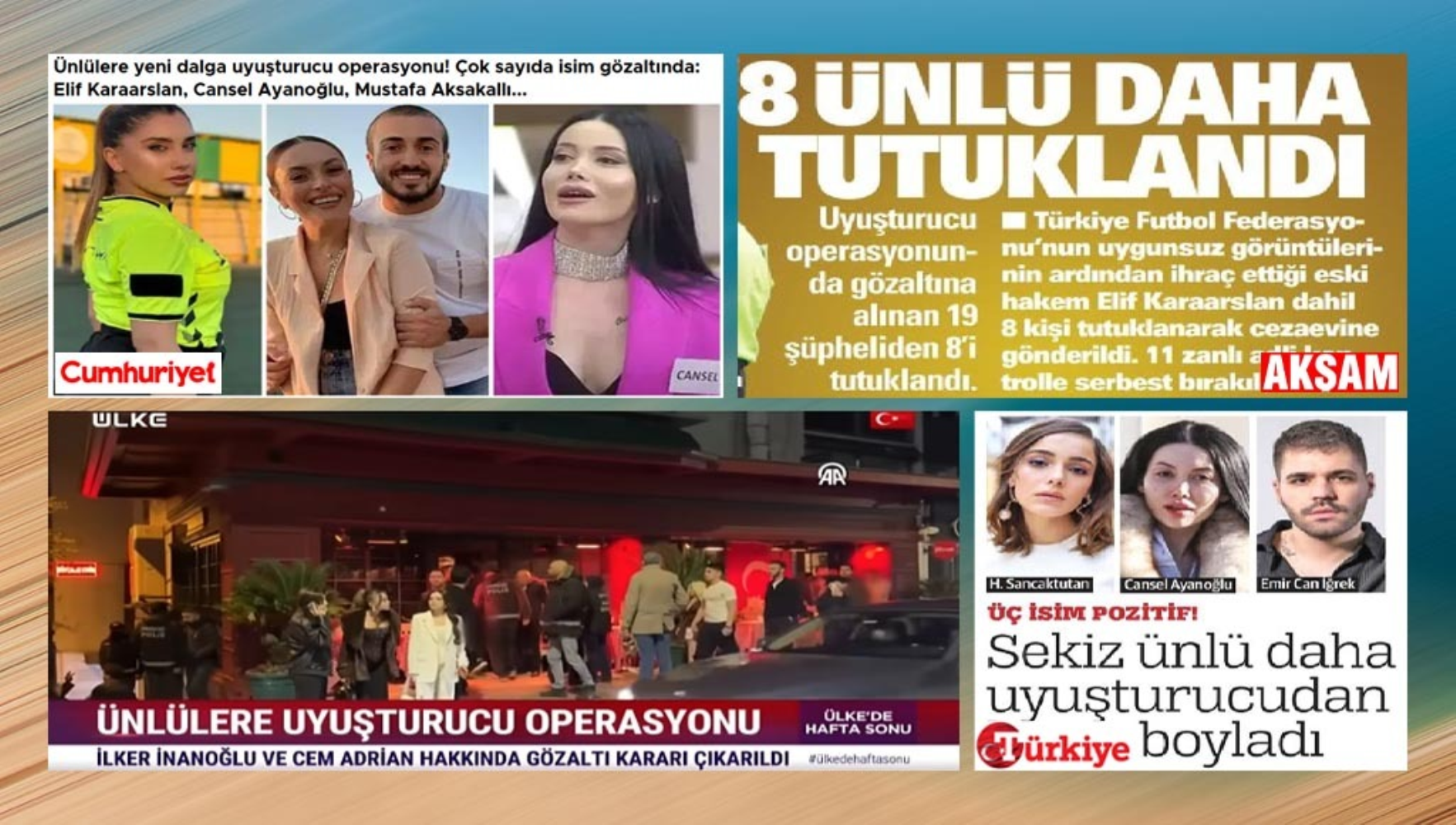
Are these people being subjected to operations because information or evidence has been obtained that they use drugs, or just because they are famous? Istanbul Chief Public Prosecutor Fatih Dönmez, while explaining the success of “drug operations” at a meeting with courthouse reporters, indirectly provided the answer to this question:
“Celebrities are people who are taken as examples and admired. We think that awareness in society and families is increasing. Our narcotics operations will continue.”
Chief Prosecutor Dönmez has explained with these words, in an indirect language, that they use “admired” celebrities to “increase awareness in society.” Indeed, he also provides the information that “narcotic substances were found” in 169 of the 255 suspects detained within the scope of the “celebrities drug file.” He does not mention the victimization of the 86 “celebrities” in whom no drugs were found.
Chief Prosecutor Dönmez says on one hand, “Our goal is not to expose,” but as soon as these people are detained, they announce them by name, declaring them guilty and stigmatizing them. In this way, being a “celebrity” is presented to society as a crime in itself.
As the operations continue in waves, “anxious waiting, fear, and unrest” are spreading in the art world, the theater, TV series, and cinema sectors. So much so that producers have reached the point of considering drug testing for actors when starting projects. Unfortunately, the media also contributes to the “character assassination” of celebrities by repeating the prosecutor’s statements and language.
THEY PUNISHED JOURNALISM AGAIN
BirGün columnist and BirGün TV programmer Zafer Arapkirli began his defense in the trial he is facing by reporting a “more serious and real crime”:
“‘The crime of dragging the public into a collective and dense darkness.’ Today’s political power, like the situation I am exposed to, wants to prevent independent journalists from doing their jobs, thereby obstructing the public’s right to information and news.”
Citing journalists Merdan Yanardağ, Alican Uludağ, and İsmail Arı, who are still kept in prison, as well as Furkan Karabay and Sinan Aygül, against whom lawsuits have been filed, as examples, Arapkirli said, “They are trying to punish journalism by finding a pretext.”
As always happens in such cases, this defense did not affect the court at all; they sentenced Arapkirli to 2 years and 6 months in prison on the grounds that he “publicly disseminated misleading information to the public.”
The validity of the assessment that “journalism is being punished” was proven once again two days later by the decision of the Bakırköy 34th Criminal Court of First Instance. Journalist Timur Soykan was sentenced to 10 months in prison for “violating confidentiality,” and Barış Pehlivan and Murat Ağırel were each sentenced to 15 months in prison for “publicly disseminating misleading information to the public.”
The reason for the sentences given to Soykan, Pehlivan, and Ağırel was the broadcast on the “Kayda Geçsin” program on Halk TV, which explained that Turkey’s trade with Israel was continuing and that gold smuggling was taking place in the VIP section of Istanbul Airport!
In Şanlıurfa, journalist Mehmet Yetim was also arrested on the same grounds. Yet, he was not misleading the public; on the contrary, he was trying to enlighten them; he was doing journalism.
In a single sentence:
• The word “tane” (piece/unit) is not used for living beings in Turkish, but Interior Minister Mustafa Çiftçi used the word “tane” exactly 11 times for the students and teachers who died, the injured, prosecutors, and inspectors in his statement after the attack in K. Maraş.
• The report in the Türkiye newspaper titled “No more requesting a quorum and running away in Parliament” did not mention the impact of ruling party deputies not coming to the TBMM (Grand National Assembly of Turkey) on the disruption of work.
• The report in the Yeni Yaşam newspaper titled “Miners on the road to Ankara” lacked the information that the workers set out from Eskişehir and that Doruk Mining is in this city.
• Yeni Şafak’s report titled “Erkol is not a priority in CHP” contained incorrect information that the CHP provincial chairs meeting was “planned for Wednesday”; the meeting was held on Tuesday, the day this report was published.
• Local journalist Yüksel Kalkan was attacked and beaten by a group after his reports about the CHP-run Ayvalık Municipality.
• Sports commentator and journalist Ertem Şener drove on the road to Bursa at 150 km/h, using the steering wheel with one hand while recording an announcement with his phone in the other, and published the footage on social media.
FOR YOUR CRITICISM, COMPLAINTS, AND SUGGESTIONS: [email protected]
Most Read

Striking picture for Özgür Özel's 'New Party'

The PKK opening and Özgür Özel’s path!..

How did the newspapers view Özgür Özel's farewell to the CHP?

He killed his wife by slitting her throat: Their children witnessed the moments

What did the CHP do?

Özel’s new party move in the world press

Fire at TUSAŞ engine factory in Eskişehir under control

The New CHP, against CEHAPE

From self-efficacy to despair

Kılıçdaroğlu's first message on Özgür Özel's new party announcement