



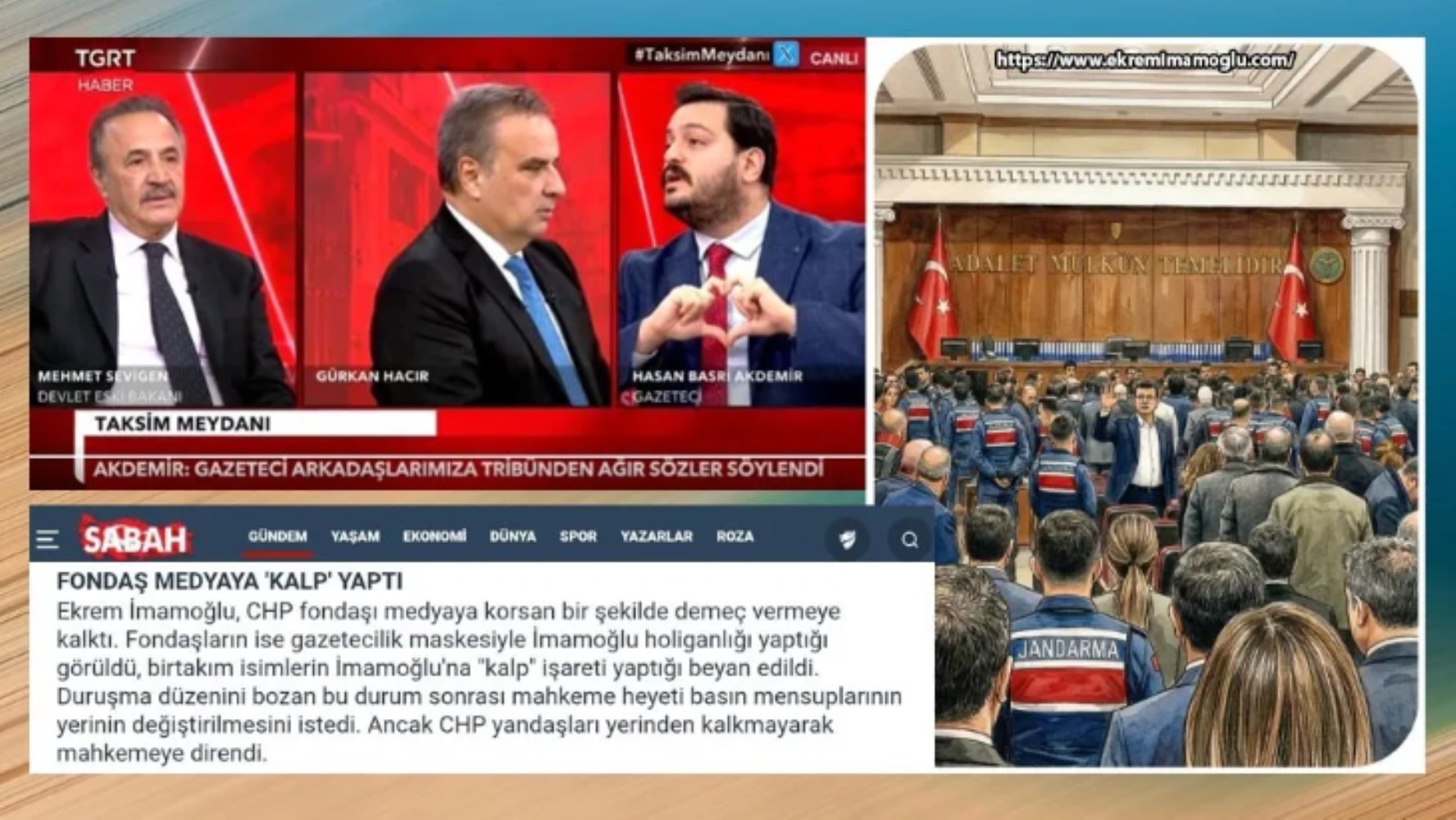
In Sabah's report titled "They made a 'heart' to the funded media," opposition journalists covering the Istanbul Metropolitan Municipality (İBB) trial were belittled as "CHP-funded"; a specific accusation was also leveled:
"Ekrem İmamoğlu attempted to give a statement to the CHP-funded media in a pirate fashion. It was observed that the funded ones were engaging in İmamoğlu hooliganism under the mask of journalism, and it was declared that certain names made a 'heart' sign to İmamoğlu."
Not only did they feel no need to use objective language in the report, but they also did not see the need to write down who saw these "certain names" making a "heart sign" to İmamoğlu and who "declared" it. Since what happened at the hearing was not secret, who saw it and who "declared" it could have been written, and should have been.
As such, I investigated the "declarant." I found that journalist Hasan Basri Akdemir had said on a program on TGRT, "Asking questions to İmamoğlu is the journalist's job. But doing this to İmamoğlu (making a heart sign with his hands) is not the journalist's job. This is not journalism."
Akdemir is very right; a journalist asks questions wherever they find the opportunity. Journalists cannot be blamed just for asking questions. But of course, a journalist cannot make a "heart sign" to a person on trial in a case they are covering. Such an attitude is incompatible with journalism.
However, Akdemir did not say anything on the program about who or whom made the heart sign. I spoke with him and asked about those who made this sign. He said that "a young journalist did it, and he did not give names so as not to put them in a difficult situation."
I understand not exposing them out of a concern for protection. But by not giving names or numbers, all the opposition journalists there were left under suspicion as if they had made this sign; this should not have been allowed to happen.
Indeed, Sabah newspaper used Akdemir's words—without citing a source—and by saying "certain names," it presented all the opposition journalists there as supporters making a "heart sign" to İmamoğlu. What Sabah did was a smear campaign under the "mask of journalism," as it emphasized in its own report. It was a great injustice.
When such a report appeared in Sabah, Akdemir clarified his words on the TGRT program, stating that "many journalists" did not make the "heart sign"; he criticized Sabah's reporting language. Of course, Sabah did not apologize to the journalists it accused, nor did it feel the need to correct its report.
Joint statement manipulation
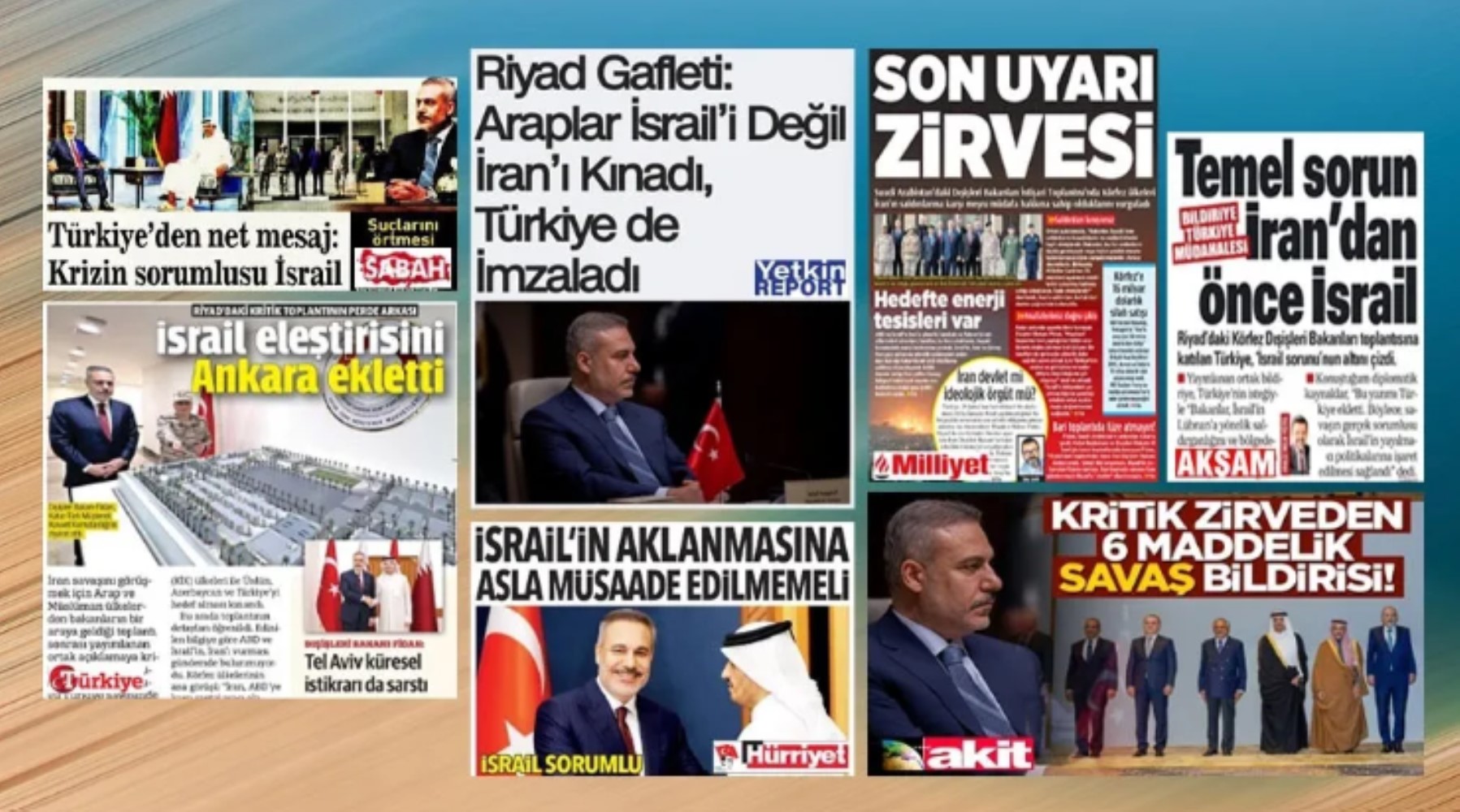
Reports regarding the joint statement of 12 countries, including Turkey, following the "Arab and Islamic Countries Foreign Ministers meeting" held in Riyadh, should be taught in communication faculties as examples of "manipulative journalism"...
Anyone with common sense who reads the statement, which was also signed by Foreign Minister Hakan Fidan on behalf of Turkey, understands that the core idea of this statement is a call to Iran to stop "the attacks it carries out with missiles and UAVs against Gulf countries, Azerbaijan, Jordan, and Turkey." The United States is not even mentioned in the six-article statement, and there is no objection to the attacks against Iran; it was not the US and Israel, but Iran, that was shown as the party responsible for the war.
While the statement and Turkey's stance were so clearly evident, the pro-government media did not refrain from manipulation in their "Joint Statement" reports. Hürriyet, which placed the report on the content of the statement on an inside page, published a report on the front page with the headline "Israel must never be allowed to win," and included Fidan's words, "The primary culprit of the war is Israel." Of course, there was no mention of how this view, which Fidan expressed in Doha, contradicted the statement he had signed in Riyadh hours earlier...
In reports by Akşam, Sabah, Türkiye, Milliyet, and Ülke TV, which claimed to reflect the "behind the scenes of the meeting in Riyadh," such as "Turkey had the Israel criticism added," "Clear message from Turkey: The culprit of the crisis is Israel," "The final warning summit," and "Turkey's intervention in the statement," it was emphasized that Turkey had ensured that "Israel's expansionist policies were pointed out" by having a sentence about Israel added to the statement.
It was true, the sentence "They also condemned Israel's aggression against Lebanon and its expansionist policy in the region" had been added to the text, but that sentence did not cover the war in Iran or the attacks by the US and Israel on that country.
Despite this, presenting a joint statement—in which Iran is shown as the culprit of the war instead of the US and Israel—by highlighting a sentence about Lebanon and words that are the exact opposite of what Fidan signed in the text, and presenting it as "Fidan's diplomatic success," is a misleading style of "journalism"! Especially the accounts and attitudes of the journalists Fidan took with him on his private plane...
A journalist who feels a sense of responsibility toward the society they live in and their profession cannot act this way.
The crime of spreading "enlightening" information to the public!
Now, İsmail Arı from BirGün newspaper has become the target of the accusation of "publicly spreading misleading information"; he was detained in Tokat, where he had gone to visit his family for the holiday.
İsmail Arı's latest reports, published for three consecutive days, were about the "Ayhan Bora Kaplan gang and the setup against the police" file. He also reported that the name of an MHP executive was mentioned in the file and that the gang leader's lawyer, Cengiz Haliç, had sent a message from his phone to the leader's right-hand man, Serdar Sertçelik, saying, "Sabah newspaper will publish a report characterizing the Ayhan Bora Kaplan operation as a 'coup'."
Indeed, one day after this message, the report "Ayhan Bora Kaplan criminal organization and coup attempt claim shook Turkey" appeared in Sabah! For some reason, although an MHP figure's name was included in the "Supplementary Indictment" as it appeared in phone correspondence, there was no mention of Sabah at all!
This information written by İsmail Arı must have angered the pro-government side quite a bit, as after it was announced that he was detained, they spent the night making posts supporting this operation and trying to legitimize it.
Judging by what they wrote and drew, that's not all. İsmail Arı's remarks some time ago on Zafer Arapkirli's program on BirGün TV regarding "foundations under the management of Bilal Erdoğan and the transfer of public resources to these foundations" also drew the reaction of some.
While reporting these, İsmail Arı was doing what journalism required without caring about who he might anger. But just because he did good journalism, someone had been targeting him for a long time, perhaps even since his reports on the Red Crescent selling tents during the earthquake days. Lawsuits and access blocks were never lacking.
Apparently, the report titled "Historical structures were written off," which announced that an area containing historical structures was chosen for the construction of a dormitory for the imam hatip high school from which President Erdoğan graduated, was also used as a justification for his arrest.
The accusation directed at İsmail Arı is "publicly spreading misleading information." But we journalists know that the real reason for his arrest is not that he misleads the public, but that he enlightens them. The real accusation is this, the "crime of spreading enlightening information to the public"...
Wrong photo in the "Maryam from Gaza" report
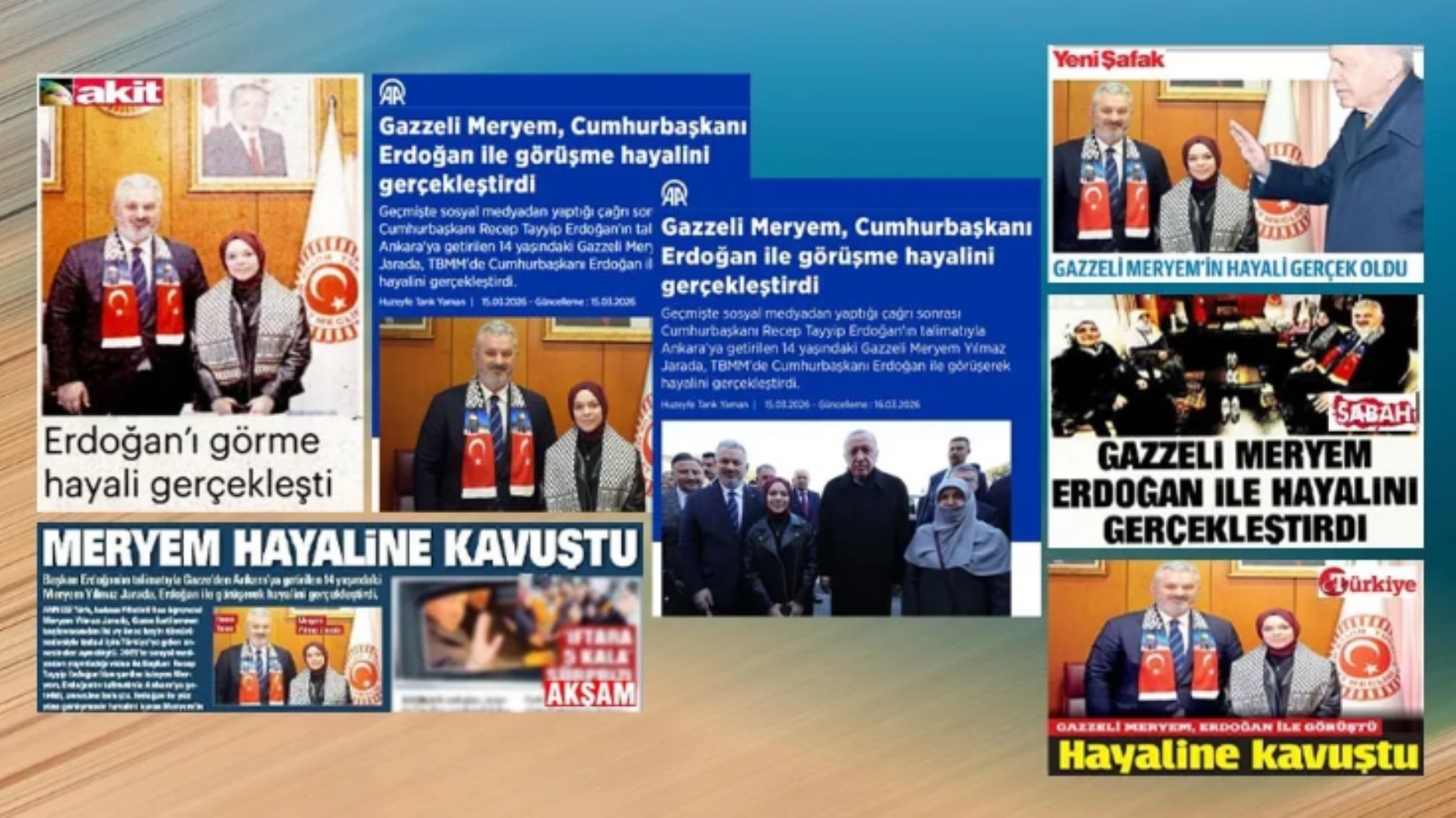
Reports titled "Maryam achieved her dream" and "Maryam from Gaza realized her dream with Erdoğan" were published in Akşam, Sabah, Türkiye, Yeni Akit, and Yeni Şafak newspapers.
The reports described how Hasan Turan, Chairman of the Turkey-Palestine Inter-Parliamentary Friendship Group, had enabled Maryam Yılmaz from Gaza to meet with President Erdoğan, thereby realizing the young woman's dream.
When reading these reports, one's eyes inevitably look for a photo of "Maryam from Gaza" taken side-by-side with President Erdoğan. However, there was no such photo in any of these reports. Only a photo with Hasan Turan was included.
Even if it were a brief meeting at the TBMM Group meeting, there should have been a photo with Erdoğan in the report. Or at least it should have been stated why there was no photo. The absence of these is wrong, incomplete journalism. When a photo with someone else is used instead of a visual element of the reported meeting, the report moves away from reflecting the realization of a young woman's dream and turns into an advertisement for commission chairman Hasan Turan.
Among those who published the report, only the editors of Anadolu Agency noticed the deficiency and later added a photo of the meeting between Erdoğan and Maryam to the report by obtaining it from the Presidency.
The fact that other editors could not perceive the deficiency is a journalism problem.
Doubt, curiosity, and accuracy in digital media
It can be difficult to distinguish truth, lies, and disinformation in digital media. Even communicators and journalists can lose their way in digital media and end up in dead ends.
It is not possible for people to possess a litmus-paper-like "truth-meter" that allows them to instantly detect errors. It is now mandatory for everyone to be a good digital media literate.
Within the framework of the "Our Media" project carried out under the leadership of the IPS Communication Foundation / Bianet, a guide was created that everyone who is a recipient of digital media can benefit from. The "Digital Media Literacy Guide," prepared under the leadership of Dr. Sinem Aydınlı and Prof. Dr. Yasemin İnceoğlu, includes articles by 15 experts, including myself.
Each article is summarized with questions at the bottom. After finishing the guide, it is of great benefit to keep those questions in mind. Let me present a selection of those guiding questions:
"Do I look at information in the digital environment critically? Do I question the source? Do I follow media that makes room for different voices? Do I investigate by whom, for what purpose, and representing which interests the content I encounter in the digital environment is produced?
Even under the pressure of speed, do I verify the source, time, and context of the news?
Do I avoid manipulative clickbait strategies in headline and content production?
Can I keep the principles of doubt, curiosity, accuracy, and public interest alive along with digital tools? Can news organizations admit their mistakes and explain them to the public, and maintain a culture of self-criticism?
Are there transparent structures (ombudsman, media monitoring platforms) where readers can convey their views and participate in decision-making processes? Can journalists, NGOs, and citizens work on media ethics and social trust on common platforms?
Do we evaluate the discriminatory or exclusionary effects of the discourse as much as the accuracy of the information shared?"
These questions advise not only distinguishing truth from falsehood but also being a participant and thinking critically in digital environments. The main purpose of the guide is to strengthen democratic culture...
In a single sentence:
In Akşam's report "Zero-mile vehicle could not leave the service," the brand of the accused vehicle was hidden.
In ANKA's report "Children's Literature House opens its doors" and BirGün's "They will build a free world in the Children's Literature House," there was no information about where the Literature House was located.
Habertürk had headlined the report "13-year-old child who had a drowning danger in the pond lost his life in the hospital," but the child had not had a "drowning danger," he had drowned.
Reports that Fatih Altaylı "had surgery" were published, but it was not surgery, but "Gamma Knife Radiosurgery Treatment" (a radiosurgery method performed with high-dose radiation) that was applied.
Gazete Oksijen, in its report on the promotional interview that digital publisher Adem Metan conducted with Minister of Justice Akın Gürlek, which contained no critical questions, accidentally wrote "Virtual betting is a very dirty family" instead of "a dirty world."
Journalists from Akşam, Hürriyet, Milliyet, and Sabah, who went to Slovenia at the invitation of Cengiz İnşaat, made praise reports about the tunnel opening such as "Turkish signature on Europe's trade route."
FOR YOUR CRITICISM, COMPLAINTS, AND SUGGESTIONS: [email protected]
Most Read
It never ends: Another FETÖ memory
A mind fixated on leggings...
Famous director Ezel Akay and his brother have been detained
The official, rumored to be switching to the AKP, has begun a persuasion tour
The debates within the CHP do not interest me at all
Ümit Özdağ's comment on the new party
Strict oversight for novice drivers

Warning on the risk of hair loss with GLP-1 drugs
The acting mayor election won by the CHP will be repeated starting from the third round
Enver Altaylı claim in the Yazıcıoğlu file