



Yeni Yaşam, the daily newspaper of the Kurdish media, announced the news of the rallies organized by the DEM Party in Istanbul, Van, Mersin, and Diyarbakır for the "demand for Abdullah Öcalan's physical freedom" with the headline "No regret, there is Honor!"
The sub-headline also emphasized that "the government should not approach the new process with the old mentality of the law and should not confuse peace with regret." Apparently, there is a reaction within DEM Party circles and among Kurdish politicians to the possibility of settling for legal regulations similar to the old "Repentance Law" after the PKK lays down its arms; this creates an allergy to the word "regret."
Indeed, Çetin Arkaş, a member of "Öcalan's Imralı Secretariat," also expressed his reaction to the "regret" issue at the rally in Mersin:
"If you are going to keep coming back to the repentance law, look at us, look at the tens of thousands in the square, is there any sign of regret in us? Is there anyone who would accept my child as a child if they came back having repented?"
These words of Arkaş, which coincide with the headline of Yeni Yaşam, were published in Cumhuriyet with the headlines "Terrorist Arkaş, one of those responsible for the Çetinkaya attack, challenged at the rally: Is there any sign of regret in us?", in Sözcü as "Mass-murderer PKK member Çetin Arkaş spoke in Mersin: Is there any sign of regret in us?", and in Takvim as "The language poisoning the process from Çetin Arkaş." Many news sites also presented Çetin Arkaş's speech in a similar way.
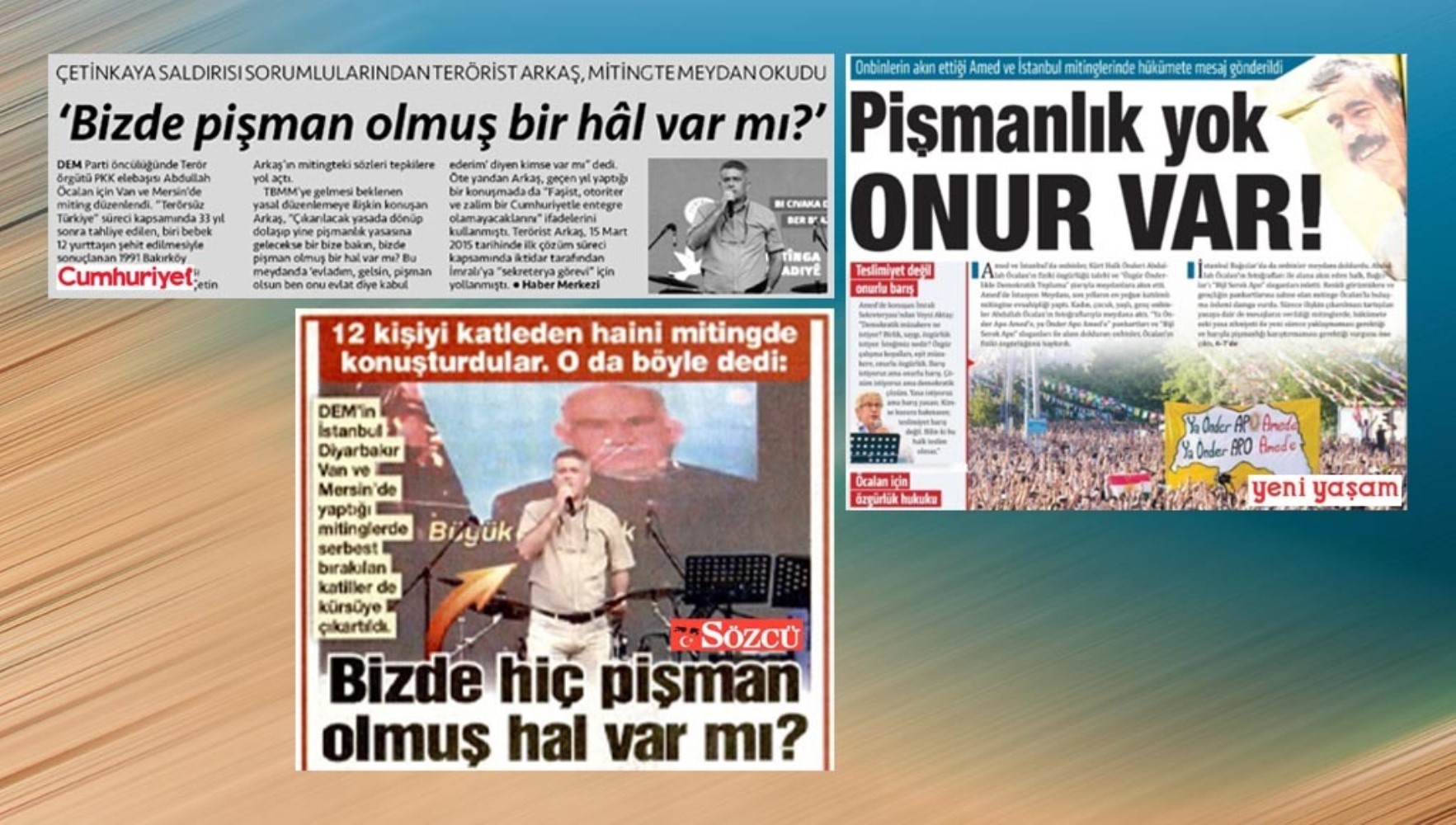
These reports recalled that Çetin Arkaş was one of the PKK members who caused the death of 12 people, including two children, by setting fire to the Çetinkaya Store in Istanbul's Bakırköy district in 1991, and that he had spent 33 years in prison for this reason.
The language of peace was not used in the reports of Sözcü and Cumhuriyet, but it is natural to recall the killing of those people after someone like Çetin Arkaş takes the stage and says, "Is there any sign of regret in us?" Because with these words, Çetin Arkaş did not express the slightest regret for that terrorist act or the death of innocent civilians. While focusing on the struggle, pain, expectations, and goals of his own ranks, he could not empathize with the other side, at least with the relatives of the civilians who died.
This cannot be the language of peace. Yeni Yaşam cannot practice peace journalism by broadcasting such a language that "focuses only on the pain and fears of one side." Peace journalism requires focusing on the pain of both sides. Only in this way can emotional ruptures be prevented.
Thousands of Turkish and Kurdish youth have died in this "low-intensity" war. The media should help leave these pains behind by pioneering the development of empathy for all deaths and all experiences. Without soothing the pain of both sides, one cannot properly reckon with the past, nor can mistakes be confessed with an open heart and apologies be made.
Of course, for the resolution of the Kurdish issue, the complete end of terrorism, and the establishment of peace, it is essential that the entire national media in Turkey, like the Kurdish media, change the one-sided language of conflict.
NATO Summit and stuffed vine leaves
Our national media, which has been tireless in explaining the importance and historical nature of the NATO Summit for days, has also not refrained from trivializing the summit:
"Necla Özmer, who claims to be Trump's daughter: I prepared stuffed vine leaves for my father"
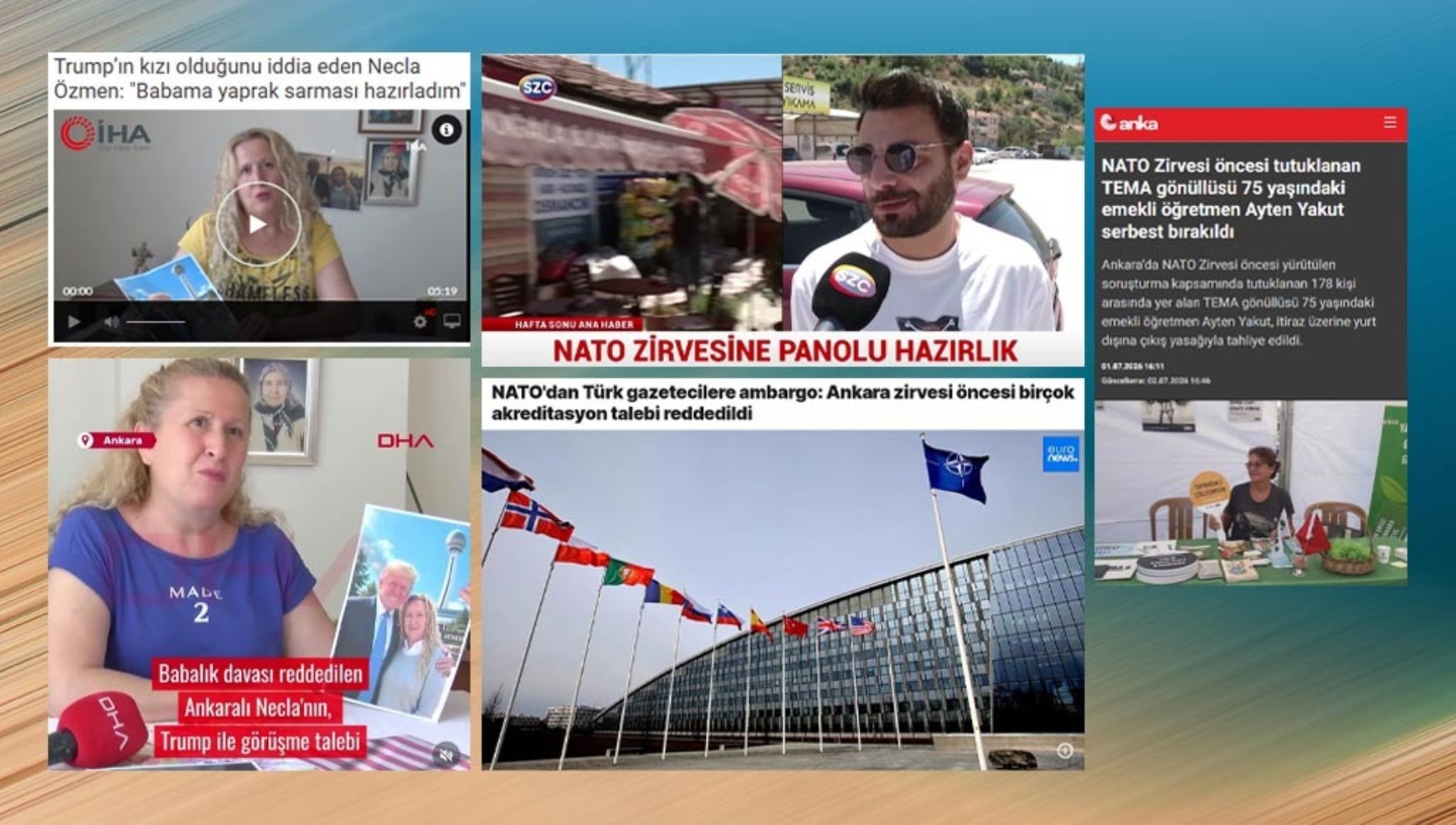
The news, which was also reported by İHA and DHA, was published in dozens of outlets including A Haber, Halk TV, Haber Global, Hürriyet, Karar, Nefes, Sabah, Show TV, Sözcü TV, and Ülke TV.
However, I have written about this before. This woman named Necla Özmen, who lives in Ankara, has no evidence to confirm her claim that she is the biological daughter of US President Donald Trump, nor is there a logical explanation. The court has already rejected the paternity suit anyway.
Despite this, the media taking this woman seriously and reporting on her, especially before a major organization like the NATO Summit, shows the stage journalism has reached in its pursuit of clicks, likes, and attention. This is the misery of reporting now…
The pro-government media, which is so interested in the woman who appeared claiming "I am Trump's daughter," ignores the suspension of life in Ankara, the bans, access restrictions, detentions, and arrests. Instead, they talk about the importance of the summit and its contribution to the Ankara economy; they give good news after good news. Even though it is a subject for international media, they do not report on the accreditation bans. Yet, pro-government outlets like Aydınlık, Ulusal Medya, TV NET, and Ersin Çelik (Yeni Şafak) were also among those rejected.
By the way, let me correct a mistake. I wrote last week that he was rejected, but that was wrong; Murat Yetkin's application was awaiting approval, and in the end, he was granted permission. The reactions of professional organizations must have yielded results, as the number of those accredited has increased slightly.
However, in addition to Cumhuriyet, İlke TV, and Sözcü TV, Doğan Tılıç (Spanish News Agency) received a rejection. The requests of ANKA and BirGün are still pending. It is also noteworthy that Duygu Güvenç (Turkey in Depth) and Deniz Zeyrek (Nefes), who have been covering such summits for years, were also rejected.
Unfortunately, the obstacles to the media did not stop with accreditation bans. Before the summit, T24 Foreign News Editor Buse Söğütlü and Odatv editor Ceren Erdoğdu were detained. As if it were their duty, RTÜK also issued a statement demanding that "broadcasts be made in a manner worthy of our country's international position"; it also threatened by saying, "Our experts are watching."
Clearly, critical and investigative journalism regarding the summit is not wanted.
Davutoğlu and the October 10 Train Station attack
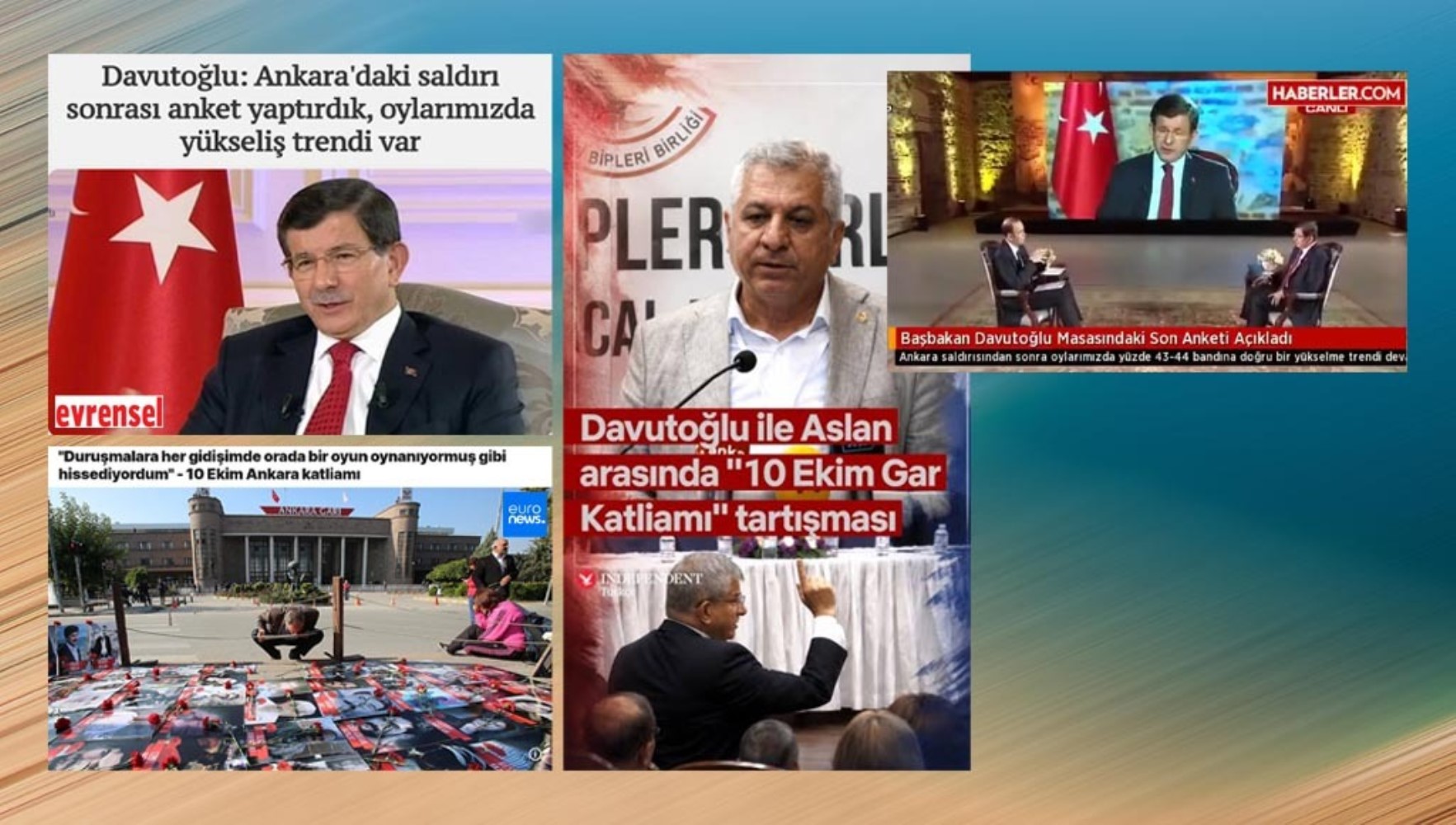
It was not dwelled upon much in the media, but the debate between Labor Party Chairman Seyit Aslan and Future Party Chairman Ahmet Davutoğlu at the Turkish Medical Association congress was important in terms of recent political history.
Aslan recalled that bombs exploded in front of the Ankara Train Station, in Suruç, and in Diyarbakır during Davutoğlu's prime ministry, saying, "Despite this, he went out on television and declared, 'Our votes are rising.' This is not acceptable."
Davutoğlu jumped up from his seat and said, "Look at that speech. In one part of the interview, I am describing the Train Station attack. In a much later section, I am asked about the poll situation while heading to the election. I am saying that we are doing well in the polls. These words are being mixed up to produce lies."
Seeing this debate, I also rummaged through the archives. Davutoğlu appeared on AHaber on October 19, 2015, as Prime Minister. Nine days after the bomb attack in Ankara. In the program, Davutoğlu first answers Murat Akgün's questions about the attack, and then the topic comes to the polls:
Akgün: Are there any polls conducted especially after the attack in Ankara and their results?
Davutoğlu: The polls are coming in. We conducted polls before, and after the declaration. Now, after the terrorist attack in Ankara, we are taking the pulse of the public. There is an upward trend in our votes.
Akgün: Did the result come in? Is there a poll?
Davutoğlu: It came, of course, it exists. But since there are many polls now, evaluating them one by one...
Akgün: I mean after the attack.
Davutoğlu: After the attack, an upward trend towards the 43-44 percent band continues in our votes...
Davutoğlu talks exactly like this about his votes increasing right after the bomb attack. Indeed, the results of the June 7, 2015 elections were reversed, and the AKP emerged victorious from the November 1 elections. The dark atmosphere created by the bombs that exploded between the two elections had a major impact on the increase in AKP's votes.
The common problem of Sözcü and Turkuvaz Media
Tamar Tanrıyar is a name that attracts attention with the videos she publishes on social media. She made allegations against many CHP figures, especially Ekrem İmamoğlu and Özgür Özel, in her videos. Most of them were "below the belt," targeting private life.
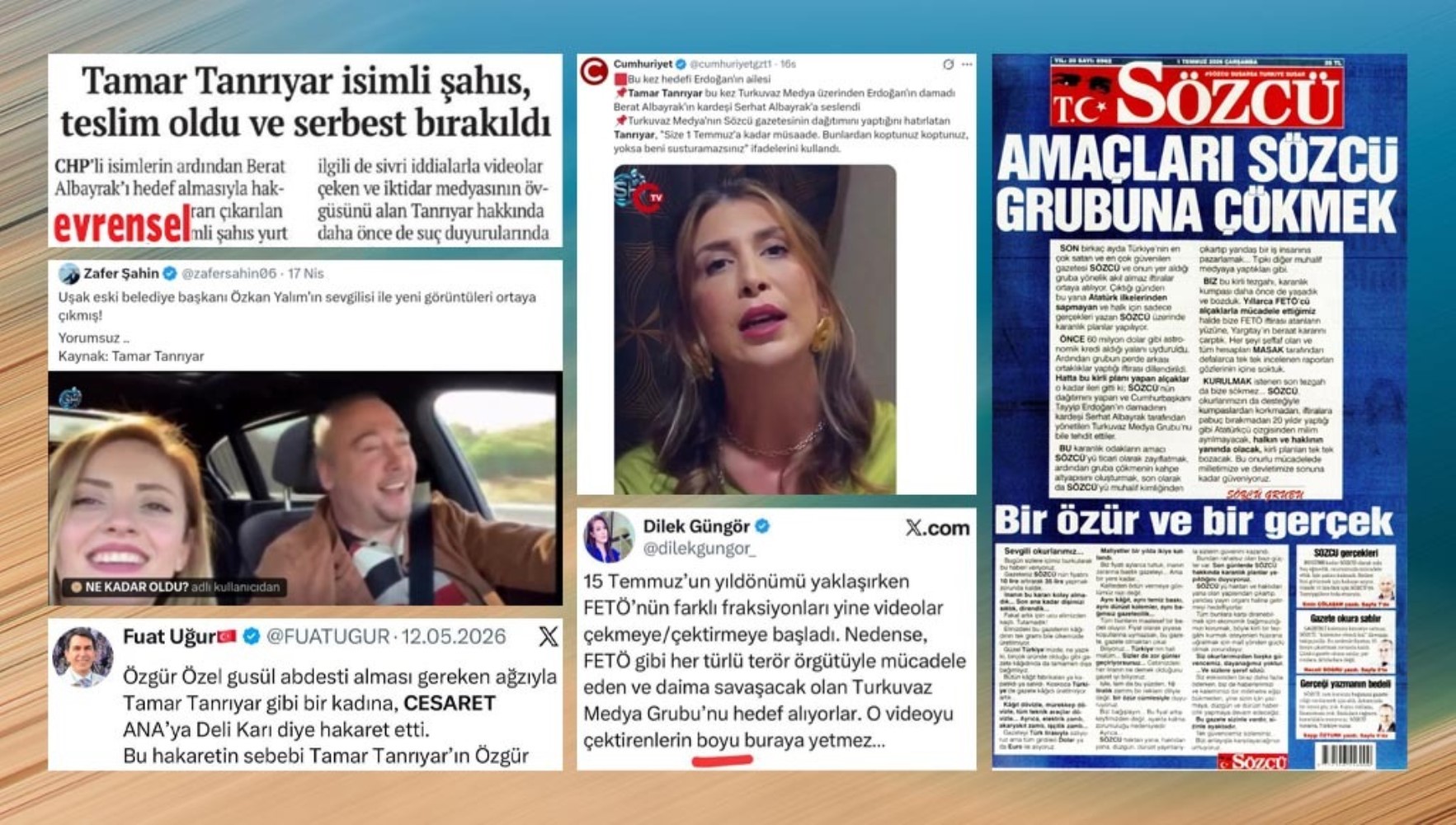
The subjects of her allegations were denying Tamar Tanrıyar's claims, but the pro-government media was watching without intervening in those days. Sometimes they would report it, and some journalists would express their appreciation on social media. Zafer Şahin also cited Tamar Tanrıyar, whom Fuat Uğur described as "Mother Courage," as a source while sharing images of Özkan Yalım with his lover.
Tamar Tanrıyar only got into a fight with Cem Küçük from the pro-government media. Cem Küçük replied to Tamar Tanrıyar, who said he was an "Adnan Oktar follower," by saying, "They are using you as a hitman just because I have objections to 'absolute nullity.' You go, let your owner come."
As such, Tamar Tanrıyar gradually increased the scale of her accusations; she claimed that the owners of Halk TV and Sözcü used millions of dollars in irregular loans. When this accusation was also denied, she turned to the pro-government Turkuvaz Media this time. She asked them not to distribute Sözcü; she openly threatened Serhat Albayrak, giving him until July 1, claiming that "some names who appear close to the government are targeting President R.T. Erdoğan."
An investigation was opened into Tamar Tanrıyar, her statement was taken, and she was released, but her accusations brought the pro-government Turkuvaz Media and the opposition Sözcü Group to the same side. Both groups are of the opinion that they are the target of an "organized attack" that goes beyond Tamar Tanrıyar.
While Sözcü settled for the statement that a "plot" was set up to "collapse the Sözcü group," Sabah writer Dilek Güngör wrote, "a conscious and programmed attack on our group through the video of a social media phenomenon." Hilal Kaplan said, "Tanrıyar is not an actor on her own. She is a tool, but a tool that was deliberately chosen, carefully placed, and coldly abandoned when the time came." Salih Tuna also described her as a "sleeper cell."
This attitude of Sabah writers, who remain silent when CHP members are involved, is a double standard. Besides, Serhat Albayrak can defend himself, he also has lawyers...
In a single sentence:
•The Directorate of Communications mediated the promotion of the newly opened social media account and site called "The Lies of Israel" by sending the link to journalists' WhatsApp groups.
•Sadık Eral, one of the lawyers for the Çorum massacre case, refuted with documents on OdaTV the news reported by İHA, Habertürk, Sabah, and Yeni Şafak that the father of the arrested comedian Deniz Göktaş was "involved in the martyrdom of a police officer in Çorum in 1980."
•While BirGün, Cumhuriyet, Dünya, Hürriyet, Korkusuz, Milliyet, Nefes, Sözcü, Posta, Sabah, Odatv, Takvim, and Türkiye used an e-commerce platform page with an "advertisement" warning, Aydınlık, Yeni Akit, Yeniçağ, and Yeni Şafak published it like a news page without a warning.
•The newspaper Tavır coded the name of the "international drug trafficker" who was stated to have been caught while being sought with a red notice in the news of an operation by the MIT, and blurred his face.
•Cumhuriyet's news, "TTB elections: Current President Azap received the highest vote," was incomplete; there was no information that Alpay Azap receiving a high vote did not mean the continuation of his presidency.
•Journalist Bahar Feyzan introduced a construction company's new construction project in Istanbul's Şişli district by explaining it in detail, from the strength of its load-bearing columns to the quality of the concrete used.
•The expression "doctor error" in the article titled "I will teach my daughter to run just as I taught her to walk!" in Gazete Oksijen was one-sided.
•Cumhuriyet reporter Gülnur Saydam was detained and questioned due to the news "Is Istanbul's popular district Göktürk the new address of gangs?"; the gangs were not pursued.
•In Hürriyet, Zeynep Bilgehan shed light on the history of the race by interviewing jockey Mümin Çılgın, who had previously lifted the cup nine times before the 100th Gazi Race.
FOR YOUR CRITICISM, COMPLAINTS, AND SUGGESTIONS: [email protected]
Most Read

Striking picture for Özgür Özel's 'New Party'

The PKK opening and Özgür Özel’s path!..

How did the newspapers view Özgür Özel's farewell to the CHP?

He killed his wife by slitting her throat: Their children witnessed the moments

What did the CHP do?

Özel’s new party move in the world press

The New CHP, against CEHAPE

Fire at TUSAŞ engine factory in Eskişehir under control

From self-efficacy to despair

Kılıçdaroğlu's first message on Özgür Özel's new party announcement