



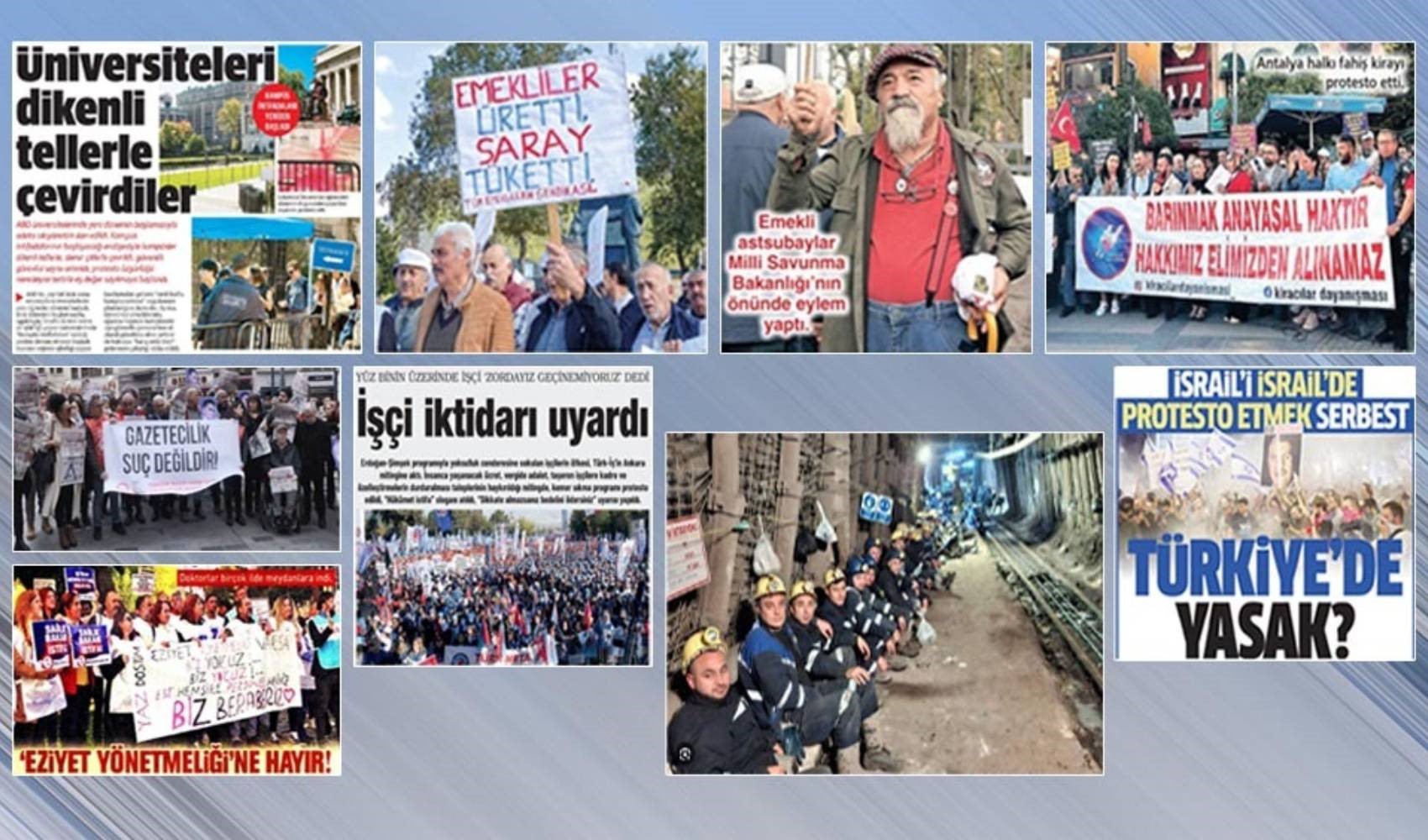
In recent months, voices of dissent have been rising from society; there is more protest activity in many cities than in previous years. Small and large protests are taking place here and there; miners in Nallıhan barricaded themselves in the mine; teachers who have not been appointed in Ankara, tenants in Antalya, and those who do not want hydroelectric power plants (HES) in Uzungöl unfurled banners; family physicians went on a three-day strike; and journalists also held protests in Zonguldak and Istanbul after İzmir.
The number of those marching to Ankara for economic reasons has also increased. After the miners at the Fernas company, workers employed at the Bolvadin State Hospital construction site, teachers, and retirees also marched to Ankara. Before them, retired non-commissioned officers had protested in front of the Ministry of National Defense, and private school teachers had protested in front of the Ministry of National Education. Workers affiliated with Türk-İş and family physicians were also in the squares in Ankara. KESK members will also march to Ankara on November 30.
However, the pro-government media, from Sabah to Yeni Şafak, and from Hürriyet to A Haber,
does not report on any rally or democratic pursuit of rights that contains objections or criticism directed at the Erdoğan government. They ignore the workers who say 'We cannot make ends meet,' the strike actions of family physicians who unfurled 'Enough is enough' banners, and those who oppose the appointment of 'trustees'...
The police also display an obstructive and repressive attitude toward the pursuit of rights and protests, but all squares and streets are open to the rallies and marches of pro-government groups; everything is free for them. For example, when there was a 'Support for Palestine, curse Israel' rally attended by President Erdoğan's son Bilal Erdoğan and some ministers, even the Galata Bridge could be opened.
But even Istiklal Avenue was closed to young people protesting this government's continuation of trade with Israel. The police did not allow those who wanted to protest ships belonging to the Israeli company ZIM to approach the port of Mersin. The police also forcibly prevented CHP district organization officials from making statements against the trustee in Esenyurt, and DEM Party officials in Tunceli in front of the municipality.
The government's media also shares the same cross-eyed view regarding democratic actions. The AKP-supporting media, which ignores the pursuit of rights and protests in Turkey, suddenly becomes democratic when it comes to protests in the US and Europe. Forgetting the harsh interventions of the police in Turkey, they can characterize the German police's use of dogs during a pro-Palestine protest in Berlin as 'intolerance'.
They only report on protests or strikes when they occur in CHP-run municipalities. The newspaper Sabah headlined strikes in CHP municipalities as 'They turned their backs on the laborers' and published a story on November 12 stating, 'The workers' strike continues at Maltepe Municipality'.
The most striking example of this cross-eyed perspective was recently displayed in the newspaper Yeni Şafak. In a report titled 'They surrounded universities with barbed wire' regarding measures taken against pro-Palestine protests at universities in the US, it was written that '...campuses were surrounded by barbed wire and iron fences, the number of security guards was increased, and the freedom to protest began to be considered almost equivalent to terrorism.'
I wish they had remembered what they wrote about the protests at Boğaziçi University while they were talking about 'freedom to protest.' Perhaps then they would have blushed. A journalist should defend the freedom to protest for everyone. They should not use terms like 'unauthorized demonstration' or 'unauthorized march' in news reports, as if permission is required by law for democratic actions.
CHINESE MEDIA'S INTEREST IN TURKEY
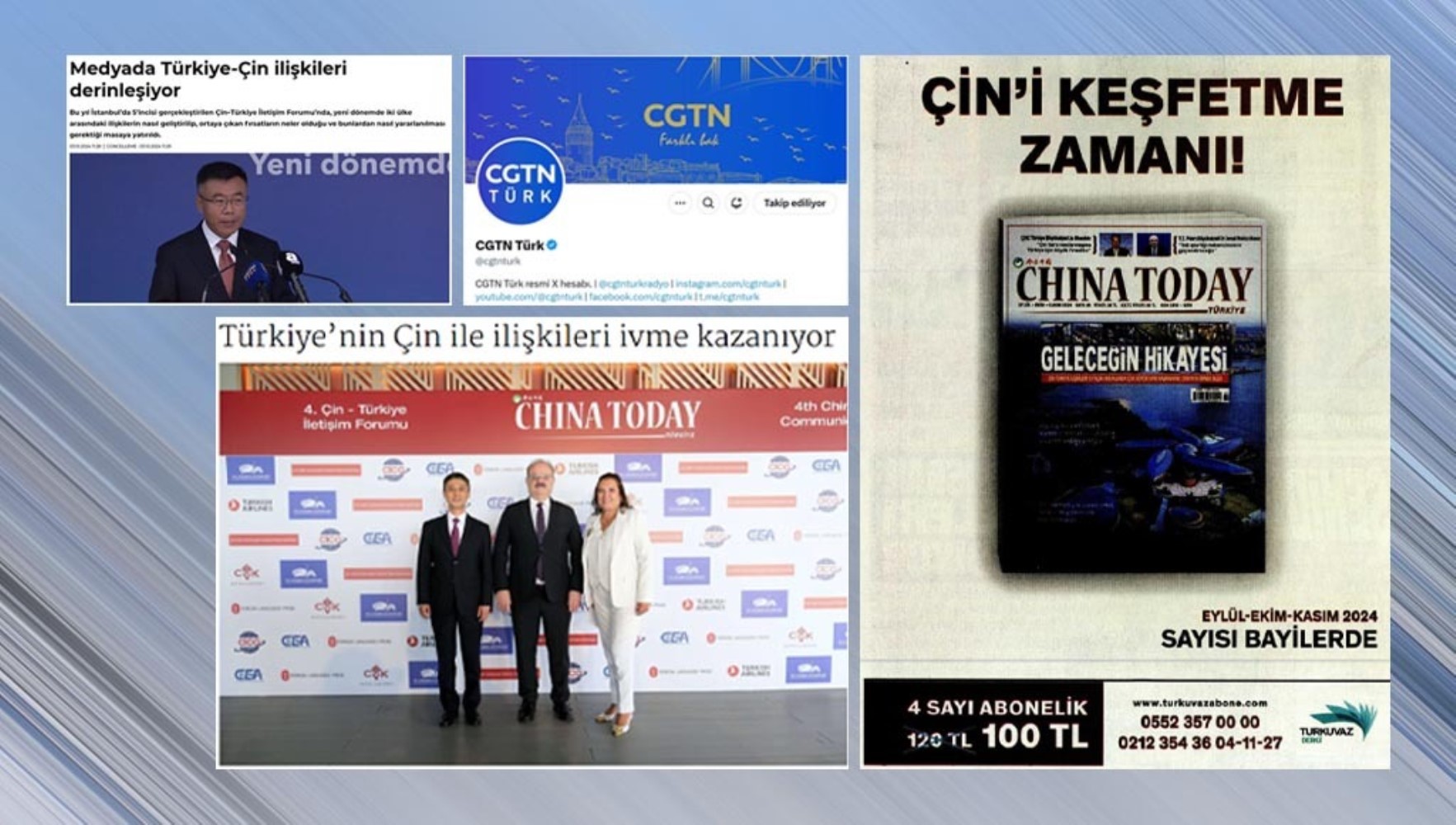
China's official news agency, XINHUA, has been operating in Turkey for many years. The CRI (China Radio International) Turkish Service was also broadcasting. Since the 2000s, China's interest in Turkey has increased, and after the pandemic period, it turned into a full-scale media offensive.
CRI Radio began broadcasting in major cities in 2016 via Radio Mega frequencies. With China consolidating its international broadcasting brands under the 'CGTN' (China Global Television Network) umbrella, CRI Türk in Turkey has continued its radio broadcasts as CGTN Türk since last year, and also maintains internet operations under the name cgtnturk.com. This radio station broadcasts music in addition to news.
The magazine China Today Turkey has also been published quarterly since 2012. This magazine, published in cooperation with Turkuvaz Media, also concretizes China's approach to the government in Turkey. The headline of the advertisement published in Sabah for its latest issue was 'Time to discover China.'
It was also noteworthy that China Today Turkey and the CICG (China International Communications Group) organized a forum last month themed 'Deepening reforms in China in the new era and the opportunities it brings.' Speaking at the opening, CICG Vice President Liu Dawei pointed out that cooperation between the media and think tanks of the two countries should be strengthened.
There is also a magazine called BRICS Business, which has ties to China and Russia; articles by Turkish academics are also published in this magazine.
The most important reason China places special importance on Turkey is that it views the country as both a secure market and a gateway to Europe and the Arab-Islamic world. They calculate that a positive image created in Turkey will also be influential in European and Arab-Islamic countries.
Furthermore, according to a study conducted by the BBC World Service in 21 countries between 2008 and 2009, "Turkey is one of the countries where the negative perception of China is highest." They are also contributing to their efforts to change this perception, in which they have made progress with electric vehicles, through media power.
Let us not be surprised if Chinese journalists and Chinese media become more visible in the coming days...
WHAT IS GÜLEÇYÜZ'S CRIME?
Yeni Asya Editor-in-Chief Kâzım Güleçyüz was detained after his home was raided by counter-terrorism units and was subsequently arrested. More than a month has passed; he is still in prison. (October 24) The justification was a condolence message he shared on social media following the death of Fethullah Gülen:
"Fethullah Gülen has also migrated from this world of trials to the realm of the afterlife. The account for the allegations against him will now be settled on the other side. Reiterating our wish for an end to the injustices that have caused the victimization of so many people, justified by these allegations, we say may God treat him with mercy and justice. May the community have my condolences."
You may find such a post wrong, and you may not agree with the views expressed. I, too, do not characterize them as a "community"; it is clear that we are facing a criminal organization. But even if I do not agree, I defend Kâzım Güleçyüz's freedom of expression. The penalty for making a post should not be being thrown in jail for months.
Unfortunately, because Yeni Asya is a religious community newspaper, journalistic professional organizations do not stand up for Kâzım Güleçyüz, and the opposition media does not even mention his name; because the newspaper follows a line opposed to the AKP government, the pro-government media is also against him.
A journalist should be fair and not adjust their scale of conscience based on the person or the situation.
THEY HAVE ACCUSTOMED JOURNALISTS SO MUCH THAT...
In the past, news reports regarding court hearings would include the names of judges and prosecutors. This is because trials are public unless a confidentiality order is issued.
However, in recent years, the names of judges and prosecutors are not included in reports on hearings. News reports simply settle for saying 'the judge' or 'the prosecutor.' This has almost become a general rule.
I most recently noticed this in reports regarding the Narin Güran case in Diyarbakır, which stated, 'The judge even took off his robe.' The judge, who is the president of the 8th High Criminal Court, had taken off his robe while questioning the defendant, Nevzat Bahtiyar, and said, 'I am asking you as a father of three children, is there anything you are hiding from us regarding this incident?' Whether the judge took off his robe to ask the question or because he was preparing to adjourn the hearing remained unclear in the reports.
But more importantly, why is the name of a judge who displays a highly humanistic attitude in a public trial hidden from readers and viewers? What harm could there be in writing the name of the judge in such a murder case?
I asked these questions to my colleagues who are judicial reporters. They pointed to Article 6 of the Anti-Terror Law. This article stipulates prison sentences for those who 'disclose or publish the identities of public officials who have taken part in the fight against terrorism, or who target individuals in this way.' Indeed, this article has been used so frequently against journalists, and so many of our colleagues have been detained and imprisoned for 'targeting' individuals, that reporter colleagues have found the solution in not writing the names of judges and prosecutors in any case to play it safe.
However, the Narin Güran case has nothing to do with terrorism, and writing the judge's name cannot be considered targeting. Therefore, it was wrong to turn the judge into an anonymous subject in this report. As is known, self-censorship is a poison worse than censorship in journalism. Yet, the existence of boundaries only becomes visible if we push them; if we retreat, the boundaries only narrow further.
In a single sentence:
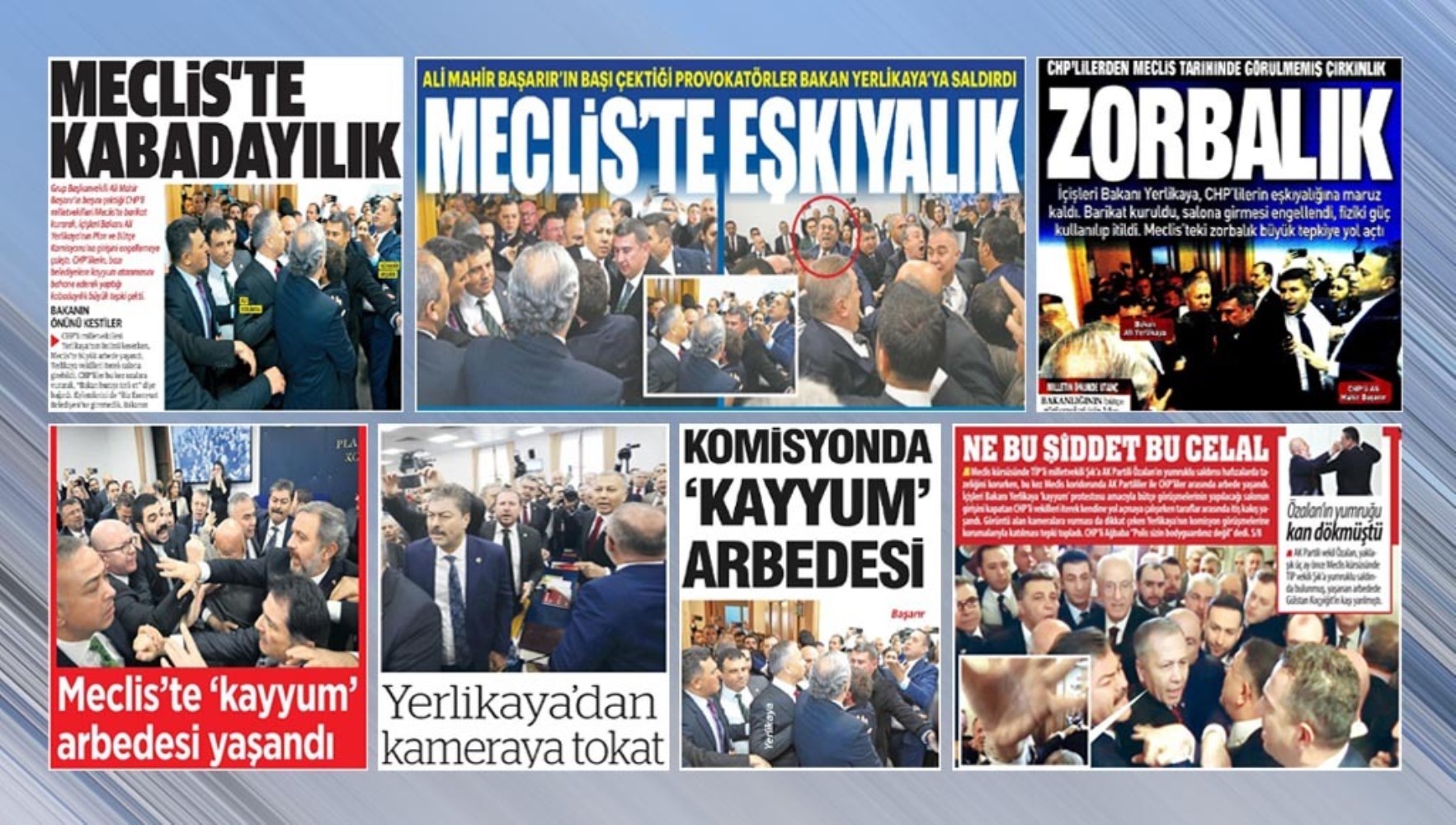
Akşam, Sabah, and Hürriyet failed to include Interior Minister Ali Yerlikaya striking an ANKA agency camera in their reports regarding CHP members forming a barricade in front of the commission hall and AKP members forcing their way in.
In Yeni Şafak's report titled "They will turn ANAP's building into a plaza," the phrase "ANAP Headquarters, which is Turkey's first political party building" is incorrect; years before ANAP, the headquarters of the Justice Party and the CHP had already been designed and built specifically for those parties.
In the report "Passenger bus overturns in Eskişehir: 1 dead, many injured," İHA omitted the name of the bus company, Kâmil Koç, in its report and photo, while AA did the same in its video footage.
Akşam, Hürriyet, Milliyet, and Yeni Şafak reported on the resignation of three deputies from the MHP but failed to mention that these deputies were involved in gold smuggling.
In Yeni Şafak's report titled "You are against Özgür Özel, you cannot enter this 'pub'," there was no mention of the name of the CHP PM member who was denied entry, nor the name of the venue or the person who reacted.
In its report "Picasso operation in Bayburt," Hürriyet fell victim to the fake painting fraud frequently encountered in Turkey by writing that the seized painting belonged to Pablo Picasso.
In Cumhuriyet's Çorum-sourced report titled "Natural antibiotic that strengthens immunity: The benefits of tripe soup," it was unclear how it was determined to be an "antibiotic."
BirGün's report titled 'Çiğli City Restaurant opens with affordable prices' failed to mention the actual meal prices.
On Karar's website, a photo in the article 'Call to cut oil from New York to Tokyo' incorrectly labeled the 'Tokyo-Turkey Embassy' as the 'Tokyo-Istanbul Embassy'.
Yeni Akit insulted US President Joe Biden by using the headline 'Senile Biden'.
Sözcü TV's broadcast of footage showing the moment a person suffered a fatal heart attack while walking in Diyarbakır was inappropriate due to its traumatic impact and the privacy of that moment.
Despite snowfall in many cities across the Marmara and Central Anatolia regions, Akşam reported 'Istanbul meets snow,' Cumhuriyet reported 'Snow falls on Aydos forest,' and Yeni Şafak reported 'First snow falls on Istanbul'.
FOR YOUR CRITICISMS, COMPLAINTS, AND SUGGESTIONS: [email protected]
Most Read

Striking picture for Özgür Özel's 'New Party'

The PKK opening and Özgür Özel’s path!..

How did the newspapers view Özgür Özel's farewell to the CHP?

He killed his wife by slitting her throat: Their children witnessed the moments

What did the CHP do?

Özel’s new party move in the world press

Fire at TUSAŞ engine factory in Eskişehir under control

The New CHP, against CEHAPE

From self-efficacy to despair

Kılıçdaroğlu's first message on Özgür Özel's new party announcement