



5-year-old Deniz Sönmez died after having a tooth extracted and four others filled under general anesthesia, yet in most of the news reports, we did not see the name of the dental clinic accused of causing her death. In reports by Cumhuriyet, Haber Global, Türktime, Yeni Akit, and Odatv, the name Mesam Dental Clinic was mentioned only in passing within the father's account; in the others, it was not mentioned at all.
Even in reports by Hürriyet, Milliyet, Karar, and Yeni Şafak regarding the one-month closure of the dental clinic, the clinic's name was hidden. The reports, which even included a photo of the seal on the clinic's door, referred to it as “a branch of a private dental clinic chain in the Hürriyet neighborhood.” In reports by Habertürk, NTV, and Sözcü, which used the AA report on the autopsy, and in T24 and Sabah, which used the DHA report, the clinic's name was not mentioned at all. Only BirGün, which published the report on the clinic's closure and the autopsy, did not shy away from publishing the clinic's name.
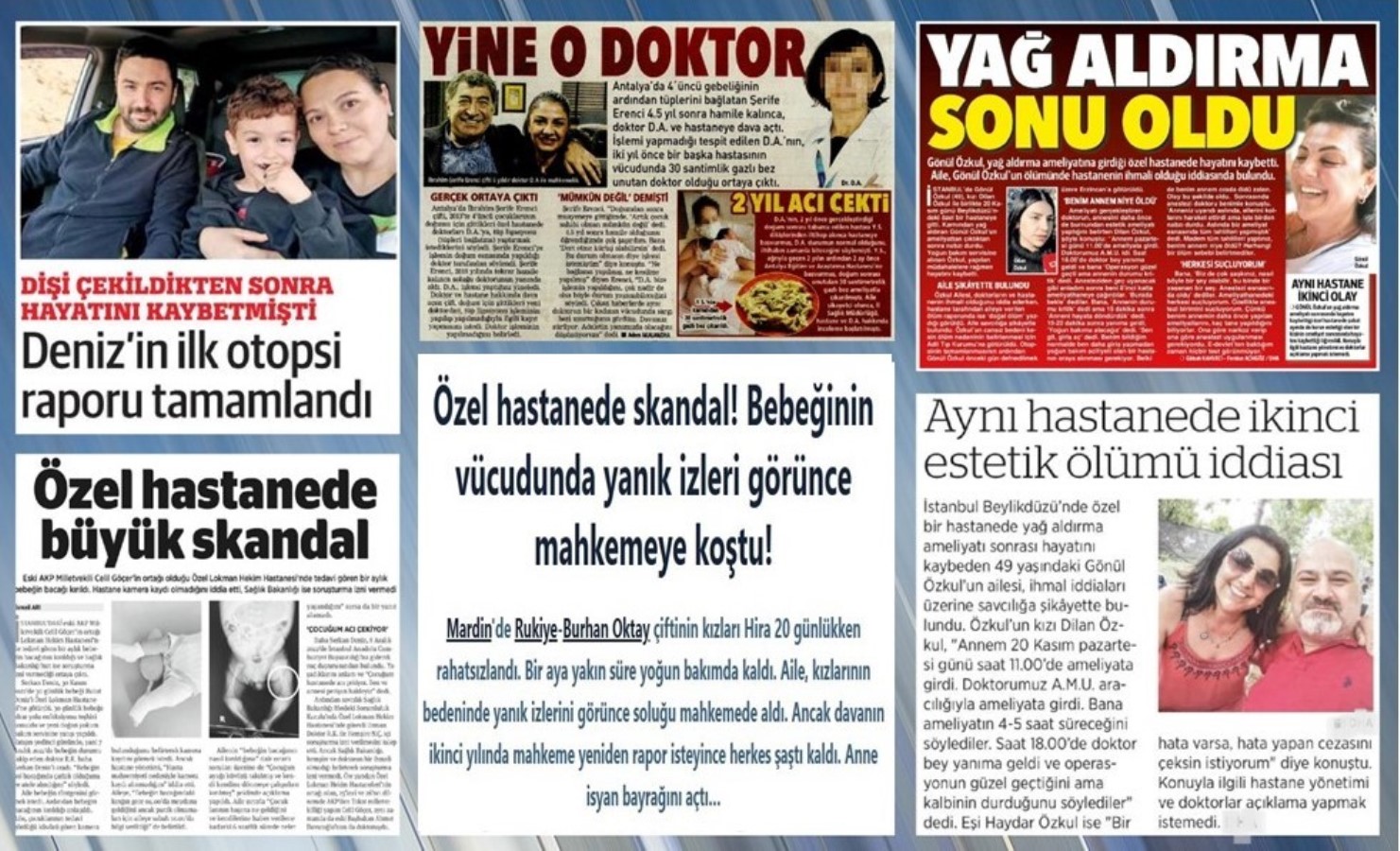
However, the “1K” in the journalists' “5W1H” rule stands for the answer to the question “By whom?” Every news report must answer this question. Moreover, the subject in this incident is the “1K” accused of being responsible for a child's death. Therefore, not explicitly stating the name of the clinic is a serious journalistic error.
The effort to protect private hospitals is not a behavior unique to the dental clinic in Bursa. In almost all news reports containing negative information about private hospitals, the name is hidden. In the DHA report titled “Allegations of negligence in death after liposuction surgery in Beylikdüzü,” the name of the hospital was also missing. Even though information was provided that “another person who had a nose job at the same hospital also lost their life,” the hospital was protected.
In the Posta report titled “That doctor again,” it was stated that “Şerife Erenci, who had her tubes tied, became pregnant 4.5 years later,” but there, too, the doctor's name was coded, and despite a lawsuit being filed, the name of the hospital was never given.
Hiding the names of private hospitals, just like private banks or private mines, in reports containing negative information is a journalistic disease. It is an indicator that the media has surrendered to power centers and bosses. If it were not so, they would not act so protectively and would not stop looking out for the public interest. A journalist who protects their own boss sees no harm in protecting other bosses.
TWO ERRORS IN ERDAL EREN REPORTS
In reports regarding the commemoration of Erdal Eren, who was executed by the September 12 military regime, it was written as if by prior agreement that “Erdal Eren, who was 17, was executed after his age was increased.”
This information, which appeared in reports by ANKA, Bianet, BirGün, Cumhuriyet, Gazete Duvar, Gazete Pencere, Kısa Dalga, Muhalif, Solhaber, Sözcü, T24, and even in the message of CHP Chairman Özgür Özel, is not true. I heard the truth from Erdal Eren's lawyer, İsmail Sami Çakmak:
“Lawyer Nihat Toktay had stated in the martial law court that Erdal Eren was under 18. But the court rejected this objection on the grounds that ‘there was no convincing and persuasive evidence regarding his young age.’”
“When Erdal Eren was hastily sentenced to death on March 19, 1980, after a short trial of 1.5 months, Niyazi Ağırnaslı and I took over his defense. While appealing the death sentence, we requested that a bone X-ray be examined to determine that Erdal Eren was 17 years old. One of the reasons for the first reversal decision at the Military Court of Cassation was that his real age had not been examined. But the Board of Chambers of the Military Court of Cassation rejected this request while approving the execution. Erdal Eren's date of birth was accepted as September 25, 1961, on the grounds that ‘since his father was a teacher, he had registered him with the civil registry on the very day he was born.’ Erdal Eren was executed on December 13, 1980.”
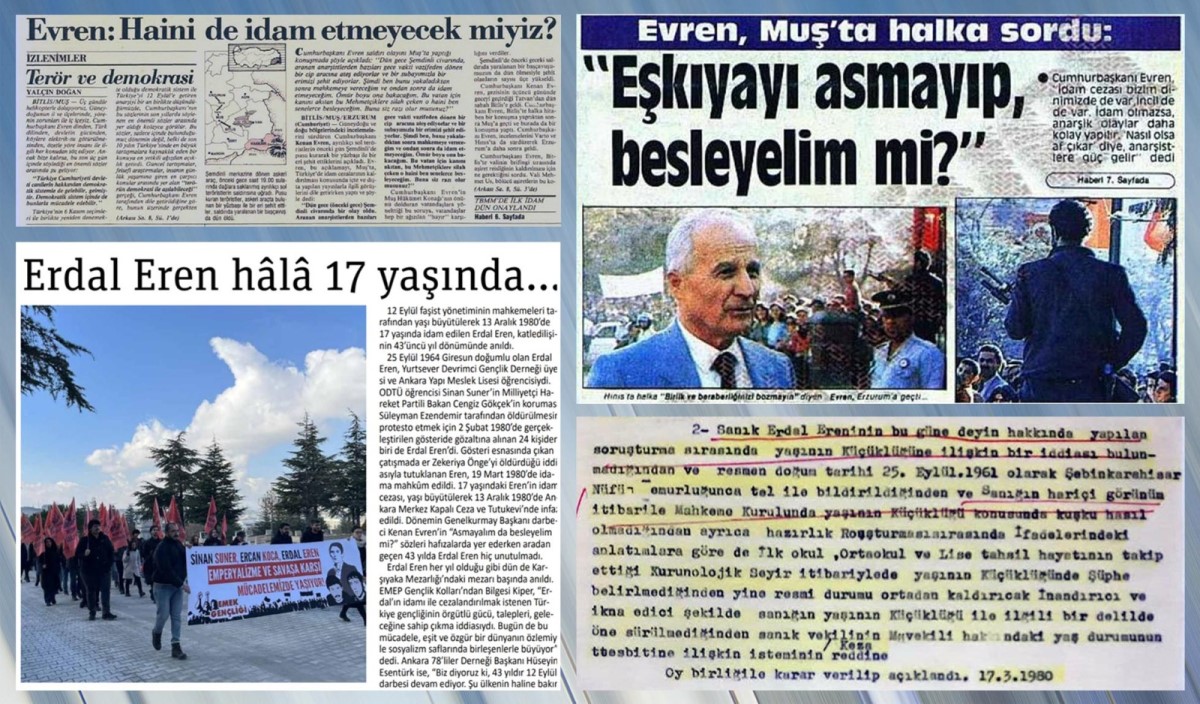
In short, he was not executed after his age was increased by the court; he was executed without the objection that he was 17 being considered. Furthermore, most of these reports emphasize that the coup-plotting President Kenan Evren said the words “Should we not hang them and instead feed them?” for Erdal Eren. This is also incorrect information.
Evren said these words long after Erdal Eren's execution, in his speech in Muş on October 3, 1984. Indeed, the headline “Should we not hang them and instead feed them?” attributing the words to Evren appeared on the front page of the October 4, 1984 issue of Milliyet. Evren also recounts these words in the 5th volume of his “Memoirs” on page 126 as: “When they are caught and sentenced to death, are we not going to execute them and feed them for life?”
Evren is a coup plotter who approved the execution of 48 people, including Erdal Eren, but as can be understood from the documents, he did not say the words “Should we not hang them and instead feed them” for Erdal Eren. While commemorating with sadness those who were brutally executed, especially Erdal Eren, it is primarily the responsibility of us journalists to reflect what happened in accordance with the truth…
TREATS FOR JOURNALISTS
I remember that when DYP deputies organized a çiğköfte party in Parliament in 1992 and threw çiğköfte at the ceiling, they were heavily mocked and overwhelmed by criticism in the media.
I see that now, some journalists find it natural to organize a liver kebab party in Parliament; those who criticize it find it disturbing that it was held while SP Deputy Hasan Bitmez was in the hospital. This is an indicator of the change in the perspective of some parliamentary correspondents.
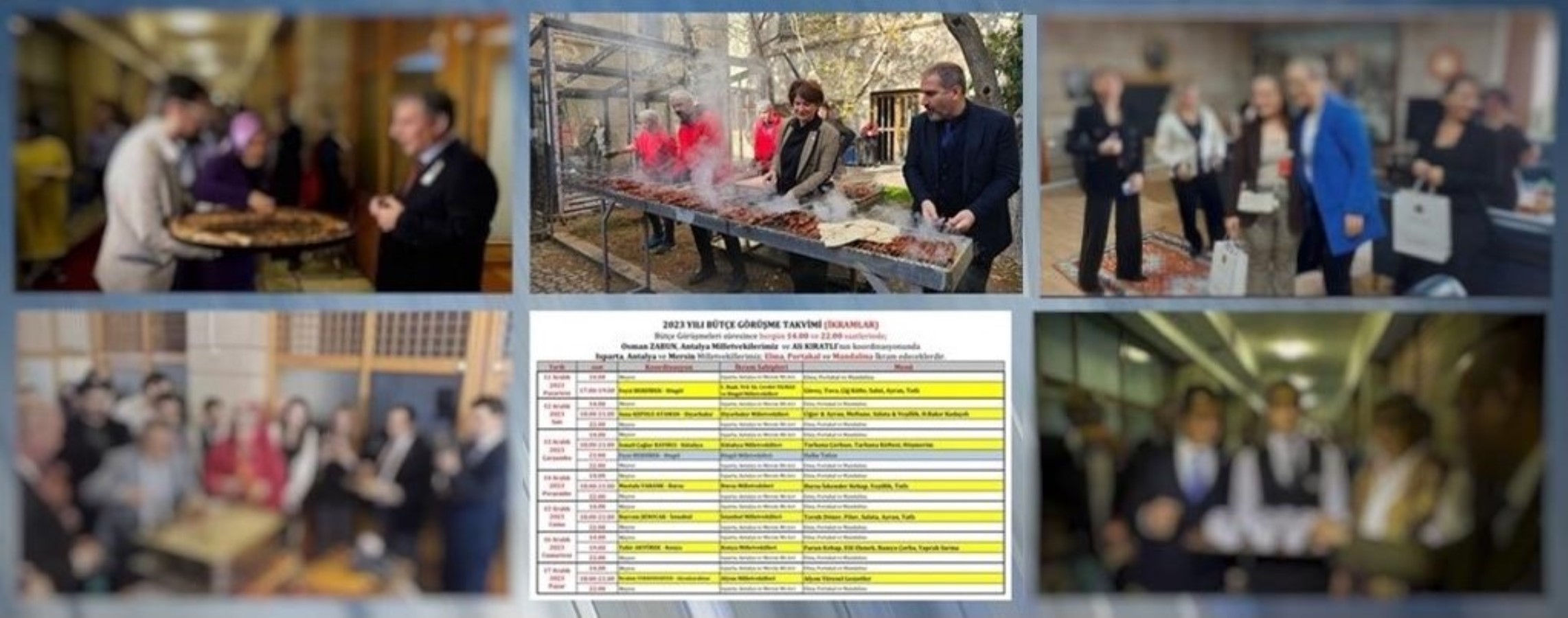
According to what I hear from journalist friends, the change has also been reflected in the press corridor. It is now a common sight for deputies to storm into the press corridor with gift packages, food, or dessert trays in their hands, such as scarves, shawls, coffee cups, and coffee. While the deputy distributes their gifts and treats, their advisor photographs this happy moment and shares it on social media accounts. In fact, some TV correspondents are happy to report on the deputies' treat tours in the press corridor; because it gets a lot of views…
Journalists starting to see such an intimate relationship with politicians as natural is a sign of professional weakness. Establishing such a relationship with deputies and party officials, who are news sources, even if the value is small, means the erosion of the contact-distance rule. When there is no distance left, our friends have difficulty producing critical news.
It is necessary not to allow deputies to see journalists as a group to be kept happy with treats.
NON-JOURNALIST WRITERS
We journalists are constantly discussing impartiality. Let's talk about the state of “taking sides” this time. Journalists are human too… It is extremely natural for them to have political views, to support a sports club, to have preferences regarding social issues, and to have hobbies outside of work.
What is correct is that a journalist should not report on issues where they are “taking sides.” Because “taking sides” can cast a shadow over the objectivity of journalistic products. If one is writing on a subject where they are “taking sides,” the situation must be conveyed to the reader or viewer. The “taking sides” article of the Turkish Journalists' Rights and Responsibilities Declaration states:
“A journalist and a media outlet must clearly state their position to the public in an event where they are a party, for whatever reason and in whatever form. A media outlet or commentator may broadcast in line with their political, economic, and social preferences. In this case, this attitude must be clearly revealed, and a strict distinction must be made between commentary and news events.”
It is the right of readers and viewers to clearly know the position of those who are journalists, writers, commentators, TV program hosts, and main news anchors in the events they are “taking sides” on. They would then have the opportunity to evaluate what they read and watch with that perspective.
There are also experts whose numbers have increased recently; these people, whose primary field of activity is not journalism, also write articles and host programs. Naturally, these people earn income by working in their fields of expertise; they carry out commercial/financial relations with various institutions, companies, or individuals. Their situation must also be stated to the reader/listener or viewer.
Ensuring objectivity is a necessity not only for readers or viewers to evaluate in light of this data, but more importantly, to ensure that no “suspicion of conflict of interest” arises. For example, a health writer must state which hospital they work at, an economy writer their financial company, an art writer their workshop, and a political writer their research company.
Some news sites comply with this rule; information notes about the writer are added to the bottom of the articles. If the writer has an activity other than journalism, it is also conveyed to the reader. However, on most sites and especially in the printed media, footnotes regarding the main professions or second jobs of non-journalist writers are not added to the articles.
Let me give two examples. Prof. Dr. Yalçın Karatepe is no longer just an academic. He became a Deputy Chairman in the CHP, but this information is not in his articles in BirGün. Ece Ulusum, whose art articles and interviews are published in Ekonomim, is also the founder of a digital creative agency and works with many large firms, but there is no information about her work given to readers there either.
Politics and writing, creative agency and journalism are debatable, but at least it is useful to add a footnote. Transparency is indispensable for journalism.
GENEROUS IN PRAISE, STINGY IN CRITICISM
Three newspapers had declared Monday a day of boasting. Özay Şendir in Milliyet, in his article “Milliyet's most missing and beautiful aspect,” praises his newspaper's journalism; he was boasting by saying that they do not know how to “brag.”
Yavuz Donat in Sabah, in his article titled “Turkey learned from us,” was boasting that his newspaper was the first to announce the developments regarding the discovery of oil in the Gabar mountains. Fatih Selek in Türkiye newspaper was more ambitious. In his article titled “The Turkey difference in journalism,” he emphasized that they were the ones who reported it first in recent days.
Let's assume that all three are right. Let's accept that all three newspapers have done successful journalism in those examples. Well, do these newspapers have no shortcomings at all? They do not talk about negatives or mistakes. However, if these colleagues of ours expressed their mistakes as much as their successes, they would contribute to journalism. When they are generous in praise and stingy in criticism, the articles turn into a window-dressing activity.
In one sentence:
-
Since “personnel” already means all those working in a workplace, it was wrong to write “personnels” in Cumhuriyet's headline “Missing personnels still not found.”
-
The pro-government media, except for Hürriyet, did not show interest in the news about courier Yunus Emre Göçer, who was killed after being hit by Somali President's son Mohamut.
-
AA, Akşam, Sabah, Milliyet, Y. Şafak did not include in their reports that voices of “This is how God's wrath is” rose from the AKP benches while SP Deputy Hasan Bitmez was having a heart attack.
-
The headline “First photo of Vuslat Doğan Sabancı after the accident” by ABC, Cumhuriyet, Ekonomim, Gazete Pencere, Tele1, Sözcü, and Haber7 was wrong; the photos were taken before the accident.
-
In the news of “Turkey's space journey begins,” the information that “approximately 70 million dollars will be paid to a US company for the space travel of the first Turkish astronaut Alper Gezeravcı” was missing.
FOR YOUR CRITICISM, COMPLAINTS, AND SUGGESTIONS: [email protected]
Most Read

Striking picture for Özgür Özel's 'New Party'

The PKK opening and Özgür Özel’s path!..

How did the newspapers view Özgür Özel's farewell to the CHP?

He killed his wife by slitting her throat: Their children witnessed the moments

What did the CHP do?

Özel’s new party move in the world press

Fire at TUSAŞ engine factory in Eskişehir under control

The New CHP, against CEHAPE

From self-efficacy to despair

Kılıçdaroğlu's first message on Özgür Özel's new party announcement