



Journalists often latch onto certain patterns, reporting almost every story or writing every headline using the same template. Sometimes codes are broken, and sometimes they set sail for a new romance.
These days, I see the “girl issue” (kız meselesi) pattern frequently in the news. This phrase, a relic from old times, has recently been resurrected and has begun to seep back into the headlines and content of news reports.
In an IHA report titled “Details of the murder committed in a daily rental apartment in Esenyurt have emerged,” it was stated that 18-year-old M. Ali Polat was “killed because of a ‘girl issue’.”
In an NTV report titled “Prison requested for 5 children who beat Kıvanç to death,” it was noted that high school student Kıvanç Uman in İzmit was also beaten to death due to a “girl issue.”
According to a Milliyet report titled “Tragic end in a ‘girl issue’ fight,” 17-year-old Yusuf Mutlu was killed by Zafer A., with whom he had an argument, again due to a “girl issue.” (November 28)
Of course, these are not the only “girl issue” news stories. The internet is flooded with headlines like “High schoolers’ girl fight,” “Fight breaks out in Sultangazi over a ‘girl issue’,” “Relatives clash over a ‘girl issue’,” and “Blood spilled over a ‘girl issue’.” Once upon a time, the label “honor killing” was attached to most femicides; news outlets had recently managed to rid themselves of this error.
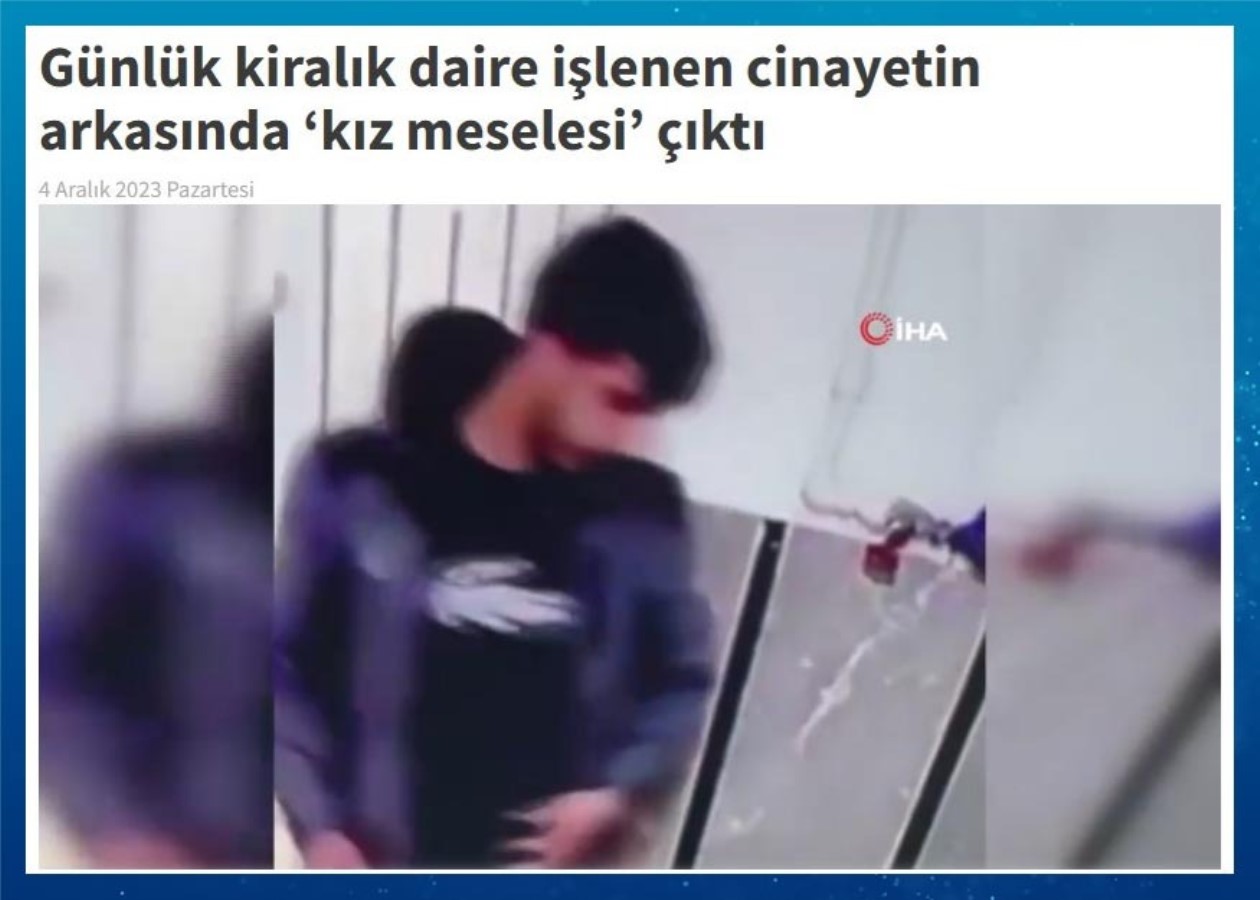
“Girl issue” is just as incorrect as “honor killing,” acting as a template that prevents the explanation of the actual cause of every fight or murder. First and foremost, simply saying “due to a ‘girl issue’” is journalistic laziness. They likely fall into the comfort of relaying information provided by the police. They might even think they are explaining the cause of the incident by saying “girl issue” instead of investigating.
However, as seen in the NTV, Milliyet, and IHA reports I cited above, saying “girl issue” in these stories does not clarify the event; the cause of the murder remains ambiguous. Were two men in love with the same “girl,” and was the “girl” even aware of this? Did one make a remark to the “girl” the other loved, or did he harass her? What was the “girl’s” role or influence in this incident? A news report that does not provide answers to these questions is problematic in terms of “journalistic technique.”
These reports, which present men as the main actors and women as passive, will-less beings that can be shared by powerful men, are mired in sexism and discrimination. Moreover, they reproduce a morality from the last century using patriarchal language, reducing women to mere “girls.” We are witnessing a form of primitiveness that cannot view women with an egalitarian perspective, having infiltrated journalism.
SHIPS TO ISRAEL, PRAYERS FOR PALESTINE
Despite the massacre in Gaza, the fact that shipments from Turkey to Israel by ship continued did not fall from the top of the news bulletins, including FOX TV, just like in all opposition media last week.
The report featured in the December 5 bulletin, “Opposition does not let go of trade with Israel,” was based on the opposition’s “allegations.” While the report featured microphones held out to opposition MPs, the screen displayed headlines such as “Trade debate with Israel” and “Opposition criticizes Erdoğan over ship shipments to Israel.”
In the December 6 news bulletin, the parliamentary group speech by GP Chairman Ahmet Davutoğlu, in which he claimed that “the number of Turkish ships reaching Israel has exceeded 350,” was broadcast under the headline “Pressure from the opposition on Erdoğan to ‘stop trade with Israel’.” The report, which also included the words of opposition MPs, ended with the phrase, “The opposition does not let the trade debate with Israel fall off the agenda.”
On December 7, Selçuk Tepeli presented this news by saying, “Now let’s move on to the continuation of trade ship shipments from Turkey to Israel while the massacre in Gaza continues. The opposition’s reaction is also growing every day.” In the report, which was broadcast accompanied by the on-screen text “Who owns the ship trading with Israel?”, the allegation that one of the ships going to Israel belonged to AKP Trabzon MP Vehbi Koç and Koç’s response to this were covered.
While the pro-government media ignores the ships going to Israel, FOX TV’s daily coverage of this issue is a valuable approach in terms of journalism. Of course, it is not just FOX TV; other opposition media outlets are also constantly reporting on the shipments to Israel by ship.
What I really want to emphasize is the deficiency in these reports. Undoubtedly, it is important to convey the opposition’s allegations. But one should not be content with just conveying them; these allegations must be investigated, and whether they are true or not must be revealed. An unverified allegation—except in exceptional cases—is not news anyway.
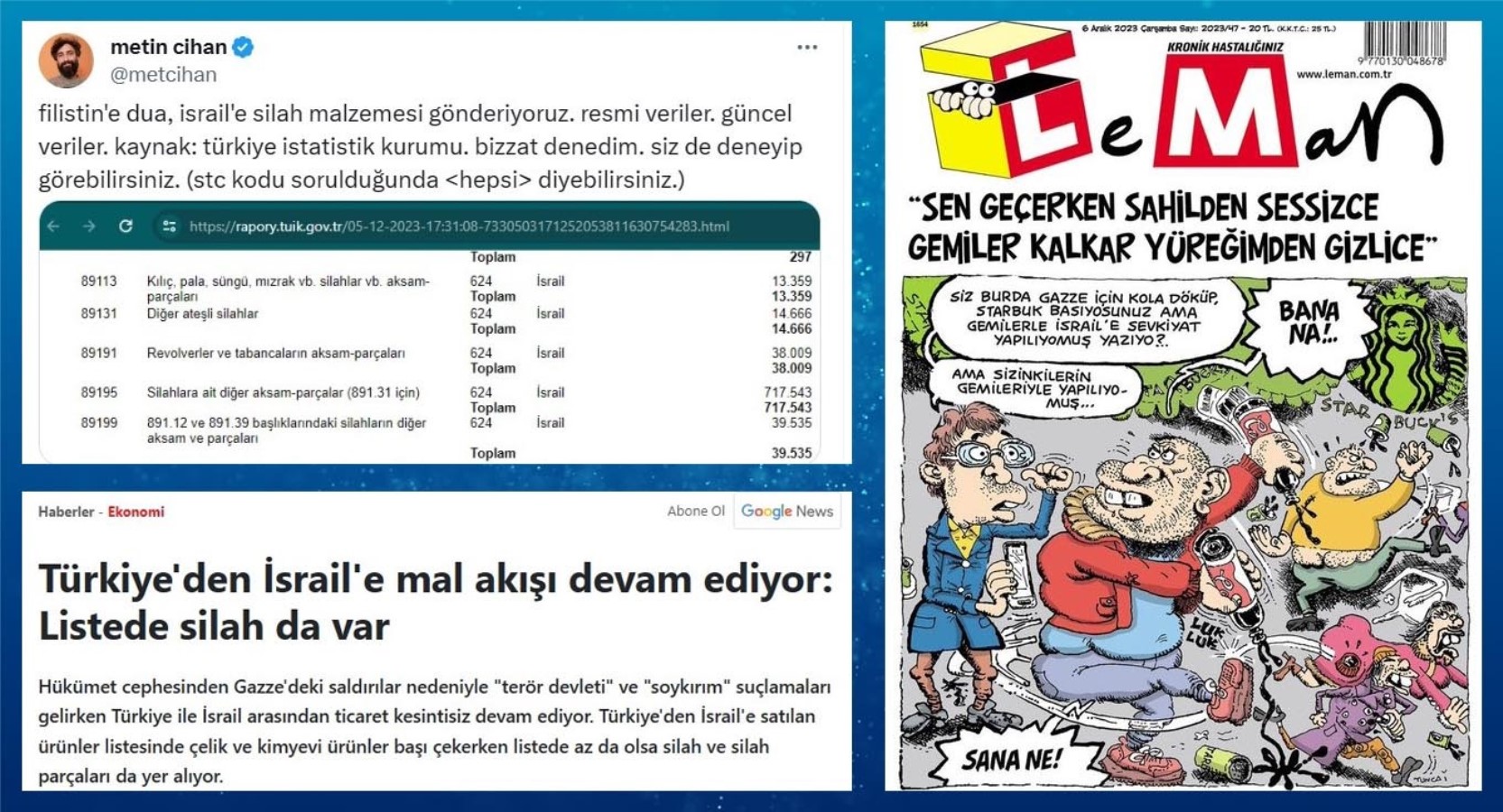
Moreover, information proving the accuracy of this allegation and showing that the ships are going to Israel is out there. For days, Metin Cihan has been publishing the routes of the ships going to Israel and the companies that own them, based on Marinetraffic data showing ship traffic.
AKP’s Binali Yıldırım and his son obtained a decision from the peace criminal judgeship to have these posts deleted, but he did not delete them. FOX TV also presented the ban decision as “opposition criticisms” and “opposition allegations” with excerpts from opposition MPs. It did not mention Metin Cihan’s name, nor did it bring the documents in the posts to the screen. Yet, that same evening, Halk TV clearly published those posts and documents in its news bulletin.
Furthermore, TÜİK (Turkish Statistical Institute) data also proves that trade with Israel continues. The report on Sözcü’s website titled “Flow of goods to Israel continues: There are also weapons on the list” is based on TÜİK data. But Sözcü did not add the TÜİK data to its report published in the printed newspaper, which featured Davutoğlu’s words under the headline “The crucial question: What are you carrying to Israel, explain.”
It is not just FOX TV and Sözcü that take refuge in the laziness of “allegation journalism.” For example, Cumhuriyet and Karar were also content with just relaying Davutoğlu’s words. However, if they had not stopped at “he said, she said” and added data regarding the allegation, the reader and viewer would have been fully informed. This “allegation” and “he said, she said” journalism has become a shackle on the wrists of journalists…
THIS MAN IS STILL TALKING ABOUT “ETHICS”!
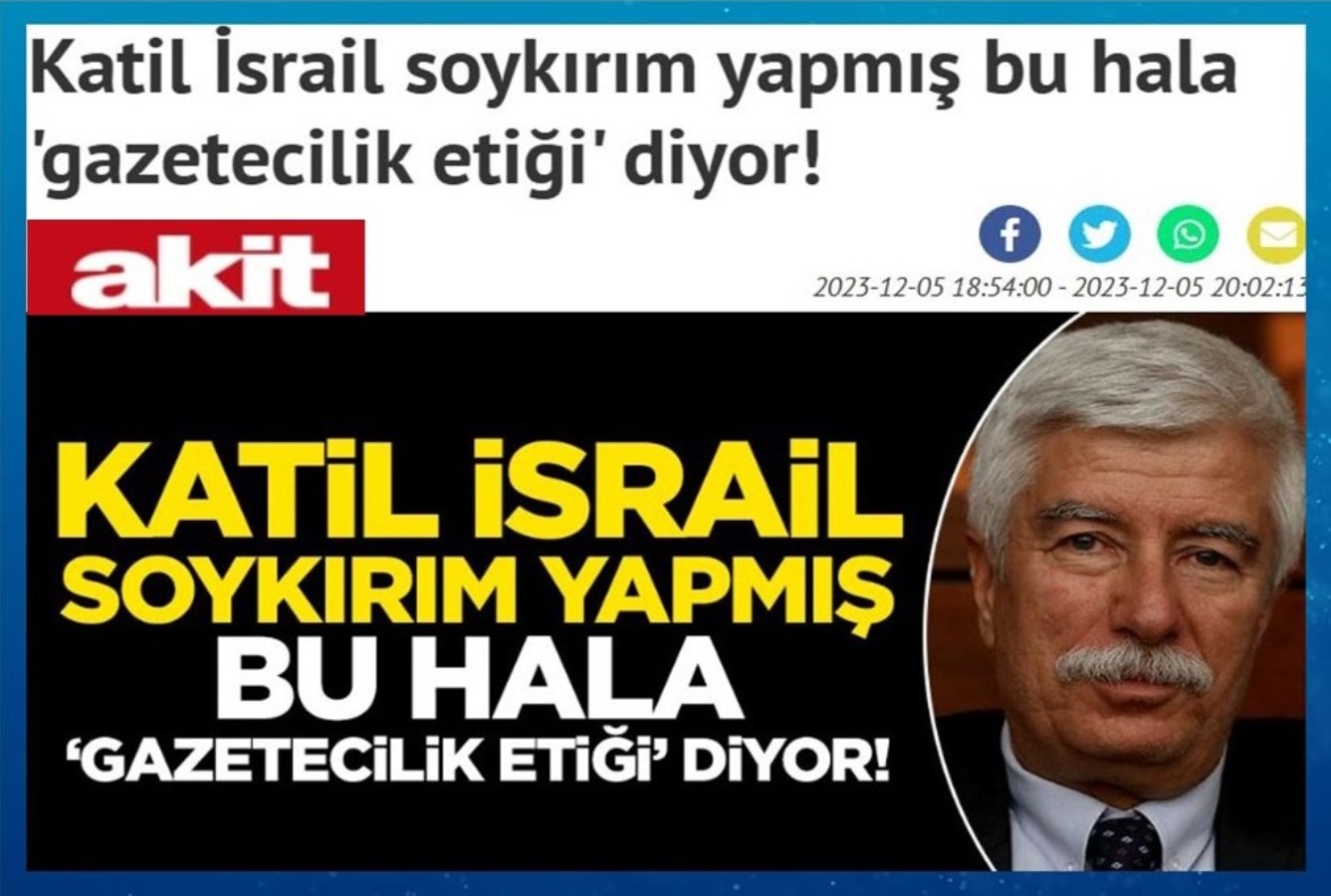
Yeni Akit took offense at my criticism of “warmongering” and responded to my article with an aggressive text, saying, “The murderer has committed genocide, and this guy is still talking about ‘journalistic ethics’.” You would think they had an interest in “journalistic ethics” before, and now they are bothered by my mention of ethics!
In fact, the value of journalistic ethics emerges precisely at such times. If we abandon our professional principles because Israel does not care about humanitarian or moral concerns, slaughters tens of thousands of people regardless of whether they are civilians, women, or children, and practices state terrorism, we cease to be ourselves. We must adhere to ethical principles to explain the reality of Gaza to large masses accurately and to avoid causing further damage while informing the public.
Let me explain my point with a new example. Last week, Yeni Şafak published a bloody, close-up photo of a baby killed by Israeli soldiers on its front page. The same photo, albeit slightly smaller, was also published in Yeni Akit and Akşam without being blurred.
They may have wanted to convey the violence strikingly with this photo, but that photo was pure violence pornography. It is clear that they did not care at all about the traumatic effect it would have on people in our country who would see that photo, especially children. In addition to its traumatic effect, such bloody photos normalize and desensitize society to violence.
Look, the Washington Post did not publish bloody photos of massacres in schools in the US or images of corpses; last month, the newspaper’s management decided to change its stance. Editor-in-Chief Sally Buzbee also explained the reason for the decision to its readers. But even so, the “disturbing nature” of the bloody photos they published cannot compare to that bloody baby corpse photo in Yeni Şafak.
One does not necessarily have to resort to violence pornography to describe brutality. Last week, Milli Gazete used a photo of a child killed in Gaza, and so did Sabah. One was in a shroud, the other was blurred. Both were striking photos. Milli Gazete and Sabah, acting with common sense, also considered the people who would see those photos.
WHAT HAPPENED TO BRANDO’S WATCH?
I had difficulty reading Karar newspaper’s report titled “Brando’s Rolex in the cult film stirred things up.” The short 10-sentence report was made into a mess with repetitive sentences instead of telling the story within a beginning-middle-end structure like a narrative. Let me try to explain what kind of report it is by quoting the ends of the sentences, starting from the headline:
“Rolex stirred things up,” “the watch caused a crisis at the auction,” “it went on sale last month,” “its sale was stopped,” “it received bids of over 5 million dollars at the auction,” “a problem occurred just as the sale was about to take place,” “it was sold for a price of over 42 million dollars,” “then the transaction was suspended,” “It is not clear what kind of problem it had,” “They were told not to make the payment.”
As can be seen, it first mentions that a crisis broke out; then it goes back to the beginning and explains that it went on sale, then it returns to the sale being stopped. Then it goes back to the beginning once more to the point where bids were received, immediately after that it repeats that there was a problem with the sale, then it is reported again that it was sold. As the report ends, the information that the transaction was suspended and the sale was stopped is given.
The fact that a short report turns into a Gordian knot is an editing error. The editor who laid out the page put no effort into the report other than cutting it… They did not bother to rewrite it…
In a single sentence:
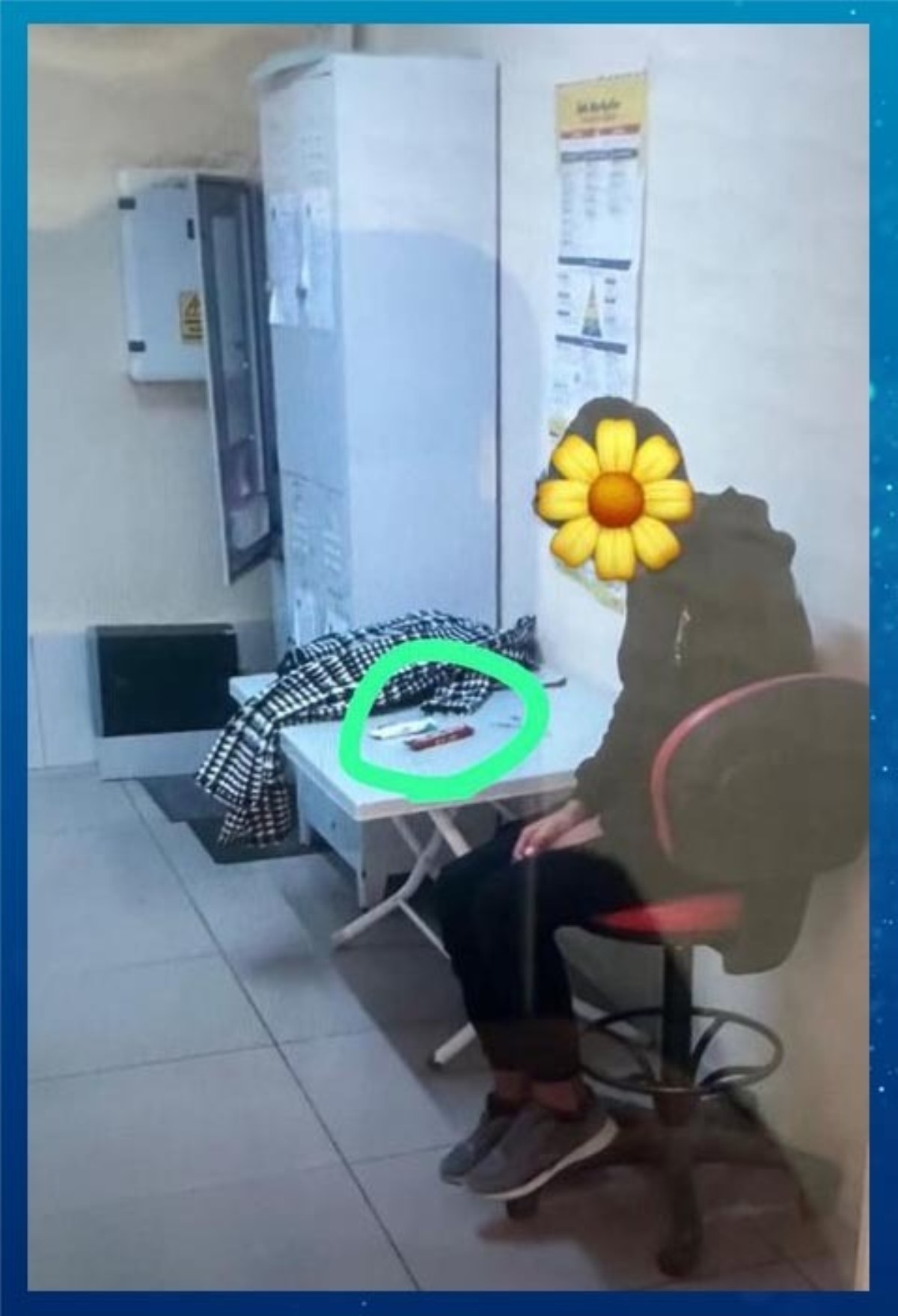
In Hakkari, the fact that a photo taken from social media of a child locked in a market warehouse for allegedly stealing chocolate was reported in the media with the child’s face covered with a flower or blurred was a positive example in terms of protecting “child privacy.”
In Hürriyet’s report titled “Hürriyet is in the ‘Teachers’ Room’ with Minister Tekin,” the fact that there was not a single sentence about the teachers’ conversations and questions in that room crippled the content of the report.
In the wedding reports of Alina Boz and Umut Evirgen by Akşam, Cumhuriyet, CNNTürk, Habertürk, NTV, and Takvim, there was no information that Fatih Terim had not been seen around for a while due to the “fraud case at Denizbank” and was avoiding journalists.
Korkusuz’s reporting of a photo of 81-year-old artist Gönül Akkor with the headline “‘Sultan of hearts’ saddened with her latest state” was a discriminatory approach.
The headline “Temperature will drop by 10 degrees” in Türkiye newspaper contradicted the statement in the spot right next to it, “the air temperature is expected to drop to the 10-degree level.”
In the report “Alimony prison for 81-year-old grandfather,” which was passed by AA and DHA and published in Akşam, Sözcü, and Milli Gazete, the information that the unpaid alimony was 5,700 TL was missing.
The promotional text regarding the Bursa Metropolitan Municipality’s support for fishermen, which was published in Sabah and Yeni Şafak last week, was published this week in Milliyet in the guise of a news report.
Posta announced in the spot as an “important increase (!)” that the “headroom increased by 5 mm, knee room by 10 mm, and legroom by 17 mm” in a new vehicle model.
The Akşam, Dünya, Ekonomi, Hürriyet, Milliyet, Sabah, and Türkiye reporters whom Trendyol took as guests to Baku reported extensively on the company CEO’s words in return.
Akşam, Dünya, Hürriyet, Karar, Posta, Sabah, Takvim, Türkiye, Yeni Asır, and Yeni Şafak published the record-breaking automotive sales with TOGG photos.
In Yeni Şafak’s report “Curse rain on Akşener,” there were no names of those who allegedly cursed.
Takvim columnist Ufuk Özcan’s failure to name the “famous business person” about whom he wrote that they bought the apartments next to, below, and above their own for the goat they keep at home destroyed his credibility.
Hürriyet columnists, like Sabah columnists, went to Afyonkarahisar to contribute to the newspaper’s advertising revenue and promoted the municipality and the city in the six pages published.
FOR YOUR CRITICISMS, COMPLAINTS, AND SUGGESTIONS: [email protected]
Most Read

Young couple dies after jeep falls off 15-meter cliff
The debates within the CHP do not interest me at all
The official, rumored to be switching to the AKP, has begun a persuasion tour
Ümit Özdağ's comment on the new party

Warning on the risk of hair loss with GLP-1 drugs
Message from Naim Babüroğlu on Yılmaz Büyükerşen's decision to leave
The acting mayor election won by the CHP will be repeated starting from the third round
Enver Altaylı claim in the Yazıcıoğlu file

Fenerbahçe's new board of directors has been determined
Young chef dies after falling from hotel terrace